ChartMogul Review: Free CRM, a Read-Only AI Analyst and the Real Cost Past $10K MRR
ChartMogul review: free to $10K MRR, Starter from $57/mo, Pro from $99/mo. What the free CRM and read-only AI do, and where the ARR-based pricing bites.
Expert Review

What changed in 2026
For most of its life ChartMogul was the dashboard a SaaS founder opened to see MRR, churn and LTV calculated properly from Stripe. In 2026 the Berlin company set out to be three products at once. On August 5 it made its CRM free for every user and "removed paid CRM seats entirely" - seats that had cost $39 a month each ($32.50 billed annually) beyond one free seat. The same day it launched ChartMogul AI, an assistant that reads your revenue data and answers questions about it. By October 1 the pricing page had been rebuilt into four tiers: Free, a new Starter, Pro and Enterprise.
The free threshold did not move. Founders under $120K ARR used ChartMogul for nothing in 2025 and still do. What moved is everything around that line, and this review - prices checked on the pricing page in November 2026 - is mostly about where the new ladder makes you pay.
Pricing: set by your ARR, not your seats
ChartMogul prices on the annual recurring revenue it tracks for you. "As your ARR increases, we'll move you to the next tier," says the FAQ, and there are seven bands between $0 and $10M. Annual billing saves about 17%. The figures below are per month on annual billing, with the month-to-month price in brackets.
| ARR tracked | Starter | Pro |
|---|---|---|
| $0 - $500K | $57 ($69) | $99 ($119) |
| $500K - $1M | $99 ($119) | $174 ($209) |
| $1M - $1.5M | $137 ($165) | $249 ($299) |
| $1.5M - $3M | $245 ($295) | $449 ($539) |
| $3M - $5M | $382 ($459) | $699 ($839) |
| $5M - $7M | $515 ($619) | $949 ($1,139) |
| $7M - $10M | $707 ($849) | $1,199 ($1,439) |
Enterprise starts at $19,900 a year, billed annually, for companies over $10M ARR, and adds a named SaaS expert. Every paid plan has a 14-day trial with no card, and startups can claim $50 off any paid plan for 12 months - $600 in total.
Pro prices have not changed since at least January 2025, according to archived copies of the page. As a share of revenue they are small - $249 a month is 0.3% of $1M ARR. The bands are where it stings. Cross from $1.5M into the next one and Pro goes from $249 to $449 a month, an 80% rise for what may be a single new customer.
Starter is the plan you pay for crossing $10K MRR
Starter caps you at three team members, one billing system and two custom or third-party sources. That is fewer custom sources than Free, which allows unlimited, and fewer seats too - Free's team is unlimited. Starter's real feature is that it is legal above $10K MRR. If you need a fourth seat or a second billing system, Pro is $42 a month more at the lowest band and removes both limits.
What the free plan really gives you
Under $10K MRR you get the same analytics core as paying customers: revenue segmented by plan, country or cohort, industry benchmarks against similar SaaS companies, revenue forecasting, scheduled email and Slack reports, saved custom reports and the full CRM. The benchmarks draw on anonymised data from over 2,500 SaaS businesses - the one feature a spreadsheet cannot copy.
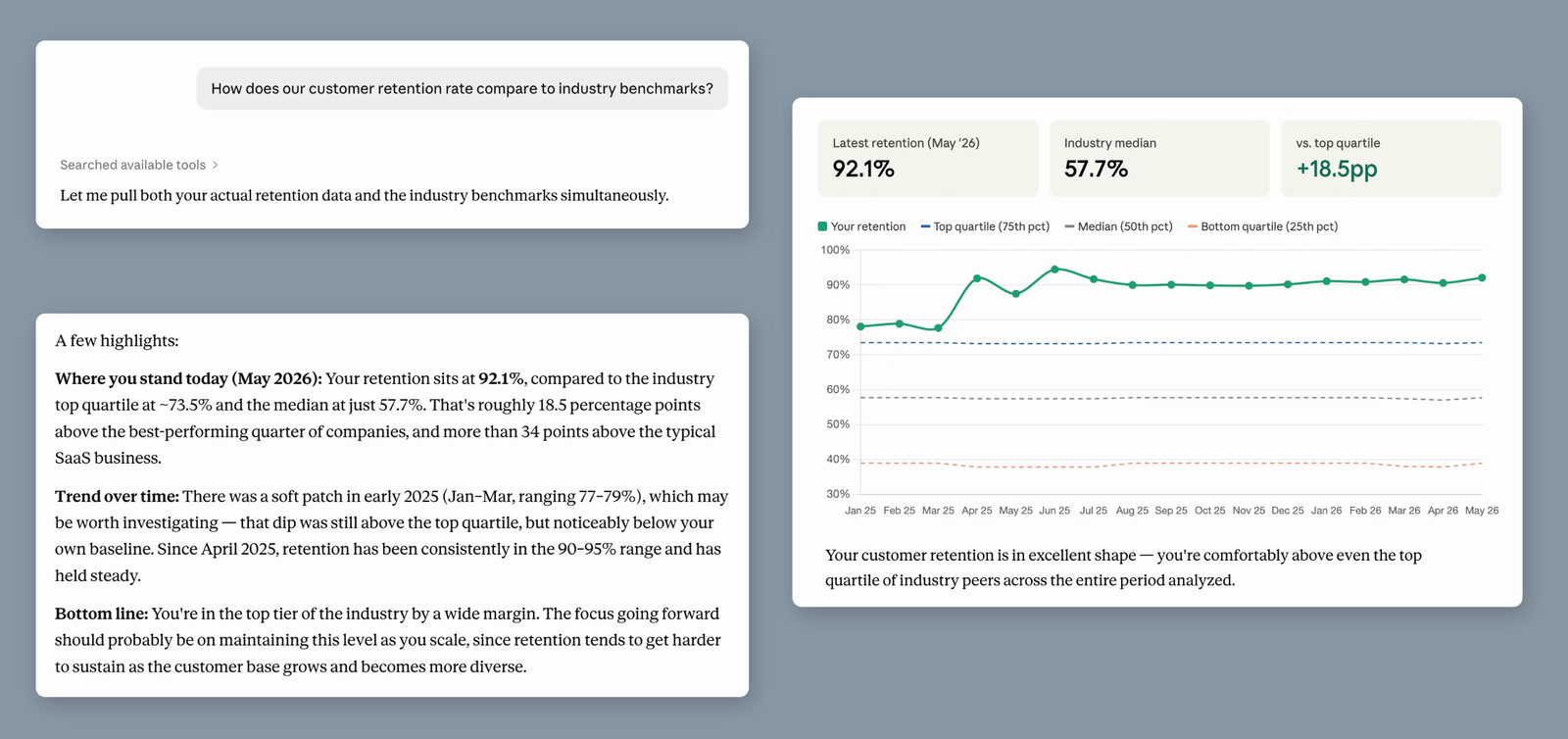
The limits sit elsewhere. Free connects one billing source, meaning one integration ChartMogul builds and maintains, such as Stripe or Chargebee, or one built by its partner SaaSync, such as Paddle or Xero. PricingSaaS, a third-party tracker, logged that number falling from three to one in early 2026. API uploads, CSV imports, Google Sheets and Zapier don't count against the limit, so a second revenue stream can still go in by hand.
The second limit is the export an accountant or investor asks for. The help centre is blunt: "MRR exports under Settings > Data & Integrations > Exports are not available on the Free plan." Every plan keeps API, MCP and standard CSV exports, but the file with MRR per customer per month, or a scheduled delivery of it, starts at Pro.
A free account idle for one year and 30 days is closed, then deleted after a 60-day grace period. Free support is the help centre; a Slack Connect channel starts at Pro.
ChartMogul AI: useful, and honest about its limits
CEO Nick Franklin calls it "an analyst inside ChartMogul that investigates your data". It picks metrics, builds segments, inspects customers and MRR movements, pulls in CRM context and summarises. The launch post lists its limits itself. It is read-only. "It has no memory yet. Each new chat starts fresh." It "does not ask clarifying questions yet." The security page says it runs Anthropic Claude and Amazon Nova models through Amazon Bedrock, with processing inside AWS in the EU.
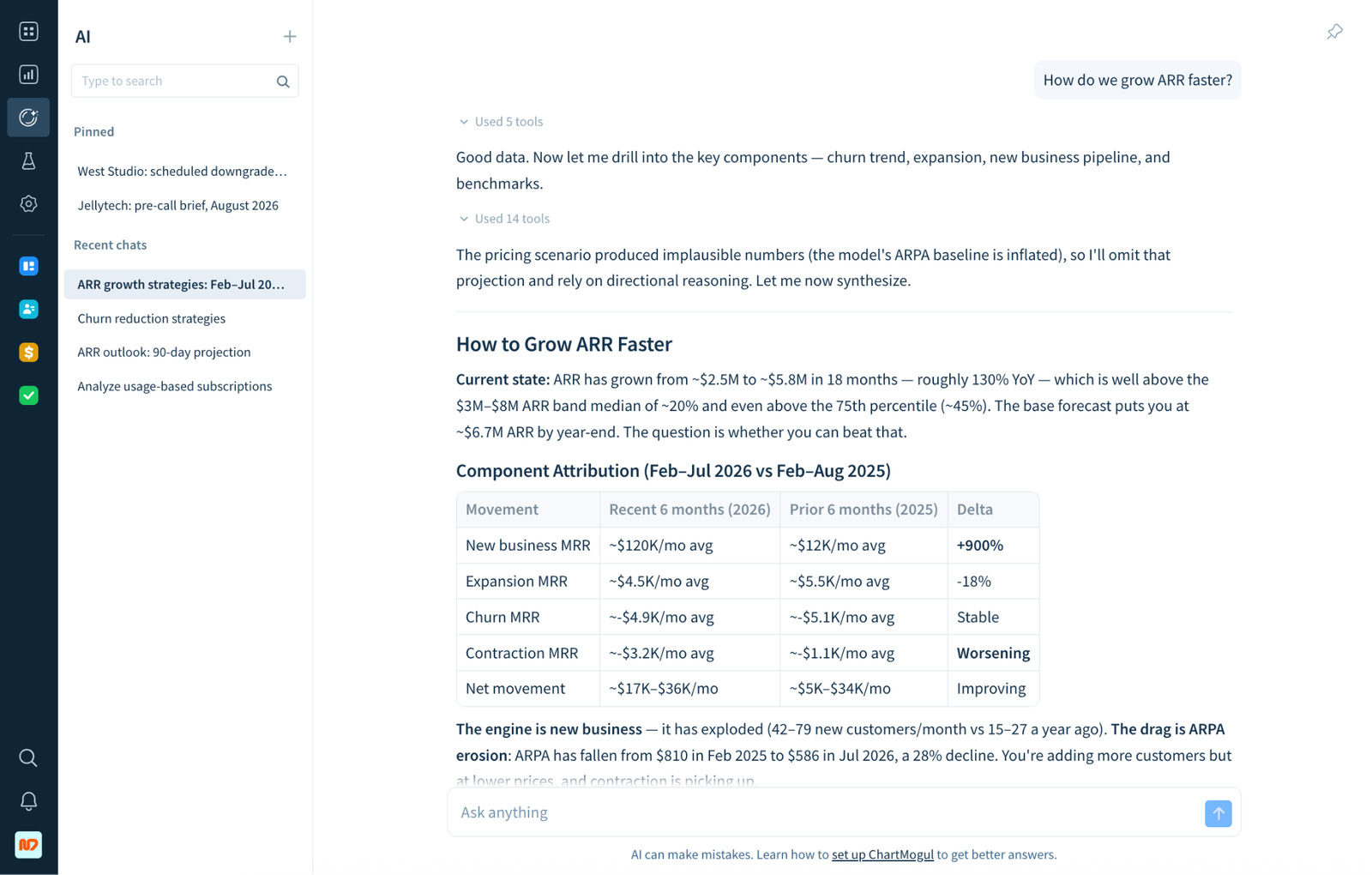
The most telling detail is in ChartMogul's own demo screenshot. Asked how to grow ARR faster, after 14 tool calls, the assistant says "the pricing scenario produced implausible numbers (the model's ARPA baseline is inflated), so I'll omit that projection." Right behaviour, and a warning: answers are only as good as the billing data underneath, as ChartMogul's homepage concedes: "Generic AI on top of messy billing data gives you confident nonsense." Every chat carries the footer "AI can make mistakes."
No ChartMogul page says which plans include the AI or how many questions you get, and only Owner, Admin and Staff roles can open it. Prefer your own assistant? The MCP server exposes revenue metrics, customers and pipeline to any MCP-compatible client, with ready connectors for Claude and ChatGPT.
The free CRM
For a small team's budget this is the bigger change. Every plan now ticks "Full CRM built-in", and it sits on the same customer records as the revenue data. A customer profile shows the MRR step chart and the subscription lines, and the AI panel beside it can explain a -$3,170 cancellation as price-driven churn by reading the email thread. The October update added contact lists, contact profiles, batch email and batch enrolment into sequences, plus automations that enrol contacts for you.

Connected mailboxes are capped at three on Free and Starter and 20 on Pro, so a sales team of five on the free plan cannot all connect an inbox. Salesforce sync is still listed as "coming soon". HubSpot and Intercom import and export, but only Pro advertises two-way CRM sync; Starter's card just says "sync data to your CRM". A founder selling from a shared inbox can drop a separate CRM; a team living in HubSpot just gets a second place to look.
Billing sources, exports and security
ChartMogul imports from 31 billing systems, from Stripe and Chargebee to App Store Connect and Google Play. Free and Starter take one, Pro five, Enterprise fifteen. So a company billing the web through Stripe and its iPhone app through App Store Connect hits the wall on day one: Pro at $99 a month even below $10K MRR, or the second source pushed in through the API.
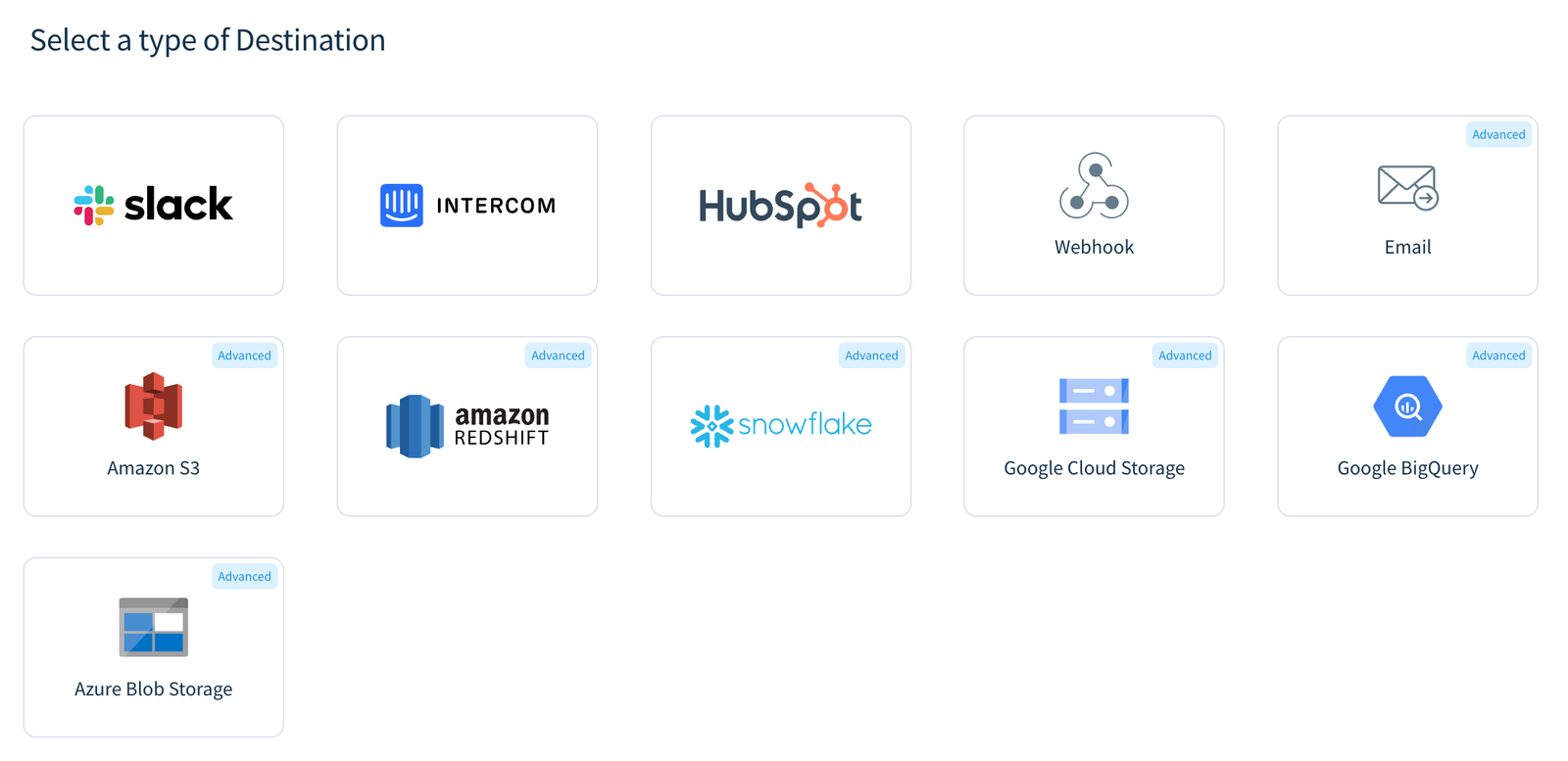
Warehouse export follows the same line. Slack, Intercom, HubSpot and webhooks work on every plan, two at a time on Free and Starter. S3, Snowflake, BigQuery, Redshift, Azure, Google Cloud Storage and email delivery need Pro (two) or Enterprise (four).
ChartMogul is SOC 2 Type II certified, GDPR compliant and hosted on AWS in Europe. The security page cites 99.99% app uptime, which is a stated figure rather than a contractual SLA, and the current pricing page names no SLA at all. SSO appeared on the February 2026 pricing page and is absent from the current one, so ask before you sign if you need it.
What users complain about
Scores are high - about 4.6 out of 5 from roughly 110 reviews on G2, and 4.7 from 44 on Capterra - and the complaints cluster around one thing: ChartMogul believes your billing system. A G2 reviewer whose customer was overcharged and later corrected in Chargebee says the fix "looks like a downgrade or churn and there's nothing I can do about it." A Capterra reviewer notes that after a failed payment "the person didn't really subscribe so you have to fix the data manually." Another says "the worst part of Chartmogul is if you have implemented something wrong." Slow exports and a thin mobile app are minor gripes.
It is the same weakness the AI demo flagged. Clean up refunds, failed payments and test plans before you trust the churn number.
Verdict: who should buy it, and who should skip it
Use the free plan if you are under $10K MRR on a single billing system. Full analytics, benchmarks, forecasting, a CRM and unlimited seats for nothing is the best deal in subscription analytics, as long as you can live without the per-customer MRR export.
Buy Pro if you run more than one billing system, need warehouse export, or have more than three people who need access. It is priced against revenue, not headcount, and the free CRM takes a line off the software budget.
Skip it if you bill through Paddle and only want the core metrics - ProfitWell Metrics is free and owned by Paddle. If you want a paid dashboard without a CRM and an AI assistant you will not use, compare Baremetrics before you commit.
Ready to try ChartMogul?
Visit the official website to see the latest plans, pricing, and special offers.
Get Started - ChartMogul* Affiliate link - we may earn a commission at no extra cost to you.