AnswerThePublic Review: The Question Wheel Now Reads ChatGPT, but Free Users Get 3 Searches a Day
AnswerThePublic review: $20/mo or $120/yr Starter, 3 free searches a day, Google-only volume data, Content Studio credits and the no-refund annual billing.
专家评测

What the wheel shows now
Most marketers met AnswerThePublic as a free toy: type a keyword, get a wheel of every "how", "why" and "can" question Google's autocomplete had attached to it. That wheel still exists. What sits around it has changed enough that the old mental model will mislead you, in both directions.
A search now pulls suggestions from Google, Bing, YouTube, TikTok, Instagram, Amazon, ChatGPT and Gemini, grouped on the wheel into Search Engines, Social Media, Shopping and AI Models. The modifiers are the familiar five (Questions, Prepositions, Comparisons, Alphabeticals and Numbers), plus keyword wheels for related ideas and a People Also Ask view. A separate AI Models report lists the prompts people put to ChatGPT and Gemini and summarises their intent, sentiment and the brands they mention. Results come as the wheel or as a plain table, and paid plans export to XLSX, CSV or PNG with no export limit.
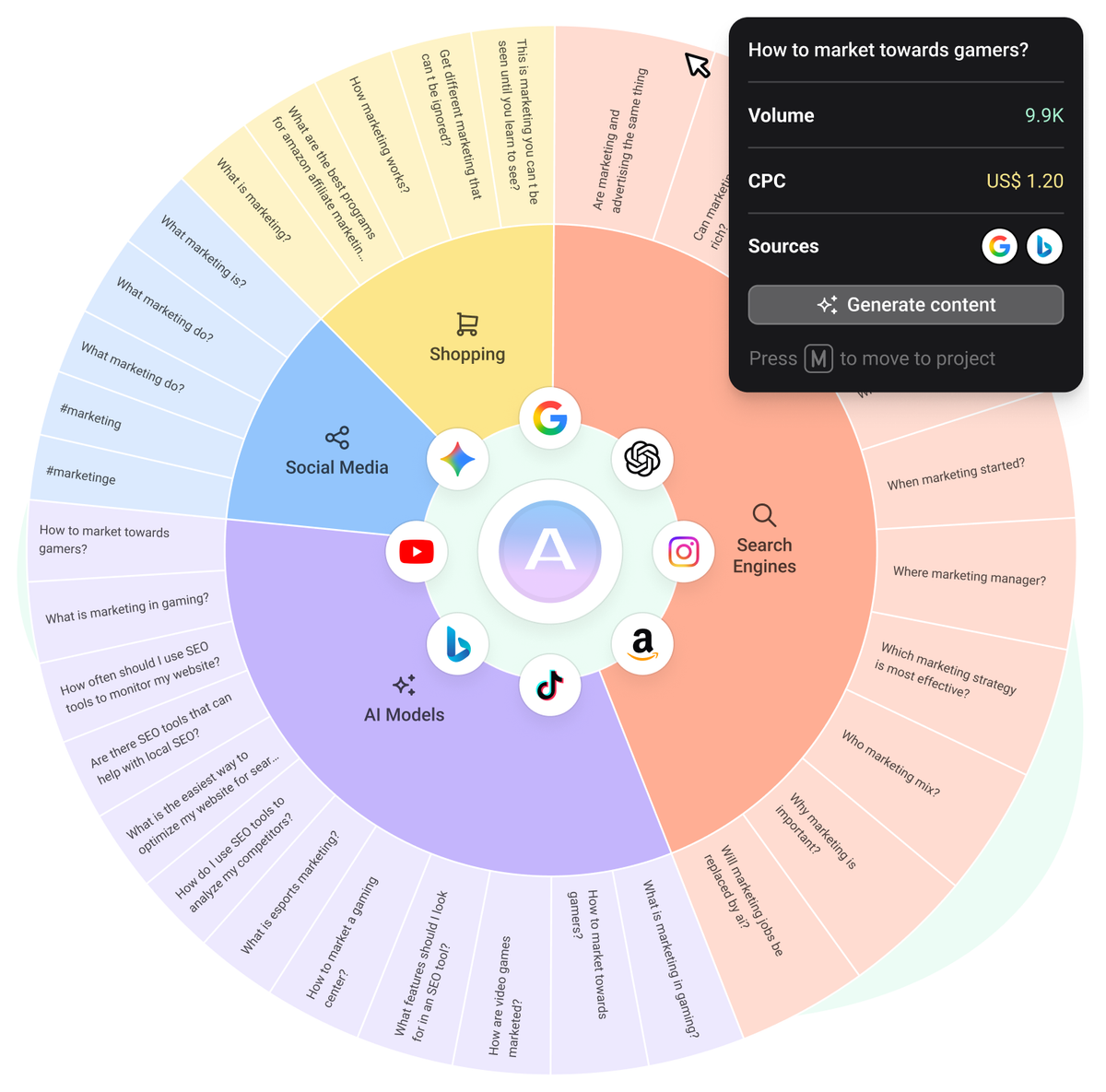
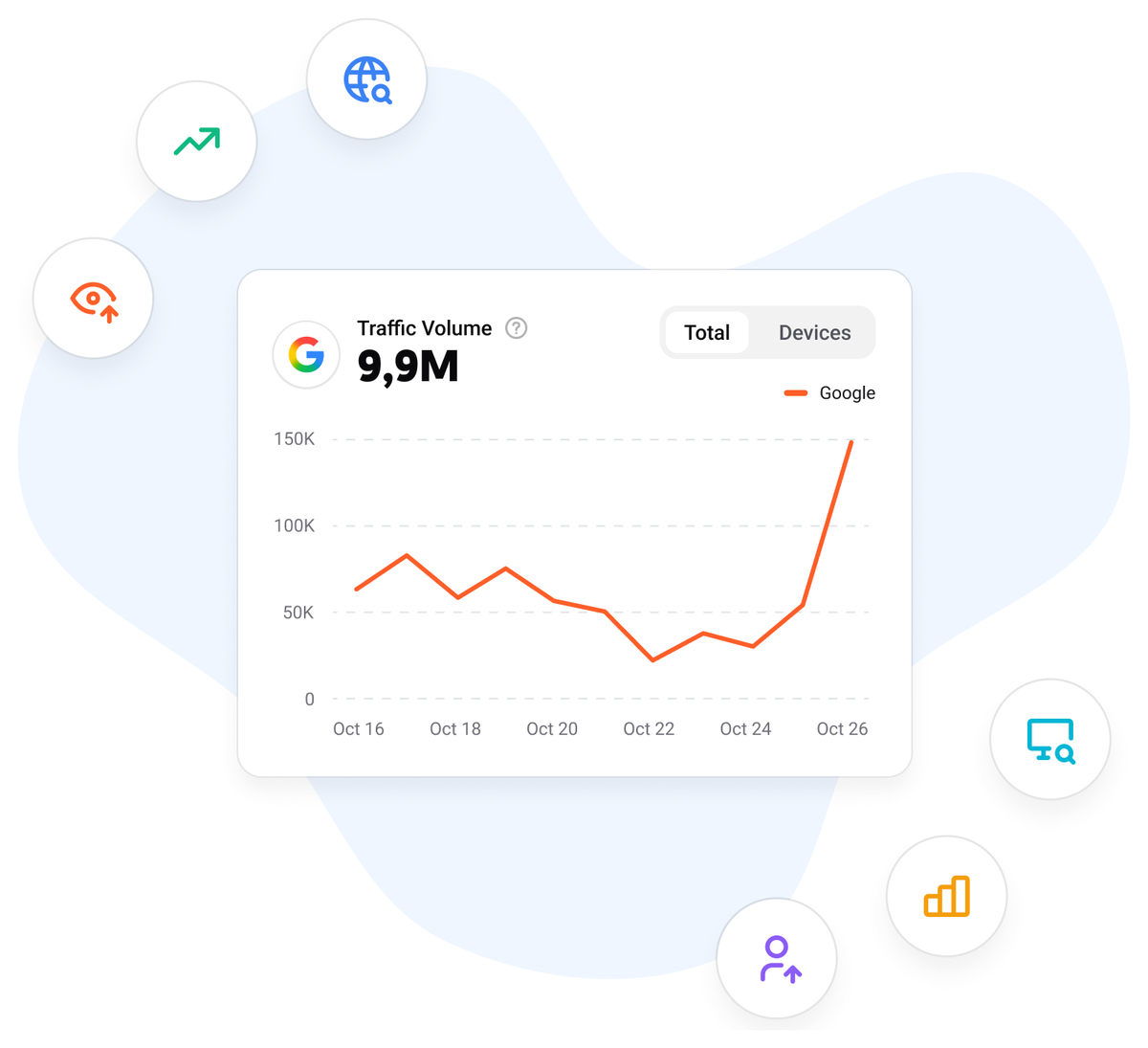
Here is the catch the marketing page never spells out. The search volume and CPC next to every suggestion are Google's figures for the previous month, whichever platform the suggestion came from. A TikTok phrase showing 9.9K is telling you how often it is typed into Google, not how often TikTok users search for it. The help centre also says topics Google restricts, health and finance among them, come back with zero volume. If you sell supplements or credit cards, expect a wheel of zeros. That is not the same thing as no demand.
The owner changed too. NP Digital, Neil Patel's agency, announced the acquisition on 31 May 2022; the UK company is still Answer the Public Ltd. Ubersuggest, NP Digital's other SEO tool, is a separate subscription, and paying for one gets you nothing in the other.
What the free plan actually gives you
You need a free account, and it gets 3 searches a day, reset daily. The help centre is specific about what those searches hide: volume and CPC appear on only two branches of each report, XLSX exports stop at 30 keywords, and image downloads come out at lower resolution. On the AI side you get 30 prompt responses a month, 10 prompts shown per search and no filtering by AI model. Content Studio credits: none.
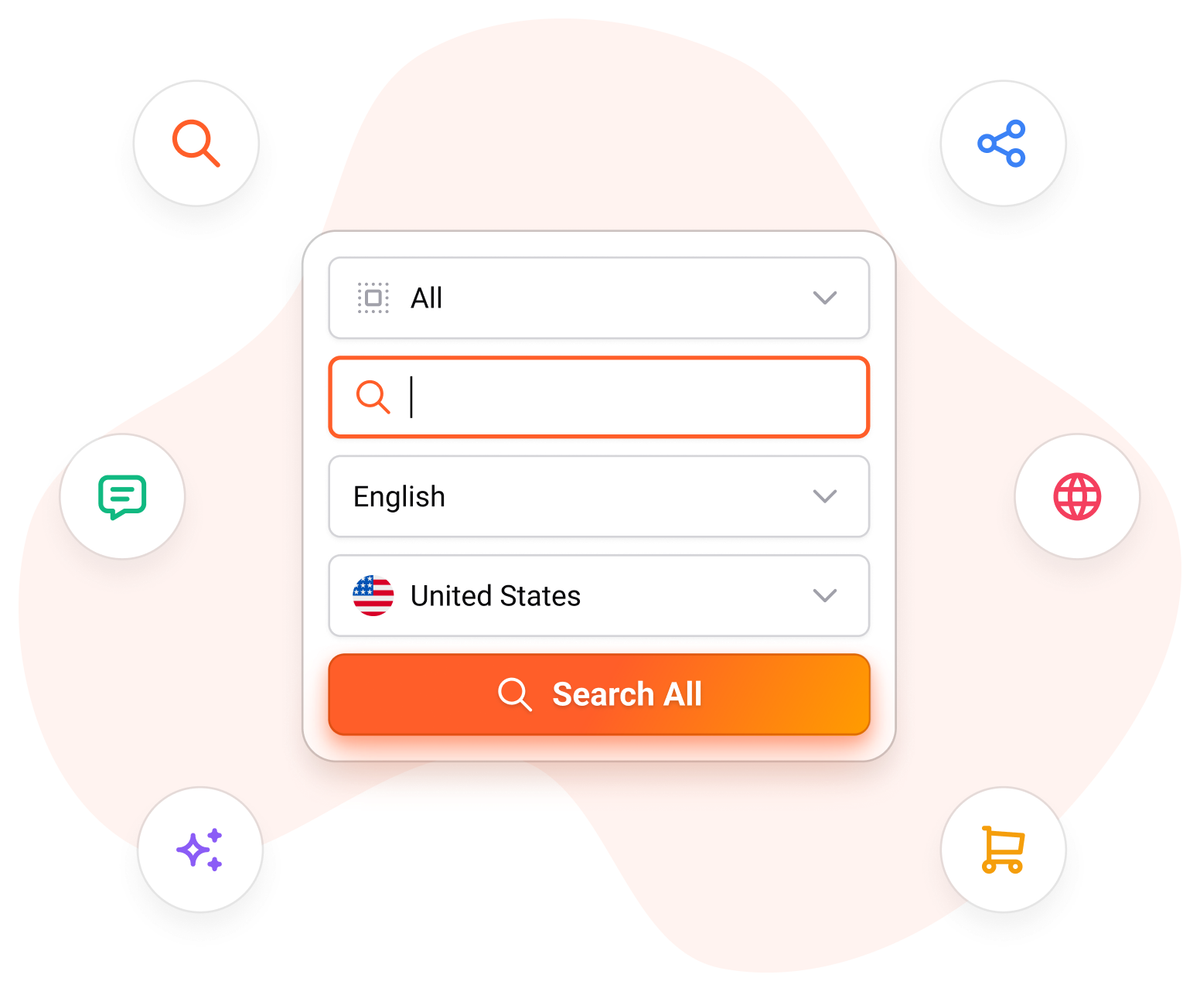
Three searches is enough to brainstorm one blog post a day. It is not enough to research a content cluster, where you run a seed term and then five or six of its branches, and the cap is gone before lunch.
The 7-day trial on monthly plans asks for a card before it starts, is a one-time offer per account and leaves out API access. Annual plans have no trial at all, which matters more than it sounds - see the billing section.
Pricing and plan limits
Prices are USD, checked on the pricing page on 15 October 2026. The page is running what it calls a "special limited time offer" of 6 free months on annual plans, with no end date shown. Visitors in some regions are offered lower local prices; these are the headline figures.
| Starter | Growth | Business | |
|---|---|---|---|
| Monthly billing | $20/mo | $99/mo | $199/mo |
| Annual, current offer | $120/yr ($10/mo) | $594/yr ($49.50/mo) | $1,194/yr ($99.50/mo) |
| Annual, standard price | $160/yr | $792/yr | $1,592/yr |
| Searches per month | 100 | 200 | 300 |
| Users | 1 | Up to 3 | Up to 10 |
| Search Listening Alerts | 1 | 5 | 20 |
| Keyword Lists | 1 | Unlimited | Unlimited |
| Compare data over time | No | Yes | Yes |
| AI prompt suggestions / responses per month | 1,000 / 30 | 2,000 / 60 | 3,000 / 100 |
| Content Studio credits per month | 60 | 350 | 800 |
Two rows deserve a second look. First, searches. 100 a month on Starter is about three a day, the same as the free plan. What Starter buys is full volume and CPC on every branch, unlimited exports and full-resolution images, not more research. The counter also resets on your billing date every month, even on a yearly plan, so you cannot save up a year of searches for a launch week.
Second, seats. The pricing page says Growth covers up to 3 users and Business up to 10; the help centre's Plans & Limits article says 2 and 3. Get the number in writing before you buy Business for a team of eight.
Search Listening Alerts are a weekly email of new suggestions for a tracked keyword, and Growth adds a view that compares a keyword's data over time. Those two features, more than the extra 100 searches, are what Growth's extra $79 a month pays for. All paid plans include API and MCP access. Lifetime deals, which never had either, are no longer sold.
Content Studio and the credit maths
The newest part of the product is Content Studio, an AI workspace that turns a keyword into a draft article and publishes it to WordPress, Webflow or Shopify. The pricing page promises "months of content that ranks on Google and ChatGPT in less than 30 minutes". The help centre's numbers are more useful: an article costs 10 credits and a Deep Search costs 8.
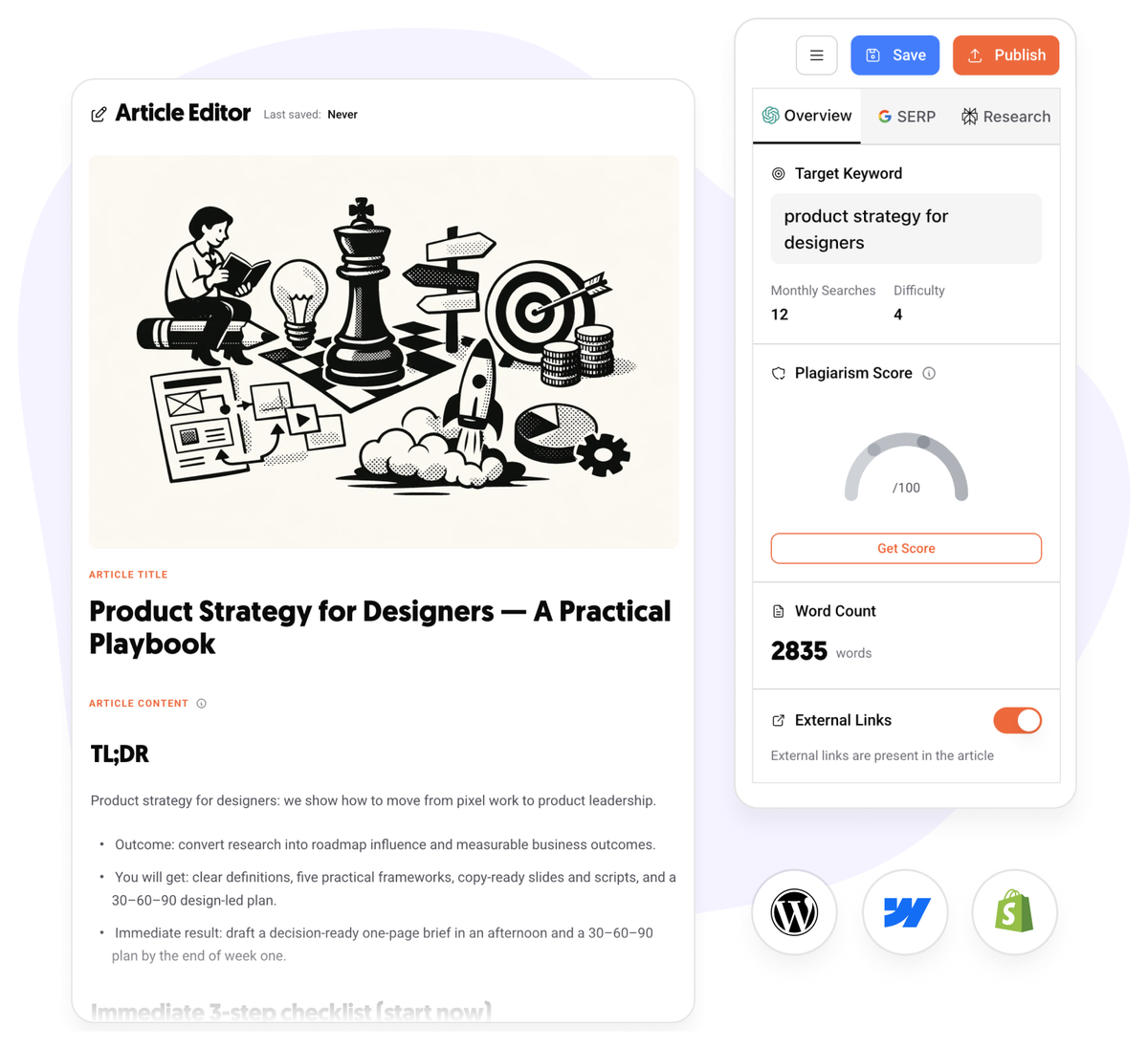
So Starter's 60 monthly credits buy about six articles, fewer if you run a Deep Search before each one. Growth's 350 buy about 35. Extra packs run from $8 for 30 credits to $130 for 600, and unlike the monthly allowance, purchased packs do not expire. Content Studio writes for more than 90 countries and over 40 languages, which is wider than the research side: the help centre warns that only the countries and languages in its dropdown are in the database.
Do not buy Growth for Content Studio alone. A dedicated AI writer costs less, and the drafts still need an editor. Buy AnswerThePublic for the wheel and treat the credits as a bonus.
The billing small print
AnswerThePublic scored 3.3 out of 5 from 78 reviews on Trustpilot when checked on 15 October 2026, and the complaints are rarely about the data. They are about renewals. "No reminders before renewal. Nothing," one reviewer wrote in July 2026. Another, in February: "Charged $160 for the entire year up front and DID NOT receive any free trial." That $160 is the standard annual Starter price.
The vendor's own documents explain both complaints. Annual plans are charged immediately and include no trial. Once a paid period begins, fees are "generally non-refundable", and the terms say no refund is payable on cancellation. Subscriptions renew automatically "at the prevailing rate" unless you cancel through the online procedure, a clause that sits awkwardly next to the pricing page's line that annual plans renew at the same price every year. Cancelling keeps the plan running to the end of the cycle you paid for.
The practical rule: test it on the monthly trial, put the renewal date in your calendar the day you pay, and cancel a day early. Trial expiry times are shown in UTC, not your time zone.
AnswerThePublic vs AlsoAsked and Keywords Everywhere
If what you want is the People Also Ask tree for a query, AlsoAsked draws it live for $12 a month with 100 credits, or $144 a year. That is $8 a month less than Starter on monthly billing, but $24 a year more than Starter on the current annual offer, and you lose the TikTok, Amazon and ChatGPT suggestions entirely.
If what you want is volume while you browse, Keywords Everywhere puts Keyword Planner numbers on the Google results page for $84 a year (100,000 credits, annual billing only). It undercuts every AnswerThePublic plan, but has no question wheel and no social or AI-prompt data.
AnswerThePublic's edge is breadth: one search shows how the same topic is phrased on Google, YouTube, Amazon and ChatGPT. Neither rival does that.
Verdict
Buy Starter on the annual offer ($120 a year, checked 15 October 2026) if you publish regularly, want question ideas from more than Google and need full volume data and unlimited exports for content briefs. At $10 a month it is fairly priced for what it adds over the free plan. Just do not expect more searches.
Skip Growth and Business unless the team needs the extra seats, 5 to 20 keyword alerts or the comparison over time. Content Studio credits alone do not justify going from $120 to $594 a year.
Skip it altogether if you only need PAA trees, where AlsoAsked does the job for $12 a month, or volume beside the results page, where Keywords Everywhere's $84 a year is the cheaper answer. Occasional users should stay on the free 3 searches a day. Whatever you choose, set your own renewal reminder; reviewers say the vendor does not send one.