Botify Review: The Enterprise Crawler That Now Tracks ChatGPT and Feeds Shopping Agents
Botify review: crawler, log analysis, AI Visibility and AgenticCatalog, which of its five plans include what, and the $30K-$400K+ a year buyers report paying.
专家评测

What Botify is now
For a decade Botify was the crawler large sites bought once Screaming Frog ran out of memory: a cloud crawler, a server-log analyzer, and a pre-rendering service that hands Googlebot a finished page. That product still exists, but almost everything Botify shipped in 2026, though, points somewhere else - at ChatGPT, Gemini, Perplexity and the shopping agents being built on top of them.
The timeline comes from Botify's own release notes. AgenticCatalog, a product-feed builder for AI shopping agents, was announced in tech preview on March 24, 2026 and declared generally available in the June 2026 release highlights. August added competitor citation tracking to AI Visibility. The September highlights, published October 8, 2026, introduced a Botify MCP server, so a team can query its Botify data from inside Claude or ChatGPT.
The question here is what you get for a price Botify will not publish, which of its five plans carry the AI features, and when a cheaper tool or BrightEdge is the better call. Everything below was checked against Botify's help centre and release notes on October 13, 2026.
The core: crawling and log analysis
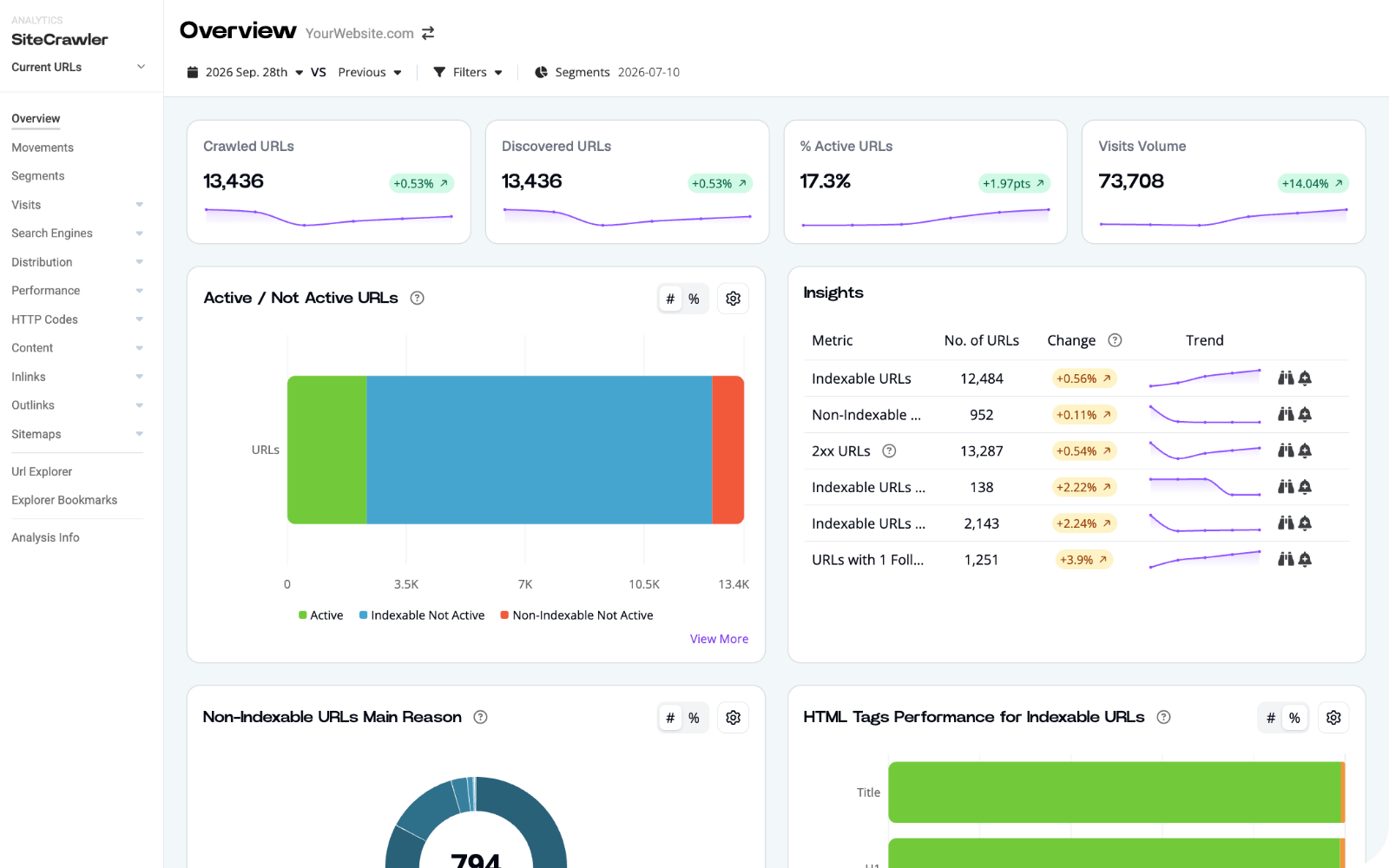
SiteCrawler and LogAnalyzer are why enterprise SEO teams buy Botify, and the help centre is more candid about them than the marketing site. The crawler "can crawl over 200 pages per second", with no speed cap once you have validated ownership of the site. Point it at a site you have not verified and it drops to three pages per second - enough to spot-check a competitor's templates, not to crawl one.
LogAnalyzer is the part rivals find hardest to match. It joins your server logs to the crawl, so you see which URLs Googlebot actually requests, how often, and which sections it never visits. Saffron Edge's May 2026 comparison calls log analysis Botify's "core differentiator" and rates Lumar's as "limited / not core". The same pipeline now reports AI crawlers as well: Botify's AI bots report breaks out GPTBot, ChatGPT-User, OAI-SearchBot, ClaudeBot and Meta-ExternalAgent next to Google and Bing.
The limits appear when you try to take the data somewhere else. Explorer exports stop at one million rows and ten columns each, and recommended reports allow ten exports a day. Automatic exports after every crawl, and exports to S3 or Google Cloud Storage, are Pro and Enterprise only. The Google Sheets and Data Studio connectors are no longer supported. Below Pro, the way out is the API and BQL queries.
Retention is tiered too. Essential, Accelerate and Growth keep 13 months of logs, which is just enough for a year-over-year look at how Googlebot treated a migration. Pro keeps 24 and Enterprise 36. Raw HTML is kept for one month on the lower three plans, three on Pro and six on Enterprise. Crawl quotas are not published at all: crawls run against "crawl credits" defined by your plan, and Botify creates projects on your behalf.
AI Visibility: useful, with a blind spot
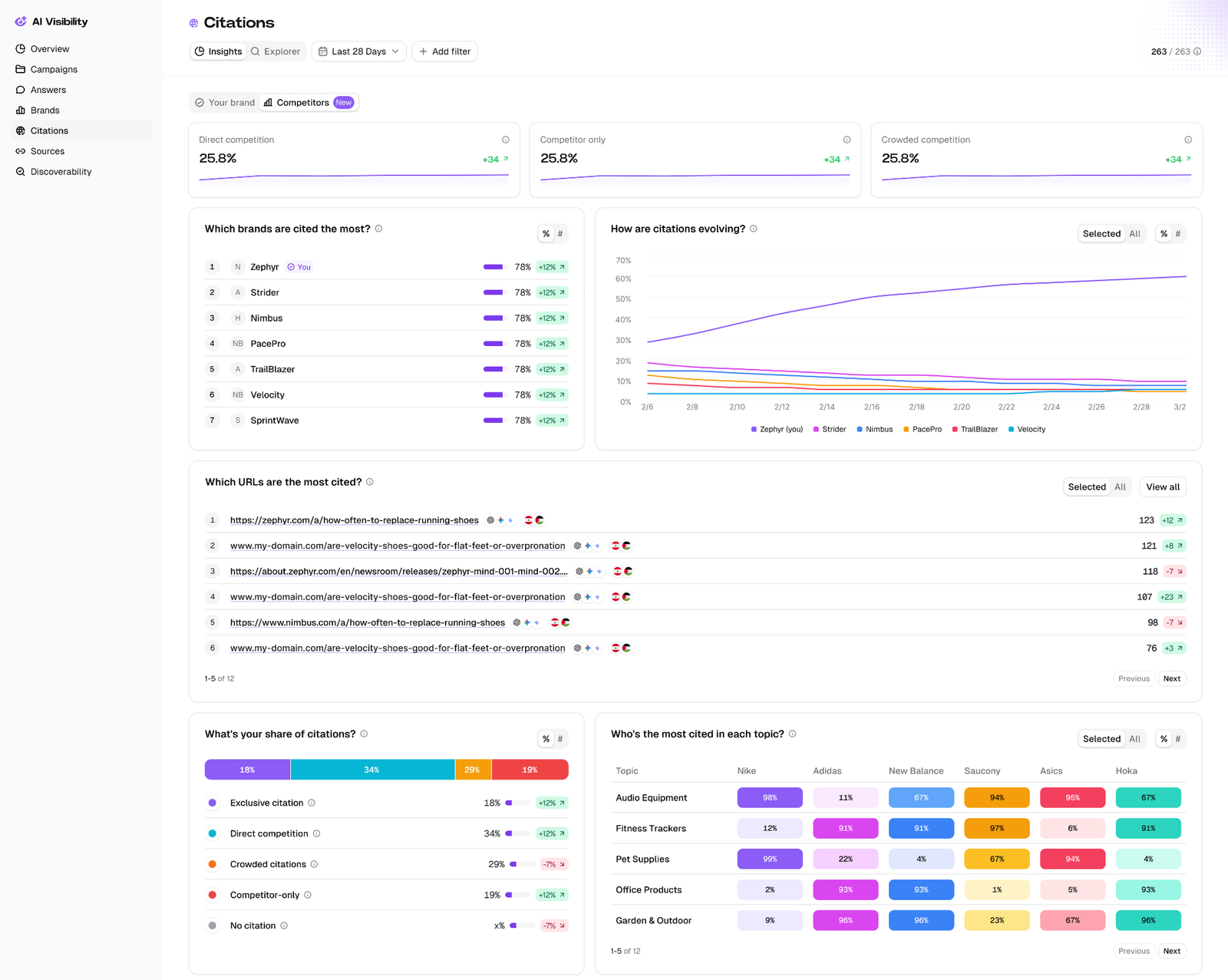
AI Visibility measures how often your brand is mentioned and cited in answers from five engines: ChatGPT, Google AI Mode, Google AI Overviews, Google Gemini and Perplexity. Claude and Microsoft Copilot are not on the list. It is sold as an option on every plan, and the number of answers each campaign can collect is set by that plan. Botify does not publish the allowances.
How the data is gathered matters more than the dashboard. Botify's FAQ says it comes from "vetted third-party providers" who "submit each prompt to the platform's public website, as a logged-out user in the chosen country." That gives repeatable numbers. It also means you are measuring the anonymous answer. A signed-in ChatGPT user with memory and chat history may be shown something else, and nothing in Botify measures that.
August added competitor citations (Mention and Citation Share of Voice, plus the domains behind each rival's citations) and "Smarter Topics", which folds prompts about cost, pricing and fees into one topic, retroactively. September added brand consolidation for name variants and sub-brands, named competitor groups with their own Share of Voice, daily refresh per project and year-over-year date ranges.
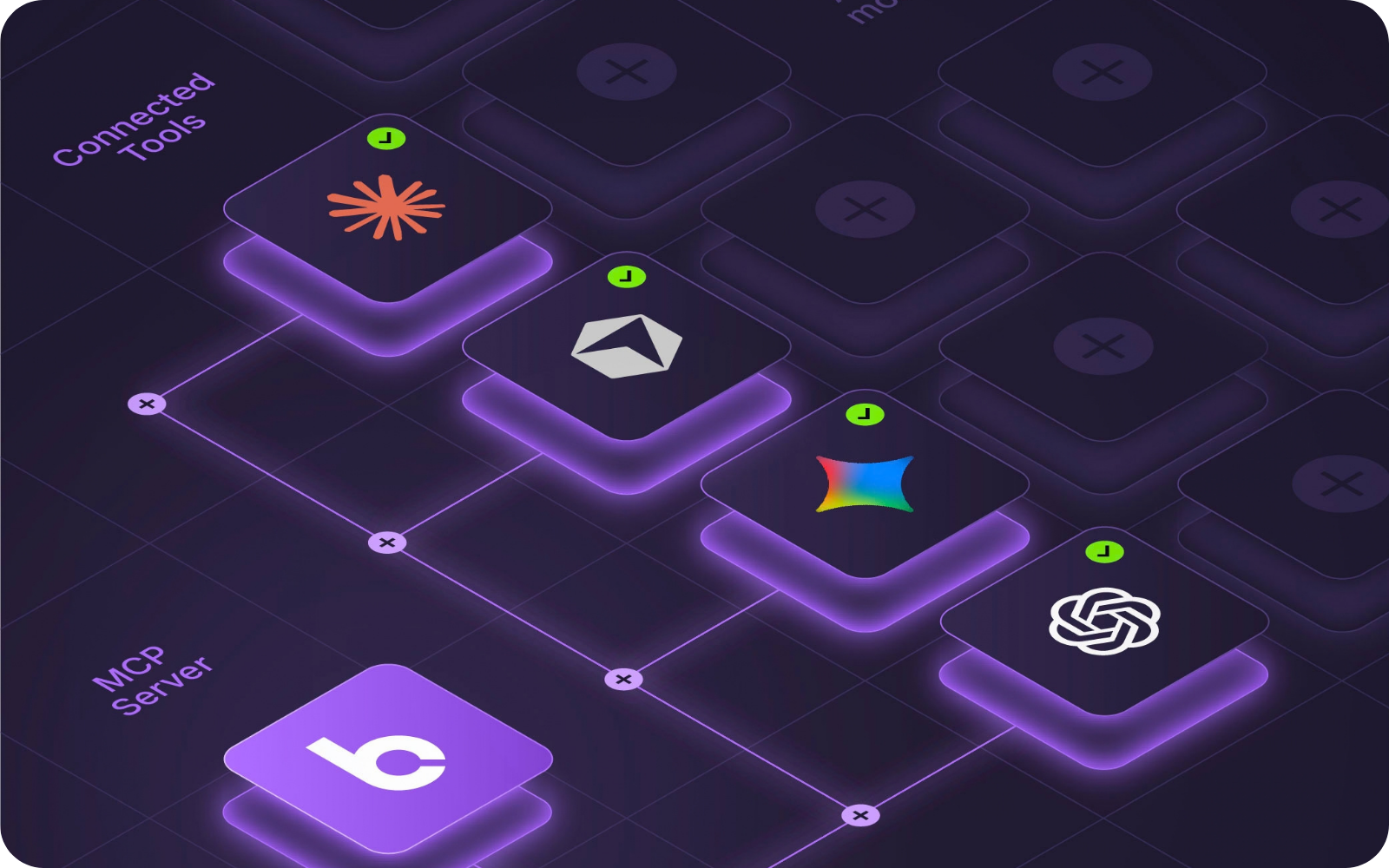
One catch for data teams: AI Visibility has no REST API. The routes out are Botify Assist, the in-app assistant included on every plan (but not on legacy or ad-hoc projects), and the new MCP server, which exposes the same tools to Claude or ChatGPT through a Botify API key with per-person sign-in and permissions. Piping citation share into a BI warehouse is a question for the demo call.
AgenticCatalog, SpeedWorkers and PageWorkers
The third suite, Activation, changes the site instead of reporting on it, and it is where the add-ons stack.
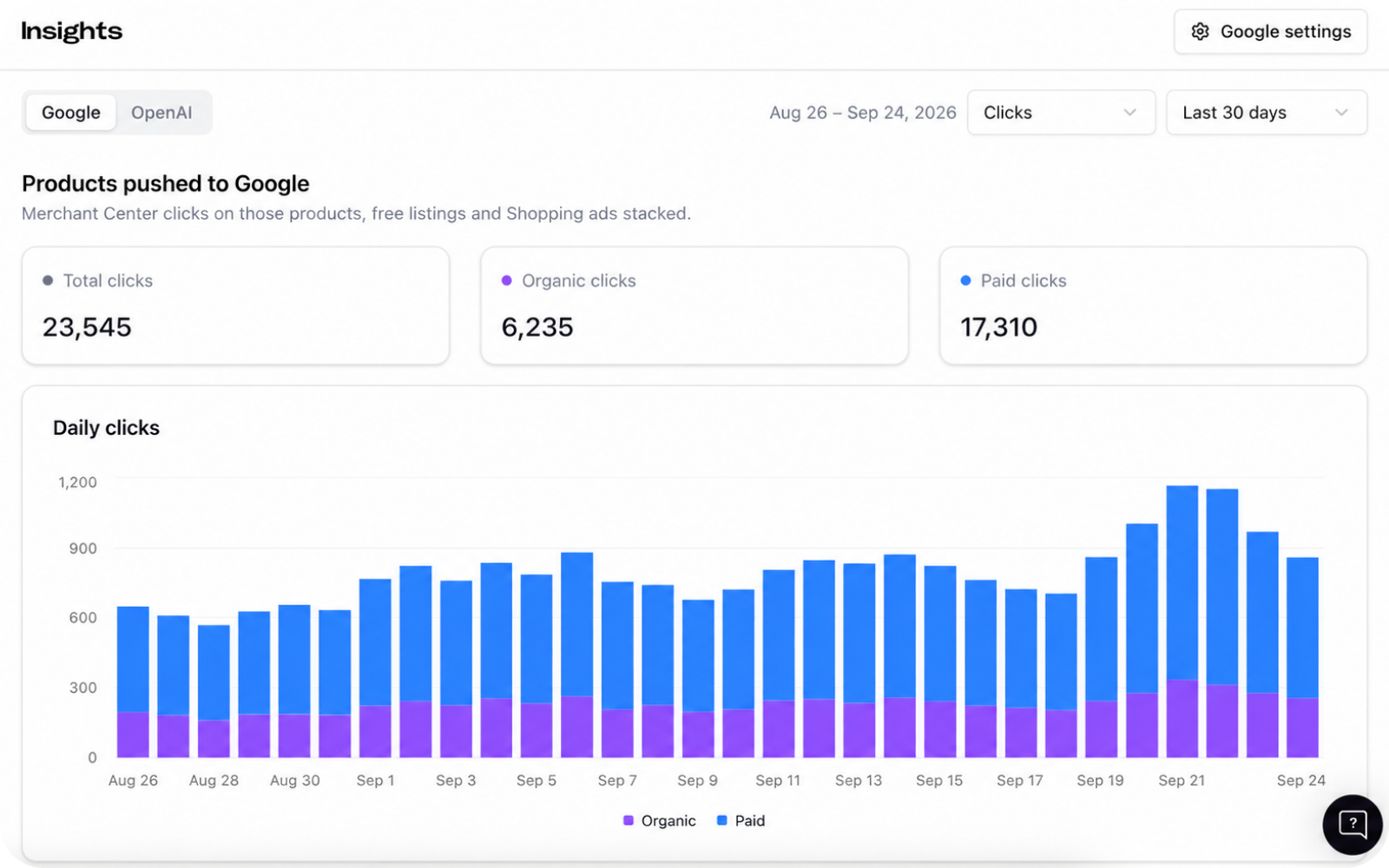
AgenticCatalog builds product feeds in the formats of OpenAI's Agentic Commerce Protocol (ACP) and Google's Universal Commerce Protocol (UCP), enriched with reviews, Q&As and crawl data. It is an option on all plans and needs your OpenAI and Google Merchant Center credentials. Botify's case rests on its own figure that AI bot traffic to retail sites rose 5.4x in 2025. The September Feed Audit checks a feed against Google's requirements and shows which attributes came from generative AI and which from crawled pages. Read that column closely: an AI-written product attribute that is wrong is now wrong in front of a buying agent.
SpeedWorkers pre-renders pages and serves them to bots from the edge, which is what JavaScript-heavy storefronts need. The plan table rules it out on Essential, Accelerate and Growth and lists it as an option on Pro and Enterprise. It serves Google only by default: "If you purchase additional support for Bing, all supported AI bots are also included." Getting rendered pages to GPTBot therefore means an add-on to an add-on, on one of the two top plans.
PageWorkers pushes on-page changes without an engineering ticket, and since August it can turn FAQs, reviews, product details and breadcrumbs into JSON-LD. It is included on Growth, an option on Essential, Pro and Enterprise, and view-only on Accelerate. The September Visual Editor lets you click an element on the live page and preview the change before it goes out. SmartContent, SmartIndex (IndexNow and push to Bing, capped by Bing's daily URL limits) and SmartLink complete the suite.
Botify's documentation disagrees with itself here. One help article says the Activation suite is available on Pro and Essential, while the plan table says SpeedWorkers is not on Essential at all. Get the plan table attached to the contract rather than relying on either page.
Pricing and plans
Botify publishes no prices. Its pricing URL redirects to the demo request form (checked on October 13, 2026), and we found no free trial. What it does publish is the plan list - Essential, Accelerate, Growth, Pro and Enterprise - in a help-centre table last updated June 12, 2026. The gating that matters most:
| Feature | Essential | Accelerate | Growth | Pro | Enterprise |
|---|---|---|---|---|---|
| SpeedWorkers (edge rendering) | No | No | No | Option | Option |
| PageWorkers | Option | View-only | Included | Option | Option |
| AI Visibility, AgenticCatalog, SmartLink | Option | Option | Option | Option | Option |
| Analytics source | Google Analytics | Google Analytics | Google Analytics | GA, Adobe or Piano | GA, Adobe or Piano |
| Log data kept | 13 months | 13 months | 13 months | 24 months | 36 months |
| Crawls kept in trended reports | Last 5 | Last 5 | Last 5 | Last 10 | Last 20 |
| Keyword data kept | 36 months | 36 months | 36 months | 48 months | 72 months |
| Export to S3 / GCS | No | No | No | Yes | Yes |
For money, the best public signal is Vendr's buyer data, last updated February 2026. It puts the median contract at $74,200 a year. By site size: up to 250K URLs runs $30,000-$60,000 a year, 250K to 1M URLs $75,000-$150,000, and above 1M URLs $150,000-$400,000 or more. Those bands are by URL count and do not map onto Botify's plan names. Twelve months is the standard term, 24- and 36-month deals are common and come 15-30% cheaper per year, and cancelling takes 30 to 90 days' notice.
User reviews follow the money. Botify scores about 4.4 on G2 from roughly 80 reviews (checked in October 2026), with praise for integrations and responsive support and recurring complaints about a steep learning curve and pricing that shuts out smaller businesses. Capterra has only four reviews, too few to mean much, but they score value for money and customer service at 2.0 out of 5.
Botify vs BrightEdge, Lumar and desktop crawlers
BrightEdge is the like-for-like rival: enterprise-only, priced behind a demo, and rebuilt around AI search in the same year. If your problems are technical - crawl budget, JavaScript rendering, what bots do in your logs - Botify is the stronger fit, because log analysis and edge rendering are its centre of gravity.
Lumar is the cheaper cloud crawler. Saffron Edge's May 2026 comparison lists a Starter tier around $89 a month and enterprise deals around $15,000-$30,000 and up, against Botify's $30,000-$60,000 floor - but Lumar's log analysis is described as limited, so you lose the Googlebot-behaviour view that justifies Botify's price.
For a site under roughly 100,000 URLs, a desktop crawler such as Screaming Frog or Sitebulb covers the crawl audit for a small fraction of the cost, and Semrush or Ahrefs handle keywords and backlinks, which Botify was never built for.
Verdict: who should buy Botify, and who should skip it
Buy Botify if you run a site with hundreds of thousands to millions of URLs, crawl budget and rendering are real problems, and you have a five-figure budget and someone to own the tool. It is strongest for large e-commerce catalogs: log analysis shows what Googlebot and GPTBot actually fetch, SpeedWorkers fixes what they cannot render, and AgenticCatalog is one of the few products already producing ACP and UCP feeds for shopping agents.
The features behind the 2026 pitch are options, not inclusions, and SpeedWorkers needs Pro or Enterprise. Get answer allowances, crawl credits and seat counts in writing; none are published.
Skip it if your site is under about 100K URLs or you cannot commit roughly $30,000 a year for twelve months. A desktop crawler plus Semrush or Ahrefs covers most of the same ground, and Lumar is the cloud crawler to try first if you have outgrown your laptop.