cloro 评论:AI 搜索可见性工具背后的数据 API
cloro 评论:AI 可见性工具背后的 API。涵盖的引擎、实际延迟、30 美元起的信用定价、计费陷阱以及它与 SerpApi 和 DataForSEO 的比较。
专家评测

What cloro actually sells
Most AI-visibility tools sell a dashboard. cloro sells the data underneath it. You send it a prompt, a country and an engine, and it returns the answer that engine gave a real user, parsed into JSON - the text, the cited sources, the follow-up searches the model ran and any shopping cards it showed. Its own FAQ draws the line plainly: "Is cloro an AI visibility dashboard? No. cloro is the data layer, and several AI-visibility and SEO dashboards are built on it."
Its named clients, Ahrefs, BrightEdge, Surfer SEO and Scrunch, build dashboards rather than buy them. If you want a screen to look at, this is the wrong purchase. If you are building that screen, or feeding a data warehouse, it is the right one.
How it collects the data matters more than the feature list. cloro does not call OpenAI's or Google's model APIs. Per its docs, "each request drives a real browser session through a proxy in the country you asked for: load the surface, submit the prompt, wait for the answer to finish streaming, then parse the rendered page into the response fields." So the output matches what a person sees on chatgpt.com, citations and product cards included, which a direct GPT API call would never return. It is also why every request is slow.
What a response contains, and how long it takes
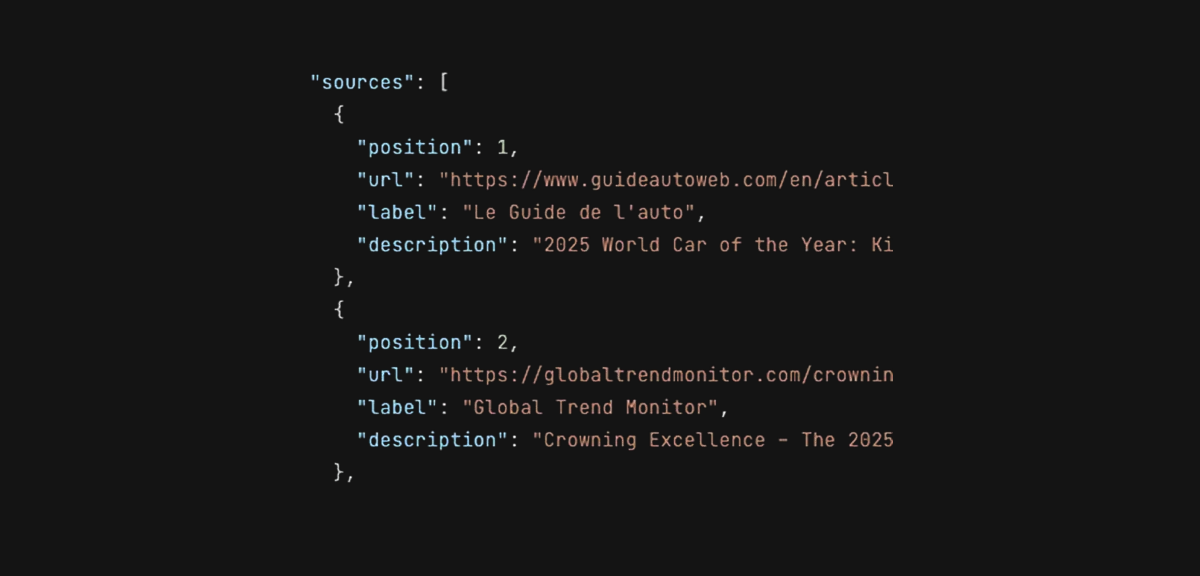
Every call returns the answer as text and markdown, with HTML on request. The value is in three parsed arrays. sources lists each citation with its position, URL, label and description, which tells you if your page was cited and where. searchQueries is the query fan-out: the searches the model ran behind the scenes to build its answer, the field SEO teams care most about because it shows what to rank for. shoppingCards carries product name, brand, price, currency, rating, review count, image and product URL. Gemini started returning shopping cards on 22 September 2026, per the changelog.
Speed is the trade-off. The docs publish medians and 90th-percentile times from the last seven days of production traffic: Google Search 5s and 19s, AI Mode 15s and 22s, ChatGPT 21s and 38s, Perplexity 23s and 49s, Gemini 33s and 41s, Copilot 41s and 56s. This is a batch tool. Nothing a user waits on in real time should sit behind it.
Engines, countries and integrations
Eight surfaces were marked Live on the home page when we checked in October 2026: ChatGPT, Perplexity, Microsoft Copilot, Gemini, Google AI Mode, AI Overviews, Google Search and Google News. Grok is the exception. The docs still describe a Grok endpoint, but both the home page and the pricing page list it as Unavailable, so do not plan a project around it. Country targeting covers every country, with US state-level targeting on ChatGPT, Copilot, Perplexity and Gemini. cloro warns that Gemini has regional restrictions, the EU among them.
Authentication is a plain bearer key. There are official Python and Node SDKs, an n8n node, a Zapier app and LangChain support, but no Make integration. For volume work you send batches of up to 500 tasks and get a signed webhook as each finishes.
A hosted MCP server lets an AI agent call cloro as a tool, but MCP uses the synchronous endpoints, which cost two extra credits a call. On a 4-credit Perplexity request that is 50% more.
Judging it costs nothing. Since 29 September 2026 the Playground on cloro's site runs every endpoint with no API key, so you can test your own prompts before signing up. The free plan then adds 500 credits a month at a concurrency of one.
Pricing and what a credit buys
cloro is a monthly subscription to a pool of credits. There is no pay-as-you-go. These figures were checked on the pricing page in October 2026:
| Plan | Per month | Credits | Per 1k credits | Concurrency |
|---|---|---|---|---|
| Free | $0 | 500 | - | 1 |
| Lite | $30 | 37,500 | $0.80 | 10 |
| Hobby | $100 | 250,000 | $0.40 | 20 |
| Starter | $250 | 650,000 | $0.39 | 50 |
| Growth | $500 | 1,350,000 | $0.37 | 75 |
| Business | $1,000 | 2,800,000 | $0.36 | 100 |
| Enterprise 2K to 5K | $2,000 to $5,000 | 5.87M to 16.39M | $0.34 to $0.31 | 135 to 255 |
Paid plans include unlimited seats. Support is email from Lite to Starter, priority email on Growth and Business, and Slack on Enterprise.
What a credit buys depends on the engine. A full ChatGPT response costs 7 credits, ChatGPT web search 5, Copilot 5, AI Overview with its results page 5, and Perplexity, Gemini and AI Mode 4 each. A Google Search or Google News page costs 3, plus 2 for each extra page. These are the async rates. Synchronous requests add 2 credits.
Our own arithmetic from that table: Lite buys about 5,357 async ChatGPT answers a month, roughly $5.60 per thousand. Hobby buys about 35,714, roughly $2.80 per thousand, and Perplexity on Hobby works out near $1.60 per thousand. The free 500 credits cover about 71 ChatGPT answers. Checking 100 prompts a day across ChatGPT, Perplexity and AI Overviews is 16 credits per prompt, or 48,000 credits a month. That overflows Lite, so the real entry price for that job is the $100 Hobby plan.
The billing rules that cost money
Self-serve plans have a hard cap. When the credits run out the service stops and every call returns "403 Insufficient Credits" until the next cycle or an upgrade. Only Enterprise annual contracts keep running past the allowance and bill the overage. Unused credits expire at the end of each billing period, so a quiet month cannot be saved for a busy one. There are no refunds, since the free credits exist "precisely for the purpose of testing", and annual discounts are Enterprise-only.
Two rules in the docs bite engineers. Failed requests are free, but cancelled ones are not: "A 499 means you closed the connection, but the processing done before that point is billed." A client with a 30-second timeout calling Copilot, whose 90th percentile is 56 seconds, pays for answers it never receives. Set timeouts above the published p90, or use async. Second, concurrency does not queue. On a plan with 10 slots, an 11th request gets a rate-limit error, so your code needs its own queue. Async results are also kept for only 24 hours, after which an unread result is gone.
In the terms, fees can rise "upon providing you sufficient notice" and Irish law governs. The clause that matters is section 2.1, which makes the customer responsible for complying with the terms of service of every platform accessed through cloro. cloro does the scraping, but the legal risk is yours.
Where its own pages disagree
cloro is young. Cloro Incorporation Ltd. was founded in October 2025 by Ricardo Batista and is based in Valletta, Malta, with a remote team across Europe. Its pages disagree with each other. The home page promises 99.99% uptime while section 1.5 of the terms commits to 99.9%, and the docs put the request success rate "above 99% on average." The about page claims 300+ paying companies against 250 in an August 2026 press release, which is likely just growth. The pricing table charges 5 credits for an AI Overview, but the pricing calculator on the same site uses 3. Budget with the higher figure.
Its pricing FAQ asks "Why is cloro more expensive than some alternatives?", and its site shows a G2 rating of 4.7 from 53 reviews that we could not confirm on G2 itself. An August 2026 review on tech-advice.org named the risk every consumer-interface scraper carries: "Occasional temporary parsing issues can occur when platforms redesign." When ChatGPT changes its layout, expect a gap.
cloro vs SerpApi, DataForSEO and dashboards
SerpApi covers Google and other search engines but not ChatGPT or Perplexity answers. Its Starter plan is $25 for 1,000 searches and Production is $150 for 15,000, which is $10 per thousand. A Google Search call on cloro's Hobby plan works out to $1.20 per thousand, so cloro is much cheaper per Google request at volume. SerpApi does count only successful searches, and has no 499 billing trap.
DataForSEO's LLM Scraper is the price threat for ChatGPT data. It charges $1.20 per thousand in its standard queue, which can take up to 45 minutes, $2.40 for priority (up to 5 minutes) and $4.00 for live (up to 90 seconds). That undercuts cloro's $2.80 Hobby rate for ChatGPT, but it covers only ChatGPT and Gemini, where cloro covers eight live surfaces, including Perplexity, Copilot and AI Mode.
If you want charts rather than JSON, look at a finished AI-visibility dashboard such as Profound or Peec AI. And if what you need is a no-code scraper for ordinary websites, see our Browse AI review.
Verdict
Buy cloro if you are building an AI-visibility product, or an internal tracking pipeline, that needs ChatGPT, Perplexity, Gemini, Copilot and Google's AI surfaces in one schema, with the citations and query fan-out a real user would see. From Hobby up, the per-answer cost is fair and the async batching is well built.
Skip it if you want a dashboard, because cloro has none. Profound or Peec AI is the purchase there. Skip it too if you only need ChatGPT and Gemini text and can wait: DataForSEO's standard queue is cheaper. And if your usage swings month to month, credits that expire, a hard cap and no refunds will cost you money. Start in the no-key Playground and pay only once your own prompts prove the output is worth it.
We earn a commission if you subscribe through links on this page. It does not change our verdict.