ZeroGPT 评测:一款免费的人工智能检测器,误报率低于 1%,测量结果为 16.9%
ZeroGPT 评论:免费计划提供的内容、2026 年 10 月检查的每个计划价格、测量的 16.9% 误报楼层 RAID,以及谁不应该信任它。
专家评测

98.4% on the homepage, 16.9% in the benchmark
ZeroGPT's homepage, checked on 2026-10-26, makes three promises in a row: "98.4% Detection accuracy", "<1% False positive rate" and "35+ LLM families covered". The FAQ text on the same site says something slightly different - "an accuracy rate of text detection up to 98%" and "an error rate lower than 2%". Two figures from one vendor that do not quite agree are a small thing. What independent testing found is not.
RAID, the largest public benchmark of AI-text detectors (Dugan et al., ACL 2024), ran four commercial tools: GPTZero, Originality, Winston and ZeroGPT. The researchers tuned every detector to a 5% false-positive rate. ZeroGPT is the one marked with an asterisk, because it "was unable to achieve the target FPR" - the lowest it reached was 16.9%. In plain terms, at its most cautious setting about one human-written text in six still came back flagged. Its accuracy across different generators and decoding settings swung from 0.3% to 95.4%.
The anecdotes line up. In October 2024, Decrypt repeated tests by Christopher Penn of Trust Insights: ZeroGPT scored the Declaration of Independence 97.93% AI-generated. It rated E.M. Forster's "The Machine Stops" 4.27% human, and a ChatGPT rewrite of the same passage 6.35% human. The machine version came out more human than the original. ZeroGPT did not answer Decrypt's request for comment.
A 2024 paper by Cooperman and Brandão in Foot & Ankle Surgery: Techniques, Reports & Cases found ZeroGPT had the highest false-positive rate of the detectors tested, flagging 5 of 6 human-written abstracts as AI. That is a tiny sample, 12 abstracts in all. It still points the same way.
One result in ZeroGPT's favour: under RAID's homoglyph attack, which swaps letters for look-alike Unicode characters, it lost only 0.3% while five other detectors dropped 40.6% on average. It is hard to fool with that trick. It is easy to make it accuse the wrong person.
What the free plan actually gives you
The free plan is why people use ZeroGPT, and it is generous on the number that matters most: one check reads up to 15,000 characters, roughly 2,500 words, with no credit card and some use allowed before you create an account at all. Paste the text, solve a reCAPTCHA, and you get a percentage plus highlighted sentences showing which lines it thinks a machine wrote.
What it holds back is nearly everything around that. No batch uploads - the free allowance is zero files. Ads on the page, which only paid plans remove. A reCAPTCHA on every check, which you will feel by the fifth essay. The bundled side tools are token-sized: 300 words of paraphrasing, 1,500 of summarizing, 1,000 of grammar checking, 500 of translation and 300 words of plagiarism checking.
Paid plans keep a "History of all your detections (text not included)". So the log tells you a score but not which draft earned it. If you ever need to show someone what was checked, export the PDF report at the time - paid plans have it, the free one does not.
Pricing, and why PRO is the plan to skip
Prices below come from ZeroGPT's pricing page, checked on 2026-10-26, in US dollars. Annual billing is advertised as "40% off annually"; the monthly figure in brackets is our own division of the annual total.
| Plan | Monthly | Annual | Characters per check | Batch files |
|---|---|---|---|---|
| Free | $0 | - | 15,000 | 0 |
| PRO | $14.99 | $107.88 (about $8.99/mo) | 100,000 | 50, up to 10 MB |
| PLUS | $21.99 | $167.88 (about $13.99/mo) | 100,000 | 60, up to 10 MB |
| MAX | $30.99 | $239.88 (about $19.99/mo) | 150,000 | 75, up to 50 MB |
| EXPERT | $60.99 | $467.88 (about $38.99/mo) | 350,000 | 100, up to 100 MB |
| EDU | yearly only | $263.88 | 250,000 | 80, up to 10 MB |
| Enterprise | Custom - contact sales | |||
The catch is PRO. At $14.99 a month it lifts the detection limit to 100,000 characters and adds batch files, PDF reports and an ad-free page. But the paraphraser stays at 300 words and the summarizer at 1,500 - exactly the free allowance - and plagiarism checking rises only to 750 words. If the add-ons are the reason you are paying, the real entry point is MAX, which raises the paraphraser to 5,000 words and plagiarism to 60,000 words across 150 checks. PLUS exists for one thing: 35,000 plagiarism words for $7 more than PRO.
It sells the detector and the way around it
Paid plans include "Humanize AI generated text", and the upsell inside that tool reads: "for the highest accuracy and up to 99% human scores, upgrade to the Advanced Model powered by Undetectable AI." The same site that scores text for AI sells a rewriter built to make AI text score as human. Through the API it costs $0.25 per 1,000 words.
That should change how much weight a ZeroGPT score carries. A detector whose maker also sells the bypass has little reason to be hard to bypass, and independent testing cited in our AISEO review suggests it is not: 75% of humanized passages slipped past ZeroGPT, against 38% for GPTZero, 24% for Copyleaks and 12% for Turnitin. Put that beside the 16.9% false-positive floor and you get the worst pairing a detector can have. It flags human writers too often and lets edited AI text through too easily.
Your text, and the ten-hour refund window
ZeroGPT is run by Olive Works LLC, a Wyoming company with a Casper mailing address, under Wyoming law. Both the terms and the privacy policy were last updated on October 7, 2026. The privacy policy says ZeroGPT "does not use private User Content submitted through the Services to train, retrain, fine-tune, or otherwise develop AI models" and does not pass it to advertisers. That is a clear commitment. What it does not give is a retention period: unsaved text is kept "for the period reasonably necessary" to run the service, including security and backups, with no number of days attached. Processing may happen in the US, Germany and the wider EEA.
Read the refund terms before paying, because the window is counted in hours. A first subscription can be refunded in full within ten hours of purchase, and an annual plan bought by accident within twelve. One refund per customer. Renewals, consumed usage and API credits are never refunded, subscriptions renew automatically, and cancelling stops the next charge without returning the current one. If you want to find out whether a paid plan is worth it, do all the testing on the day you buy.
The API is the cheap part
The developer API is pay-as-you-go: top up a balance (from $9.99 to $499.99), get a key, and whitelist your server IPs in the dashboard. AI detection costs $0.042 per 1,000 words on the Beginner tier, so a 2,000-word essay costs under a dime. Short snippets cost more than that rate suggests, though, because any check under 300 words carries a $0.11 minimum charge.
The tiers run the opposite way from most price lists. PRO at $0.057 and VIP at $0.072 cost more per word than Beginner; what the extra buys is size - 150,000 and 500,000 characters per detection instead of 50,000, and larger batches. Plagiarism checks cost $0.41 to $0.52 per 1,000 words, image detection $0.013 per image. The documentation lives on Postman.
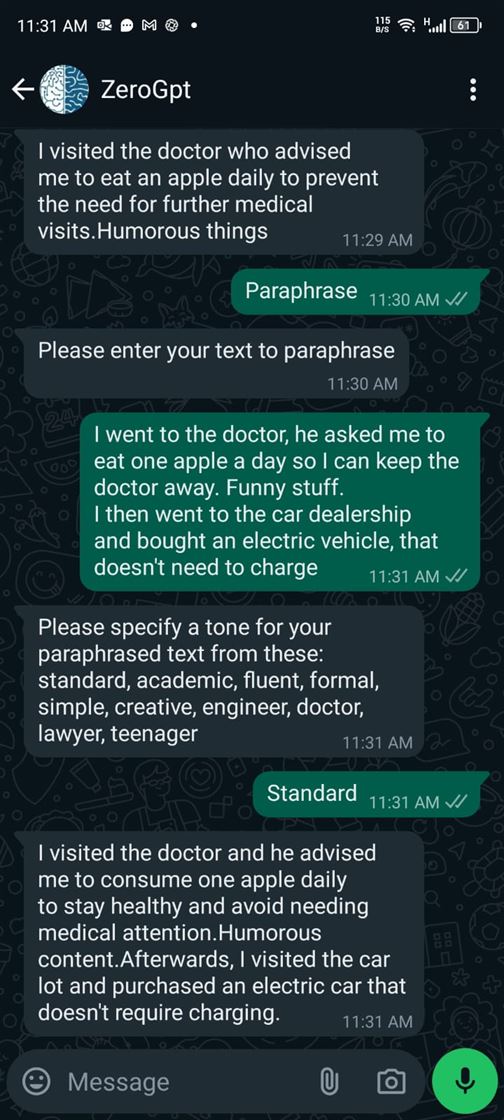
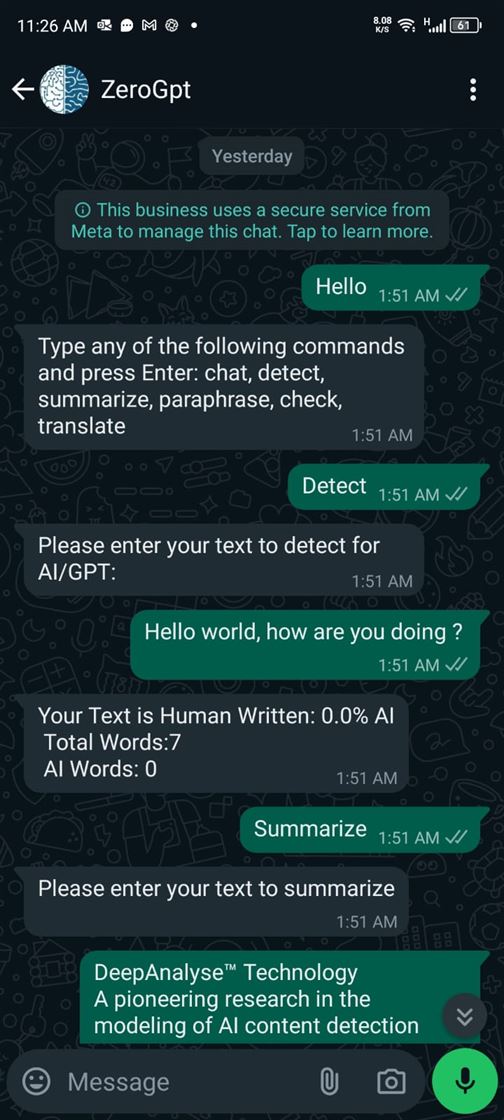
Subscribers get a lighter route too: "Access ZeroGPT on Whatsapp and Telegram", a chat bot that runs Detect, Summarize and Paraphrase on whatever you send it. Handy on a phone, but it reports the same score with even less context.
Verdict: a free first pass, never evidence
ZeroGPT earns a bookmark for one job. You have a block of text you suspect is raw ChatGPT output and you want a free second opinion in thirty seconds. For that, 15,000 free characters per check and sentence highlighting are hard to beat on price.
It is the wrong tool for anything that ends in a consequence. A teacher grading essays, an editor deciding whether to pay a freelancer, a manager screening writing samples - each would be leaning on a detector that never got its false-positive rate below 16.9% in RAID and called the Declaration of Independence 97.93% AI. Penn's warning in the Decrypt piece applies here: these tools are used to "disqualify students, putting them on academic probation or suspension", which he called "a very high-risk application." If a detector has to be part of those decisions, Copyleaks or Originality.ai are built for that work. Even their scores are a reason to ask the writer about their drafts, not a verdict.
Skip the subscriptions unless you specifically need batch uploads or PDF reports - PRO buys a bigger detector and almost nothing else. Developers who want a cheap detection signal at volume are the one group for whom paying makes sense, and they should pay through the API.