Copyleaks Review: A Fast-Moving AI Detector Priced for Schools, Not Writers
Copyleaks review: unified-credit pricing ($16.99 for 25,000 words), AI text, image and video detection, cross-language plagiarism, model training on your uploads, and who should buy it.
Expert Review

The catch: you pay per 250 words
Copyleaks sells one plan that does three jobs - AI text detection, AI image detection and plagiarism checking - and bills all of them in the same currency, the credit. One credit covers up to 250 words or one image. That sounds tidy until you divide. The Personal plan is $16.99 a month for 100 credits, which is 25,000 words, about 100 standard pages. That works out to $0.68 per 1,000 words.
Originality.ai charges $14.95 a month for 200,000 words. GPTZero's Essential plan is about $10 for 150,000. Per word, Copyleaks Personal costs roughly 9 times the first and 10 times the second.
That is the review in one number. It is not the whole story. Copyleaks ships faster than almost anyone in this market - AI Text model V11.0 on September 22, 2026, dedicated German, Spanish, French, Italian and Portuguese models on October 20, plus image and video detection - and it is built to be bought by a university, not a freelancer. Which side of that line you sit on decides whether it is good value.
Pricing and the credit maths
Prices below come from Copyleaks' pricing page as archived on October 5, 2026, checked in October 2026. The live page turns away automated visits, so we read the archived copy and cross-checked it against the developer docs.
| Plan | Monthly billing | Annual billing | Allowance |
|---|---|---|---|
| Personal | $16.99/month | $13.99/month ($167.88 a year) | 100 credits: 25,000 words or 100 images |
| Pro | $99.99/month | $74.99/month ($899.88 a year, 25 user seats) | 1,000 credits: 250,000 words or 1,000 images |
| Education, Enterprise, API | Quote from sales; schools pay per full-time student | Custom, includes LMS integration | |
The annual plans list 1,200 and 12,000 credits without saying "per year". Those figures are exactly twelve months of the monthly allowance, so read them as the year's pool - 300,000 words a year on Personal, not a month.
Here is what that means per 1,000 words, our arithmetic from each vendor's published prices:
| Plan | Price | Words | Per 1,000 words |
|---|---|---|---|
| Copyleaks Personal, monthly | $16.99 | 25,000 | $0.68 |
| Copyleaks Personal, annual | $167.88 | 300,000 | $0.56 |
| Copyleaks Pro, monthly | $99.99 | 250,000 | $0.40 |
| Copyleaks Pro, annual | $899.88 | 3,000,000 | $0.30 |
| Originality.ai Pro, monthly | $14.95 | 200,000 | $0.075 |
| GPTZero Essential, monthly | about $10 | 150,000 | about $0.067 |
Three rules on the pricing page cost money if you miss them. Credits reset at the start of each billing cycle, and on a monthly plan the unused ones are cancelled rather than carried over. Plans do not stack: switching "will override your current plan, including any remaining credits", so moving from an annual plan to a monthly one throws away whatever is left of the year. And a refund is possible only within the first 10 days of a billing cycle, and only if you have not scanned a single page - so one test scan ends your right to one.
Both paid plans include AI text detection, plagiarism checking and AI image detection; cross-language plagiarism is Pro only. There is no cheaper AI-only plan on the public page, and the page does not spell out a free tier. Expect to pay before you can judge results on your own writing.
AI text detection: fast-moving, and contested
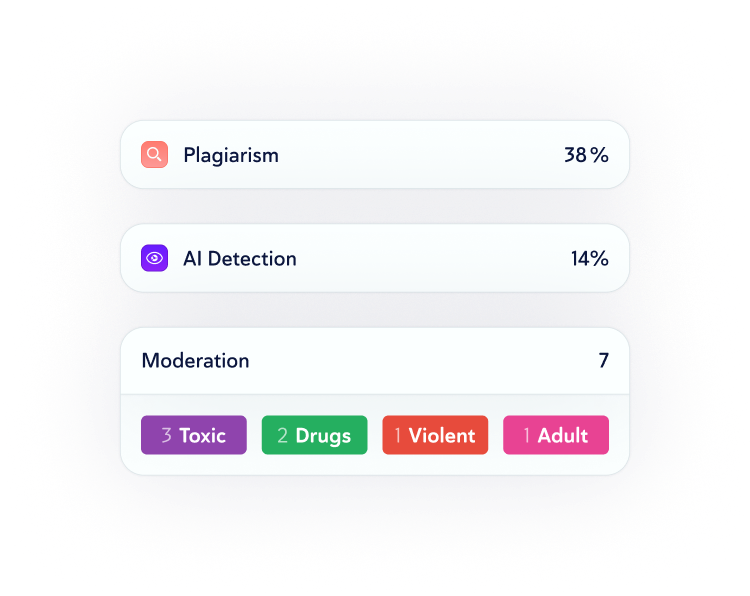
The detector says it recognises text from ChatGPT, GPT-4, Gemini, Claude, DeepSeek, Llama "and other large language models", in more than 30 languages. Its AI Logic view highlights the phrases that drove a verdict, which is more useful than a bare percentage when you have to explain a flag to someone - but it covers only six of those languages. In June 2026 the API limit rose from 25,000 to 100,000 characters per request, so a long report no longer has to be chopped into pieces.
Copyleaks claims over 99% accuracy and a 0.03% false-positive rate, quoting 99.97% on human text and 99.20% on AI text in English. Those are its own numbers. Its developer docs say the model was "independently tested ... with very low false positive rates" and give no figure. The best-known independent study, Weber-Wulff and colleagues in the International Journal for Educational Integrity (2023), tested 14 detection tools and found that "all scored below 80% of accuracy and only 5 over 70%". That predates V11, but it is a reason to read any 99% claim as a best case.
Users report the gap. Copyleaks sits at about 2.5 out of 5 on Trustpilot, split 49% one-star and 42% five-star, and the recurring one-star story is human work flagged as machine-written - writers whose essays came back "flagged as 100% AI when they know the work is 0% AI". Capterra (4.3 from 91 reviews) and G2 (4.5 from 41) are far kinder. Our reading: the people paying for Copyleaks and the people being scanned by it are describing different experiences. Treat a score as a reason to talk to the writer, never as proof on its own.
Image and video detection
This is where Copyleaks goes past a text-only checker. The image detector names OpenAI (DALL-E and GPT), Google (Imagen and Gemini), Midjourney, Stable Diffusion and Black Forest Labs' Flux, plus AI edits made on a phone such as Samsung's GenAI editing. It reads JPG, PNG, WEBP, BMP, HEIC and HEIF. One image costs one credit, the same as 250 words, so 100 images is the whole Personal month.

The 2026 release notes are busy: an AI video detection API on May 31, image plagiarism detection on July 1, object detection on July 15, and heatmaps showing which region of an image looks generated on September 23. Adding object detection to an image request still costs the same single credit.
Plagiarism checking, across languages
The plagiarism checker compares against billions of web pages, academic journals and, through Data Hubs, your own document collections, in more than 100 languages. The feature with no common equivalent is cross-language detection: submit text in Danish, Dutch, English, French, German, Italian, Portuguese, Russian or Spanish, and Copyleaks looks for translated matches in over 30 target languages. That is what catches an essay lifted from a Spanish source and run through a translator - a match a single-language checker never sees. It is a Pro feature.
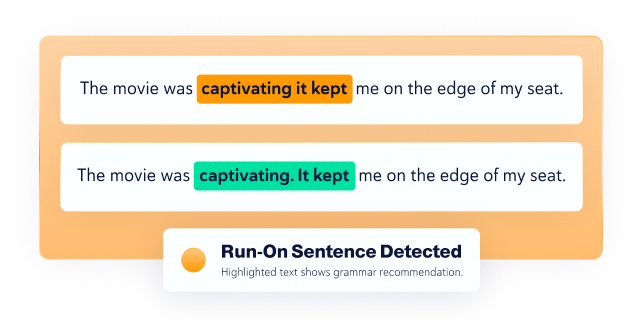
Two newer tools sit alongside it: a Citation Checker (July 12, 2026) and Citations Cross-Check (October 11). The old Writing Assistant now appears in the docs as Grammar Checker, a proofreader that shows each correction it makes.
What happens to what you upload
Read this before you scan an unpublished manuscript or a client's draft. Copyleaks' privacy policy, last revised August 24, 2026, says plainly: "We also use this information to train our models." Direct customers can opt out, but by "contacting customer support" - the policy describes no setting to switch it off. Retention is "as long as necessary ... or as required by law", with no fixed period. If the text is confidential, email support before the first scan, not after.
The Shared Data Hub is the second thing to check. Its documentation says that "when you index a document, it becomes available for everyone to compare against." The API lets developers keep submissions out of the internal database; the docs do not say whether scans from the web app are indexed by default, so confirm your account settings before uploading anything you would not want matched against later.
The security paperwork, by contrast, is what a procurement office wants to see. Copyleaks holds SOC 2 and SOC 3 certification, with the SOC 3 report audited by KPMG and published. Data is encrypted with AES-256 at rest and TLS 1.2 or newer in transit. There is an EU instance at copyleaks.eu with servers in Germany, an on-premises option, and a FERPA position as a "school official" with a legitimate educational interest.
Built for institutions
Copyleaks plugs into Canvas, Moodle, D2L Brightspace, Schoology, Sakai, Edsby and Blackboard, and runs as a browser extension for Chrome, Edge and Firefox and as a Google Docs add-on. The customer logos on its pricing page are a mix of schools and publishers: Medium, Semrush, Oakland University, Edmentum, Edgenuity. School pricing is quoted per full-time student, the same model Turnitin sells on.
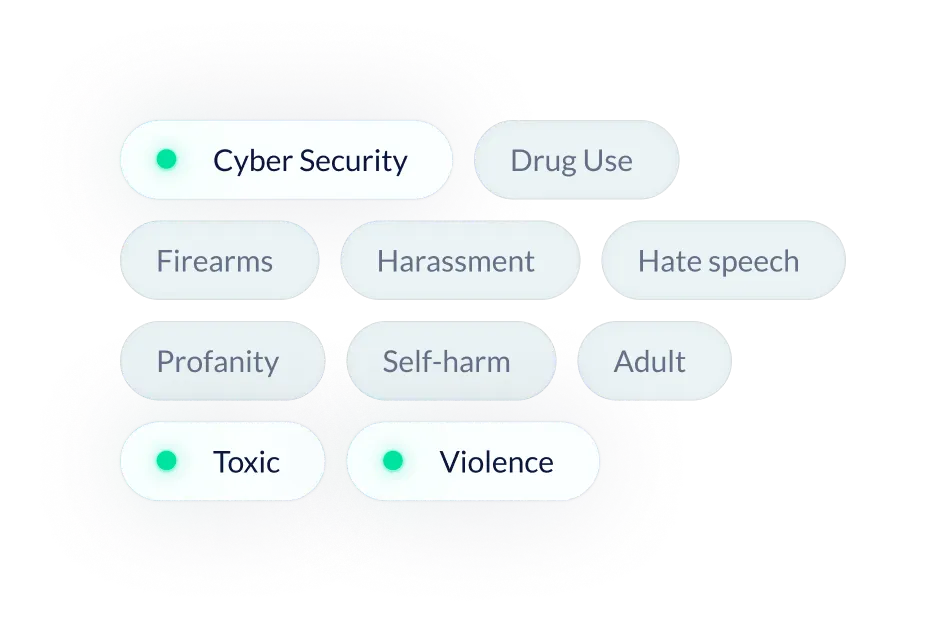
The company was founded in 2015 and is based in New York, run by co-founders Alon Yamin (CEO) and Yehonatan Bitton, and raised a $6 million Series A led by JAL Ventures in May 2022. API customers can also add text moderation, which flags harmful content by category - another sign the product is aimed at platforms rather than individual writers.
For a small team, Pro billed annually is the sweet spot: $899.88 a year over 25 seats is about $36 per seat, and the per-word rate drops to $0.30 per 1,000.
Verdict: who should buy Copyleaks
Buy it if you are a school, a publisher or a platform that needs AI detection inside Canvas or Moodle, checks images as well as text, has to catch translated plagiarism, or answers to a procurement team asking about SOC 2, FERPA and EU hosting. Few detectors put all of that in one contract, and the model updates arrive monthly.
Skip it if you are a freelancer, an editor checking client copy or a student checking your own essay. Originality.ai gives you 200,000 words a month for $14.95, and GPTZero about 150,000 for $10. Copyleaks Personal gives you 25,000 for $16.99, trains on what you submit unless you email support, and forfeits unused credits when you change plans. Unless you need image detection or cross-language matching, nothing on the Personal plan justifies paying nine times as much per word.
Ready to try Copyleaks?
Visit the official website to see the latest plans, pricing, and special offers.
Get Started - Copyleaks* Affiliate link - we may earn a commission at no extra cost to you.