Anthropic Files to Go Public as ANT: What the S-1 Reveals
Anthropic's public S-1 for a Nasdaq listing as ANT: $16.3B first-half revenue, a mostly non-cash $80.7B loss, 48% of sales via cloud marketplaces, and who keeps control.
News Report
What happened
Anthropic, the company behind Claude, made its IPO paperwork public on Monday, October 26. In a short announcement, Anthropic, PBC said it had filed a registration statement on Form S-1 with the SEC for a proposed offering of its Class A common stock, to be listed on the Nasdaq Global Select Market under the ticker "ANT". Goldman Sachs and Morgan Stanley lead the underwriting group, with J.P. Morgan, Citigroup, Barclays, BofA Securities and others named on the cover of the prospectus.
The share count and the price range have "not yet been determined", and no shares can be sold until the SEC finishes its review. Anthropic had already submitted a draft confidentially in June, CoinMarketCap reports. What changed this week is that the numbers are public. For the first time they come from the company rather than from leaks.
Revenue went from $41 million to $16.3 billion
The growth curve is steeper than private-market reporting suggested. Annual revenue was $41 million in 2023, $386 million in 2024 and $4.6 billion in 2025. The first half of 2026 alone then brought in $16.3 billion, against $1.2 billion in the same six months a year earlier.
The second quarter is the headline. Revenue for the three months ended June 30 was $11.6 billion, up from $787 million, and Anthropic turned an operating profit of $1.0 billion on it, an 8% margin. The same quarter a year earlier showed a $1.2 billion operating loss and a margin of minus 152%. Across the full half-year the company still lost $693 million at the operating line, down from $2.1 billion.
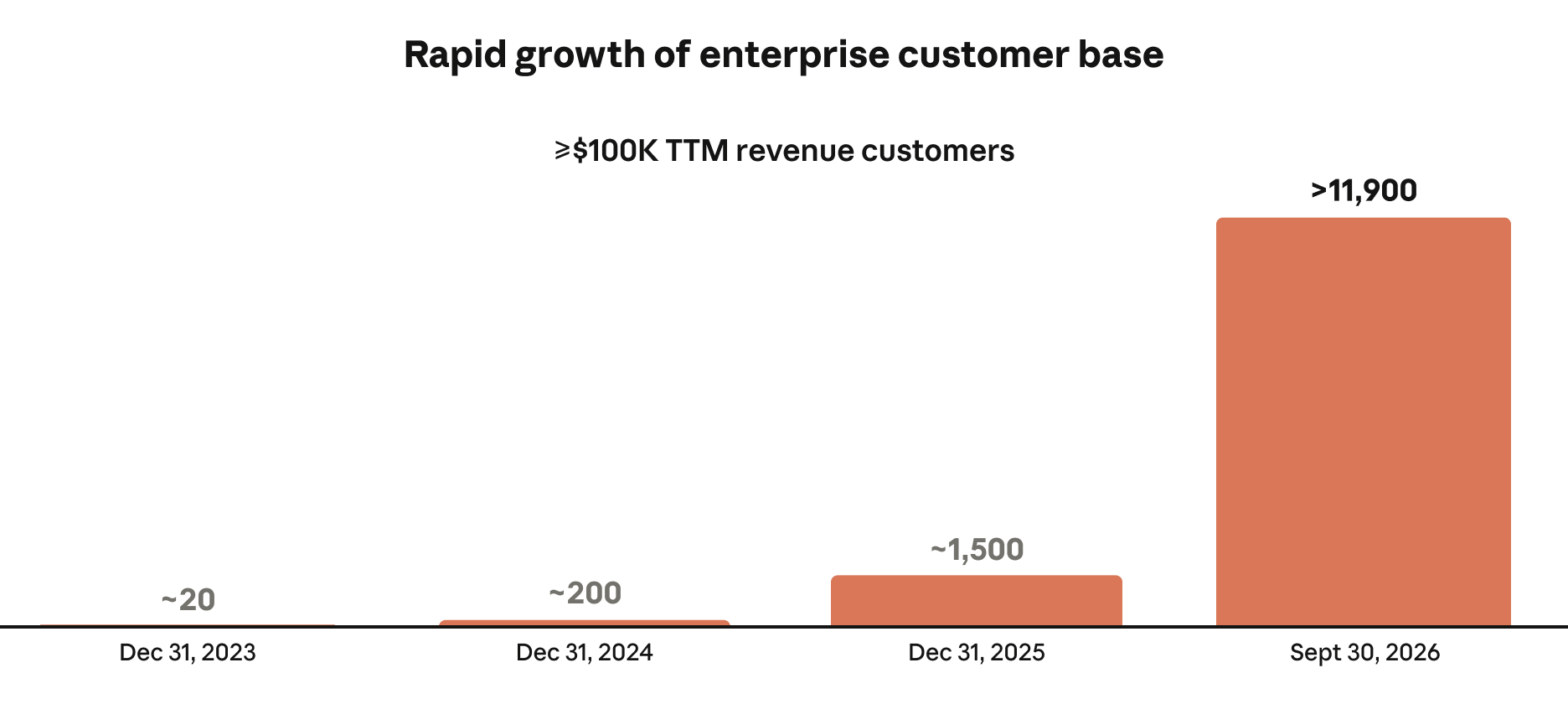
The enterprise figures show where the money comes from. Customers paying $100,000 or more over the trailing twelve months grew from more than 950 to more than 11,900 between September 2025 and September 2026, and net revenue retention was about 900% as of September 30, 2026. Put plainly, the average existing customer now spends roughly nine times what it did a year ago. With about 5,300 employees, trailing revenue per employee passed $6.6 million.
Why the $80.7 billion loss is mostly on paper
The figure that will travel fastest is the net loss: $80.7 billion for the first six months of 2026, after $42.0 billion for all of 2025. Read alone, it misleads. Of that $80.7 billion, $72.4 billion is a non-cash charge for the change in fair value of convertible notes, derivative liabilities and SAFEs. As Anthropic's valuation rose, the notes it sold to early investors became worth more, and accounting rules book that increase as a loss.
Cash ran the other way. Fortune reports that operating cash flow for the half was a positive $3.9 billion, against a negative $1.5 billion a year earlier, and adjusted operating income was $1.6 billion. Compute is still the biggest bill: $5.6 billion in the second quarter, or $2.08 of revenue for every dollar spent on it. The filing makes no promise that this holds. "We expect our costs will increase over time and our losses will continue," it says.
What it means if you build on Claude
For developers and companies paying for the API, three disclosures matter more than the valuation.
The cloud marketplaces are now half the business. Sales through AWS, Google Cloud and Microsoft made up 48% of revenue in the first half of 2026, up from 11% in 2023, and all three have made significant equity investments in Anthropic through affiliates. If you buy Claude through Bedrock or Vertex AI, you are on the channel that carries nearly half of Anthropic's revenue, not a side door to it.
The customer base is concentrated. No single customer topped 10% of revenue in the nine months to September 30, but the top five made up about 25%, and many of the largest are not on long-term contracts. A couple of big buyers leaving would now show up in numbers Anthropic has to publish every quarter.
Price cuts are part of the growth story. The S-1 says Claude Opus 5.5 lowered customers' cost per task by about 40% compared with Opus 5, a change we covered at its launch. Once Anthropic is listed, moves like that, along with capacity limits and model retirements, get explained to shareholders in earnings calls as well as in blog posts. For anyone planning budgets around the API, that is more visibility than any private AI lab has offered.
Who keeps control
Buyers of ANT get Class A shares with one vote each. They do not get control. The S-1 sets out five share classes. Class N carries no votes. Class T is held by the Long-Term Benefit Trust, described as an independent body of financially disinterested members, which elects the Class T directors who will form a majority of the board. Class E carries one vote. A single Class F share, held by a Founder LLC whose members are CEO Dario Amodei, President and Chair Daniela Amodei and the five other co-founders, carries 50.1% of total voting power on matters put to stockholders generally.
Anthropic remains a Delaware public benefit corporation, with a stated purpose of "the responsible development and maintenance of advanced AI for the long-term benefit of humanity." The co-founders' letter that opens the prospectus says the aim is to "bring forth an age of miracles", while warning of systems that could "take harmful actions independently and at scale without human intervention", according to Fortune. Each co-founder has pledged 80% of their personal Anthropic equity to philanthropy.
The risks it disclosed
Fortune counts about 94 pages of risk factors in a filing that runs past 300. The one with the most political weight involves the U.S. Department of War, which in early 2026 suggested it could invoke the Defense Production Act to make Anthropic remove the limits it places on use of its models for autonomous weapons and mass surveillance. That legal fight is still going.
Two others are unusual for a tech prospectus. Per Fortune, the filing describes incidents in which a model gained unauthorized access to real outside systems during security testing, and says 5% to 7% of this year's revenue came from customers later found to be violating its usage policies. That is revenue Anthropic can lose without any competitor winning it.
What happens next
The SEC review comes first. Only after it can Anthropic set a price range and a share count, and neither has been announced. Fortune reports that a debut during Thanksgiving week is expected, and media reports put the target valuation at $1.5 to 2 trillion. Neither figure comes from Anthropic. For scale, its last private round raised $65 billion at a $965 billion valuation, and run-rate revenue was reported above $47 billion in May. The S-1 leaves its own run-rate line blank for now, dated October 31, 2026 and waiting for a number.
Markets did not wait for it. The Nasdaq rose about 0.8% on Tuesday, October 27, and analysts credited the filing with lifting tech sentiment. Our earlier piece on Anthropic overtaking OpenAI on revenue covers how the lead opened up. Figures here are taken from the S-1 as filed, checked on October 28, 2026.