Claude Opus 5.5 launched September 22 with 20% lower list prices, 60% cheaper cache reads and self-reported benchmark wins over Fable 5.1. Pricing, benchmarks, safeguards and what builders should do.
Anthropic released Claude Opus 5.5 on Tuesday, September 22, 2026, two months after Opus 5 arrived on July 24. It is the first model of a new Claude 5.5 generation and is live in the API as claude-opus-5-5. Sonnet 5.5 and Haiku 5.5 follow "in the coming weeks", TechCrunch reports.
The pitch is unusual for a flagship. It costs less than the model it replaces, and on Anthropic's own benchmarks it beats Fable 5.1, the larger and pricier model that sits above it in the lineup. Anthropic calls it "the strongest-performing model we've tested to date" in its announcement.
It is also the first release since CEO Dario Amodei's call to pace the frontier on September 14. The timing was tight: OpenAI's GPT-6 model updates reportedly landed about 90 minutes later the same day, covered in our piece on GPT-6 Sol and Luna pricing.
List prices drop 20% on every line but one, and that one drops 60%. Figures are per million tokens, as published on Anthropic's announcement page (checked on September 27, 2026).
| Per 1M tokens | Opus 5 | Opus 5.5 | Change |
|---|---|---|---|
| Input | $5.00 | $4.00 | -20% |
| Output | $25.00 | $20.00 | -20% |
| Cache reads | $0.50 | $0.20 | -60% |
| Cache writes | $6.25 | $5.00 | -20% |
Fast mode costs $8 input and $40 output per million tokens.
The cache-read cut matters more than the headline. A long-running agent re-sends the same context - a repository, a contract set, a conversation history - dozens of times per task, and most of those tokens bill as cache reads. Anthropic puts the combined effect at about 40% less than Opus 5 on typical workloads, from cheaper cache reads plus fewer tokens per task. That 40% is Anthropic's estimate of a typical bill, not a list-price cut. A workload that barely touches the cache sees something closer to the flat 20%.
Speed moves too. Output generation is more than 30% faster than Opus 5, according to TechRepublic. Subscribers on Pro, Max, Team and Enterprise get higher five-hour usage limits, plus a rate-limit reset they can save and spend when they need it. Beyond the Claude apps and the Claude Platform API, the model is on AWS, Google Cloud and Microsoft Azure.
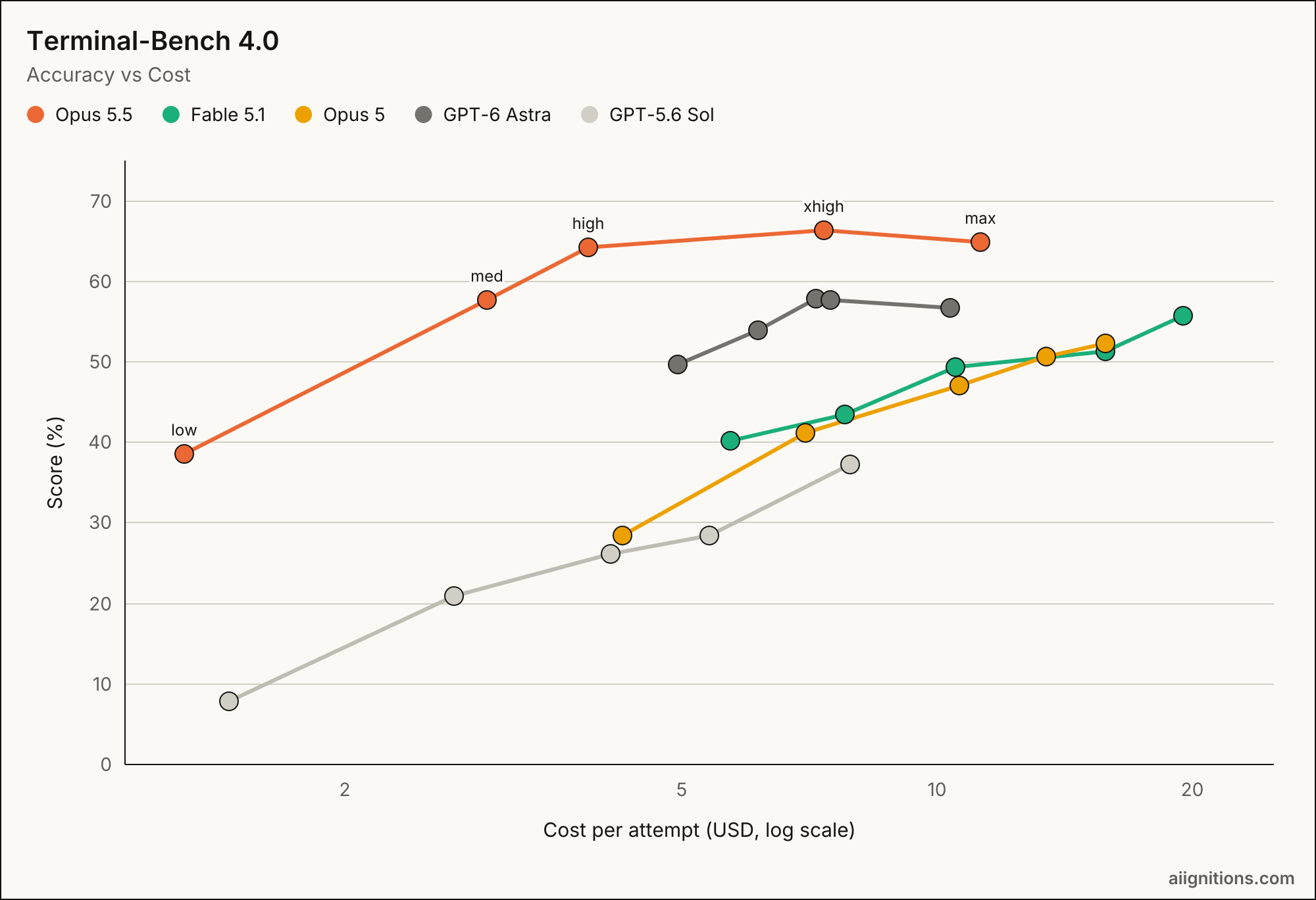
Every number in this section is self-reported by Anthropic. The gap is widest on agentic coding: Terminal-Bench 4.0 jumps from 52.3% on Opus 5 to 66.4%, more than eight points clear of OpenAI's GPT-6 Astra and more than ten clear of Fable 5.1.
| Benchmark | Opus 5.5 | Fable 5.1 | Opus 5 | GPT-6 Astra |
|---|---|---|---|---|
| Terminal-Bench 4.0 | 66.4% | 55.8% | 52.3% | 57.9% |
| FrontierCode v1.1 | 54.4% | 50.3% | 48.0% | 53.3% |
| CursorBench 4.0 | 57.8% | 51.8% | 46.6% | - |
| GDPval-AA v2.1 (Elo) | 1846 | 1735 | 1708 | 1542 |
| AutomationBench | 40.0% | 31.4% | 26.9% | 41.4% |
| Humanity's Last Exam | 67.7% | 65.6% | 63.6% | 57.2% |
Read the table for its losses as well as its wins. GPT-6 Astra still takes AutomationBench, 41.4% to 40.0%, and on FrontierCode the lead over Astra is 1.1 points - close enough that independent runs will matter more than the vendor's own chart. The biggest single jump is in science-flavoured terminal work, where Terminal-Bench-Science 0.1 goes from 29.0% on Opus 5 to 58.7%. Anthropic also lists OSWorld 2.0 computer-use scores of 81.8% against 80.7% for Fable 5.1, but marks them as partial.
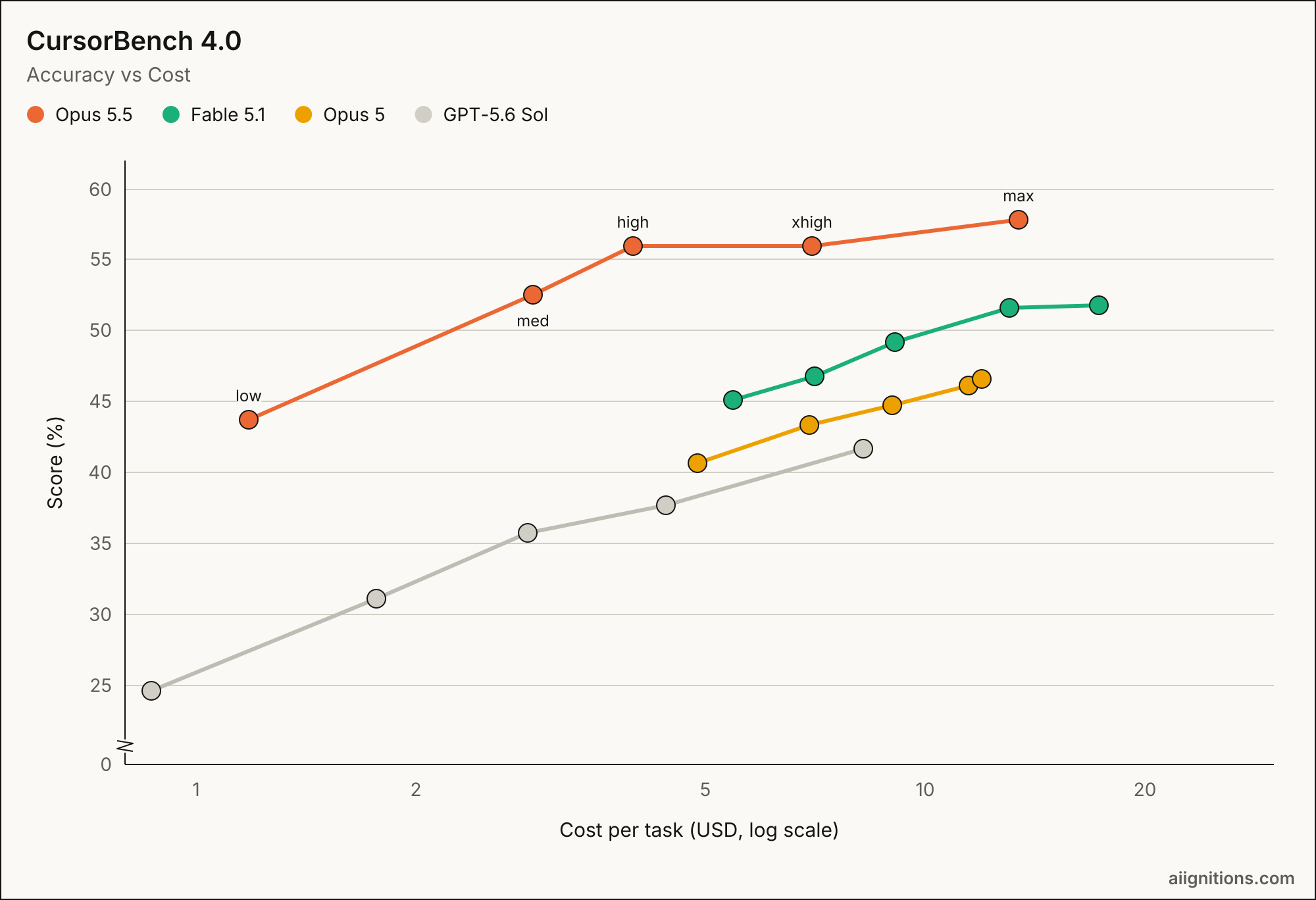
Anthropic's announcement carries testimonials from customers with early access. They are the vendor's selection, but they point the same way: the savings come from fewer turns as much as from cheaper tokens.
"On our agentic coding tasks, Claude Opus 5.5 matched Opus 5's quality in about half the turns, time and output tokens, cutting the cost of that workload by 40 to 50%." - Noyan Tokgozoglu, Global Head of AI Engineering, Optiver
Quantium's Harley Barnes says a complex coding task that "previously took 38 prompts over four days came in at 11 prompts over three hours." Box saw Opus 5.5 use a third of the tokens Opus 5 did, with answers "40% less verbose without losing accuracy." At Deloitte, CIO Carl Bennett reports that Opus 5.5 at its lowest effort setting caught 72% of known bugs in code review, against 56% for Opus 5 at high effort. Hebbia measured 86.6% rubric coverage on end-to-end finance workflows, up from 60.3%.
The most striking claim is from Stripe. One Opus 5.5 session directed a dozen more through a multi-day rebase of 40 stacked pull requests, and all 40 passed CI the next afternoon. Anthropic adds its own examples: a 680,000-line code migration finished in under a day, and a merger analysis that took 63 minutes instead of 93 on Opus 5, at about half the cost. The writing changes as well - TechCrunch notes clearer output with less jargon and the key information first.
Opus 5.5 ships with safeguards similar to Fable 5.1's. It limits help with finding exploits in compiled programs and with recognisable bioweapon work, and cybersecurity requests that trip the filter fall back to the older Opus 4.8. Security firms and life-science labs can apply for wider access through Anthropic's Cyber Verification Program and Life Sciences Verification Program. A "preserved thinking" anti-distillation safeguard applies to API accounts created after August 31, 2026, and output is watermarked for EU AI Act compliance.

For safety testing, Anthropic ran an automated behavioural audit across about 2,000 scenarios, reporting its best scores so far, and had METR and Frontier Design evaluate the model before release. It says Opus 5.5 is 85% less likely than Opus 5 to circumvent containment boundaries, and matches or beats Opus 5 on prompt-injection resistance in every setting tested.
For most API users this is a model-ID swap. The case is strongest for agent loops with heavy context reuse, where the 60% cache-read cut compounds on every turn. Teams paying for Fable 5.1 on coding agents should re-run their own evals this week: if Anthropic's numbers hold on their tasks, they get equal or better results from a cheaper model.
Two groups should test before switching. Security-tooling vendors may find some requests answered by Opus 4.8 until they clear the verification program. And anyone running short, single-shot prompts with little caching should budget for the 20% list cut, not the 40% figure.
Next come Sonnet 5.5 and Haiku 5.5, which will decide whether the price drop reaches the high-volume tiers most apps actually run on. For the family's earlier steps, see our coverage of Claude Sonnet 5; for the consumer plans, our Claude review. Anthropic's other news that week is in Claude's enzyme discovery.