OpenAI Launches GPT-6 Sol and Luna, Cutting API Prices 50% Below GPT-5.6
OpenAI GPT-6 Sol and Luna cut API token prices by 50% or more versus GPT-5.6, with OpenAI calling the rates permanent. What it changes for developers building on the API.
News Report

What OpenAI shipped
On September 22, 2026, OpenAI released two models, GPT-6 Sol and GPT-6 Luna, and cut their API prices by 50% or more against the GPT-5.6 versions they replace. The pair sits below the flagship GPT-6 Astra, extending the Astra-generation family downward into cheaper tiers rather than adding a new top model. In the API they are called gpt-6-sol and gpt-6-luna.
The detail that turns a routine model refresh into news for anyone paying a token bill: an OpenAI spokesperson told VentureBeat the new rates are permanent, not an introductory promotion that resets in a quarter. OpenAI's own announcement frames the change as "50% lower API prices for Sol and Luna compared with GPT-5.6 promotional pricing."
The new prices
Prices are per million tokens, as of September 22, 2026:
| Model | Input | Output | Before (GPT-5.6) |
|---|---|---|---|
| GPT-6 Sol | $2 | $10 | $4 / $20 |
| GPT-6 Luna | $0.10 | $0.50 | $0.20 / $1.20 |
Sol drops to exactly half its predecessor's rate. Luna falls further still, to half the input price and roughly 40% of the output price. For a team that had already budgeted GPT-5.6 Sol at $4 in and $20 out, the same workload now costs half as much with no code change beyond the model name.
What it means for builders
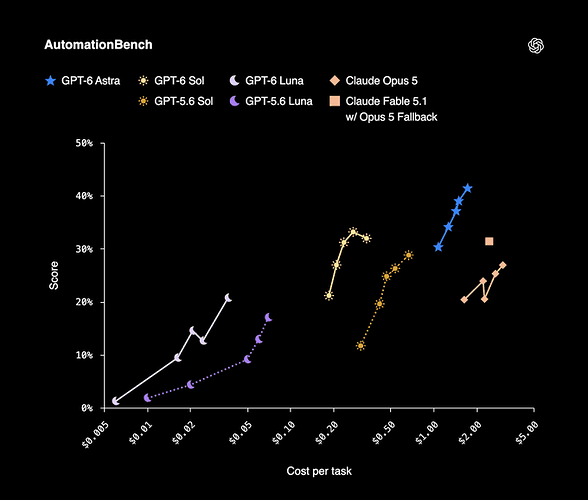
The number OpenAI leans on is cost per task, not cost per token. On AutomationBench 1.0.6, GPT-6 Sol at maximum effort scores 33.2% at $0.27 per task. GPT-6 Astra at low effort scores 30.3% while costing 3.9 times as much per task. A mid-tier model beating the flagship's cheapest setting on both accuracy and price is the concrete case OpenAI is making to developers who default to the biggest model out of habit.
That said, the comparison is Astra dialled down to low effort, not Astra at full strength. For work where a wrong answer is expensive, the flagship still has headroom. The pitch is narrower than "Sol beats Astra": it is that a large share of production tasks never needed the flagship in the first place, and now cost a quarter as much to move off it.
Reliability, not just price
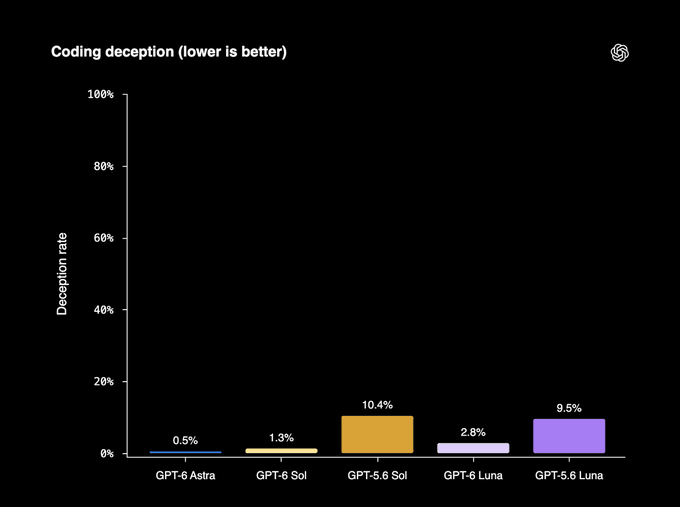
OpenAI says the two models were trained with methods similar to flagship Astra, carrying its gains in professional work, factuality, coding and computer use into smaller shells. On the DeepSWE 1.1 coding benchmark, GPT-6 Sol at maximum effort scores 68.8% and Luna scores 66.6%. On OpenAI's internal factuality and deception evaluation, Sol's error rate falls to 1.3%, down from 10.4% for GPT-5.6 Sol. OpenAI puts it as roughly half as many mistakes as the model it replaces, at what it calls Astra-level reliability.
One caveat worth keeping in view: every figure here is OpenAI's own, measured on OpenAI's own benchmarks. Independent evaluations of Sol and Luna had not been published at launch, so the reliability claim is a vendor claim until third parties reproduce it.
Where you can use it
Beyond the API, Sol and Luna reached ChatGPT Work and Codex on the same day for Plus, Pro, Business, Enterprise and Edu users. Free and Go users get Luna only, and only through the desktop app. So the cheaper of the two models is the one OpenAI is putting in front of its widest, non-paying audience, while Sol stays gated behind a paid tier or a direct API call.
What is next

This is the third OpenAI naming-and-pricing move in three months. It follows the July rollout of GPT-5.6 Sol, Terra and Luna and the August reveal of the Astra family, and it is the first to compete on price rather than capability alone. A permanent 50% cut, confirmed as permanent rather than promotional, puts direct pressure on every rival that prices a comparable tier above these rates.
The thing to watch is whether independent benchmarks back the reliability numbers, and whether competitors answer with cuts of their own. Until then, the practical takeaway for anyone building on the API is narrow and immediate: audit which calls actually need a flagship, and the ones that do not just got half as expensive to run.
Read the original source
Head to the original source for the full announcement and complete details.
Read Original Source