Google Will Switch Off Gemini and Search for K-12 Students Until Schools Opt In
Google will turn off Gemini and Search by default for K-12 student accounts until admins opt in, and adds Guided Learning. Why critics call it leverage.
News Report

What Google announced
On November 3, 2026, Google said it will change the defaults for K-12 student accounts in Google Workspace for Education. Access to Gemini, Gemini Notebook, Gemini in Classroom and Google Search will be "entirely off for K-12 student accounts until school administrators explicitly turn them on," according to a post on Google's blog by Chris Phillips, VP and General Manager of Education.
"We believe schools should have control over AI in their classrooms," Phillips said. The change covers student accounts only. Teacher accounts, higher education and consumer Google accounts are not part of it.
Google gave no rollout date. It says it will share specifics with schools "in the coming months" before the controls change. In the same announcement it brought Guided Learning, its step-by-step tutoring mode, to Google Classroom worldwide and to a Search pilot in U.S. schools.
Why Search is on the list
Gemini starting switched off is a reversal. Google limited Gemini to students 18 and older until August 2026, when it turned the assistant on by default in Google Classroom for many K-12 students, a move educators objected to, CBS News and Engadget reported. The new default undoes that.
Search is the part that drew the backlash. Phillips told The New York Times that "Search and AI are deeply integrated," and that schools that ban AI "will not have access to search, and they'll see a message from their school that indicates it's not available." For a district that has paused generative AI, that reads as a choice between AI and no search engine at all.
Google then softened the framing. It told CBS that schools can "turn on one, two or all three services," and told Engadget the choice is not all-or-nothing. In a statement on X, Google said the changes "give schools more choice, not less" and that "schools are in control." What it has not offered is Search without AI. The student version of Search still includes AI Overviews and AI Mode, so a school can enable Search on its own, but not a Search with the AI taken out.
The reaction came within hours. New York City Mayor Zohran Mamdani said "Google is trying to use its monopoly power to force AI into our public schools." Sen. Bernie Sanders said "Google is threatening schools" and called it "extortion." Former FTC Chair Lina Khan pointed to "the danger of allowing an unregulated monopolist to control an essential service," CNBC reported.
Teachers and advocacy groups joined in. Randi Weingarten, president of the American Federation of Teachers, said "it is unfortunate that Google has prioritized its business interests over the education of our children," according to NBC News. Josh Golin, executive director of Fairplay, said Google is trying "to strong-arm schools into using its AI products," and told CBS the attempt "is likely to backfire."
Scale is why this lands hard. Google says roughly 150 million students and teachers use Google Classroom. A 2023 Schoolytics report, cited by NBC, found that nearly two-thirds of assignments use a Google product.
Guided Learning in Search and Classroom
The other half of the announcement is about what students see once AI is on. When Google's systems detect certain kinds of homework help in Search, such as a pasted physics problem or a request for help with a book report, student accounts get Guided Learning: Search walks through the topic with prompts "without going directly to the answer." Google's statement adds that AI Mode and AI Overviews "will offer step-by-step guided learning through problems." A pilot starts in select U.S. schools later in November 2026 and is due to reach more districts in the coming months.

In Google Classroom, Guided Learning is available globally from November 3. A teacher assigns a Guided Learning activity, a one-to-one study tool anchored in the class's own material, and gets real-time insight into where the class needs support. In the school version, teachers can read transcripts of students' conversations with the chatbot.
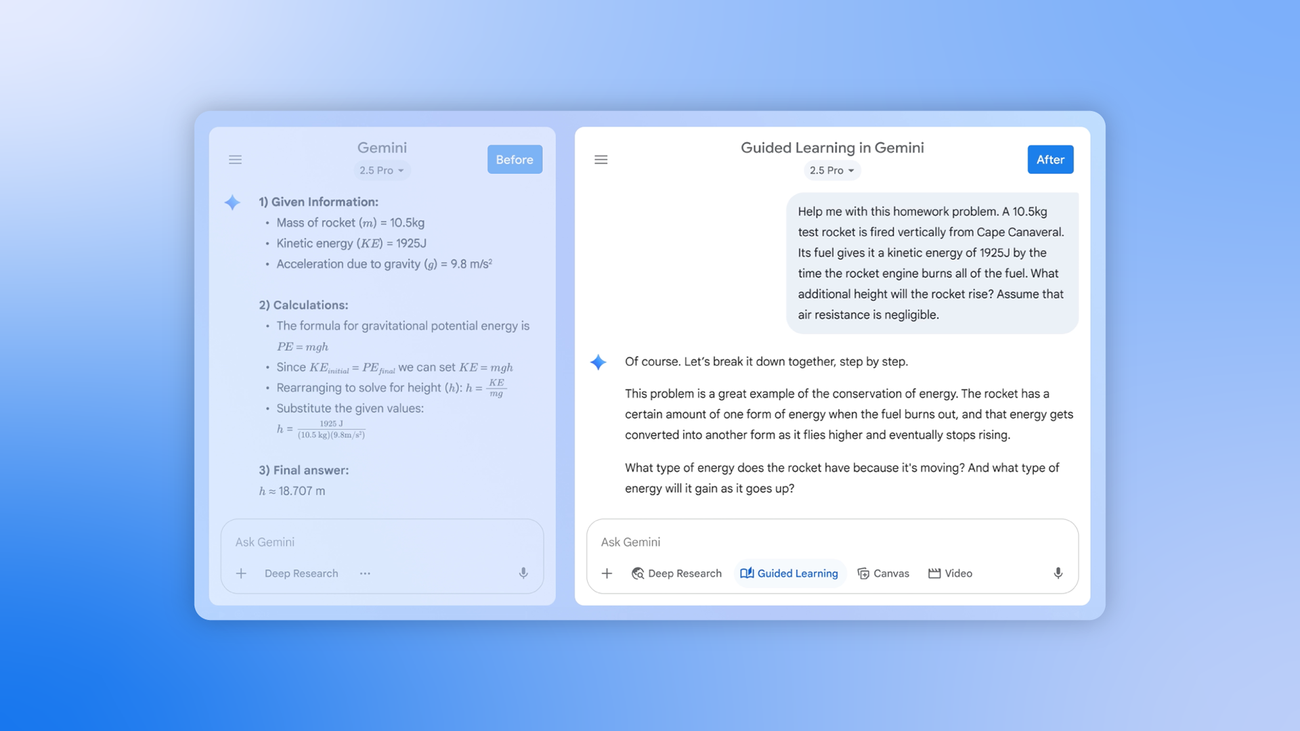
That before-and-after comparison is from Google and shows Guided Learning as it first appeared in the Gemini app in August 2025. Google has not yet published images of the new Search or Classroom versions.
Google backs the feature with its own research, released the same day. In a University of Tokyo randomized controlled trial with more than 300 students on a half-day statistics lesson, students using standard online resources improved by 5.3 percentage points, while those who also had Guided Learning in the Gemini app improved by 8.1 points. Google calls that 1.5x higher learning gains. A four-week pilot with Ark in three UK secondary schools found that Guided Learning took the first questions during independent work, which freed teachers for one-on-one help, and over half of the students surveyed said it helped them solve problems on their own. Both results come from Google, not an independent review.
What changes for districts
The admin console becomes the decision point. As of November 4, 2026, Gemini is on by default in Classroom for many K-12 students and Search is simply there. After the rollout, all four services start off for student accounts, and an administrator enables each one separately. A district that turns on Search gets AI Overviews and AI Mode with it, and, once the pilot widens, the Guided Learning behaviour on homework-style queries.

That matters most where AI is restricted by policy. In September 2026, New York City put a one-year moratorium on generative AI tools for public school students through eighth grade, and the Los Angeles public school system enacted a similar ban the same month, Engadget reported. Districts like these now have to decide whether Search, with its AI features, counts as an AI tool under their own rules. If it does, students lose Google Search on school accounts. If it does not, AI Overviews arrive through the Search toggle.
What comes next
Google says schools will get the specifics "in the coming months," and no date is set for the default-off controls. The Guided Learning pilot in Search starts later in November in select U.S. schools.
The political pressure predates this week. In October 2026, Sens. Richard Blumenthal (D-Conn.) and Josh Hawley (R-Mo.) opened an inquiry into Google's push of AI into classrooms, and Common Sense Media has rated Google's AI Overviews an "unacceptable risk," according to CNBC. In early October, 13 parent advocacy organizations signed an open letter urging districts to turn off Gemini and YouTube. Engadget also noted that New York Governor Kathy Hochul recently signed a law barring AI companies from offering certain chatbot features to minors.
The open question is whether Google will offer a student Search with AI Overviews and AI Mode switched off. Until it does, the "one, two or all three" choice still leaves districts that ban AI picking between AI-assisted Search and no Google Search for students. For a closer look at the assistant itself, see our Gemini review.