Claude Agents Find ART, a New CRISPR-Like Enzyme System in Phage DNA
Anthropic says Claude agents discovered ART, a previously undescribed reverse transcriptase system in bacteriophages with a CRISPR-like repeat array. What was found, how, and what it does not prove yet.
News Report

What happened
On September 23, Anthropic said its Claude agents had found a biological system nobody had described before. The company calls it array-associated reverse transcriptases, or ART, and it lives mostly in bacteriophages, the viruses that infect bacteria. It is the first published result from the molecular biology group Anthropic set up in spring 2026, and the announcement comes with a preprint rather than a journal paper.
The division of labour is the headline. Anthropic says human involvement "was limited to the initial prompt and the lab work." The agents did the searching, the pattern-spotting and the write-ups. People in a Bay Area lab then checked whether the thing the agents flagged was real.
How roughly 950 agents narrowed 200,000 enzymes to 20
Reverse transcriptases (RTs) copy RNA into DNA. They are common, which is the problem: finding an unusual one means reading through a very large pile of ordinary ones. Anthropic pointed about 950 Claude agents at "a massive database of DNA sequences" and let them run for 21 hours, spending 210 million tokens.
The funnel, in Anthropic's words: the agents "gathered over 200,000 RTs, picked out 3,500 new candidate systems, and narrowed those to the 20 most-compelling candidates that they analyzed to produce human-readable reports." That is a 10,000-to-1 reduction before a human read anything.
According to TechCrunch, the agent that caught ART worked the way a patient postdoc would. It read the raw DNA around an odd-looking RT, found in a jumbo phage, and logged what it saw. Then it counted the repeats beside it, measured their spacing and compared the layout with known RT systems. Last came a literature search for any earlier report of the pattern, and only then did it file a report for review.
The tooling is ordinary. Anthropic says the work runs in Claude Science and Claude Code, "and sometimes with a harness of our own that coordinates many Claude sessions running in parallel." It does not say which Claude model powered the agents.
What ART looks like, and why CRISPR comes up
ART has three parts: "the RT, a partner gene beside it, and a long array of evenly spaced DNA repeat sequences." That last piece is what caught attention. A CRISPR array has the same kind of evenly spaced repeats, and it is the bank of RNA sequences that makes CRISPR-Cas systems programmable.
Anthropic's framing is careful. ART combines "a set of characteristics that have only ever been found together in a handful of other systems, all of which are programmable and perform operations like cutting, copying, and pasting DNA." Being in that company is a reason to look closer. It does not mean ART does any of those things.
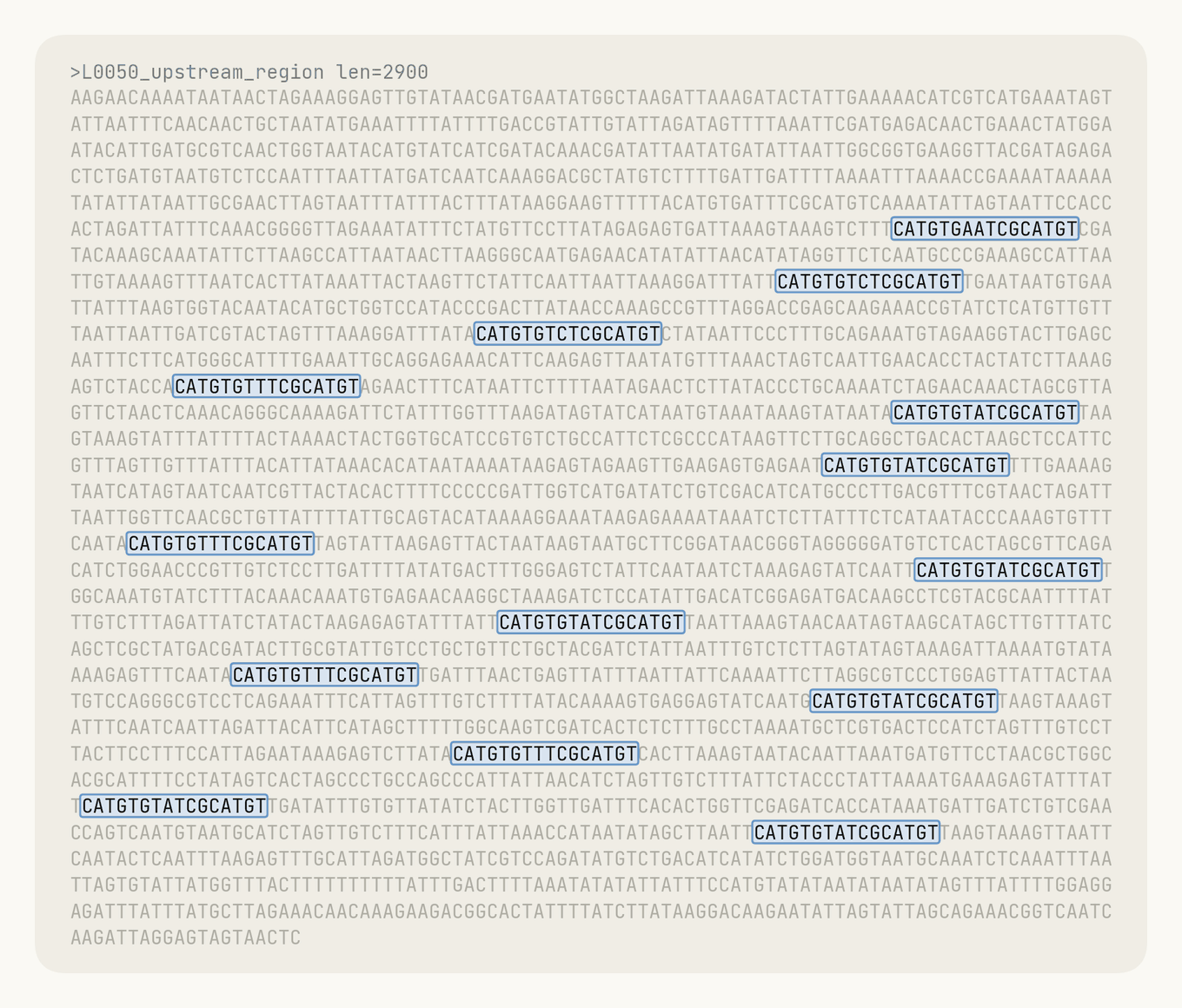
The lab has one result so far. Its first experiments show "the ART array is also expressed as a set of distinct short RNAs," which fits the CRISPR analogy. The protein has been expressed in laboratory strains, and biochemical and structural work is under way.
Feng Zhang, the CRISPR pioneer at MIT and the Broad Institute, is quoted in Anthropic's own post calling the RNA-repeat arrays "genuinely intriguing" and saying they merit further investigation. That is an endorsement worth having. It is also a quote supplied by the company, not an independent review.
What it does not prove yet
Nobody knows what ART does. Anthropic says plainly that "work to understand the primary function of ARTs is ongoing." There is no evidence yet that it edits genes, and calling it "a new CRISPR" goes well past what the data shows.
The finding is a preprint and has not been peer-reviewed or confirmed by outside groups. Dario Amodei also noted on X that Stanford had earlier found "a system in some ways similar to the one Claude found," so the novelty claim will be argued over in the review process, as it should be.
Claude also did not touch a pipette. "All of the lab work is performed by human scientists," Anthropic writes. Amodei says it may eventually be possible for Claude to run experiments by controlling lab equipment, with safeguards, "but we aren't doing that today." The lab itself works only at biosafety levels BSL-1 and BSL-2 and does not handle pathogens that can infect humans.
Why it matters beyond biology
Most AI-for-science stories so far have been about models answering questions faster, predicting a structure or summarising papers. This one is about agents generating a lead that humans did not ask for by name, cheaply enough to run a thousand of them overnight.
For anyone building agent systems, the interesting part is the shape of the pipeline, not the enzyme. Hundreds of agents fan out over a dataset too large to read, each keeps notes and checks prior literature, and the output is a short ranked list of reports a specialist can judge in an afternoon. That pattern transfers to security logs, legal discovery and code audits with very little change.
It also moves the bottleneck. Anthropic says Claude produces hypotheses "so prolifically" that the hypotheses have become a research subject: with hundreds to thousands of candidate reports from a single campaign, the team is studying what separates the ones worth testing from the ones set aside. Generating leads is getting cheap. Deciding which to spend lab time on is not.
Anthropic's CEO has written at length about how fast this could go, which we covered in Amodei on the pace of the frontier. ART is the first concrete result the company can point to.
What's next
Anthropic is continuing the biochemical and structural characterisation of ART and has invited outside researchers to collaborate. The questions to watch are whether independent labs reproduce the short-RNA result, whether ART turns out to be programmable, and how it compares with the Stanford system Amodei mentioned.
As of September 24, 2026, checked against Anthropic's announcement a day after it went up, the preprint is the only full account, and the function of the system is still open.