Atria Review: One Tool for Meta and TikTok Ad Creative
Atria review 2026: the AI ad-creative platform for Meta and TikTok. Real pricing, credit limits, the $500K spend cap, alternatives and who should skip it.
Expert Review
What Atria actually is
Most performance teams run the same relay race every week. Someone digs through the Meta Ad Library for competitor angles. Someone else pulls last week's numbers into a sheet to work out which hooks died. A copywriter turns that into scripts, a designer turns the scripts into statics, and then a media buyer spends an afternoon uploading the results one creative at a time.
Atria is a single app for that whole relay. It is built for Meta and TikTok specifically, not for paid search, and it covers four stages: researching what is already working, grading what you are running, generating the next batch of copy and images, and bulk-launching them into Ads Manager. The company positions it at brand owners and agencies, and says its models were trained on real spend data rather than generic web text.
The honest framing: this is not an AI that runs your account. It is a research-and-production line that removes the manual steps between "we should test that angle" and "the ad is live".
The ad library and Radar
Two features carry the product, and they sit at opposite ends of the workflow.
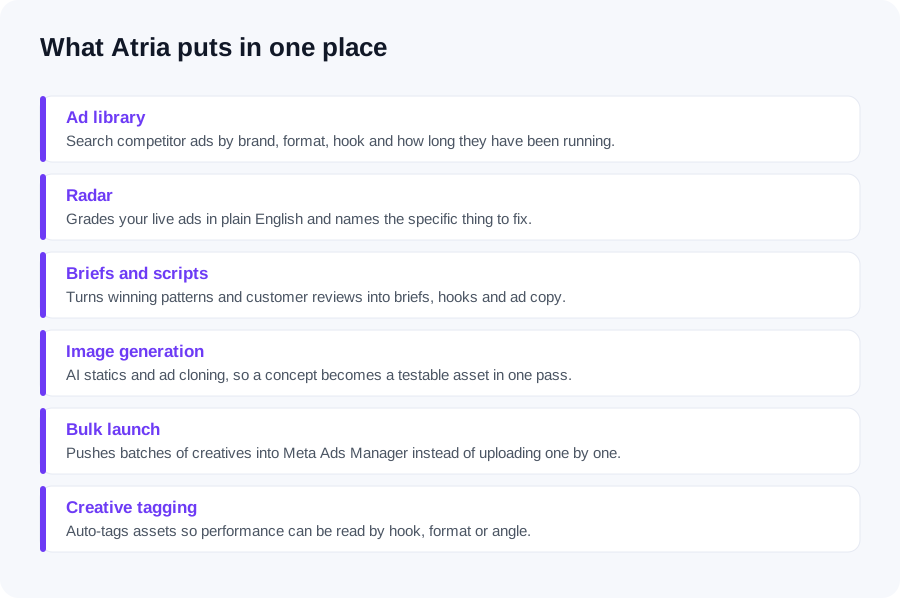
The ad library is competitor research with filters that Meta's own public library does not give you: search by brand, by format, by hook style, and crucially by how long an ad has been running. Longevity is the only public proxy for profitability an outsider has. If a DTC brand has been running the same static for eleven weeks, it is making money, and that is a far better signal than a screenshot of something that launched on Tuesday.
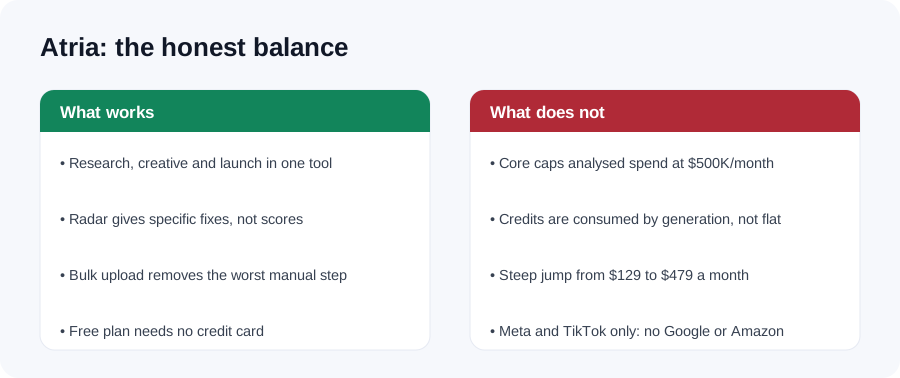
Radar works on your own account instead. It grades live ads and, rather than handing back a score out of 100, writes the diagnosis in plain English with the specific fix attached: the hook is buried past the third second, the offer never appears on screen, the creative is fatiguing against the same audience. Scores are easy to ignore. Instructions are harder to argue with, and this is the part of Atria that a junior buyer benefits from most.
Atria also mines customer reviews for language, which is the least glamorous and most reliably useful research trick in direct response: the phrases buyers already use outperform the phrases a copywriter invents.
Try the free plan before you commit to anything, since the library is the piece you can evaluate in an afternoon.
From brief to launched ad
The generation side follows the research. Winning patterns and review language become a creative brief, the brief becomes hooks and scripts, and the scripts become statics through AI image generation and ad cloning. Assets get auto-tagged as they are created, which is what makes the reporting useful later: you can read performance by hook or by format instead of by ad name, and ad names are always a mess by month three.
The last step is the one that saves the most wall-clock time. Bulk upload pushes a batch of creatives into Meta in one action. Anyone who has manually duplicated ad sets to test six hooks knows exactly how much of an afternoon that reclaims.
Two caveats on the AI output, and they apply to every tool in this category. Generated statics still need a designer's eye before they meet a paying audience, and generated scripts read as competent, not distinctive. Atria shortens the distance to a testable asset. It does not remove the person who decides whether the asset is any good.
Pricing, and the number the page does not show
Checked on tryatria.com/pricing on 26 July 2026, the ladder runs: Free with 1,000 credits and no credit card required, Core at $129 per month, Plus at $479, Business at $959, then custom Enterprise pricing.
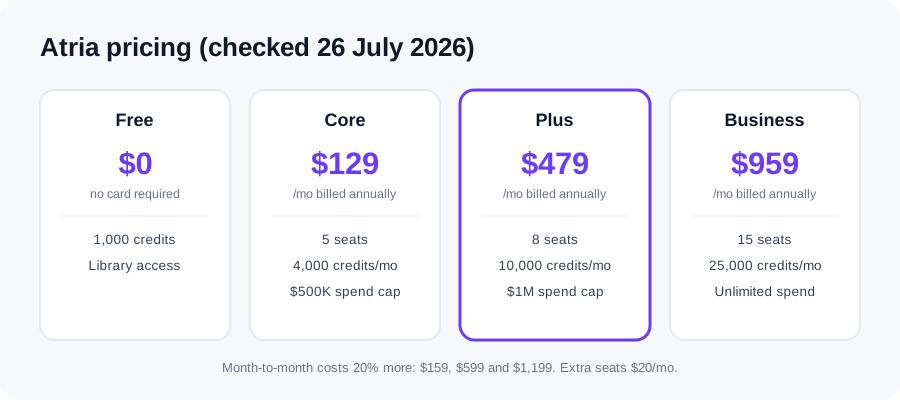
Those figures are the annual-billed rates. Month to month you pay 20% more: $159, $599 and $1,199. What each tier buys:
- Core, $129/mo: 5 seats, 4,000 AI credits a month, 5 ad accounts, 5 GB of asset storage, 3 brand profiles, 50 brands you can follow, and analysis capped at $500K of monthly ad spend.
- Plus, $479/mo: 8 seats, 10,000 credits, 10 ad accounts, 1 TB storage, 8 brand profiles, 100 followed brands with AI insights attached, and a $1M monthly spend cap.
- Business, $959/mo: 15 seats, 25,000 credits, unlimited ad accounts and unlimited spend analysis, 5 TB storage, 200 followed brands.
- Extra seats: $20 per seat per month on every paid tier.
Now the number the pricing page never puts on screen. Annualised, Core is $1,548 a year, Plus is $5,748, and Business is $11,508. Pay monthly instead and Business reaches $14,388. Software priced per month gets approved per month; it should be judged per year.
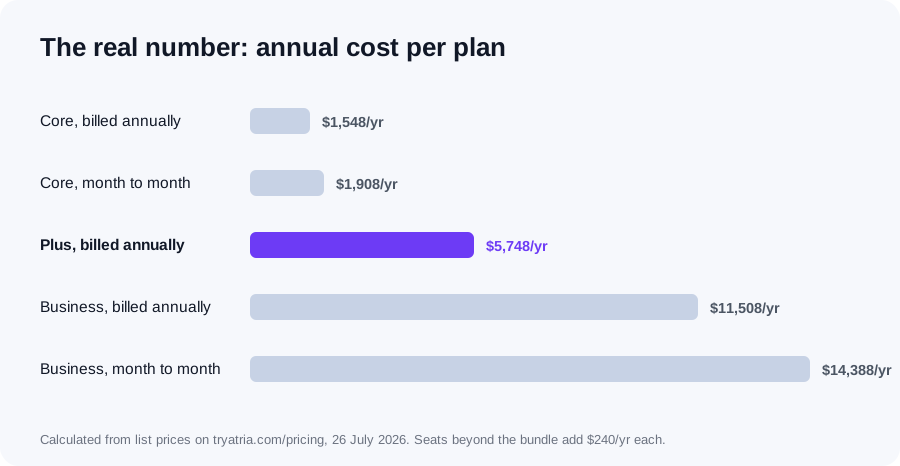
The gap between Core and Plus is the decision point, and it is a 3.7x jump. You cross it for one of three reasons: you passed $500K in monthly spend, you need more than 5 connected ad accounts, or you want AI insights on the brands you follow rather than a plain feed of their ads.
Limits worth knowing before you subscribe
Four things are easy to miss until you are already paying.
- Credits are consumed, not allocated. Generation spends them. A team that leans on image generation will move through 4,000 a month faster than one using Atria mainly for research, and the plan you need is set by your generation habit, not your headcount.
- The $500K spend cap on Core is a real ceiling. A single agency client at $150K a month puts three or four accounts into the same bucket. Agencies tend to land on Plus for this reason alone.
- Meta and TikTok only. There is no Google Ads, Amazon or LinkedIn coverage. If half your spend sits outside Meta, half your spend sits outside Atria.
- The refund position is not published. The pricing page states the prices and the annual discount, and says nothing about refunds. The free plan requires no card, which is the safe way to evaluate; before putting a year on a card, ask support in writing what happens if you cancel in month two.
On reputation: third-party review round-ups in 2026 report a low Trustpilot average for tryatria.com with recurring complaints about billing after trials. Trustpilot blocked direct access when this review was written, so treat that as unconfirmed rather than fact. It is still a good reason to start on the free tier and to get the cancellation terms in an email.
How it compares
Atria's competition splits into two camps, and the choice depends on which half of the workflow you actually need.
Creative research tools (Foreplay, AdSpy and the free Meta Ad Library) are cheaper and stop at the swipe file. If your team already writes and designs well and only lacks inspiration, a $99-a-month swipe tool plus Meta's own library covers you, and Core's extra $30 buys the generation and launch layer you may not use.
Creative analytics tools (Motion, Triple Whale) start from your reporting and work backwards. They answer "which creative made money" more rigorously than Atria does, but they do not write the next ad or launch it. Several agencies run one of these alongside Atria rather than instead of it.
Atria's genuine advantage is the join. Nobody else covers research, generation and bulk launch in one subscription with one set of tags flowing through all three. Its genuine disadvantage is that the join costs Plus money, and each individual piece has a specialist that does it better.
Verdict: who should buy it
Buy it if you are an agency or in-house team shipping creative in volume on Meta and TikTok, with at least three people touching the process, and the bottleneck is production throughput rather than budget. At that shape, Core at $1,548 a year is roughly a fortnight of a junior buyer's salary and it removes the two worst hours of every week. Plus earns its $5,748 once you are past $500K in monthly spend, where a 3% improvement in creative performance is $15,000.
Skip it if you are a solo operator spending under about $20K a month. At that level the free Meta Ad Library plus ChatGPT covers the research and the copy for nothing, and the $500K analysis cap on Core is capacity you are paying for and will never touch. Skip it too if Meta is a minority of your spend, or if what you actually need is attribution, in which case Motion or Triple Whale is the better first purchase.
Start on the free plan. It needs no card, the ad library is the part you can judge quickly, and if the library alone does not change what you would have shipped this week, the paid tiers will not either.
Ready to try Atria?
Visit the official website to see the latest plans, pricing, and special offers.
Get Started - Atria* Affiliate link - we may earn a commission at no extra cost to you.