Brave Browser Review: Still the Easiest Privacy Upgrade in 2026
Brave browser review 2026: how Shields survived Manifest V3, what Brave Search, Leo and the VPN cost, the controversies, and whether it beats Firefox with uBlock Origin.
Expert Review
Why Brave's blocking survived Manifest V3
Google's Manifest V3 extension platform capped what a content blocker running as a Chrome extension is allowed to do: a fixed budget of declarative rules, no arbitrary inspection of network requests. uBlock Origin's author said plainly that the classic extension could not be ported without losing capability, and Chrome users found it disabled.
Brave was unaffected, and the reason is architectural rather than lucky. Brave's blocker is not an extension. It is a Rust engine compiled into the browser, running in the network stack, applying the same filter lists a desktop blocker uses with none of the extension platform's limits. Google can restrict what extensions may do inside Chrome. It cannot restrict what a different browser does inside itself.
That single fact is most of the 2026 argument for Brave. Everything else it ships is optional; the blocking is the product.
What Shields does, and what it breaks
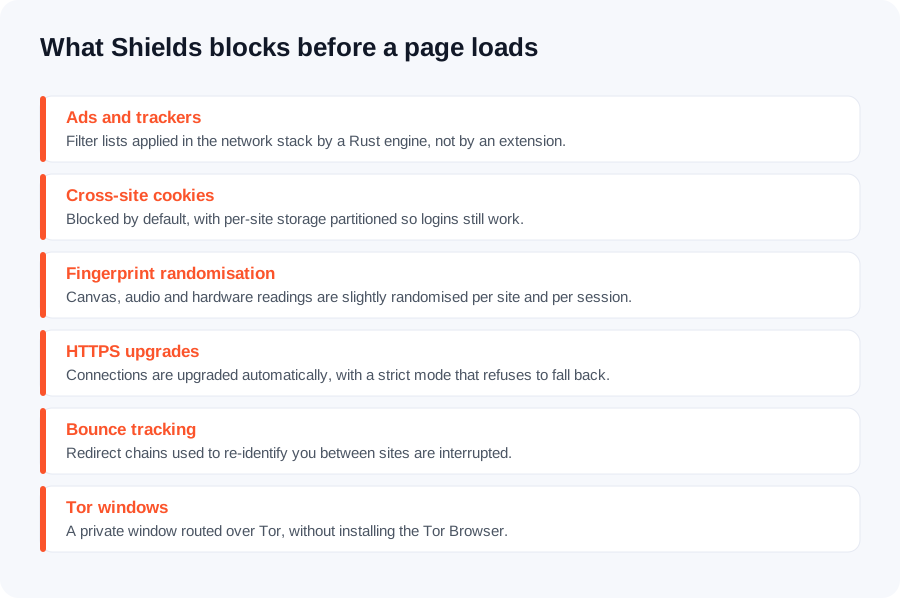
Shields is on by default, which is the part that matters for the people you install browsers for. A fresh Brave install blocks ads, third-party trackers and cross-site cookies with no configuration and no extension store visit. Firefox with uBlock Origin ends up in a similar place, but only after someone does the installing.
Two mechanisms are worth understanding because they are unusual. Fingerprint randomisation does not try to make you look identical to every other user, which is the approach that fails as soon as one API is missed. Instead Brave slightly randomises canvas, audio and hardware readings per site and per session, so the fingerprint a tracker collects is real-looking, stable within the visit, and useless for matching you across sites or days. Bounce tracking protection interrupts the redirect chains advertisers use to re-identify you between domains, which is a technique cookie blocking alone does not stop.
The breakage is real and you should expect it. In practice it shows up in three places: sites that gate content behind an ad-verification script, login flows that bounce through a third-party identity provider, and payment or booking pages that load a widget from another domain. The fix is one click on the lion icon to drop Shields for that site, and the setting is remembered. Anyone recommending Brave to a non-technical relative should show them that icon first, because a site that half-loads with no explanation is how people end up back on Chrome.
Brave Search and the independent index
Brave Search is the default engine and it runs on Brave's own index rather than reselling Bing or Google results. Only a handful of Western search engines can say that, and it is the reason Brave Search can be a genuine alternative rather than a skin.
The index is built partly through the Web Discovery Project, an opt-in scheme in which users contribute anonymised data about pages they visit. That is a real trade to understand rather than a hidden one: it is off unless you turn it on, and it is how a company with a fraction of Google's resources gets fresh coverage of the web at all.
Two features sit on top. Goggles lets you apply a custom ranking filter to your results, for instance demoting content farms or restricting to technical sources, and the rules are shareable. AI answers summarise at the top of the page with citations to the sources used.
Honest limitation: on obscure long-tail queries, local business results and non-English searches, Brave Search still trails Google. It is good enough for most work and it drops the tracking, but if you spend your day doing precise research you will keep a second engine to hand.
Leo, VPN and Rewards: the parts that cost money
Brave is free and Brave's business model is not selling you the browser. Three optional things sit on top of it.
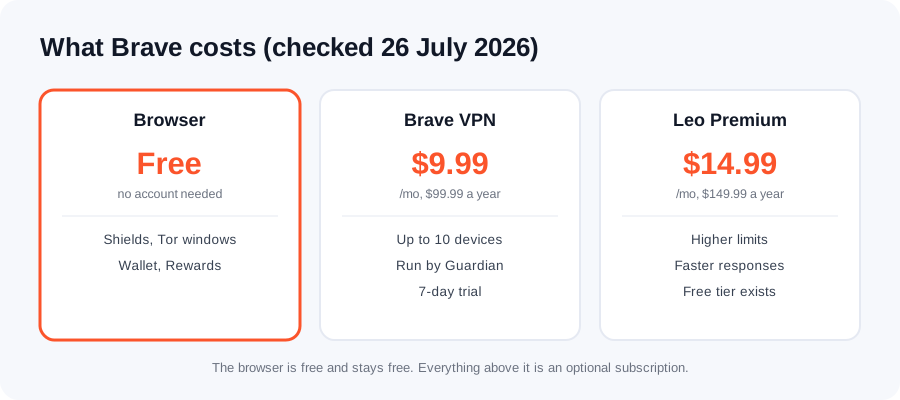
Brave VPN, checked on 26 July 2026, is $9.99 a month or $99.99 a year, covers up to 10 devices, and includes a 7-day trial. The infrastructure is Guardian's, not Brave's own, and the policy states no logging of traffic, DNS requests, connection data, IP addresses or bandwidth. Against dedicated providers that is mid-market pricing: Proton VPN and NordVPN both undercut it on a two-year term and both publish independent no-logs audits, which Brave does not for the VPN. Its advantage is that it is device-wide and one click from a browser you already run.
Leo is the built-in AI assistant, running models from Mixtral, Anthropic and Meta. Brave states that prompts are sent without identifiers that can be linked to you, that no personal data is retained, and that conversations are not used for model training. That is a materially better privacy posture than a logged-in chatbot, and it is the reason to use Leo over a tab full of something else. The free tier has limits that flex with server load; Premium raises them and is listed at $14.99 a month or $149.99 a year as of July 2026, though Brave's Leo page itself sends you to checkout rather than printing the price.
Rewards and BAT remain alive in 2026, with a partner programme that has been publishing monthly updates through July. You opt in to privacy-preserving ads and earn Basic Attention Token, which you can send to creators. Brave's transparency page counts 875,538 verified YouTube creators and 235,640 on X.
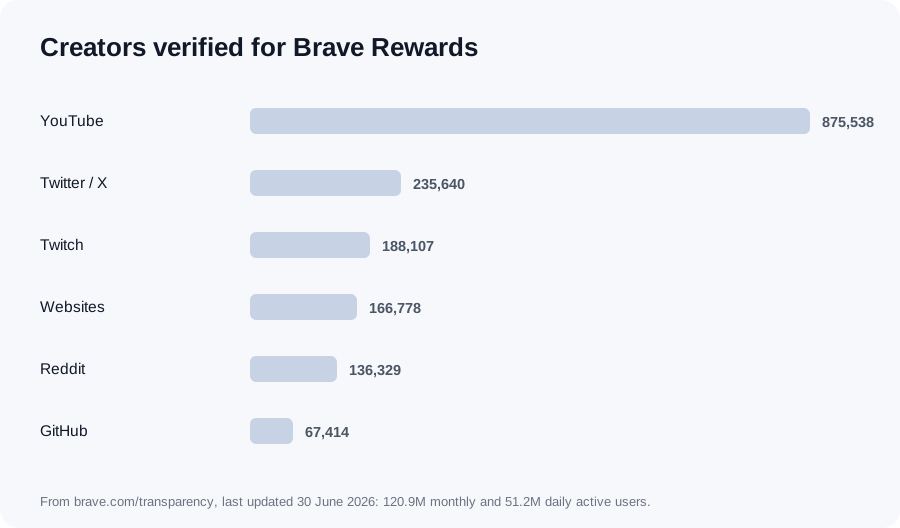
Set expectations on earnings honestly: this is beer money at best, and for most users the reason to leave Rewards switched off is simply that they came here to see fewer ads, not different ones.
The record, including the bad parts
Brave is now large. Its transparency page, last updated 30 June 2026, reports 120.9 million monthly active users and 51.2 million daily, up from around 101 million monthly late in 2025. A privacy tool at that scale deserves the full history, not the marketing version.
- The affiliate URL incident, June 2020. Brave's address bar autocompleted certain crypto exchange domains to versions carrying Brave's affiliate code. Users found it, Brendan Eich called it a mistake, and the behaviour was reverted and made opt-in. It remains the single most-cited reason people distrust the company.
- The Tor window DNS leak, February 2021. Onion addresses visited in Brave's Tor windows were leaked to the configured DNS resolver, defeating the point of the feature. It was patched, and the lesson stands: Brave's Tor window is convenience, not the Tor Browser, and anyone whose safety depends on it should use the real thing.
- Crypto in a privacy browser. Wallet, Rewards and BAT ship with the product. They can be turned off, and a large share of users would rather they were not there at all. Vivaldi's CEO called crypto tokens a pyramid scheme in 2022 in a post widely read as aimed at Brave.
- Chromium. Brave is downstream of Google's engine. It strips the telemetry and the sign-in plumbing, but web standards still move at Google's pace, and the second browser engine that the web needs is Gecko, not another Chromium fork.
Against that: the client is open source and auditable, the blocking claims are independently testable in minutes, and the company has shipped its stated roadmap for a decade rather than being acquired and folded into something else.
Brave against Firefox, Chrome, Vivaldi and Arc
Firefox with uBlock Origin is the only genuine rival on privacy, and it wins on two points: it is not Chromium, so using it supports engine diversity, and uBlock Origin gives you filter control Brave's Shields do not expose. Brave wins on defaults, on fingerprint randomisation, and on the fact that it works out of the box for someone who will never install an extension.
Chrome in 2026 is the browser where the best content blocker no longer runs properly. If ad blocking matters to you, that decision has already been made for you.
Vivaldi is the pick for people who want control instead of blocking: mail client, calendar, feed reader, tab stacking, and a public refusal to ship AI features, restated as recently as its 8.0 release in May 2026. Proton VPN has been built into Vivaldi since March 2025. But its blocker defaults to trackers only rather than ads, and it has no Tor mode.
Arc is off the table for new users. The Browser Company put it into maintenance mode in May 2025 to work on Dia, and Atlassian acquired the company for $610 million later that year. Arc still gets Chromium security patches; it gets no new features, and it is closed source.
Verdict: who should switch
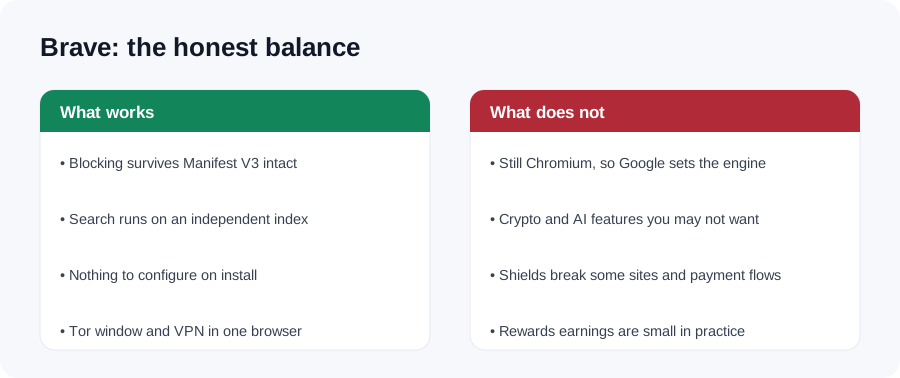
Switch to Brave if you want ad blocking that keeps working regardless of what Google does to the extension platform, and you want it without configuring anything. It is the browser to install on a relative's laptop, on a phone where extensions are not an option, and on any machine where "it should just be private by default" is the requirement. The pages load faster because a third of the page is never fetched, and that is the part people actually notice.
Do not switch if you want to weaken Google's grip on the web, because a Chromium fork does not do that and Firefox does. Do not switch if crypto features in a browser are a dealbreaker, since turning them off is not the same as them not being there. And if your threat model is serious, in the sense that identification would put you at real risk, use the Tor Browser rather than a Tor-flavoured window in a Chromium browser.
For everyone in between, which is most people, Brave remains the shortest distance between a default browser install and a private one. It costs nothing to try, and Shields tells you in the toolbar exactly how much it stopped.
Ready to try Brave?
Visit the official website to see the latest plans, pricing, and special offers.
Get Started - Brave* Affiliate link - we may earn a commission at no extra cost to you.