The 10 Best VPNs of 2026, Ranked: Why PureVPN Wins on Value
The 10 best VPNs of 2026, ranked on price, audited no-logs, speed and streaming. PureVPN leads on value; NordVPN, ExpressVPN, Proton and more follow.
Expert Review

Table of Contents
- How we ranked them
- 1. PureVPN: best value overall
- 2. NordVPN: best all-rounder
- 3. ExpressVPN: easiest to live with
- 4. Surfshark: best for a full household
- 5. Proton VPN: best for privacy purists
- 6. CyberGhost: best for streaming presets
- 7. Private Internet Access: most configurable
- 8. Mullvad: best for anonymity
- 9. Windscribe: best free tier
- 10. IPVanish: best for Fire TV
- The 10 at a glance
- Which one should you pick?
How we ranked them
A VPN roundup that just relists server counts tells you nothing. Every provider here clears 2,000 servers; that stopped being a differentiator years ago. What actually separates a VPN you can trust from one you can't comes down to four questions, and we weighted the list on them.
- Has the no-logs claim been audited, and how recently? A privacy promise nobody outside the company has checked is marketing copy. Six of the ten below have published third-party audits.
- What does it cost on renewal, not just the intro term? The $2/month headline almost always doubles or triples when the multi-year deal lapses. We name the renewal where it bites.
- Does streaming actually work? Netflix and BBC iPlayer play cat-and-mouse with VPN IP ranges, so "works with Netflix" on a sales page means nothing without testing.
- Who owns it, and under which laws? A no-logs VPN in a Five Eyes country is legal but worth knowing about. Three of these are US-based; one is Swiss.
Prices were checked on each provider's pricing page in late July 2026 and move constantly, so treat them as a snapshot. Every entry links to our full review if you want the long version.
1. PureVPN: best value overall
PureVPN wins this list for a plain reason: it delivers the thing you're paying a VPN for, an independently audited no-logs guarantee, at roughly a fifth of what ExpressVPN charges. The two-year plan works out to about $2.15/month billed upfront (the monthly plan is $12.95), and unlike most cheap VPNs the privacy claim isn't self-attested. KPMG has run four audits since 2019, and PureVPN keeps a standing "always-on" arrangement that lets the auditor inspect production servers without warning. That is a stronger commitment than most flagships make.
The network is 6,500+ servers across 70+ countries, with unusually deep coverage in Asia and the Middle East where NordVPN and Proton thin out. It's incorporated in the British Virgin Islands, outside any intelligence-sharing bloc, having left Hong Kong in 2021. Streaming holds up on the big US and UK libraries. WireGuard is supported, so speeds are competitive rather than class-leading.
Where it slips: PureVPN carries a reputational scar from a 2017 case in which it handed logs to the FBI, before the current no-logs architecture and audits existed. The company has rebuilt around that, and the audits are the answer to it, but it's the fair knock against an otherwise excellent-value service. If you want the strongest paper trail on privacy specifically, Proton or Mullvad edge it. For everyone else, this is the most VPN per dollar in 2026. See the head-to-head in our PureVPN vs NordVPN vs ExpressVPN comparison.
2. NordVPN: best all-rounder
NordVPN is the one to buy if you'd rather not think about it. Panama jurisdiction, a Deloitte-audited no-logs policy, and the NordLynx protocol (its WireGuard build) that consistently posts some of the fastest speeds we've measured. The network runs past 9,300 servers in 137 countries, and streaming just works across Netflix, Disney+ and iPlayer.
The catch is the renewal. The two-year deal near $3.09/month is genuinely good; when it lapses, the Basic tier renews around $11.59/month, and the useful extras (Threat Protection, the password manager) sit on pricier Plus and Complete tiers. Buy the long term, set a calendar reminder, and it's the safest default on this list. Read the full NordVPN review.
3. ExpressVPN: easiest to live with
ExpressVPN makes the cleanest apps in the category and runs its Lightway protocol on RAM-only servers that wipe on every reboot. It's based in the British Virgin Islands and, since 2021, owned by Kape Technologies. If ease of use and rock-solid streaming matter more than the bill, it's excellent.
The bill is the problem. Even on an annual plan it lands near $6.67/month (checked July 2026), the priciest on this page, and PureVPN gives you the same audited-no-logs promise for a third of that. Pay the premium only if the polish is worth real money to you. Our ExpressVPN review has the speed numbers.
4. Surfshark: best for a full household
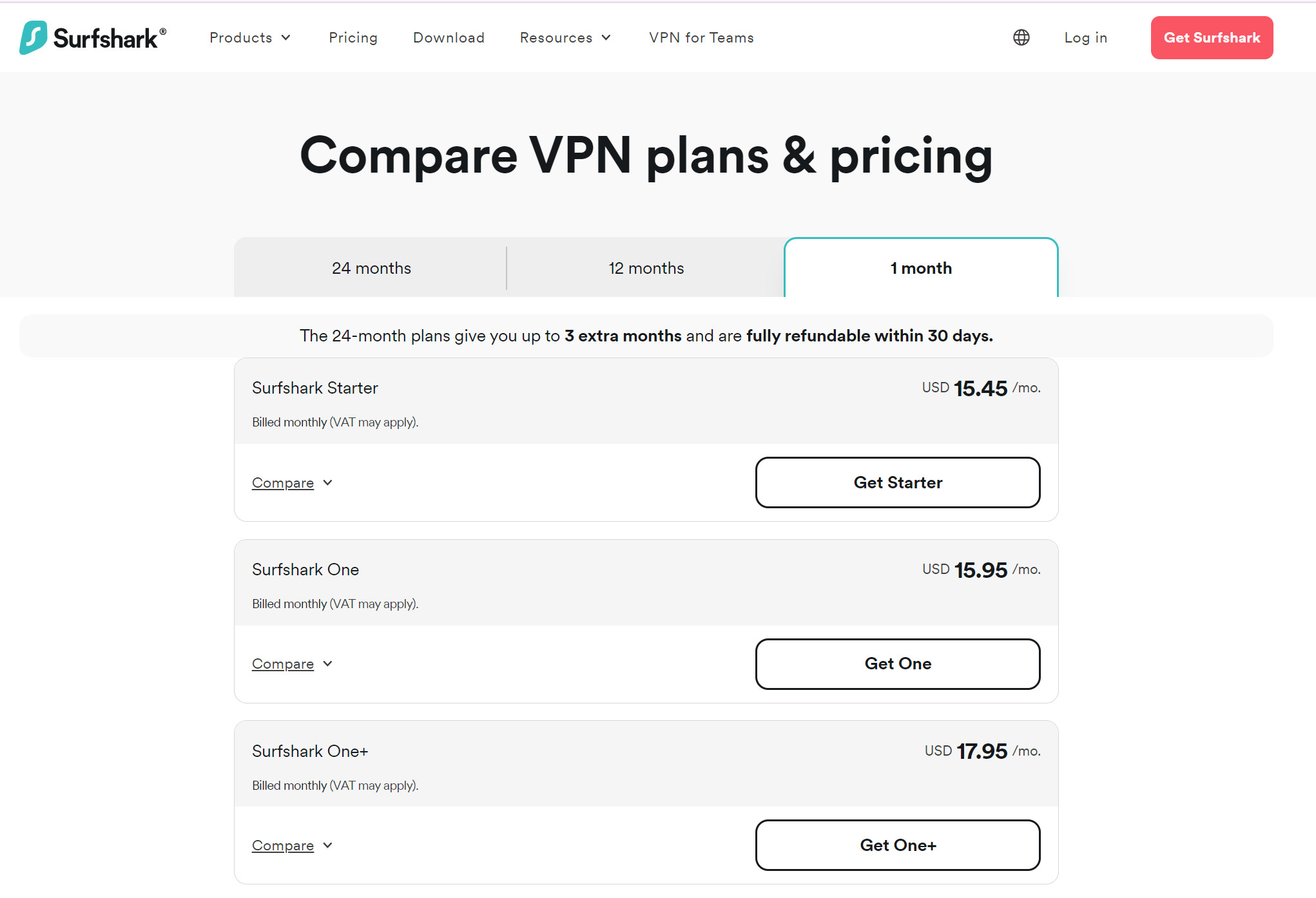
Surfshark's headline feature is unlimited simultaneous connections, so one subscription covers every phone, laptop, TV and tablet in the house. It's based in the Netherlands, merged with Nord Security in 2022, and has a Deloitte no-logs audit behind it. The two-year price near $2.49/month undercuts almost everyone.
Watch the renewal here too: the annual Starter plan renews around $79, so the multi-year lock-in is where the value lives. Speeds trail NordVPN slightly but are fine for 4K streaming. Full write-up in our Surfshark review.
5. Proton VPN: best for privacy purists
If your threat model is serious, Proton VPN is the pick. It's Swiss, its apps are fully open-source and independently audited by Securitum, and Secure Core routes traffic through hardened servers in privacy-friendly countries before it leaves the network. The paid Plus plan runs about $2.99/month on a two-year term, and there's a genuinely usable free tier with no data cap.
It isn't the fastest, and the free plan's server choice is deliberately limited to push upgrades. For anyone who reads audit reports before buying, none of that matters. See the Proton VPN review.
6. CyberGhost: best for streaming presets
CyberGhost runs the biggest network here, past 11,000 servers, and labels specific servers for specific streaming services, so beginners don't have to guess which US endpoint unblocks Hulu tonight. It's Romanian, owned by Kape (the ExpressVPN parent), and its 45-day money-back window is the most generous on the list.
The trade-off is the standard Kape one: a low multi-year intro that renews steeply, and a US-adjacent ownership structure some privacy buyers avoid. For plug-and-play streaming it's hard to beat. Details in the CyberGhost review.
7. Private Internet Access: most configurable
Private Internet Access gives you more knobs than anything else here: encryption strength, protocol, port, MACE ad-blocking, split tunnelling, all exposed in open-source apps. Its no-logs claim has been tested the hard way, in US court, and held. Pricing drops to roughly $2.19/month on the three-year plan with unlimited devices.
The asterisk is jurisdiction. PIA is US-based (Five Eyes) and owned by Kape. There's no evidence that has ever compromised a user, and the court record is reassuring, but a purist will still prefer Switzerland or Sweden. We cover it in our PIA vs Windscribe vs Mullvad vs IPVanish comparison.
8. Mullvad: best for anonymity
Mullvad does one thing better than anyone: it doesn't want to know who you are. No email to sign up, just a randomly generated account number, and you can post cash in an envelope to pay. It's Swedish, run by Amagicom, audited by Cure53, and charges a flat €5/month with no discount tiers and no upsells.
That principled simplicity is also its limit. Mullvad barely bothers with streaming and won't reliably unblock Netflix, so it's the wrong tool if that's your goal. As a pure privacy instrument it's the best on the list. It shares our four-way privacy comparison.
9. Windscribe: best free tier
Windscribe gives away 10GB a month free, enough to actually rely on, and its paid Build-a-Plan lets you pay $1 per month per server location instead of one flat fee. If you only ever need a US and a UK exit, you can build a plan cheaper than any full subscription here.
It's Canadian (also Five Eyes) and its audit history is thinner than Proton's or Mullvad's. But for a free or ultra-cheap tailored plan, nothing else is this flexible. See how it fares in the comparison.
10. IPVanish: best for Fire TV
IPVanish earns its spot on hardware support. Its Amazon Fire TV Stick app is one of the few built for a remote rather than shoehorned onto one, and it allows unlimited simultaneous connections. Speeds are solid and it's a fine all-purpose VPN.
It's US-owned and its network is smaller than the leaders, and its privacy record isn't as decorated as the top of this list, so it's a value-and-convenience pick rather than a privacy-first one. The full context is in our four-VPN comparison.
The 10 at a glance
| VPN | Best for | Jurisdiction | Audited no-logs | From (2-yr) |
|---|---|---|---|---|
| PureVPN | Value overall | British Virgin Islands | Yes (KPMG, ongoing) | ~$2.15/mo |
| NordVPN | All-rounder | Panama | Yes (Deloitte) | ~$3.09/mo |
| ExpressVPN | Ease of use | British Virgin Islands | Yes | ~$6.67/mo |
| Surfshark | Unlimited devices | Netherlands | Yes (Deloitte) | ~$2.49/mo |
| Proton VPN | Privacy purists | Switzerland | Yes (Securitum) | ~$2.99/mo |
| CyberGhost | Streaming presets | Romania | Yes | Low intro, high renewal |
| Private Internet Access | Configuration | United States | Court-tested | ~$2.19/mo (3-yr) |
| Mullvad | Anonymity | Sweden | Yes (Cure53) | Flat €5/mo |
| Windscribe | Free tier | Canada | Partial | Free / $1 per location |
| IPVanish | Fire TV | United States | Limited | Value pick |
One VPN didn't make the numbered list but deserves a mention: if you specifically need to stay connected inside mainland China, read our guide to the best VPN for travel through China, where the usual names get blocked and obfuscation matters more than speed. Only after a free plan? Start with our best free VPN roundup instead.
Which one should you pick?
Most people should stop reading and buy PureVPN. It's the cheapest way to get an independently audited no-logs VPN that streams well and covers regions its rivals ignore, and the two-year price is a rounding error next to ExpressVPN. The 2017 logging case is a real part of its history, and the audits since are the reason it now sits at the top.
Buy something else in three cases. If you want the fastest, most fire-and-forget experience and don't mind paying mid-range, get NordVPN. If your privacy needs are genuinely adversarial, journalist, activist, or you just refuse to trust a company that can't prove anything, choose Proton VPN for the open-source audits or Mullvad for anonymous, email-free sign-up. And if one subscription has to cover a large household of devices, Surfshark's unlimited connections make it the cheapest per person.
Ready to try PureVPN?
Visit the official website to see the latest plans, pricing, and special offers.
Get Started — PureVPN* Affiliate link — we may earn a commission at no extra cost to you.