Dixa Review: €0.40 AI Conversations, Native Voice and a Contract You Can't Shrink
Dixa review: €49 and €139 per agent seats, Mim AI at €0.40 per conversation, native voice routing, EU data hosting, and the 12-month contract terms the pricing page leaves out.
Expert Review

The €0.40 meter, and what it really buys
Dixa's pricing page leads with one number: Mim, its AI agent, costs a flat €0.40 per AI conversation. No per-seat fee for the bot, no monthly allowance to burn through, and no tier gate - Mim on chat, email, social and SMS is included from the cheapest plan up. Next to the outcome-based meters the site has just reviewed, that looks cheap.

The catch sits in the wording. Dixa says it "bills €0.40 per AI conversation, whether Mim resolves it or hands it to your team." That is a conversation meter, not a resolution meter. Dixa puts Mim's median resolution rate at 62%, with the top 10% of customers reaching 87%. Run the median through the price and each conversation Mim actually closes costs you about €0.65 (our arithmetic: 0.40 / 0.62). The other 38% are billed and still land in an agent's queue.
That is still a low number. Dixa's own calculator quotes Intercom's Fin at $0.99 per resolution and Zendesk at €1.50 per automated resolution - though the FAQ on the same page puts Zendesk at "$1.50 to $2.00 each", so treat both as Dixa's claims about rivals rather than verified prices. Our Fin review and Kustomer review have the competitors' own figures. The practical difference: on a resolution meter a bad week for the bot costs you less, while on Dixa's meter a bad week costs exactly the same as a good one.
Voice is the exception to "flat". Mim on phone calls is in beta, billed per conversation "with call minutes at standard telephony rates" (a line Dixa updated in November 2026), and no per-minute telephony rate is published. On the phone Mim speaks 16 languages; on chat and email it detects the customer's language and replies in it.
Seats and add-ons
All prices below were checked on dixa.com/pricing in November 2026. They are in euros, and only annual billing is published - there is no monthly price on the page at all.
| Plan | Price | What it adds |
|---|---|---|
| Team | €49 per agent/month, billed annually | Every channel (phone, email, forms, chat, social), knowledge base, Mim AI agent, intelligent routing, call recording and voicemail, Shopify and Klaviyo plus "+35 integrations" |
| Professional | €139 per agent/month, billed annually | IVR, customer callback, SLA alerts, skills-based routing, routing on external data, intent detection, advanced automations, sandbox, third-party AI agents |
| Enterprise | Contact sales | SSO, custom roles, auto redaction, multiple organisations, Advanced Insights included, enterprise API limits |
The add-ons are where the bill grows. Copilot, the agent-assist add-on, is €39 per agent/month. Advanced Insights is €29 per agent/month below Enterprise. Automated QA scoring costs €0.10 per review, voice transcription €0.012 per minute, and proactive WhatsApp messages are billed per message by country.
Put it together for a 20-agent team on Professional with Copilot handling 5,000 Mim conversations a month: €2,780 in seats, €780 for Copilot and €2,000 for Mim, so about €5,560 a month, or roughly €66,700 a year before telephony. The jump from Team to Professional is €90 per seat, and it is the jump most voice teams will have to make, because IVR and callback live on Professional.
One routing engine for the phone and everything else
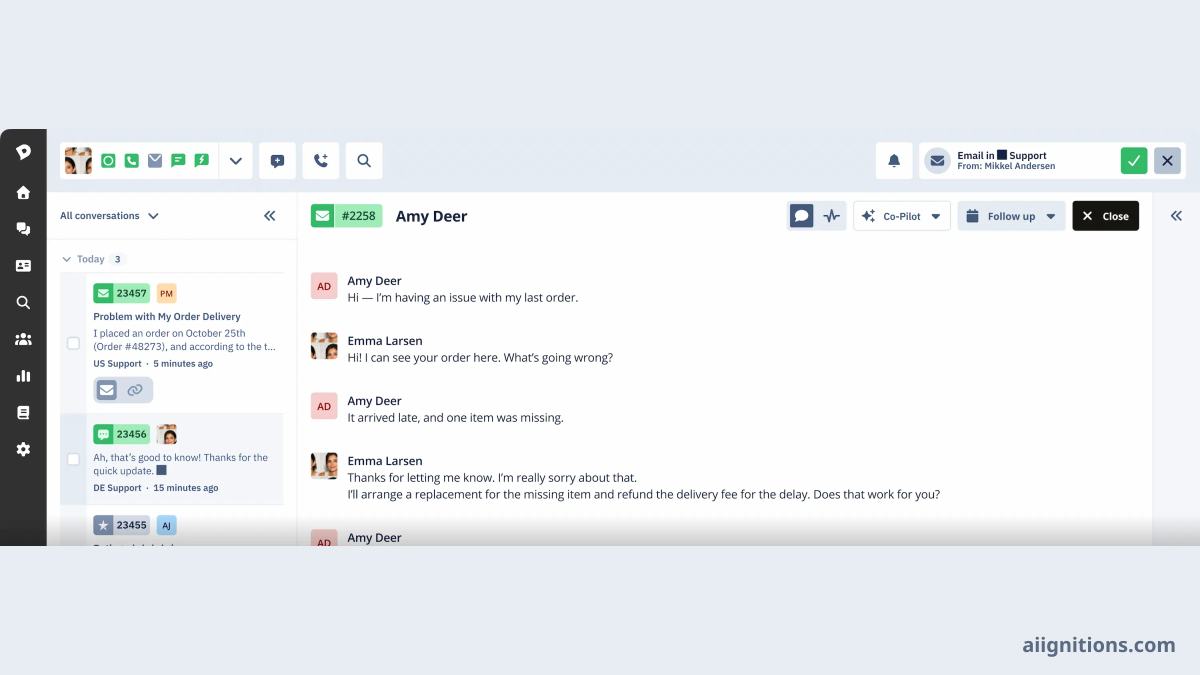
The reason to look at Dixa over a cheaper helpdesk is the phone. Voice is native on every plan, so there is no third-party telephony to bolt on and no second routing system to keep in sync. Every plan carries phone, email, live chat, WhatsApp, Instagram, Messenger and SMS.
Dixa's routing assigns each incoming conversation to the best-matched agent by skill, language, priority or any rule you set, and in Dixa's words "the same routing logic applies to phone, email, chat, WhatsApp, and social." For a team where the same agent picks up a call at 10:00 and a WhatsApp thread at 10:05, that is the product. Basic routing is on Team; skills-based routing needs Professional.
The customer list fits the pitch: Dixa says it serves 850+ brands across 42 countries, including NET-A-PORTER, Rapha, Mytheresa and Naked Wines. The company was founded in Copenhagen in 2015, is run by CEO Christian Lohmann, and says it has raised over $158M, including a $105M Series C led by General Atlantic in 2021. Integrations lean the same way - Shopify, Magento, WooCommerce, Klaviyo and Braze sit alongside Salesforce, HubSpot and Dynamics 365.
The contract is the real price
None of what follows is on the pricing page. It is in the terms of service (last updated 28 May 2025), and it matters more than any per-seat figure.
Subscriptions "will continuously renew for additional successive 12-month periods". To stop that, you must send written notice "no less than 3 months prior to the expiration" - miss the window by a day and you have bought another year. Clause 1.23 is the sharper one: "The Minimum Commitment forms the baseline for billing, and may not be reduced during the Subscription Term, regardless of actual usage." If you sign for 30 seats and shrink to 18 after peak season, you pay for 30. Dixa sells seasonal agents as an add-on, which is the honest way around this; size the base commitment for your quiet months.
There is no free trial. Dixa's FAQ says every rollout is guided, with a success manager and most teams live in 2-4 weeks, and no seat minimum is published - "the right starting point is a conversation with Dixa's team". Leaving is just as hands-on. The ToS lists help "with importing and exporting data" as a paid consultancy service, says you must "immediately cease all use" on termination, and states no window for exporting afterwards. There is an open API at docs.dixa.io, so plan the export yourself before the notice goes in.
Support targets come from an SLA page dated 3 April 2018: a 5-minute response for critical issues by phone and chat, one business hour for high, two for medium, one business day for low, during 8:00-17:00 local time with critical cover 24x7. Uptime credits are 5% below 99.9% and 10% below 99.0%. The targets are fine. They are also eight years old - ask whether they still hold.
Where the data and the model live
This part is a strength for EU buyers. Dixa stores data on AWS in Ireland with backups elsewhere in Europe, says AI processing runs inside the EU, and states that customer data "is never used to train AI models, for Mim or any other Dixa AI feature." AI sub-processors are modular, so you can opt out of one without losing the platform, and Mim is inside the SOC 2 Type II scope Dixa announced in February 2024. We found no ISO 27001 certificate.
Which model is underneath is not disclosed. The December 2023 launch release credited "OpenAI's GPT language model"; the current Mim page names nothing, so assume it can change without notice. For GDPR erasure, Dixa anonymises rather than deletes; done through the API, that strips the user object and every conversation, message and attachment the person sent.
What users complain about
G2 rates Dixa 4.2 out of 5 from 391 reviews, and its most-tagged cons are "Missing Features" and "Limited Features": analytics that stop short, chat glitches, tags you cannot edit and contacts you cannot merge. Capterra shows 4.3 from 20 reviews. These figures came from search listings, as both sites blocked direct access.
Trustpilot is a small sample - 15 reviews, 3.9 overall - but it is split almost in half, 40% five-star and 46% one-star. The one-star reviews repeat two things: slow vendor support ("their own customer service is amongst the worst", June 2026) and the lock-in ("still enforces a one-year binding contract along with a three-month notice period", May 2025). A support platform with complaints about its own support is not proof of much at 15 reviews. It is enough to ask for two reference customers your size.
Verdict: who should buy Dixa
Buy Dixa if you run a mid-market e-commerce support team, roughly 20 agents or more, in Europe, with real phone volume. Native voice, one routing engine across every channel, EU-hosted AI and a predictable €0.40 AI meter make it a tidier stack than a helpdesk plus a separate phone system, and at a 62% resolution rate Mim works out cheaper per resolved conversation than the rival prices Dixa quotes.
Skip it if you are a small team, want to try before you sign, or need to pay month to month. No trial, annual-only prices and a commitment you cannot reduce for 12 months are the wrong shape for that buyer; Help Scout or Freshdesk will let you start this afternoon. A Shopify-first shop that wants to pay per ticket rather than per seat should read our Gorgias review first, and a team that would rather pay only when the bot succeeds should look at Gladly or Fin.
If Dixa is on your shortlist, negotiate the minimum commitment down and the seasonal seats up, and diary the renewal date minus three months on the day you sign.
Ready to try Dixa?
Visit the official website to see the latest plans, pricing, and special offers.
Get Started - Dixa* Affiliate link - we may earn a commission at no extra cost to you.