GrapheneOS Confirms Motorola Signature 27 as Its First Non-Pixel Phone
GrapheneOS confirmed Motorola's Signature 27 as its first supported non-Pixel phone, with preinstalled units planned. What it changes, what the hardware needs and what is still unknown.
News Report

What GrapheneOS confirmed
For its whole life, GrapheneOS has been a Pixel-only project. That changed on September 24, 2026, two days after Motorola unveiled the Signature 27 at Qualcomm's Snapdragon Summit in Hawaii. Asked on X whether the new phone was the device its Motorola partnership had been building toward, the GrapheneOS account replied: "Yes, that will be the initial supported phone. Wait for official news." Android Authority was first to report the exchange.
A second post went further. According to 9to5Google and Android Police, the project said devices sold with GrapheneOS preinstalled are planned, but it could not share details or timing.
So this is a confirmation in replies, not a launch. Neither Motorola nor GrapheneOS has published a formal announcement, and "wait for official news" is the project telling people exactly that.
Why a second phone maker matters
GrapheneOS is the best-known hardened build of Android: an open-source OS built on AOSP, first released in 2016 and run today by the non-profit GrapheneOS Foundation in Toronto. Its reputation rests on a hardened memory allocator, aggressive use of hardware memory tagging and a sandboxed version of Google Play that runs as an ordinary app with no system privileges. Journalists, security researchers and privacy-minded buyers use it. Until now, every one of them had to buy a phone from Google to do so.
The supported-device list as of September 28, 2026 still reads Pixel 6 through the Pixel 10 series, plus the Pixel Fold, Pixel Tablet and Pixel 10 Pro Fold. That dependence was a real risk. If Google changed how it ships Pixel firmware or source code, the whole project had nowhere else to go. A second vendor that is actively cooperating, rather than merely tolerating unlocked bootloaders, removes that single point of failure.
For organisations the preinstalled plan is the bigger change. Flashing an OS is a hobbyist step that no fleet manager wants to repeat across 500 phones. A Motorola SKU that arrives with GrapheneOS on it, from a Lenovo company that already sells ThinkShield security tooling to businesses, is something a procurement team can actually order.
Why it starts with a flagship
The partnership itself is not new. Motorola and the GrapheneOS Foundation announced it at MWC in early March 2026, pitching joint research, software enhancements and new security capabilities alongside Lenovo's ThinkShield. At the time, GrapheneOS said the first phones would arrive in 2027 and would be flagships such as the Signature, Razr Fold and Razr Ultra, because only those would meet its requirements. The Signature 27 fits that plan. Motorola's new naming scheme takes the last two digits of the coming year, which is why a phone shipping this November already counts as a 2027 device.
The requirements are strict. GrapheneOS asks any device for hardware memory tagging (ARM MTE or equivalent), hardware-accelerated virtualization, verified boot with rollback protection, a StrongBox keystore backed by a secure element, inline disk encryption, isolated radios, Wi-Fi anonymity support and a supported GKI kernel (Linux 6.1, 6.6 or 6.12). Most mid-range Android phones miss at least one of those.
Update length is the other filter. GrapheneOS told Android Police that the latest Snapdragon flagships have the best security features, and that going below flagships would need Motorola to pay Qualcomm for longer update support on cheaper chips. In plain terms: a GrapheneOS Motorola for $400 is not on the table until someone funds the firmware.
The Signature 27 itself
The phone is the first to use Qualcomm's Snapdragon 8 Elite Extreme Gen 6, built on TSMC's 2nm process and reported to be about 13% faster than the Snapdragon 8 Elite Gen 5, per Engadget and Android Police. Motorola promises seven Android OS upgrades and seven years of security updates, and it ships with Android 17. That support window is exactly what GrapheneOS needs from a partner.
The rest of what Motorola has confirmed, per Android Authority:
- a 50MP Sony LYTIA 910 main camera (1/1.28-inch) and a 200MP periscope telephoto with up to 100x Super Zoom
- ArcticMesh cooling with diamond-infused thermal gel, liquid metal, copper mesh and a 3D vapor chamber 40% larger than the last generation
- audio tuned by Bang & Olufsen, a first for a Motorola phone
- an aluminum body in Pantone Coal Smoke (a woven "Tactical Weave" finish) or Pantone Capulet Olive (brushed)
Motorola's US product page says only "Stay tuned for more, coming this November." Display, battery, charging and memory specs circulating online are leaks, not announcements.
What is still unknown
Three things decide whether this matters to a buyer, and none is public yet. Price is unannounced; the previous Signature ran roughly $800 to $1,200 depending on configuration. GrapheneOS has given no date for its first Signature 27 release. And nobody has said whether the first builds will be user-installed on a retail unit or ship preinstalled, or whether the preinstalled version will be sold in the US at launch.
GrapheneOS also expects support to follow on the 2027 Razr Fold and Razr Ultra, so the Signature 27 is meant as the first of a line rather than a one-off.
What to do if you want GrapheneOS now
If you need a hardened phone today, nothing here changes the answer: buy a supported Pixel and install GrapheneOS on it. A Pixel 10 is supported now, with years of updates left, and it will not be obsolete when the Motorola arrives.
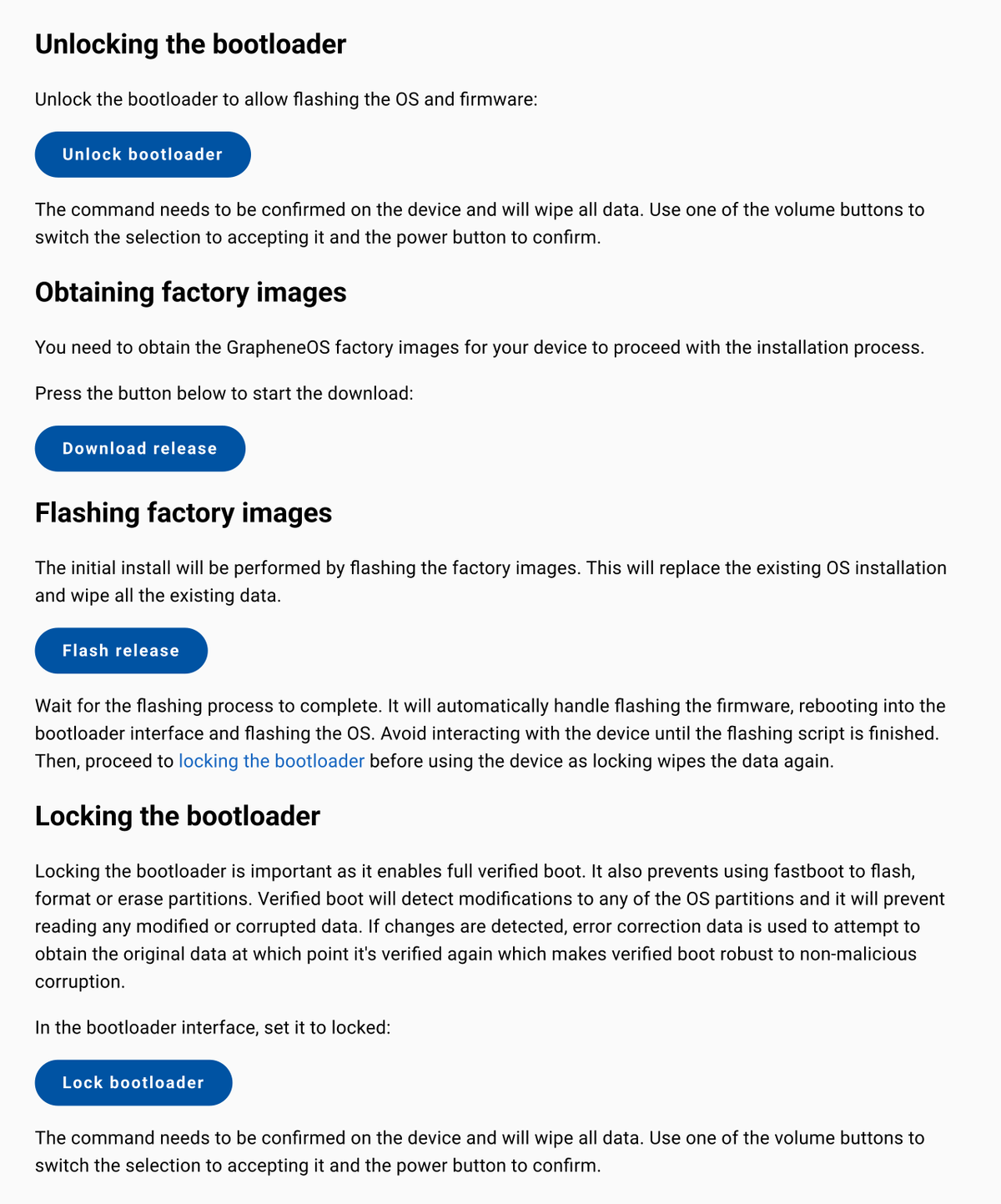
If you are replacing a fleet, or you have avoided GrapheneOS only because it meant buying Google hardware, wait for the formal announcement. The questions to put to it are the price of the preinstalled SKU, whether bootloader relocking works the way it does on Pixels, and how quickly GrapheneOS ships its monthly security patches on Motorola firmware compared with the Pixel line. Those answers, not the camera, will decide whether the Signature 27 is a real alternative or a proof of concept.