Runable Review 2026: One AI Agent That Replaces Your Whole Tool Stack?
A hands-on Runable review for 2026: what the AI general agent builds, real pricing and credit limits checked in August 2026, how it compares to Manus and Lovable, and who should skip it.
Expert Review

What Runable actually does
Most AI tools are good at one job. A chatbot answers questions, an app builder ships a landing page, a video tool cuts a clip. Runable is built on the opposite bet: type one instruction and a single agent plans the task, opens the apps it needs, and hands back a finished website, slide deck, video, spreadsheet or research report.
The company launched the product in April 2025 and now claims more than 1.5 million users (figure from runable.com, checked August 2026). On its own benchmark table it reports 92.1% on GAIA, the reasoning-and-tool-use test that trips up most agents, alongside scores on BrowserComp and SlidesBench. Benchmarks are marketing, so treat them as a starting point rather than proof.
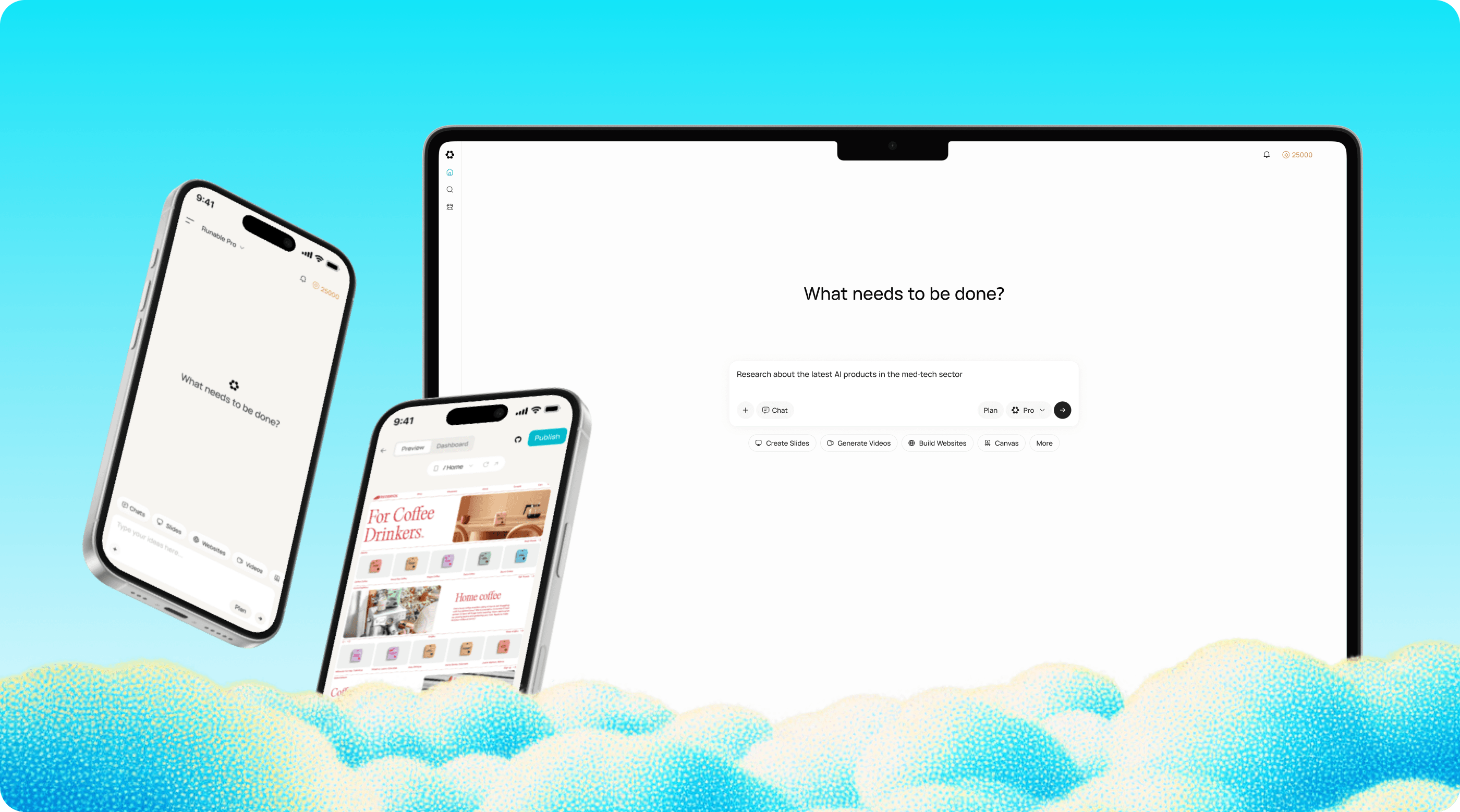
What you meet on the first screen is a plain box that asks "What needs to be done?" with shortcut chips for Create Slides, Generate Videos, Build Websites and Canvas. That framing is the whole pitch. You describe an outcome, not a workflow.
Plan Mode and the virtual computer
Two things separate Runable from a chat window. The first is a virtual computer the agent controls in the background: it can navigate a browser, fill forms, pull data off a page and assemble files, rather than only generating text. The second is Plan Mode. Before it runs anything, Runable writes out the steps it intends to take and waits for you to approve them. You can edit a step or stop the run before it burns through your budget.
That approval gate matters more than it sounds, because an agent that acts on its own is an agent that can waste an hour going down the wrong path. Seeing the plan first is the difference between supervising a junior and finding out later what they did.
Runable also runs outside its own app. Through its RunClaw integration it can take tasks inside Slack, Discord and Telegram, and there are native apps for iPhone, Android and Mac. Kicking off a "research the latest med-tech launches and draft a summary" job from a phone and reading the result an hour later is a genuinely useful pattern.

Pricing and the credit catch
Pricing, checked on runable.com in August 2026:
- Free: $0, with 1,500 daily credits. Enough to test the tool and finish small tasks.
- Pro: $20/month, or $15/month billed yearly. Adds a 25,000 monthly credit pool on top of the daily allowance.
- Max: $100/month, or $75/month billed yearly, with 150,000 monthly credits.
The headline number is fair. $15 a month for something that can draft a deck and build a site undercuts paying for a chat tool, an app builder and a video generator separately, which is exactly the comparison Runable puts on its homepage.
The catch is the word "credits." Every operation spends them, and the cost depends on the model tier, image resolution, video length, audio, and how much upscaling you ask for. A short text task is cheap. Render a minute of video and you can watch a day's credits vanish. The site never tells you, in advance, how many credits a given job will cost, so budgeting is guesswork until you have run a few real tasks. That opacity is the single thing I would want fixed before relying on it for deadline work.

How it compares to Manus and Lovable
Runable is not the only "general agent." Manus covers similar ground, and for pure app building Lovable is the tool people reach for. The honest way to place Runable is by what you lose if you pick it over a specialist.
- Versus Lovable: Lovable is sharper at turning a prompt into a real, editable web app with clean code you can export and keep building on. Runable will build a site too, but it treats that as one of a dozen tasks, so the output is closer to a polished draft than a codebase you own.
- Versus Manus: both are agent-first. Runable's advantage is breadth and the low $15 entry price; Manus has a longer track record with complex multi-step research. If autonomous research is your main use case, try both on the same task before committing.
- Versus ChatGPT or Claude: a chat assistant is still better for back-and-forth thinking and writing. Runable wins when you want a finished artifact, not a conversation.

Where Runable struggles
The jack-of-all-trades design is also the weakness. A tool that does ten things does none of them as deeply as the best single-purpose app. Slides come out clean but generic. Generated video is fine for a social clip, not a client deliverable. The website builder is quick but you will not get the fine control a Webflow or Framer user expects.
Quality also swings with the prompt. Vague instructions produce vague output, and because credits are spent on every attempt, iterating to get it right has a running meter attached. Combine that with the unpredictable credit cost and the practical advice is simple: keep tasks concrete, and check the Plan Mode step list before you hit run.
Who should use it (and who should not)
Runable is worth the free tier for anyone who juggles several AI subscriptions and wants one place to knock out a first draft: a founder building a quick pitch site, a marketer spinning up a deck and a promo clip, a solo operator who would rather delegate a task from Slack than open five tabs. At $15 a month on the yearly plan, Pro pays for itself if it replaces even two of your current tools.
Skip it if you need one job done to a high standard. For a production web app you will own and extend, use Lovable; for deep autonomous research, weigh Manus; for daily writing and thinking, a dedicated assistant like ChatGPT or Claude still reads better. And if predictable, fixed monthly cost matters more than flexibility, the credit model will frustrate you. Try the free plan first, run three real tasks, and watch how fast the credits move before you upgrade.
Ready to try Runable?
Visit the official website to see the latest plans, pricing, and special offers.
Get Started — Runable* Affiliate link — we may earn a commission at no extra cost to you.