Sudowrite Review: What $10, $22 and $44 a Month Actually Buy a Novelist
Sudowrite review, checked October 2026: $10/$22/$44 plans, why Professional now gives 450,000 credits, what eats credits, Story Bible, Muse, export limits and when NovelCrafter is the better buy.
Expert Review

What Sudowrite is now
Sudowrite started in 2020 as a button that wrote the next paragraph of your story. Checked for this review in October 2026, it is a fiction workspace sitting on top of a credit meter. You plan in a Story Bible, generate chapters with Draft, polish with Rewrite, Describe and Expand, and pay for each in credits priced by the AI model you picked.
That matters more than any feature. Sudowrite runs two in-house fiction models, Muse 1.5 and Ballad 1.1, plus 30+ third-party models. Its help page gives the spread: the same 200-word Write used "only about 70 credits" on GPT-5 Nano and "over 8,000 credits" on Claude 4.1 Opus. So a credit allowance is not a word count. It is a budget, and the model dropdown decides how fast it goes.
Pricing and what each plan buys
Every plan gets the full writing toolkit and every model. The differences are credits, Feedback and rollover.
| Plan | Billed annually | Billed monthly | Credits per month | What else |
|---|---|---|---|---|
| Hobby & Student | $10/mo | $19/mo | 225,000 | Unused credits expire monthly |
| Professional | $22/mo | $29/mo | 450,000 (docs still say 1,000,000) | Adds Feedback; credits expire monthly |
| Max | $44/mo | $59/mo | 2,000,000 | Adds Feedback; credits roll over for 12 months |
Two caveats. The headline $10, $22 and $44 are annual-billing prices; the monthly figures come from Sudowrite's January 2026 help docs, since the pricing page renders them in the browser. And the Professional allowance has moved: in October 2026 the pricing page shows 450,000 credits next to a struck-through 1,000,000, while the January help docs still promise 1,000,000. Plan on 450,000. That is a cut of more than half on the plan Sudowrite itself pitches "for longer works, like a novel or screenplay".
Feedback - developmental edits, line edits and beta reads - is Professional and Max only. On the two cheaper plans unused credits vanish at each monthly refresh. Top-up credits never expire, but their price is unpublished, and the Terms say credits "regardless of provenance, can only be used with an active subscription". Cancel, and your banked top-ups are frozen until you pay again.
The free trial needs no credit card; its credits and length are not published. Refunds are murky: a help article offers to cancel and refund if you ask "within the first 7 days", while the Terms (updated April 2025) say "we do not refund fees on cancellation". If you buy annual, ask inside that first week and keep the email.
What actually eats credits
Sudowrite admits "there's no way to predict how many credits features will use". Its docs put the old 1,000,000 credits at 50,000 to 500,000 AI words a month. Scaled to today's 450,000, that is roughly 22,000 to 225,000 words - a tenfold range set mostly by model choice.
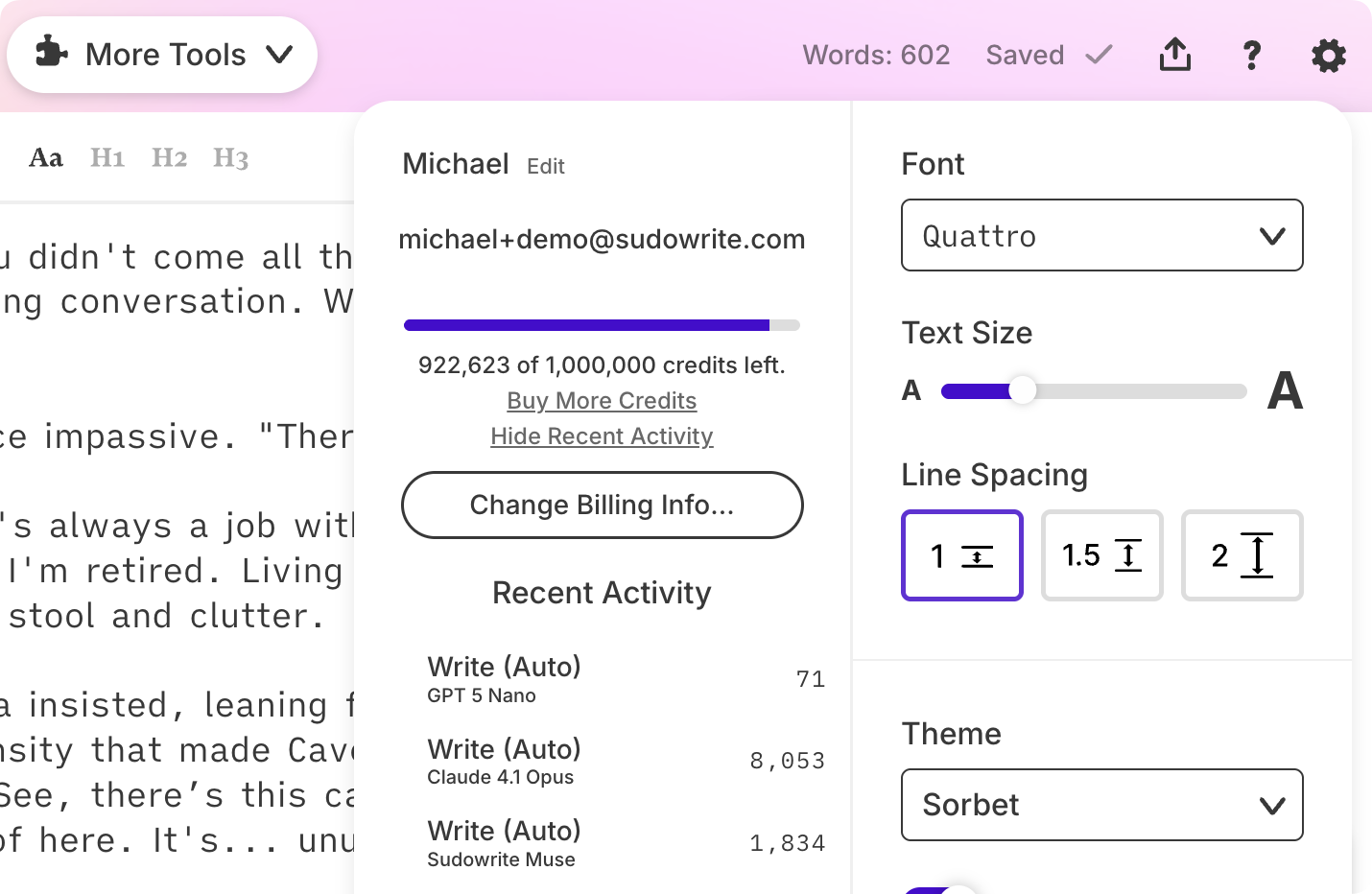
In that screenshot from Sudowrite's own docs, the same Write on Muse lands in between at 1,834 credits - about 26 times GPT-5 Nano, and under a quarter of Opus.
A few prices are fixed. Visualize costs 2,500 credits per 1024x1024 image. Character Portraits (added September 25, 2026) and Worldbuilding Images (added October 7) cost 5,000 credits each, and generating one character in all four portrait styles at once costs 20,000. On the Hobby plan that is close to a tenth of the month spent on one person's pictures.
Chat in chat-only mode "is effectively unlimited, and doesn't use any credits", and default Quick Edit is free; their High Quality modes charge. Draft, which writes a 3,000-5,000+ word chapter, shows an estimate first and since August 14, 2026 "won't charge you more than its estimate" - the most useful change of the year for small plans.
Story Bible: the reason to pay
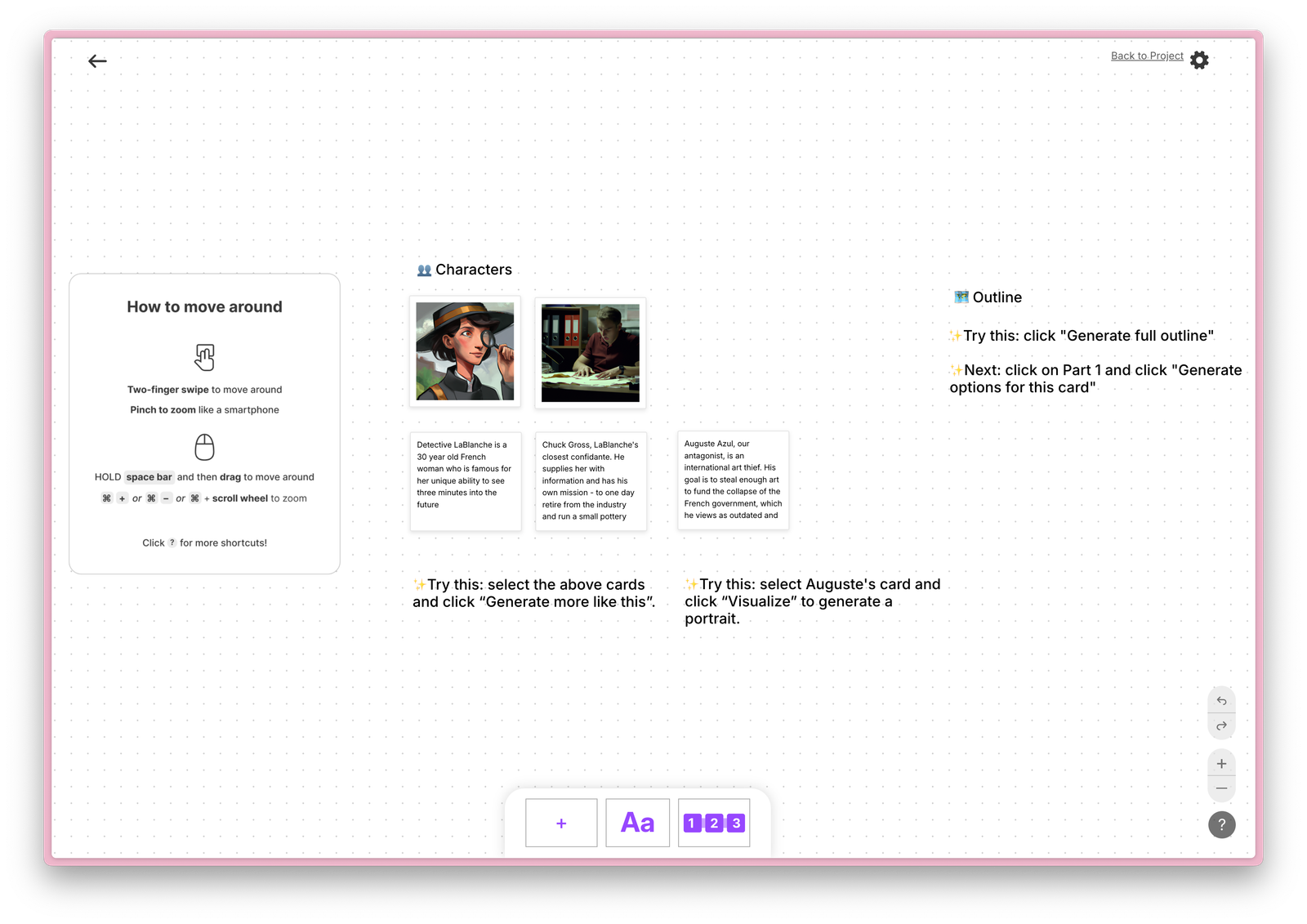
The Story Bible is where Sudowrite beats a general chatbot. You fill in genre, style, synopsis, characters, worldbuilding and outline, and the Saliency Engine sends only the cards relevant to the current scene. Cards or single traits can be hidden from the AI. Write reads up to 20,000 words before the cursor plus up to 20,000 words from linked chapters, chained across as many as 25 documents. That is how a minor character's eye colour stays straight in chapter 19, and Series Support carries the bible across books.
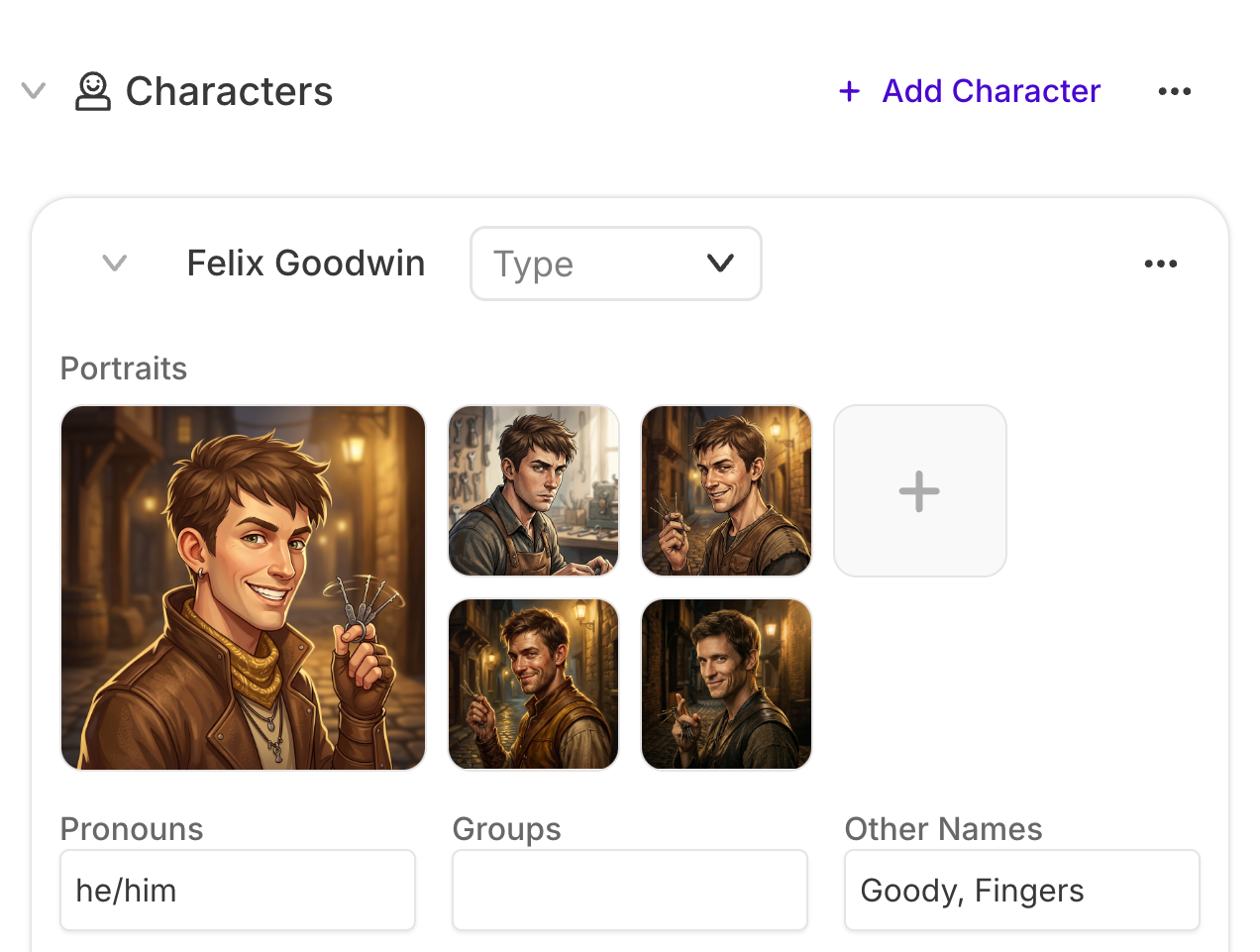
The new image features hang off those cards. Portraits come from the Physical Description you already wrote, with "no need to write a separate image prompt", in four styles: Painterly, Cinematic Realism, Bright Editorial and Storybook. Worldbuilding cards get the same one-click treatment, and every image lands in the card's gallery. Handy for a cover brief or a pitch deck. Expensive as a habit.
For plotting there is Canvas, a whiteboard for scenes and ideas. Write outputs 50 to 2,000 words at a time.
Muse, Ballad and the model menu
Muse launched in March 2025, and Muse 1.5 followed that June with "40% longer scenes" and 20% better credit efficiency. It is the default in Draft and Write. Two things set it apart. Sudowrite calls it "an unfiltered model", so dark material is not refused the way it can be elsewhere. And it is trained only on "a curated dataset with 100% informed consent from the authors". It "works best in English for now", and up to 1,000 words of style examples steer it toward your voice.
Ballad, the second in-house model, took over the Excellent prose mode, and Ballad 1.1 shipped on June 2, 2026. On September 22 Sudowrite moved Rewrite from Anthropic's Claude Sonnet to Ballad and reported that authors were "20% more likely to actually use the resulting Rewrite".
The third-party menu changes almost weekly: between June and September 2026 the changelog added Claude Opus 5.5, Sonnet 5.5, GPT-6 and GPT-6.1 variants, Gemini 3.8 Flash, Grok 4.7 and more. GPT-6 Sol runs at roughly a third of Opus 5.5's credit cost, Luna at about a seventh. Changes are announced, but a feature's default can still move under you, as Rewrite's did.
Your rights, your data, and leaving
Ownership is clean. The Terms say "All rights in and to Your Content remain with you", and the pricing FAQ adds "We claim no rights over anything you put into Sudowrite, nor anything Sudowrite generates for you." On training, the FAQ promises "we do not use your writing to train Sudowrite or OpenAI's AI models". That names Sudowrite and OpenAI only - not Anthropic, Google or the open-source models - and the privacy policy dates from October 2020. If that gap matters, stay on Muse, which Sudowrite says is never trained on your work.
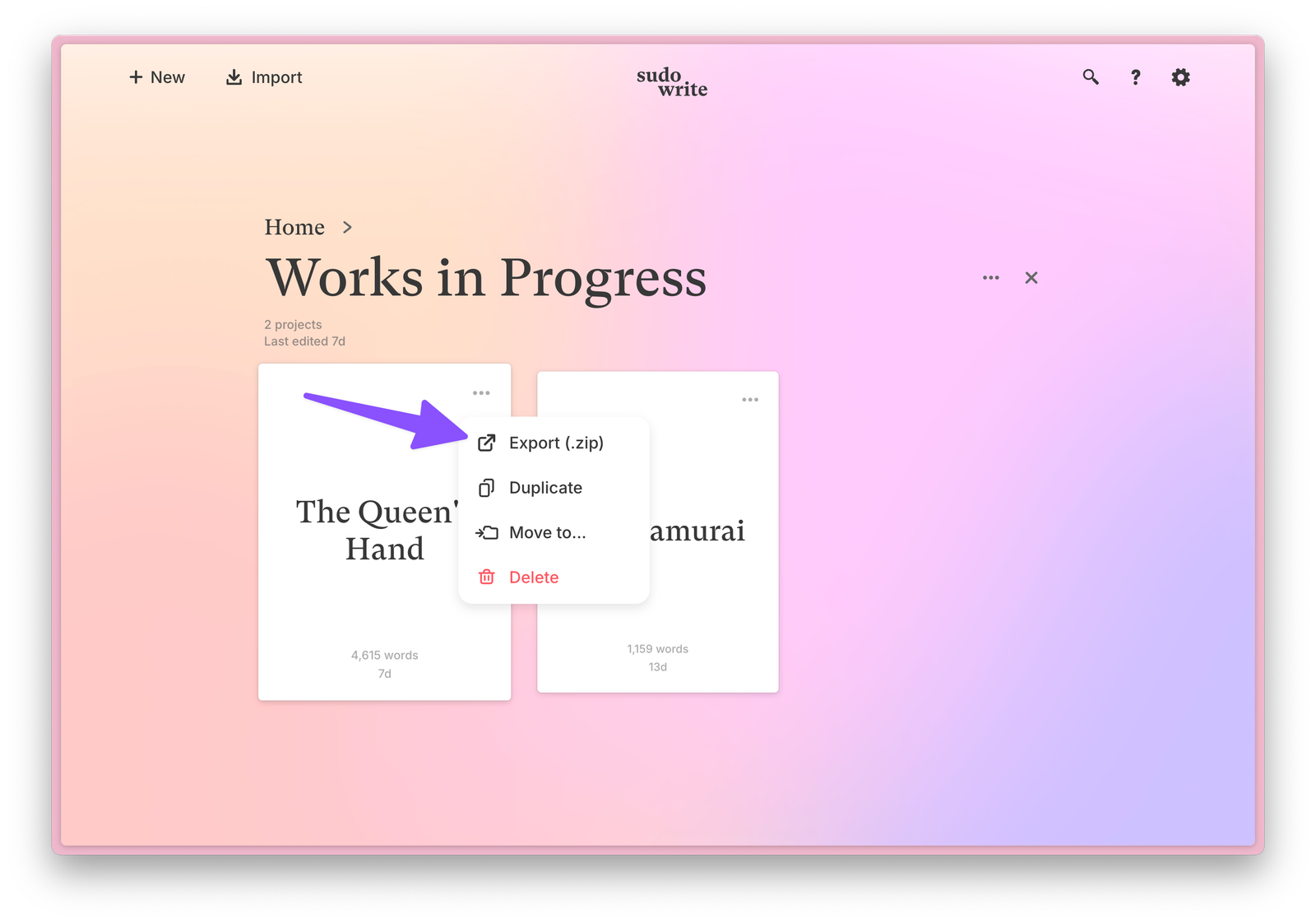
Leaving is where the lock-in shows. You can export a project as a .zip, as one .docx, or document by document, but "the export does not include the Story Bible". Months of character cards and outline stay behind unless you copy them out by hand. Import is friendlier: .docx, .txt and Scrivener projects.
It is a web app with iOS and Android companions. Collaboration means read-only share links with private comments; there is no real-time co-editing.
What users complain about
Trustpilot had Sudowrite at 3.0 out of 5 from 33 reviews when checked on October 24, 2026. One October 2026 reviewer called it "the only platform that can produce a true novel or science fiction work without feeling too much like it was written with AI", and support is praised as fast. The complaints: a September review quoting the "You already have another AI request running" lock, a July one describing "progressive corruption of the source text, characters and themes", and billing after cancellation. The aggregator CheckThat.ai finds the same pattern - credits consumed without output, and credits expiring.
Then there is reputation. Story Engine's May 2023 launch drew an author backlash - Ed McDonald wrote "Not one single writer wants to 'collaborate' with A.I." - and some readers still hold that view.
Alternatives worth pricing against it
NovelCrafter is the rival to price first. Plans run $4 to $20 a month with a 21-day trial and no card, and from the $8 Hobbyist tier you bring your own API key and pay the model provider directly. No credit markup sits between you and the model; you lose Muse and Ballad and manage your own API bill.
NovelAI, at $10, $15 and $25 a month, suits writers who want uncensored long-context story generation on a flat subscription rather than a manuscript workspace. Squibler has a free tier with 1,000 AI credits a month and unlimited credits on Pro at $49.17 a month billed annually - better than Sudowrite Max for raw volume, if you can live without a fiction-tuned model.
Verdict
Buy Sudowrite if you write long fiction in English, you want a fiction-tuned model that does not flinch at dark material, and Story Bible continuity is worth more to you than words per dollar. Start on Hobby & Student at $10 billed annually, keep Muse or a cheap model as your default, and move up to Professional only for the Feedback tools - knowing it now buys 450,000 credits, not a million.
Skip it if you want volume from the newest frontier models: an Opus-class call can burn over a hundred times the credits of a cheap one, and NovelCrafter with your own API key costs less and shows the real price. Skip it too if you need real-time co-writing, prose in another language, or a clean exit with your notes intact, because the Story Bible does not leave with you.
Ready to try Sudowrite?
Visit the official website to see the latest plans, pricing, and special offers.
Get Started - Sudowrite* Affiliate link - we may earn a commission at no extra cost to you.