Anyword Review: Is a Predicted Score Worth $49 a Month?
Anyword review: unlimited AI copy, but only 50-100 performance predictions a month on the $49 Starter plan. Pricing, Content Agent, data use and who should skip it.
Expert Review

Table of Contents
You pay for the score, not the words
Every paid Anyword plan says "Unlimited" next to words generated. It reads like the headline, and it is the least interesting thing about the product. ChatGPT, Gemini, Jasper and Copy.ai all generate marketing copy; Anyword's pricing page concedes the point by giving generation away. What it rations is the Predictive Performance Score, a 0-100 number on each headline, ad, email subject or social post that estimates how it will perform before you publish it.
Anyword says the score comes from "a proprietary AI model trained on real-world marketing performance data - including millions of A/B tests" and predicts "how likely it is to drive measurable results - such as click-through or conversion rate". In the short-form editor that becomes four Google Search ad variants scored 95, 89, 85 and 89, next to a panel reading "Better than 95% of 3,994 similar texts", a projected rank in a benchmark set, and the persona and age group each line should land with.
The homepage claims Anyword picks the winning variation 82% of the time against 52% for generic AI, and that it makes AI content "perform 76% better". Those are the vendor's numbers, and nobody outside the company has checked them.
One limit the homepage leaves out: on Starter and Data-Driven, your copy is scored against Anyword's general benchmark, not your own results. Connecting ad accounts so the scores learn from your campaigns starts on Business, which no longer has a public price.
The Content Agent writes, the score judges
The newest piece, added in 2026, is the Content Agent: a chat panel inside the editor that Anyword calls "a conversational AI teammate" which "speaks plain English. No need to learn a template library." It pulls in the saved tone of voice, target audience and brand vocabulary, and scores every output automatically.
Anyword's own launch screenshot shows the split in the product. Asked to "Create 2 facebook posts about Anyword Marketing", the agent drops two emoji-heavy posts into the editor, and the score rates them 52 and 48. The writer and the judge disagree, in the vendor's own marketing. That is also the whole case for buying: the generation is ordinary, and the second opinion is the product.
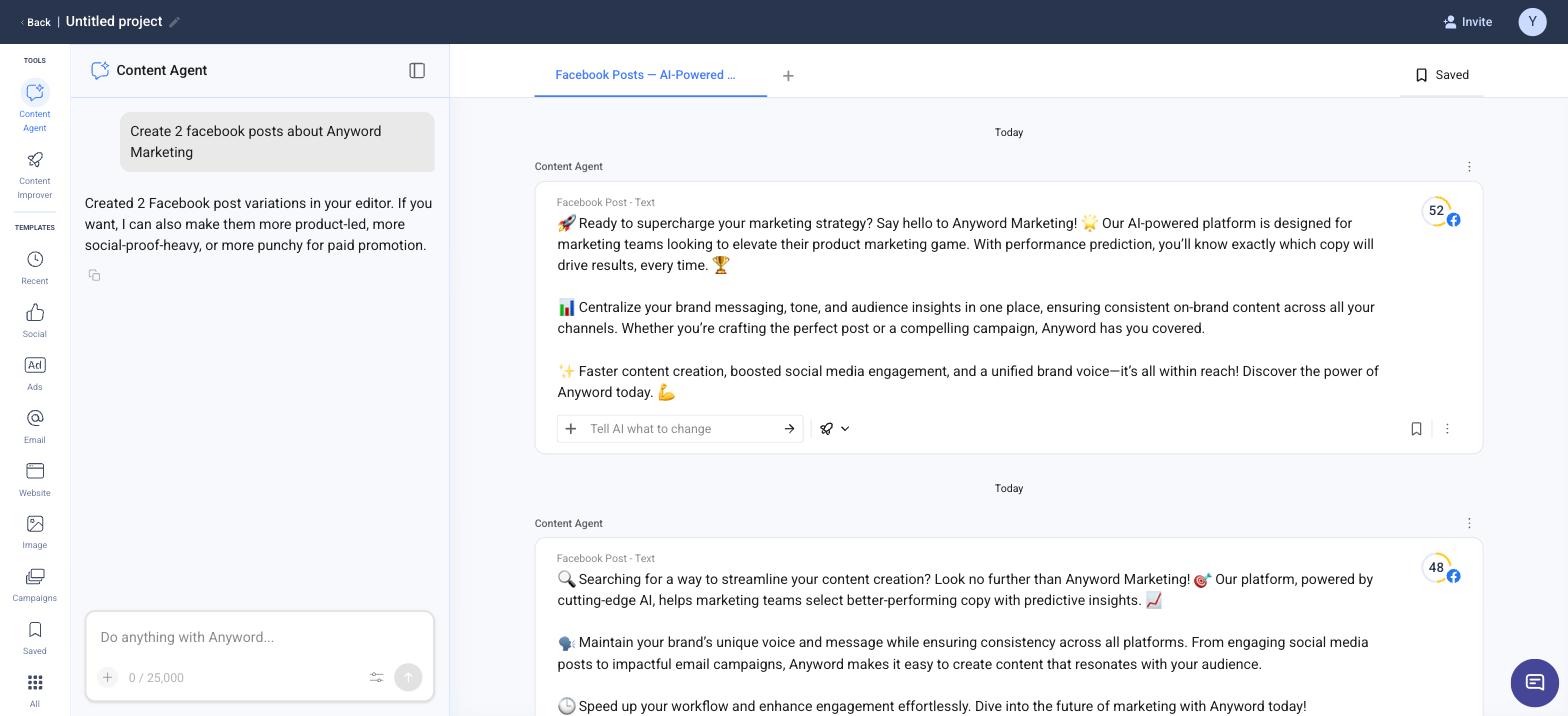
The input box takes 25,000 characters. The left rail still lists the older areas (Content Improver, Social, Ads, Email, Website, Image, Campaigns), so the agent sits on top of the template tool rather than replacing it.
Scoring copy that ChatGPT or Copilot wrote
Since August 2024 Anyword has sold itself as a layer over the rest of the stack, a "gen-AI performance platform" that "analyzes and scores all of the content generated by the various tools in a marketer's stack", as AdExchanger reported at launch.
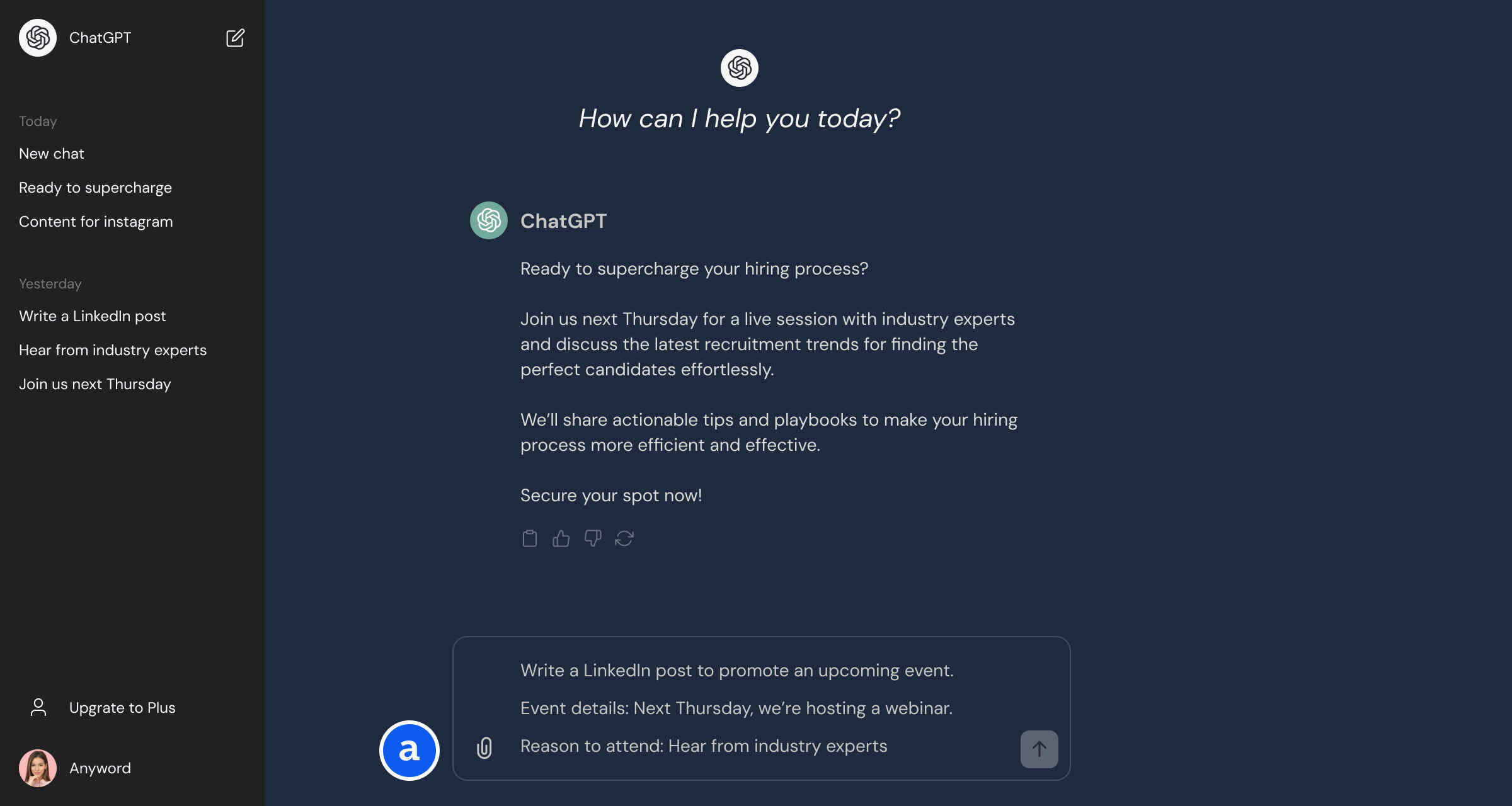
The Chrome extension, on every plan including Starter, puts an Anyword button inside the ChatGPT composer and other web tools such as Gemini. It adds your brand voice to the prompt and scores what comes back. If your team already pays for ChatGPT, this is the cheapest way to use Anyword: keep writing where you write, and spend predictions only on the lines that will actually run.
The Microsoft 365 Copilot agent, announced around mid-2026, brings brand voice, the performance score and brand guidelines into Word and PowerPoint. The catch is the licence stack. It needs an active Anyword account and a Microsoft 365 Copilot licence on top, installed from Microsoft's app marketplace, and Anyword does not say which of its plans covers it.
Brand voice and audiences
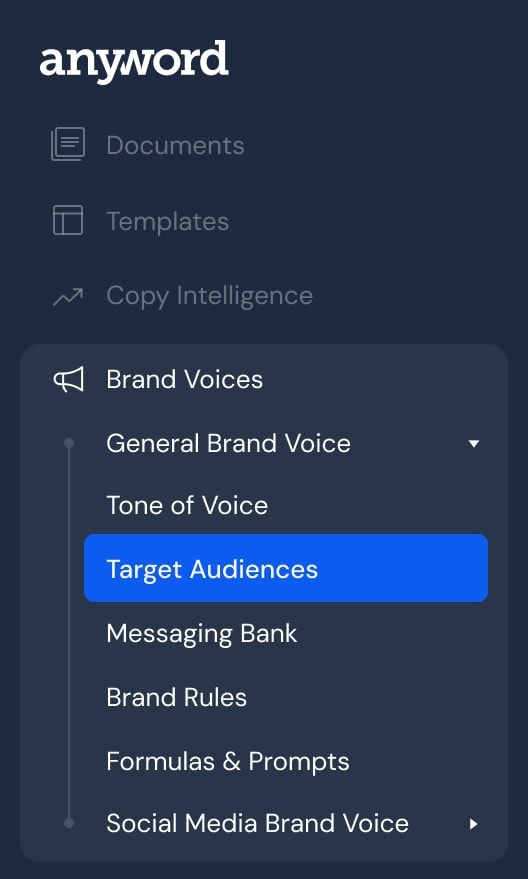
Under Brand Voices sit tone of voice, target audiences, a messaging bank, brand rules and saved formulas and prompts. The audience personas feed the score too: the editor reports which persona a line resonates with most.
How many voices you get is unclear. The Starter card says "1 brand voice"; one row of the comparison table says 1 / 1 / 5 / custom across the four plans, and another row headed "Voices" says 3 / 3 / 15 / unlimited. Get the number in writing before you build three client brands on Starter.
Pricing, and the quota that matters
Prices as checked on anyword.com/pricing in October 2026. Words generated are unlimited on all four plans.
| Plan | Monthly | Billed yearly | Predictions per month | Seats |
|---|---|---|---|---|
| Starter | $49 | $39/month | 50 (100 on the yearly tab) | 1, no add-ons |
| Data-Driven | $99 | $79/month | 100 (175 on the yearly tab) | 3, up to 10 at $59/month each ($49 yearly) |
| Business | Custom | Custom | 250 | 3, up to 20 |
| Enterprise | Custom | Custom | 500+ | Custom |
The prediction quota is the number to plan around, and the pricing page contradicts itself on it: the yearly tab shows 100 and 175, the comparison table 50 and 100. At 50 a month, Starter costs about a dollar per prediction, and a marketer scoring five subject lines a day runs out in ten working days. Real-time scoring while you edit by hand starts on Data-Driven. The API is Enterprise only.
The "Save up to 50%" banner does not match the cards either. Yearly billing is 20% off on Starter and Data-Driven ($49 to $39), and the cards say 30% for Business and Enterprise. Business was $499/month ($349 billed yearly) until August 2025 and became "Custom pricing" by September 2025.
There is no free plan. The trial lasts seven days and stops at 2,500 words, and the FAQ does not say whether it asks for a card. You can cancel at any time, but "we don't offer refunds for canceled subscriptions", so yearly Starter is $468 committed up front. Contract plans signed on an Order Form are stricter still. Payments are "non-refundable and non-cancellable", the contract renews for another year on its own, non-renewal needs written notice 90 days before the end, and the terms say the customer "will not receive notice" of that deadline.
Models, your data and the fine print
Anyword does not run one model. Its technical overview lists open-source models it has trained itself, hosted on Google Cloud and AWS, plus OpenAI models (direct or through Azure OpenAI) and Google models, chosen "depending on the customer and use case". Nothing in its documentation shows a model picker, so which model wrote a given line is not yours to choose, and it can change without you knowing. Claude is not mentioned.
By default Anyword may use your content, "aggregated and anonymized", to improve its service, and the same applies to what it generates for you. Only Enterprise private models promise that "customer data is used exclusively to train and augment models serving that customer". The output is yours, but the terms warn it "may not be unique and other users may receive similar content" - worth knowing before you trademark a tagline it wrote.
The trust claims are loose. The security page cites "SOC 2, ISO, and GDPR" and the homepage adds HIPAA, without naming the SOC 2 type or the ISO standard or linking a report. Marketing pages promise 99.9% and 99.99% uptime; the terms say the company "does not offer any specific uptime guarantee".
What users complain about
Trustpilot rates Anyword about 4.8 from more than 5,000 reviews, and the praise is mostly about output. The complaint that keeps coming back is the trial. From a two-star review in July 2024: "of my 7 day free trial I got a total of 2 hours before I'd reached a word count". So plan the trial before you start it. Bring last quarter's ads, whose winners you already know, and see whether the score picks them, instead of spending the 2,500 words on fresh drafts.
Anyword vs ChatGPT, Jasper and Copy.ai
Against ChatGPT Plus at $20 a month, Starter costs $29 more for a scoring model and a brand memory. If you already run A/B tests in your ad platform with real budget, your own results beat any predicted score, and ChatGPT plus those tests is the cheaper loop. The score earns its fee where testing is slow: small email lists, low-traffic landing pages, or a client who wants a reason before money is spent.
Jasper is built around long-form content and campaign workflows for larger teams, and Copy.ai has moved towards sales and go-to-market automation. Neither is built around a predicted score on every line. For blog and SEO articles, Anyword's Blog Wizard is a side feature, and the dedicated tools in our roundup of AI writing tools do that job better.
Verdict
Buy Anyword if you write ad, email and social variants at volume - a performance marketer, or an agency juggling several brands - and you want ten headlines ranked before any of them gets budget. Data-Driven at $99 a month is the realistic entry point: three seats, 100 predictions and scores that update as you edit. On Business, with your ad accounts connected, the scores start reflecting your own audience, which is where the product makes most sense.
Skip it if you mostly write blog posts, or if you are a solo writer who would burn through 50 predictions in a week. ChatGPT Plus and your own split tests cost less and teach you more, and teams that need long-form campaigns should look at Jasper first.
Ready to try Anyword?
Visit the official website to see the latest plans, pricing, and special offers.
Get Started - Anyword* Affiliate link - we may earn a commission at no extra cost to you.