Apple Intelligence Clears China at Last — Powered by Alibaba's Qwen
China's Cyberspace Administration approved Apple Intelligence for the mainland, powered by Alibaba's Qwen model with Baidu support. What was approved and why it matters.
News Report

What Happened
Apple has finally cleared the biggest regulatory obstacle standing between Apple Intelligence and its most valuable overseas market. In mid-July 2026, China's Cyberspace Administration of China (CAC) — the country's powerful internet and content regulator — completed the registration that allows Apple's suite of generative-AI features to operate on iPhones, iPads, Macs and Vision Pro headsets sold in mainland China.
The approval came with a defining condition. Unlike everywhere else in the world, Apple will not run its own AI stack in China. The system-level model powering Apple Intelligence on the mainland will be Qwen, the large language model built by Alibaba, with Baidu contributing additional, China-specific capabilities. The filing was made through Apple Technology Development (Shanghai) Co., Ltd. earlier in July and lists Apple's smartphones as the intended use case.
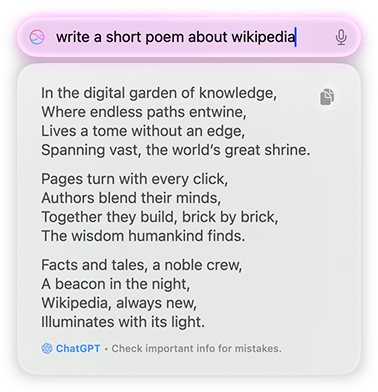
In short: the features Chinese customers have watched roll out abroad since 2024 — writing tools, image generation, a redesigned Siri, notification summaries and more — now have a legal path onto their devices. But behind the familiar Apple interface, a Chinese model will be doing the thinking.
Why It Took Nearly Two Years
Apple Intelligence debuted globally alongside iOS 18 in 2024, and Chinese users have been locked out of it ever since. That gap — roughly two years, and about 22 months from launch to this filing — is unusually long for a flagship Apple feature, and it says a lot about how tightly China regulates artificial intelligence.
China's rules require that any generative-AI service offered to the public run on a model that has been registered and licensed with domestic regulators, and that its outputs comply with the country's content and censorship requirements. Foreign models like the ones Apple uses elsewhere — including its own on-device and cloud models, and its overseas partnership with OpenAI's ChatGPT — simply cannot be deployed on the mainland without clearing that bar. There was no version of Apple Intelligence that Apple could switch on in China using the same plumbing it uses in the rest of the world.
That left Apple with one realistic option: partner with a Chinese company whose model is already approved for public use, and rebuild the AI layer of Apple Intelligence around it. Negotiating that arrangement, choosing partners, and then shepherding the result through the CAC's review is what consumed the better part of two years.
Why Apple Needs a Chinese Partner
The requirement isn't unique to Apple — it's the price of doing AI business in China. Every consumer-facing generative model on the mainland, from chatbots to image generators, must be operated by an entity that holds the appropriate regulatory approvals and keeps its outputs inside the lines drawn by the state. Apple, as a foreign company using foreign models, does not clear that on its own.
Reporting through 2025 and 2026 indicated Apple evaluated several domestic candidates before settling on its current lineup, and the company is said to have explored additional tie-ups with firms such as DeepSeek and ByteDance. What emerged is a two-partner structure: Alibaba as the primary model provider, and Baidu supplying complementary features. It is a notable concession from a company that prizes control over its own technology stack — but in China, that control is exactly what the rules don't permit.
Alibaba's Qwen at the Core
The centerpiece of the deal is Alibaba's Qwen family of models. Alibaba has confirmed that Qwen will be integrated as a system-level model across iOS, iPadOS, macOS and visionOS for devices sold in China, providing the core text understanding, image recognition, and content-generation capabilities that sit underneath Apple Intelligence.

Qwen is one of China's strongest and most widely deployed model families, with a track record of competitive results on public benchmarks and broad adoption across Alibaba's cloud and consumer products. For Apple, that maturity matters: the features it ships in China need to feel like Apple Intelligence, not a downgraded substitute, and that depends on the underlying model being genuinely capable.

For Alibaba, the win is enormous. Becoming the default intelligence layer inside every new iPhone sold in the world's largest smartphone market is the kind of distribution money can't easily buy, and it cements Qwen's position at the front of China's crowded model race. An Alibaba spokesperson confirmed that Qwen would be incorporated into the version of Apple Intelligence that eventually ships on compatible iPhone, iPad, Mac and Vision Pro models in China.
Baidu's Supporting Role
Alibaba isn't the only Chinese partner. Baidu has confirmed it is also working with Apple on the Chinese version of Apple Intelligence, supplying supplementary capabilities — reported to include China-specific search and assistant-style features that plug into the experience alongside Qwen's core model work.

The exact division of labor between the two companies hasn't been spelled out publicly, and Baidu has said little about the specifics of its contribution. But the arrangement suggests Apple is assembling its China AI experience from more than one domestic source rather than betting everything on a single provider — a sensible hedge given how fast China's model landscape moves and how much rides on getting this launch right.
What It Means for Apple's China Business
The timing is significant because China has swung back into growth for Apple. In its fiscal Q2 2026, the company reported roughly $20.5 billion in Greater China sales, up about 28% year over year, and it recently regained the No. 2 position in China's smartphone market after a rough stretch of local competition.

Part of that recovery came despite Chinese buyers not having access to the AI features Apple has been marketing everywhere else. Rival domestic brands have leaned hard into on-device AI as a selling point, and the absence of Apple Intelligence gave them a talking point against the iPhone. Closing that gap removes a real weakness heading into the next iPhone cycle.
It also changes the upgrade calculus. Apple Intelligence requires recent, higher-end hardware, so a credible AI story in China gives the installed base a fresh reason to trade up — precisely the kind of demand driver Apple wants as it defends premium market share against fast-moving local competitors.
When Will It Actually Ship?
Regulatory approval clears the biggest barrier, but it is not the same as a launch. Neither Apple nor Alibaba has announced a commercial release date, and the rollout is still described as contingent on security assessments, localization work, and the necessary operating-system updates. The redesigned, more capable Siri that Apple has been building is expected to arrive in the Chinese version once that implementation work is complete.
In practice, that means Chinese users should think of this as the moment the door opened, not the moment they can walk through it. The features will surface through a future software update rather than switching on the day the paperwork cleared. Given how carefully both sides will want to manage a launch this scrutinized, a staged rollout tied to an OS release is the likeliest path.
Why It Matters
This is more than a feature finally reaching a delayed market. It is a case study in how the world's most valuable technology company has to operate inside China's tightly governed AI regime. Apple didn't get to bring its own intelligence to the mainland — it had to rent someone else's, wrap it in the Apple experience, and get the whole thing blessed by regulators before a single Chinese customer could use it.
That template — a Western hardware giant running on a licensed Chinese model to satisfy local law — is likely to become more common, not less, as generative AI gets embedded in every device. It underscores a growing reality of the AI era: increasingly, the model that powers your phone can depend on which country you bought it in. For Apple, Alibaba and Baidu, the approval is a clear win. For everyone watching how global tech bends to national AI rules, it's a preview of the road ahead. Apple details the broader feature set on its Apple Intelligence page.
Read the original source
Head to the original source for the full announcement and complete details.
Read Original Source