Meta Releases Muse Spark Open: An 816B Open-Weight Model That Runs on Two Mac Studios
Meta released Muse Spark Open, an 816B open-weight MoE model with a 1M-token context. License terms, Mac Studio setup, benchmarks vs Kimi K3 and hosted prices.
News Report

What Meta released
On October 15, Meta put the weights of Muse Spark Open on Hugging Face: a mixture-of-experts model with about 816 billion parameters in total and roughly 42 billion active for each token. It shares its base model with Muse Spark 1.3, which until this week you could only reach through an API. The PyTorch blog calls it "the most capable US open-weights model to date".
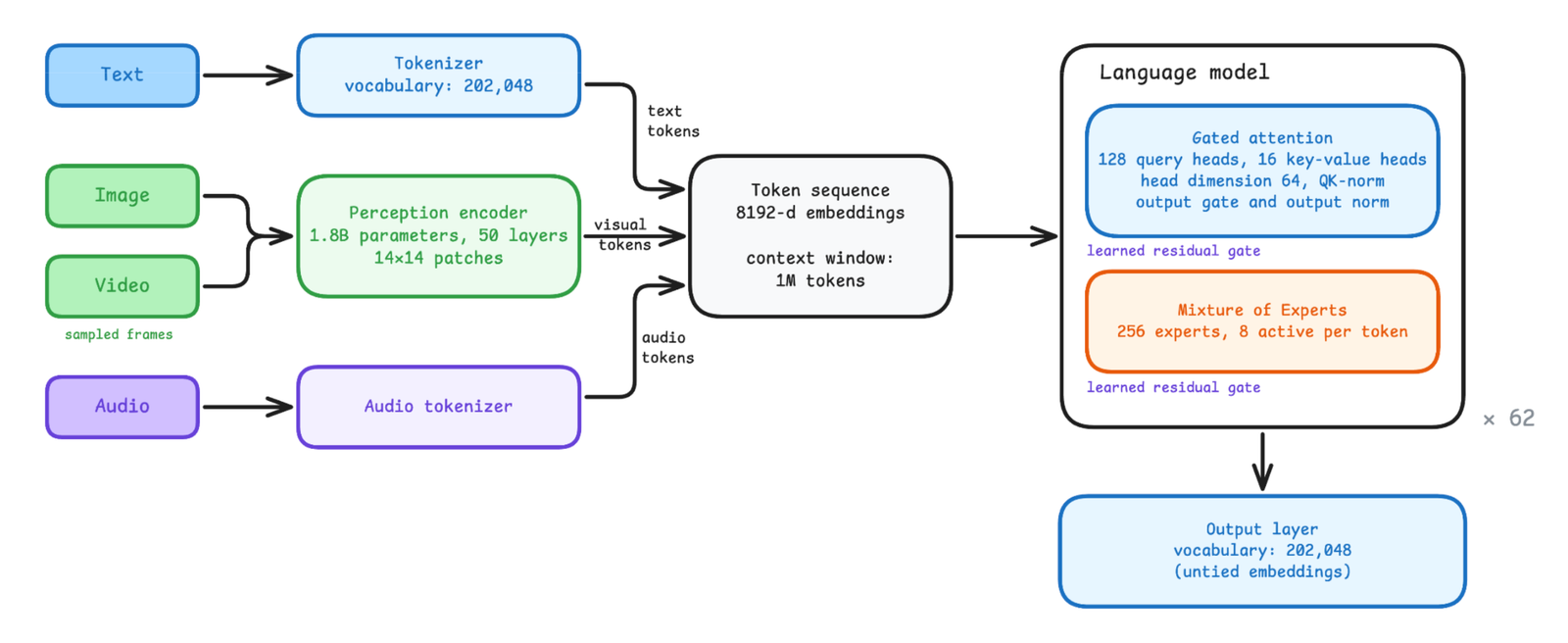
The architecture, per Hugging Face's launch write-up: 62 layers, 256 experts per MoE layer with 8 picked per token, grouped-query attention with 128 query heads and 16 KV heads, and a context window of up to 1 million tokens. It reads text, images, video and audio and answers in text. A 1.8B-parameter perception encoder handles pictures and video. Audio arrives at 12.5 tokens a second.
Meta pitches it at agentic coding - multi-file refactors, debugging, tool calls - and at agents that browse the web, spawn subagents and operate desktop, mobile and browser interfaces. In the launch demos reported by TechCrunch, it fixed bugs in a Mastodon client through Muse Code, Meta's coding terminal, and cropped footage in DaVinci Resolve.
The open version is not a straight copy of the hosted one. Meta added safety post-training so it holds up "as a standalone model without system guardrails". And Meta's strongest model, Muse Wonder, launched the same week and stays closed. Chief AI Officer Alexandr Wang told Bloomberg, as reported by Briefs: "Because of both safety and capabilities, we will generally not open-source our most powerful models." This is also a different product from Meta's Muse personal AI agent - a model you run, not an app you talk to.
The license catch
Open weights, not open source. Muse Spark Open ships under the Muse Model License, a custom license rather than an OSI-approved one. In one way it is looser than Llama's old terms: there is no cap on monthly active users, so the 700 million MAU clause that kept the largest platforms away from Llama is gone.
What replaced it is a revenue gate on one specific use. Offer the model as a service and earn more than $20 million in aggregate gross revenue over a trailing 12 months, and you must notify Meta and sign a separate agreement. Internal use, research and embedding the model as a feature of your own product sit outside that threshold. Every product built on the model or a derivative has to show "Built with Muse Spark Open" prominently, in the UI, docs, website or settings. The license is not intended for under-18s, Meta claims no ownership of outputs, and the acceptable-use policy bans malware, weapons, fraud, disinformation and the unauthorized practice of regulated professions, according to Digital Applied's reading of the terms.
The download is gated too. The Hugging Face repo asks for your full legal name, date of birth and organization before it releases the files.
Running it on two Mac Studios
The line that "it runs on Macs" needs one correction: it runs on two of them. Meta's developer guide pairs two M5 Ultra Mac Studios with 512GB of unified memory each, or four 256GB machines, linked over Thunderbolt 5 with RDMA. They load the 4-bit NVFP4 checkpoint, about 530 GB, split so each machine keeps its share of the weights and only intermediate results cross the cable. The setup came out of joint work between Meta and Apple on MLX.
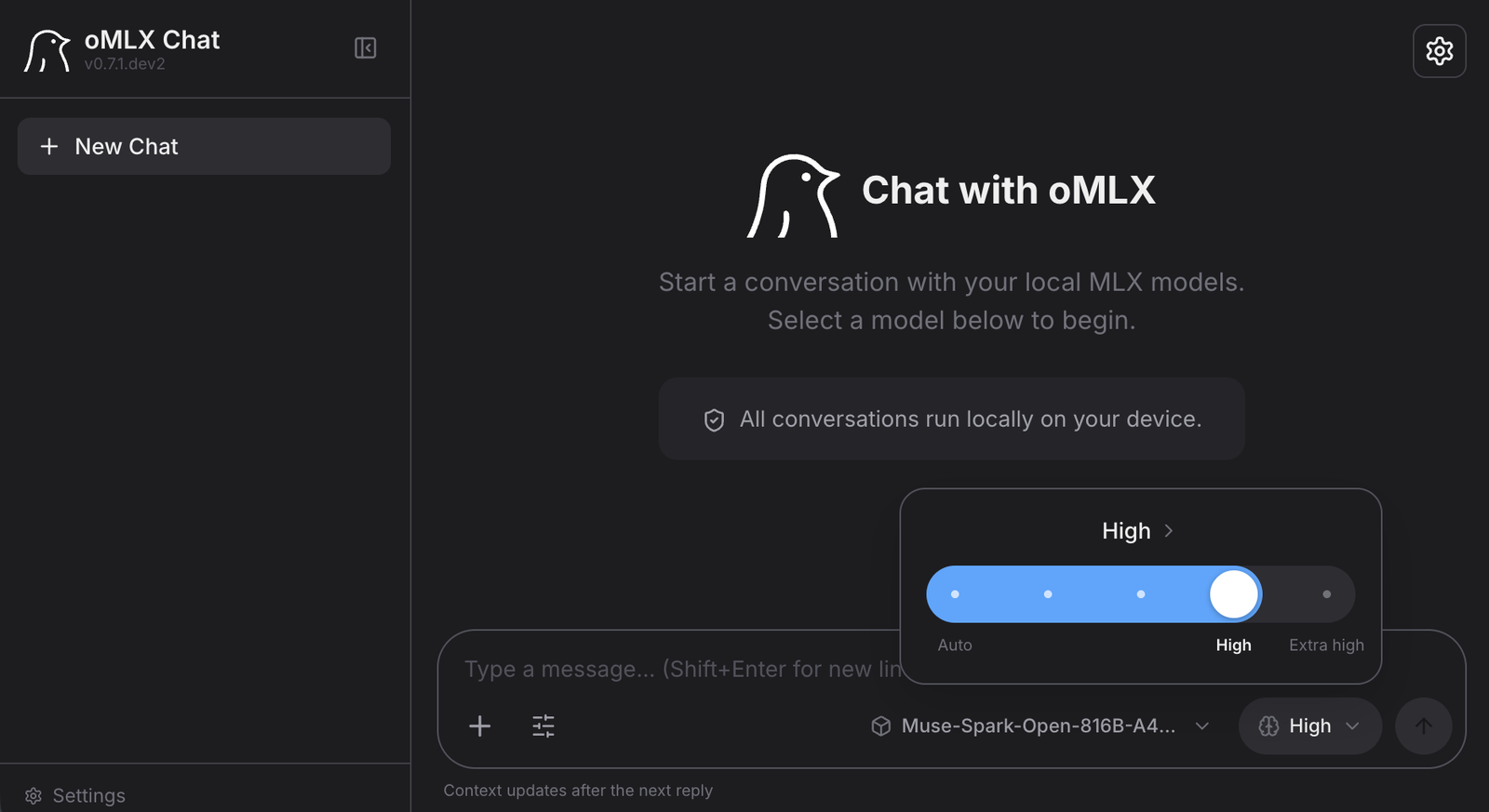
Meta published no tokens-per-second figure for M5 Ultra. The numbers that exist come from Hugging Face's tests on an older M3 Ultra with 512GB, running community 2- and 3-bit quantizations rather than the full model. The MLX 3-bit build managed about 225 tokens a second of prefill and 21 tokens a second of generation; llama.cpp at Q2_K reached 18. That is workable for an agent loop. It is not workable for filling the 1M-token window, whose KV cache alone runs to about 266 GB in BF16.
In a datacenter, the NVFP4 checkpoint fits one B200 node, while the full BF16 weights, about 1.5 TB, need four nodes of eight H200s in Transformers. vLLM, SGLang, TensorRT-LLM, MLX, llama.cpp and Unsloth support it at launch, and TorchTitan adds supervised fine-tuning, LoRA and reinforcement learning. Hugging Face shows a LoRA run on the attention layers, experts frozen, at 8,000 tokens a second across 64 H100s.
Benchmarks: strong on tools, behind Kimi on coding
Every figure below comes from Meta's model card and Meta's own runs, including its choice of effort settings. Read them as the vendor's case.
| Benchmark | Muse Spark Open | Rival scores Meta lists |
|---|---|---|
| MCP-Atlas (tool use, xhigh effort) | 89.2 | GLM 5.3: 84.2 · Kimi K3: 82.3 |
| GPQA Diamond | 89.0 | Qwen3.8: 93.5 |
| Terminal-Bench 2.1 | 76.4 | Kimi K3: 85.0 · GLM 5.3: 83.9 |
| DeepSWE 1.1 | 60 | Kimi K3: 68 |
| SWE-Atlas-QnA | 58 | Kimi K3: 66 |
| VideoMMEv2 | 61.5 | Kimi K3: 65.4 |
The pattern is plain. It leads on tool calling and trails Kimi K3 by 8 to 9 points on terminal and software-engineering tasks, the very work Meta is selling it for. Researcher Nathan Lambert of Interconnects, as summarized by AI Weekly, placed it "somewhere above GLM 5.2, near DeepSeek V4.1 Flash, and behind GLM 5.3 or Kimi K3".
What it costs
The weights are free. Hosted, the open model is no cheaper than the closed one. On OpenRouter, meta/muse-spark-open lists at $1.25 per million input tokens, $4.25 per million output tokens and $0.15 per million cached input tokens - exactly what closed Muse Spark 1.3 costs there (OpenRouter prices checked on October 18, 2026). Closed Muse Wonder lists at $4 in and $20 out.
Meta sets no official price. Baseten, Fireworks AI, Groq (in limited preview), Modal, Nebius, Together AI and the AWS, Google Cloud and Microsoft Foundry catalogs each price it their own way. So the reason to pick it is control rather than a smaller bill: data that stays on your hardware, weights you can fine-tune, and no provider's rate limits.
What it changes, and what's next
For a team building on Meta's models, the before and after is concrete. Before October 15, Spark-class capability meant an API call to Meta or a reseller. Now the same base model can sit on your own B200 node, or on two 512GB Mac Studios on a desk, with a 1M-token window and weights you can retrain. The cost of that freedom is a gated download, a mandatory attribution line and, for anyone reselling it at scale, a contract with Meta.
It suits teams that need tool-heavy agents on their own infrastructure and can live with the notice. Teams choosing on coding scores alone have a better open option in Kimi K3, by Meta's own numbers, and anyone shopping for license terms should compare it with this month's other big open-weight release, Mistral Large 4.
Meta says a full safety evaluation report is "available soon". The model card already claims 99.2% jailbreak refusal on internal cyber evaluations and over 98% refusal on single-turn chemical and biological prompts. Wang's other line to Bloomberg sets the direction: "Most of the world's AI will run on open models. They should be American." The question now is whether the next open release closes the gap to Kimi K3, or whether Wonder-class models stay behind the API for good.