Mistral Large 4 Preview: A 1-Trillion-Parameter Open-Weight Model With Weights Due This Month
Mistral Large 4 is in public preview: 1T parameters, 52B active, $1.36/$4.18 per million tokens, 82% on a cyber test rivals refuse. Weights due end of October.
News Report

What Mistral released
On October 6, Mistral AI opened a public preview of Mistral Large 4, a model the company calls "unofficially ML4, very officially: le Chonk." The nickname fits. In Mistral's announcement, ML4 is "a 1 trillion-parameter natively multimodal model with 52 billion active parameters." It takes text and images as input and returns text.
It is a mixture-of-experts model, and Mistral built it as one hybrid that "unifies instruction, reasoning, and agentic capabilities in a single model". So there is no separate reasoning variant to route to. Mistral says it speaks more than 160 languages fluently, including every official language of the European Union.
The hardware matters to the story as much as the size. ML4 "was trained from scratch on 3,800 NVIDIA Grace Blackwell GPUs in Mistral's own datacenters in Europe," and the preview is served from that same infrastructure. Mistral calls it the first milestone funded by the €3 billion Series D it closed in September, the largest equity round ever raised by a European technology company. Some early launch material, including Mistral's own X post, gave 49 billion active parameters. The blog says 52 billion, and that is the figure used here.
The cybersecurity result is really about refusals
The headline number is from security. The Artificial Analysis Cyber Index includes a test where a model has to reproduce a real vulnerability in open-source software and then patch it. Mistral reports that ML4 scores 82% on that test, "the highest of any model." Mistral's chart for that test, labelled CyberGym-E2E, puts MiMo-V2.6-Pro next at 79, with GLM-5.3-Flash and Grok 4.7 at 74.

The comparison needs care. "Several leading closed models, including Claude Opus 5.5 and GPT-6 Astra, score near zero on the same test because they refuse to perform the task." Those models don't fail the test for lack of skill. Their safety filters stop them from writing a working reproduction of the bug. On the Cyber Index as a whole, ML4 is not number one: Mistral places it "among the top five models globally" and says it leads open-weight models developed outside China "by a wide margin." It also solves 93% of Cybench, a set of 40 challenges taken from security competitions.
Mistral's chart of the full index shows the refusals directly. ML4 records 50 successes. Claude Opus 5.5 records 29, with another 36 tasks stopped by safety blocks, and GPT-6 Astra records 33 with 38 blocked. Qwen3.8 2.4T, also open-weight, refuses even more: 13 successes and 63 blocks.

Mistral's pitch to defenders is that fixing a flaw starts with proving it is real, and a model that refuses that step is no help. Attackers already jailbreak closed models, the company argues, so defenders should have a model that does the work openly, on hardware they control. That argument cuts both ways. A model that will build an exploit for a defender will build one for anyone who downloads the weights, and once the weights are out there is no API filter left to tighten.
Coding and agent benchmarks
For software work, Mistral lists 61.7% on DeepSWE v1.1, 59.4% on SWE-Atlas-QnA and 28.3% on Terminal-Bench 4. Its combined Coding Agent Index score of 49.8% puts it ahead of DeepSeek V4 Pro 0813 and Qwen3.8 Max. VentureBeat points out that the live DeepSWE leaderboard has closed models at 69 to 74%. Mistral's own DeepSWE chart doesn't show ML4 leading open models either: Kimi K3 with its Kimi Code CLI scores 68 there, against ML4's 62. On Terminal-Bench 4, GLM-5.3 scores 40 to ML4's 28. So the model is competitive in coding, not the best available, open or closed.

A blind human review run with Surge AI tells a similar story. Raters scored coding quality from 1 to 5 without knowing which model wrote what. ML4 came second of five at 3.74, ahead of GLM-5.3 (3.60), Kimi K3 (3.59) and GLM-5.2 (3.40). First place went to Claude Opus 5 at 4.22, a clear gap.

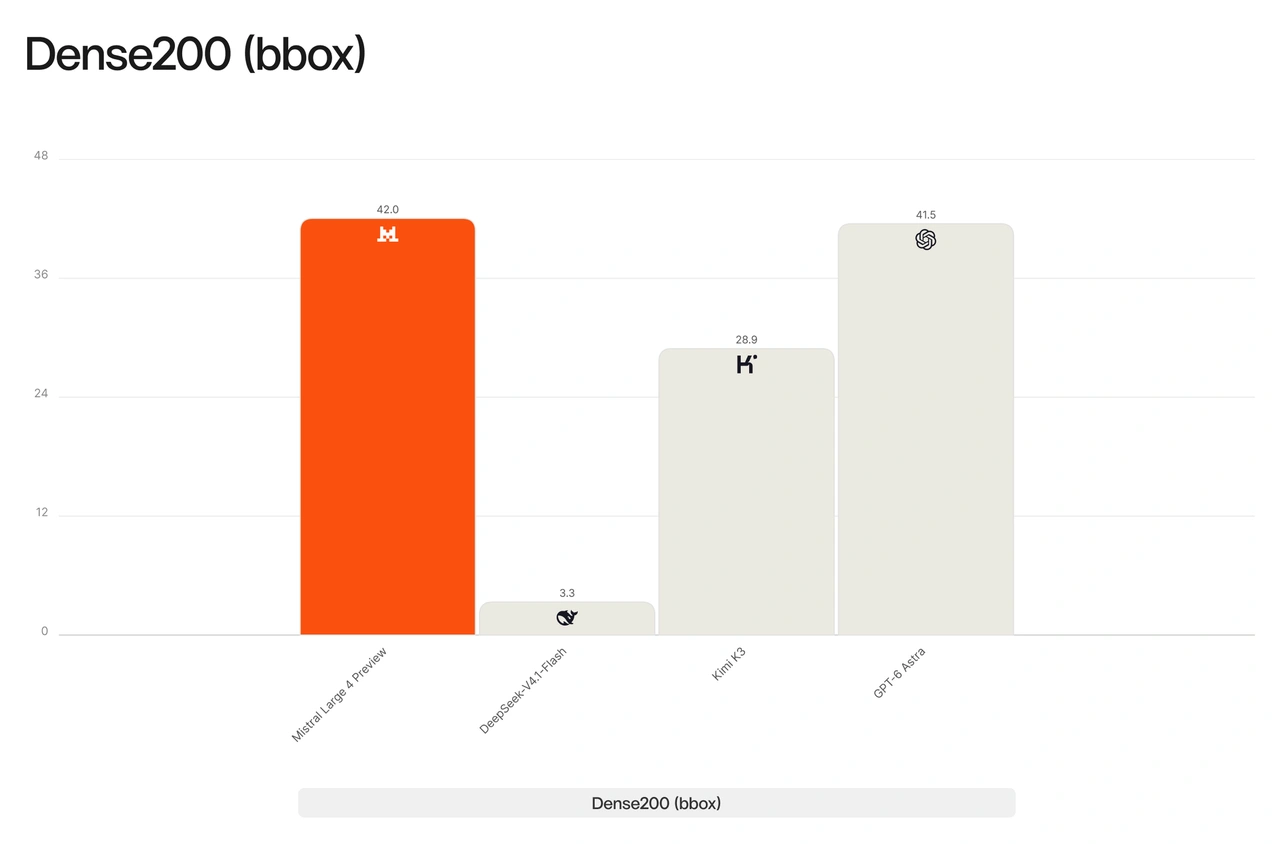
On agent tasks, ML4 scores 59.9% on AutomationBench, 657 business workflows across tools such as Gmail, Google Sheets, Slack and Salesforce, ahead of Kimi K3, MiMo-V2.6-Pro and DeepSeek V4 Pro. It edges GPT-6-Astra on the Dense 200 visual-grounding test, 42.0 to 41.5. VentureBeat lists 67% on FinWorkBench, tied with DeepSeek V4 Pro.
Every one of these numbers is Mistral's own, measured on a preview, and independent checks are thin so far. Mistral also says reinforcement learning is still running, at 33 billion generated tokens a day, and expects scores to move before the weights ship.
Pricing and access
The preview API is live on Mistral Studio under the model ID mistral-large-4-0. It costs $1.36 per million input tokens and $4.18 per million output tokens, as listed on Mistral's announcement page, checked on October 12, 2026. Preview pricing can change at general availability.
It runs in several regions, including what Mistral calls "a European deployment that Mistral operates end-to-end, independently of other digital service providers and under European law." For EU buyers that's the real point. The model, the GPUs and the operator are all under European jurisdiction, with no US cloud provider in the chain.
Mistral's blog does not state a context window. Some third-party sites quote one, but until Mistral publishes it, treat any figure as unconfirmed.
What changes for teams building on it
For security teams, this is the first model near the frontier that will reliably reproduce a real vulnerability rather than refuse, and it will soon run on their own machines. Teams that build exploit reproductions for bug triage or patch verification, and keep hitting refusals from Claude Opus 5.5 or GPT-6 Astra, now have an alternative.
For European companies with data-residency rules, ML4 is a frontier-class option that never leaves EU-operated infrastructure, and once the weights ship, it never has to leave their own.
For general coding work, the case is weaker. Mistral's own human evaluation put Claude Opus 5 well ahead, and closed models lead DeepSWE by 7 to 12 points. Teams already happy with a closed coding model get little from switching, unless self-hosting or price is the reason. A trillion parameters is also not something most companies can self-host cheaply, even with only 52 billion active per token.
What's next
Mistral says it will release the weights "by the end of the month, along with more details on the architecture, additional benchmarks, and our post-training methodology." VentureBeat reports the date as October 27, under a custom Mistral license. Mistral has not named the license yet, so whether ML4 can be used commercially without restrictions is still open. Until those terms are published, call it open-weight, not open source.
Guillaume Lample, Mistral's co-founder and chief scientist, told VentureBeat that "ML4 is at the frontier of open weight models." The weights drop will be the first chance to test that claim outside Mistral's own benchmarks.