Apple Ships a Touchscreen Mac: MacBook Pro Gets a Tandem OLED PROLED XDR Display
Apple's MacBook Pro with PROLED XDR adds tandem OLED, touch and a Dynamic Island from $2,899. Specs, prices, what touch means for Mac apps, and which model to buy.
News Report

What Apple announced
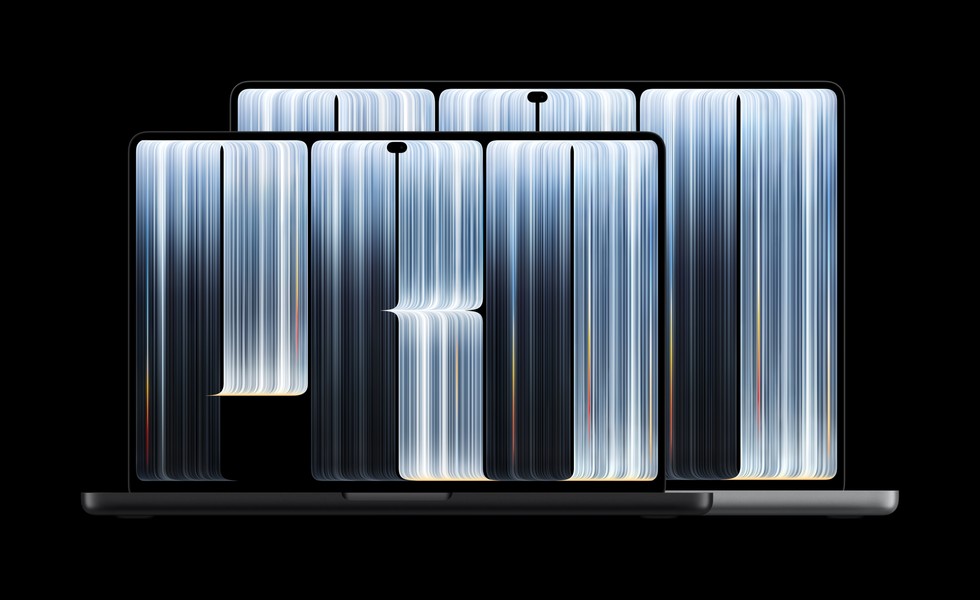
Apple has put a touchscreen on a Mac. On October 28, 2026 it introduced the MacBook Pro with PROLED XDR Display, a 14-inch and 16-inch laptop built around a tandem OLED panel with the touch sensor built into it. It is the first Mac with an OLED screen and the first that responds to a finger.
The new models run on M5 Pro and M5 Max, start at $2,899 and sit alongside the existing mini-LED MacBook Pros rather than replacing them. Pre-orders opened the same day. The laptops reach stores on Friday, November 6, 2026.
It lands in a crowded week. A day earlier Apple announced a cheaper 14-inch MacBook Pro with M6 from $1,999 and a new iMac with M6, and on October 26 the iPad mini moved to OLED. Anyone shopping for a pro Mac this autumn now has three MacBook Pro lines to pick from.
Touch on the Mac, and what it means for apps
For years Apple's line was that touch belongs on the iPad and the Mac stays pointer-first. This release reverses that. Apple says the touch sensor sits inside the display panel itself rather than in a layer on top of it, and a redesigned hinge keeps the screen steadier when you press on it.
The gestures are the ones iPad owners already know. Swipe to scroll a webpage, pinch to zoom a photo, drag slides from one presentation to another, double-tap a window to fill the screen or flick it to tile it into place. Touch works alongside the keyboard shortcuts and trackpad gestures, not instead of them.
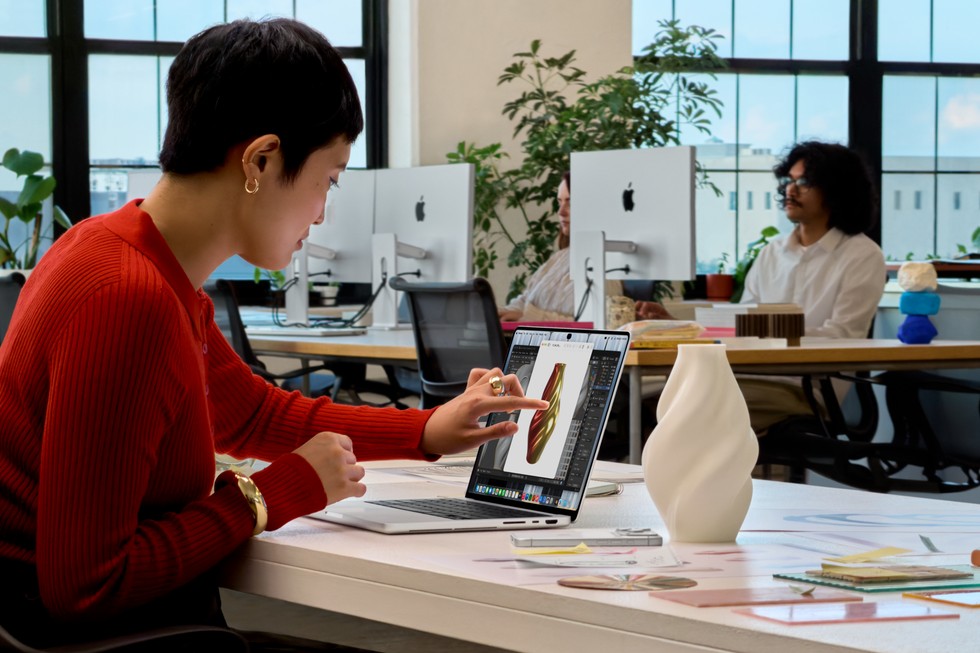
For developers the key sentence is a short one. Apple says "many existing apps work with Touch right away, because macOS automatically translates touches into clicks." An app that has never heard of touch will still respond to a tap on launch day; it just behaves as if a click landed there. That is a floor, not a design. Expect the usual rough edges of any desktop interface meeting a finger: hit targets sized for a cursor, controls that reveal themselves only on hover, and context menus with no obvious gesture.
Getting past the floor takes work. macOS 27 ships "updated system gesture APIs" for touch-specific interactions, and Apple's own apps are already tuned for touch. Microsoft Office, Adobe Lightroom, Blender and djay Pro are the third-party apps Apple names as adding support, some of them later this year. If you ship a Mac app, the before and after is blunt. Before October 28 nobody could tap your interface. From November 6 some of your paying users can, and those apps set what they will expect.
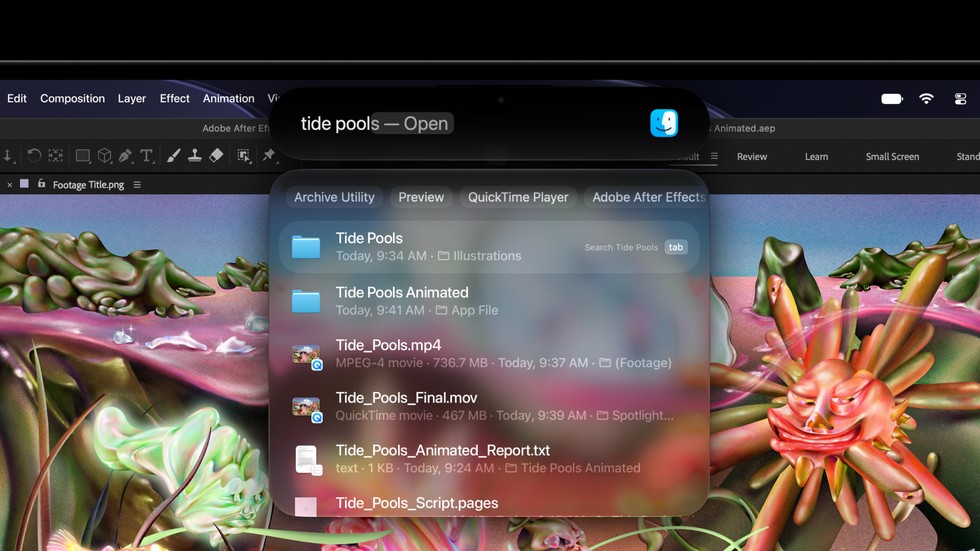
The Mac also gains a Dynamic Island, the pill-shaped area from the iPhone. On the MacBook Pro it hosts Spotlight, Live Activities and Siri AI, which Apple describes as a beta in macOS 27.2 with language, region and usage limits.
The PROLED XDR display
Apple's numbers for the tandem OLED panel are up to 2,000 nits peak brightness for both HDR and SDR, a 10,000,000:1 contrast ratio and ProMotion from 10Hz to 120Hz. The diagonals are 14.2 and 16.3 inches. Color coverage spans P3 and Adobe RGB and more than 80% of Rec. 2020.
Set that against the M6 model's mini-LED Liquid Retina XDR screen, rated at 1,600 nits HDR and 1,000,000:1. Contrast is where OLED earns its premium: every pixel switches off on its own instead of sharing a dimming zone with its neighbors, so a bright highlight on a black frame no longer glows at the edges.
The extras are aimed at colorists and video crews. There is Apple Pro Display Calibrator, a set of reference modes, DICOM presets for medical imaging (nondiagnostic use only) and Genlock to sync the display with cameras on set. An antireflective coating is standard and nano-texture glass is optional. Apple did not publish the panel's resolution, and it did not mention Apple Pencil support.
Chips, battery and ports
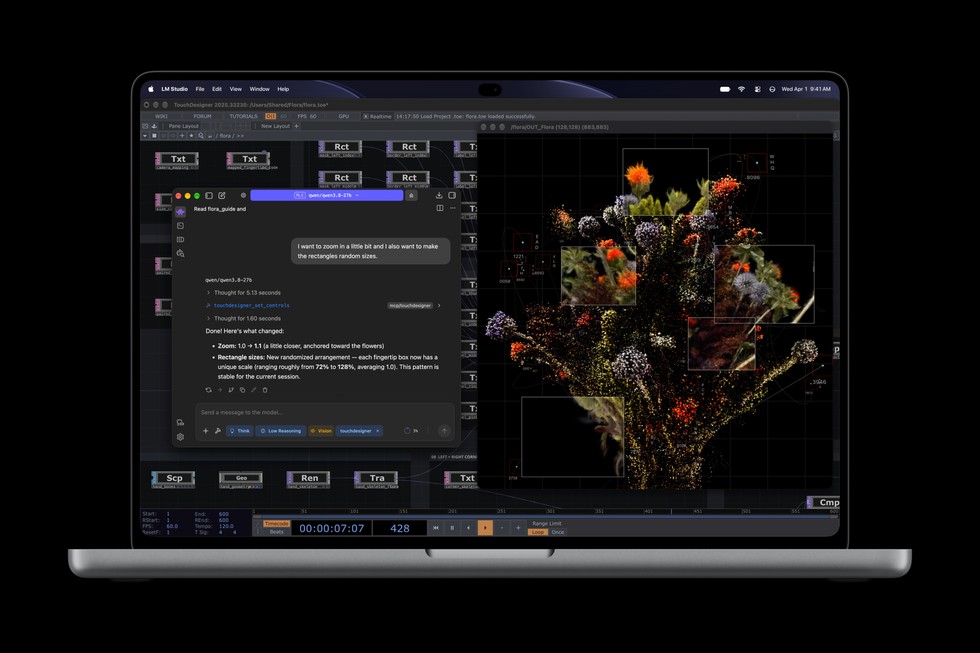
Inside are M5 Pro or M5 Max, not the newer M6 that powers the cheaper model. That looks backwards until you see the ceiling: up to 128GB of unified memory and 16TB of storage, with a Neural Accelerator in every GPU core. Apple gave no CPU or GPU core counts. For anyone running local models, memory is the figure that matters, and Apple chose to show LM Studio, a local LLM app, in its launch images.
Battery life is rated at up to 24 hours, from Apple's own testing in September 2026, and fast charging reaches 50% in about 30 minutes. The 14-inch weighs 3 lb and the 16-inch 4 lb. Apple says the 16-inch is 0.7 lb lighter and nearly 1 mm thinner than before, and the 14-inch is 0.5 mm thinner.
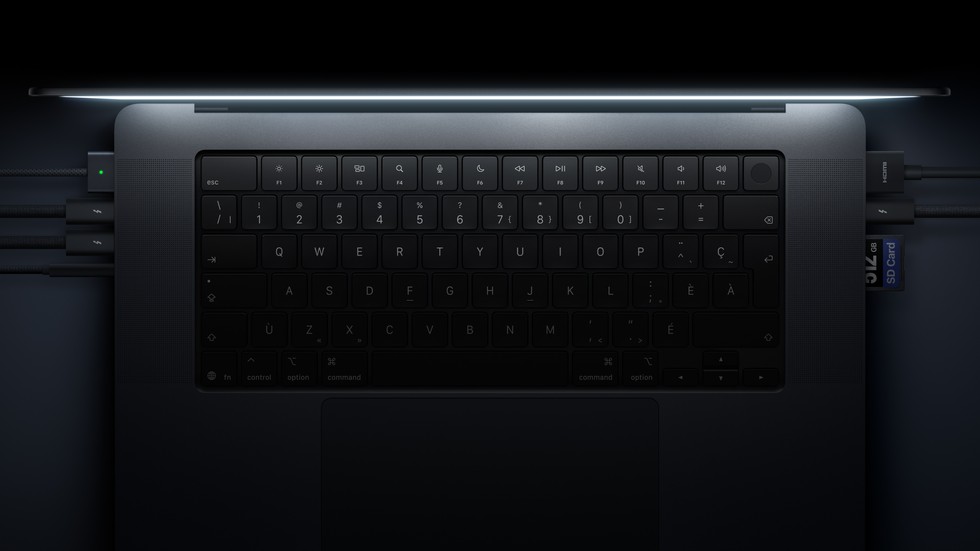
The ports are three Thunderbolt 5, HDMI, an SDXC slot, MagSafe and a headphone jack, where the $1,999 M6 model gets Thunderbolt 4. M5 Pro drives up to three external displays and M5 Max up to four. Wi-Fi 7 and Bluetooth 6 come from Apple's own N1 chip. A 12MP Center Stage camera, six speakers and Touch ID round it out.
Pricing and availability
These are US prices from Apple's October 28, 2026 announcement, checked on Apple's newsroom on October 29, 2026.
| Model | Price | Education |
|---|---|---|
| 14-inch, M5 Pro | $2,899 | $2,749 |
| 16-inch, M5 Pro | $3,399 | $3,199 |
| 14-inch, M5 Max | $4,499 | $4,199 |
| 16-inch, M5 Max | $4,799 | $4,499 |
Apple Upgrade leasing starts at $55.99 a month over 36 months. Apple also lists new power adapters at $59 for 70W, $79 for 96W and $99 for 140W, plus a $39 World Travel Adapter Kit.
MacRumors reports that the OLED models carry a $400 premium over comparable mini-LED models, which stay on sale, and that the top configuration reaches $14,549. Pre-orders are open at apple.com and in the Apple Store app in 30 countries and regions, with deliveries and store stock from November 6.
Which MacBook Pro this leaves you choosing
The lineup now has three rungs. The $1,999 M6 model is the entry point, with a mini-LED screen, 16GB of memory configurable to 32GB and Thunderbolt 4. The mini-LED M5 Pro and M5 Max models stay on sale above it. At the top, the PROLED XDR models add OLED, touch and the Dynamic Island for $400 more than the matching mini-LED configuration.
That $400 is easiest to justify for people who grade color or HDR video, where the contrast and Genlock do real work, and for developers who need to test their Mac app under touch before users report what breaks. It is hard to justify for anyone who spends the day docked to an external monitor. There the laptop panel is the whole difference, so the mini-LED model with the same chip keeps the $400 in your pocket. And if your work fits in 32GB of memory, price the M6 model first.
What's next
Shipping starts November 6, and that is when independent tests of brightness, battery life and touch accuracy will arrive. Johny Srouji, Apple's chief hardware officer, called PROLED XDR "the world's best laptop display". Reviews can now check that claim against rivals such as Microsoft's Surface Laptop Ultra.
The bigger open question is software. How fast touch support spreads beyond Apple's apps and the four third-party names in the launch release will decide whether touch on the Mac feels native or bolted on. Until then, touches translated into clicks are what every Mac app gets for free.