ChurnZero Review: Customer Success Software Rebuilt Around AI Agents
ChurnZero review: health scores, plays, Agentic Essentials, Retrospective and Kit AI, third-party pricing (~$44k/yr median), sync and export limits, and how it compares to Gainsight, Planhat and Vitally.
Expert Review

What changed in 2026
ChurnZero used to be easy to summarise: a customer success platform for B2B SaaS that turns product usage into a health score, then fires emails, tasks and in-app messages when that score moves. That part still exists, but in the last twelve months ChurnZero rebuilt the layer above it around AI agents, and the product you sign for in late 2026 is not the one in its old G2 reviews.
The timeline is short. Agents were first shown at the ZERO-IN conference in October 2025, and by December 17, 2025 the AI Marketplace listed 14 of them. In June 2026 ChurnZero bundled them into Agentic Essentials, sold as a flat annual fee with a set allotment of credits. The Retrospective churn-analysis agent followed on August 12, 2026, bringing the bundle to 20 agents. The Kit assistant arrived in October 2026. In early November ChurnZero announced its placement as a Leader in Gartner's 2026 Magic Quadrant for Customer Success Management Platforms, which it says is its third year in a row.
So the question is not whether it tracks health scores. It does. The question is whether the AI saves your CSMs enough hours to justify a contract that third-party data puts in the tens of thousands of dollars a year.
The core platform
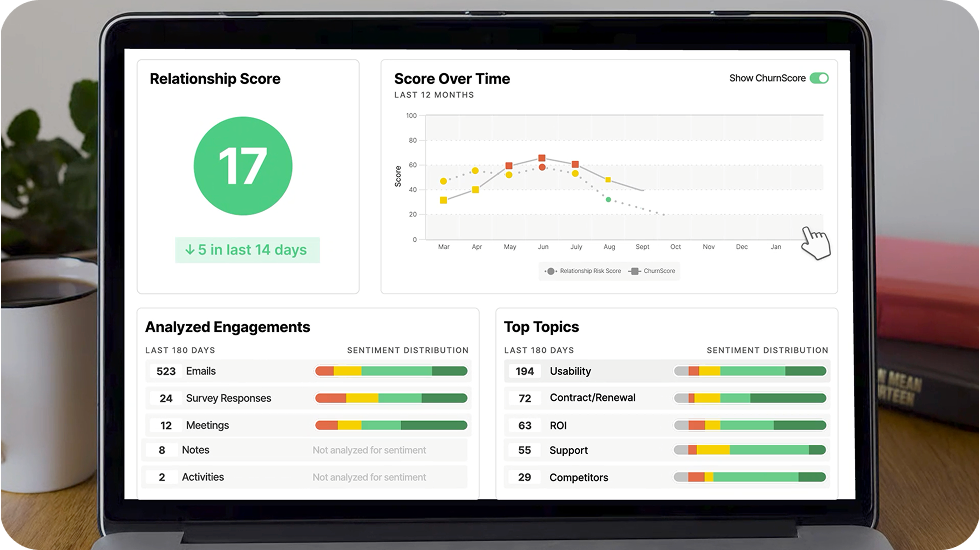
Under the AI, the workflow is the familiar one. Product usage arrives through a JavaScript snippet or an HTTP API, CRM data syncs in from Salesforce, HubSpot, Dynamics, NetSuite, Zoho, Pipedrive and four others, and the two combine into the ChurnScore that drives everything else.
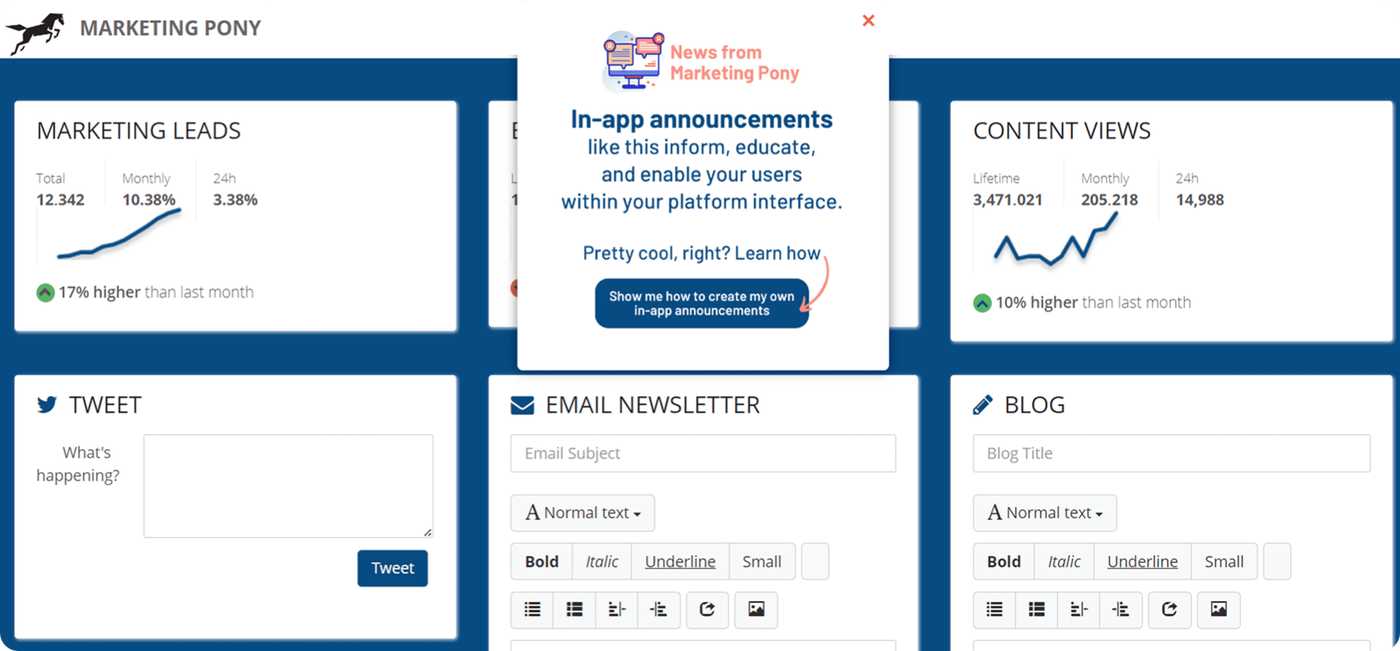
The Command Center's "My Book" tab is where a CSM starts the day: accounts renewing in the next 90 days, accounts at risk, upsell candidates, and a table with each account's ChurnScore and licence utilisation. From there, plays (rule-triggered task and email sequences) and journeys (multi-step customer paths) do the routine work, and in-app messaging reaches users inside your product without a separate tool like Pendo or Appcues for simple announcements.
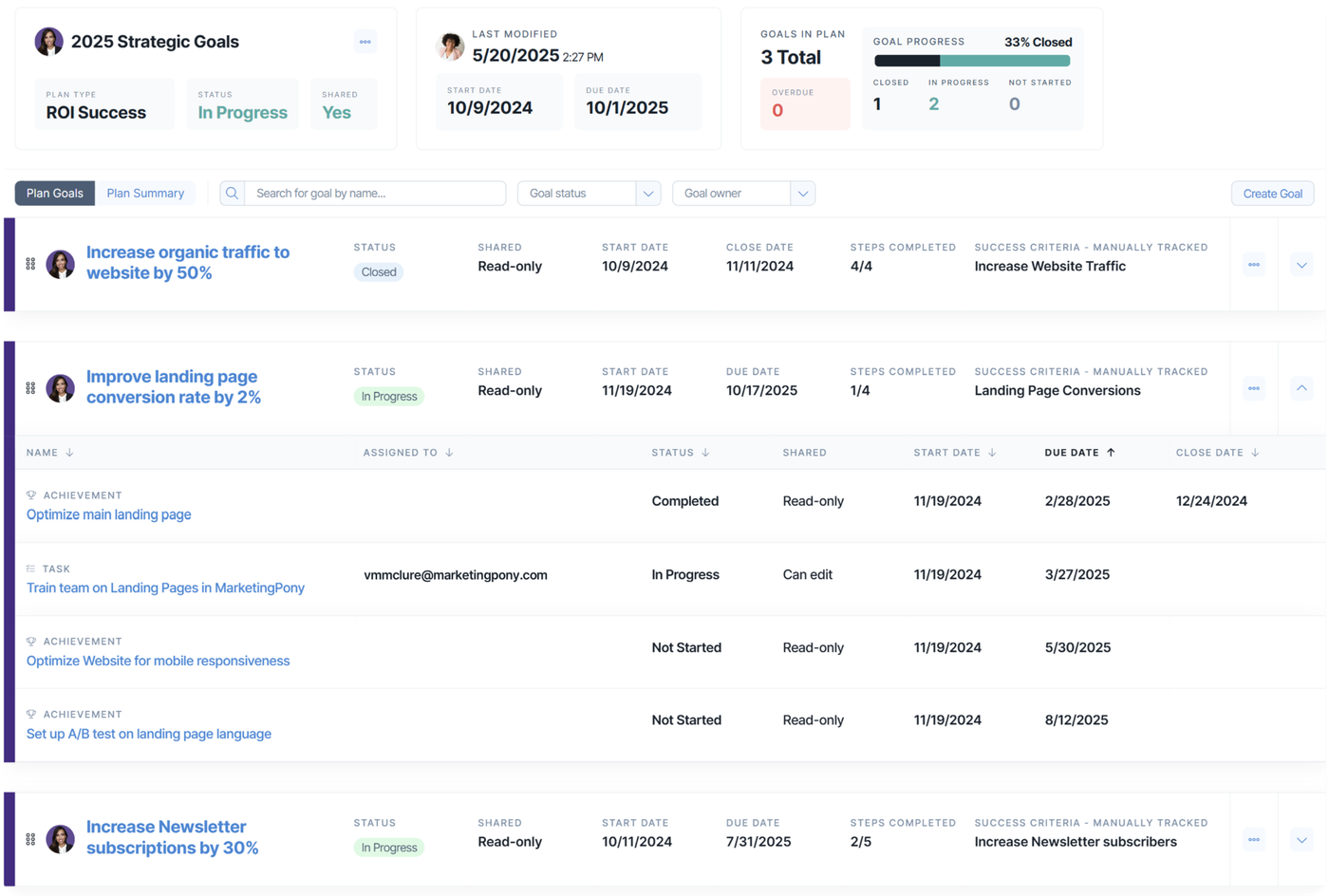
Success Plans are the customer-facing piece: a shared plan of goals and milestones that the customer can see and work on with you.
The AI agents, and what they actually do
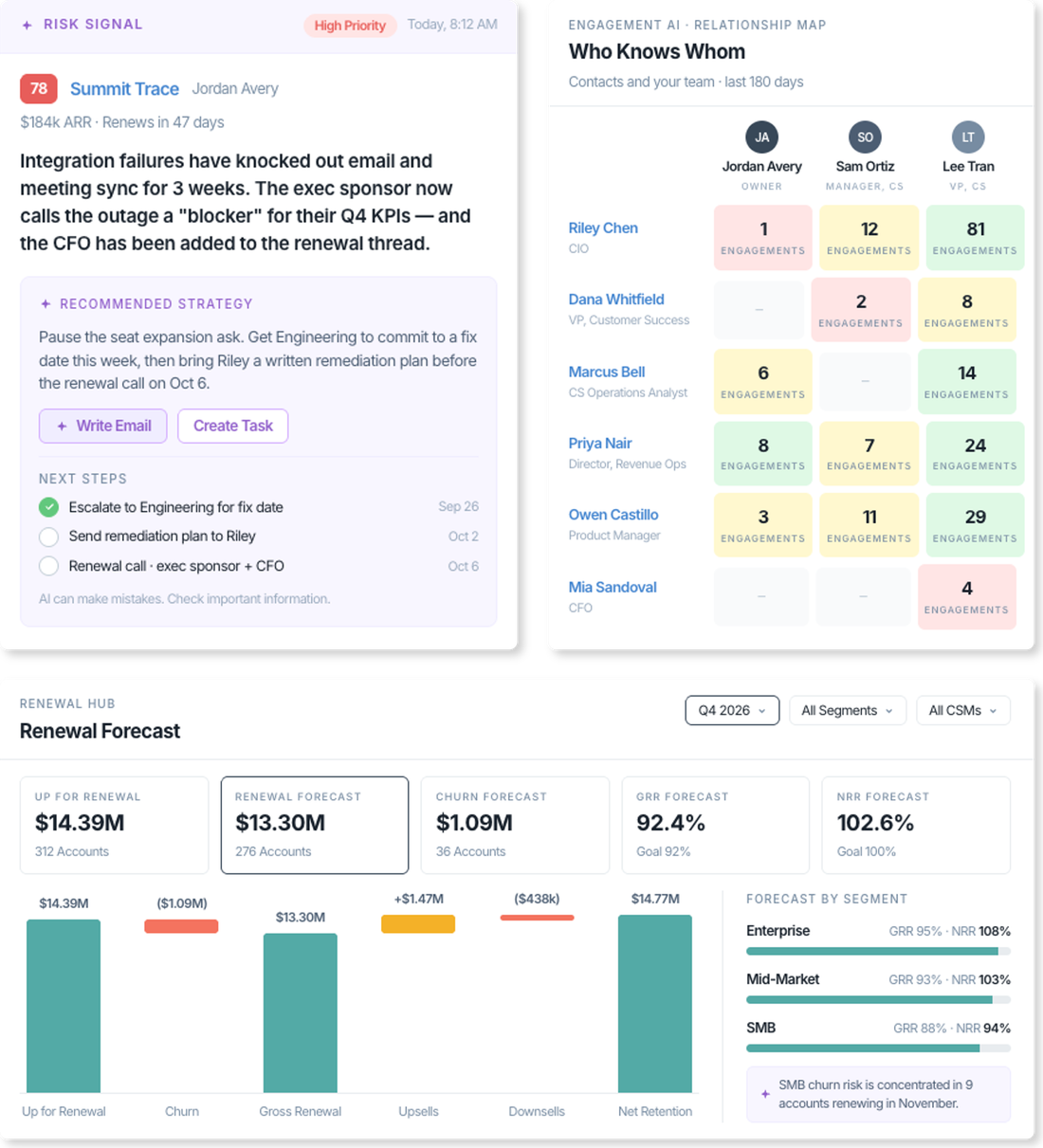
Agentic Essentials is available on the Professional and Enterprise editions, and it comes in four parts: the AI Marketplace and its agents, Knowledge Sources (product docs pulled from Zendesk Guide, Confluence, SharePoint, Intercom or Notion), a new Customer Intelligence Profile, and ChurnZero Connect, an MCP server that exposes live ChurnZero data to Claude, ChatGPT, Slack, Copilot Studio, Gemini Enterprise and Glean with admin-controlled read and write permissions.
The pricing model is the interesting part. All agents draw on one shared credit pool, paid for as a flat fee. ChurnZero pitches this directly against usage-based AI billing, and its compare page points out that Planhat charges for its own managed credits and then separately when you bring your own model. The catch is that "a set allotment of credits" is not unlimited, and the allotment is not published.
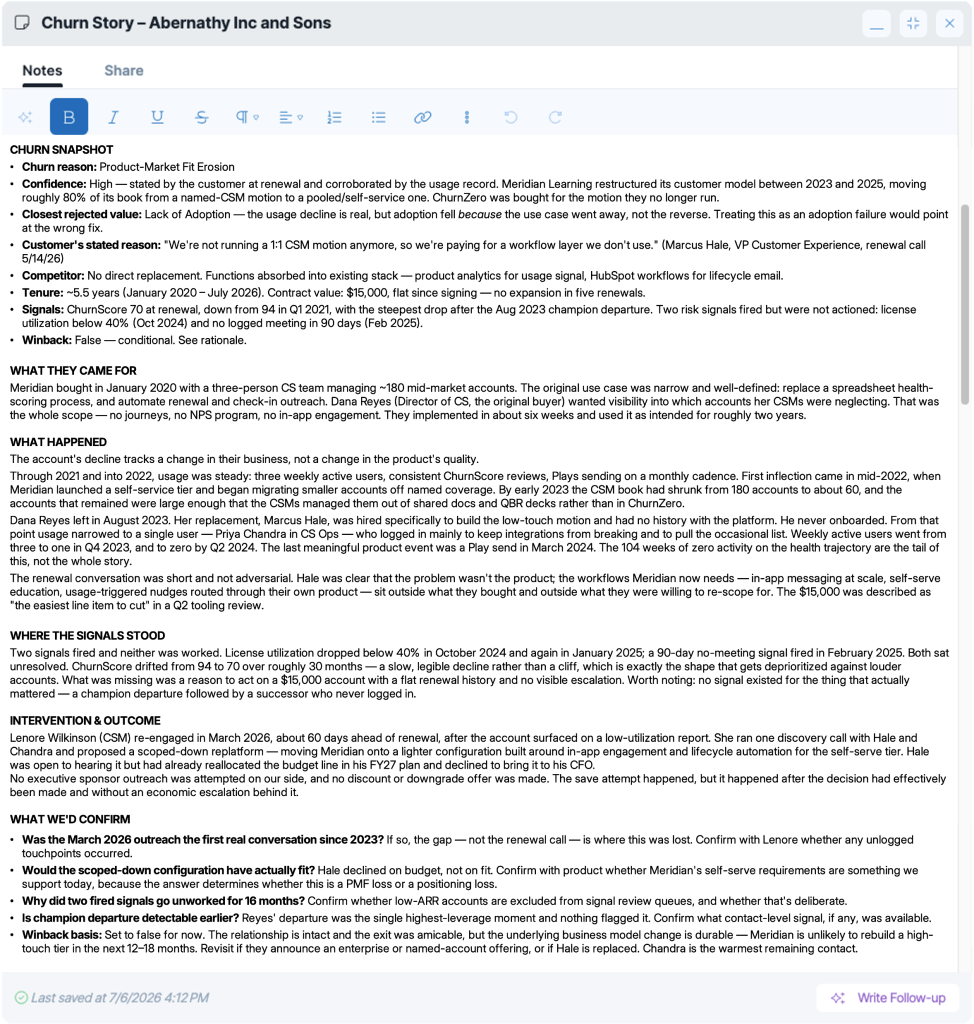
Retrospective is the agent with the clearest job. When an account is marked as churned, it reads the full account history, drafts a churn analysis, maps the cause onto your existing churn-reason list with a confidence score, and suggests a new reason to the CS leader when none fits. A CSM reviews, corrects and saves the note. As ChurnZero's Abby Hammer put it: "Most churn data is incomplete." If your churn-reason report is mostly "Other", this is the agent that pays for itself.
Kit sits in the top bar of every screen and in Slack and Microsoft Teams. It answers questions about one account or the whole book, creates tasks, drafts outreach in each user's writing profile, and saves a list of accounts as a dynamic segment that feeds a play. ChurnZero's example: find accounts nearing their licence limit, task each one, and save them as a segment feeding an expansion play, which later accounts enter on their own. Kit respects each user's permissions, and nothing reaches a customer until a person reviews it.
On data, ChurnZero states that it does not use customer data to train AI models and that requests are processed in your tenant's region, the US or the EU. Snapshot AI strips PII with NLP before prompts are sent.
The rest of the ZERO-IN 2026 keynote (November 5-6) is roadmap: AI CSMs with their own inbox and accounts, and AI renewal forecasts, were marked "coming soon" with no dates.
Pricing: no list price, and the add-ons
ChurnZero publishes no prices. Its /pricing/ URL returned a 404 when checked on November 18, 2026, and the only way in is to book a 30-minute demo. There is no self-serve trial.
Third-party data fills the gap. Vendr's buyer guide, last updated February 2026, puts the median contract at $44,213 per year across 102 purchases, with a low of $18,821 and a high of $128,773, and says buyers negotiated about 22% off on average. Capterra lists a starting point of $12,000 per year. Neither is ChurnZero's own number: use them to budget, not to quote.
Three details move the final number:
- You pay by customer accounts, not seats. According to Vendr, the main pricing dimension is how many of your customers you manage in the platform. Three CSMs covering 2,000 small accounts can pay more than ten covering 200 large ones.
- Onboarding is extra. Vendr reports onboarding, data migration and configuration fees from $5,000 to $25,000 or more, on top of the first-year subscription.
- Some AI is a separate add-on. Engagement AI, which scores relationships from calls, emails and tickets, is priced separately through your CSM, and it analyses English content only. Features such as the help centre and Snapshot auto-refresh are Enterprise-only.
Limits the sales demo won't mention
CRM sync is scheduled, not real-time. With Salesforce, the routine sync runs every 15 minutes and full syncs run over the weekend unless you force one. Custom account fields sync both ways only with a strict one-to-one field mapping, and ChurnZero will not push usage data back into Salesforce, so your sales team still has to open ChurnZero to see product adoption.
Smaller limits add up. Event descriptions are capped at 255 characters and silently truncated beyond that. Custom Tables cannot be updated with the setAttribute call, which means batch imports. Messages, tasks, notes and survey responses cannot be purged at all, which matters if a customer asks you to delete their data.
Leaving is the weak spot. Data comes out through Live Exports (segment-driven reports in Google Sheets or Excel 365) or the REST API. We found no documented process for a full data handover at contract end, so moving several years of notes and activity history to Gainsight or Vitally is a project you scope with the API, not a button.
Reviewers say the same thing from the other side. ChurnZero rates 4.7/5 on G2 from roughly 1,600 reviews, and 4.7/5 on Capterra from 131, checked in November 2026. But "learning curve" (54 mentions) and "complexity" (41) are G2's two most-tagged cons. Reviews quoted by Oliv.ai describe setup as "a significant amount of manual administration" and the product as "easier to deploy, harder to long-term manage". One Reddit comment in r/CustomerSuccess is blunter: "If you are a startup it may be too expensive and complicated for you."
ChurnZero vs Gainsight, Planhat and Vitally
| Best for | Where it loses to ChurnZero | Where it beats ChurnZero | |
|---|---|---|---|
| Gainsight | Large enterprises with a dedicated CS ops admin | ChurnZero's compare page claims Gainsight averages 4.6 months to go live and needs a dedicated admin | Deeper Salesforce-centric customisation at enterprise scale |
| Planhat | Data-heavy teams that want a flexible data model | AI is billed per credit, plus separate costs if you bring your own model | More flexible data model; transparent entry pricing |
| Vitally | Startups and small CS teams | Thinner AI agent catalogue and no equivalent of Retrospective | Faster to set up, cheaper, less admin overhead |
The Gainsight figures are ChurnZero's sales argument, but they match what reviewers say: ChurnZero sits between Gainsight's depth and the lighter tools.
Verdict
Buy ChurnZero if you run a mid-market B2B SaaS customer success team with a budget around $40,000 a year or more, your churn signals live in product usage, and you want plays, in-app messaging and AI drafting in one place without Gainsight's months-long rollout. Retrospective and Kit are real, shipping features, not slideware, and the flat-fee credit model makes AI costs predictable.
Skip it if you are a startup or a team of one or two CSMs. The account-based pricing, onboarding fees and admin overhead are hard to justify at that size; Vitally gets you health scores and playbooks for less money and less setup, and Planhat is the better fit if you need a flexible data model. And if your company lives inside Salesforce and needs heavy custom objects there, Gainsight is still the safer choice, because ChurnZero will not write usage data back to Salesforce.
Whichever way you lean, ask in the demo for the credit allotment in Agentic Essentials, the onboarding fee, and the data-export terms at contract end. Those three answers decide what ChurnZero really costs.
Ready to try ChurnZero?
Visit the official website to see the latest plans, pricing, and special offers.
Get Started - ChurnZero* Affiliate link - we may earn a commission at no extra cost to you.