UserGems Review: Job-Change Signals, Gem-E Agents and a $40K Entry Price
UserGems review: job-change and buying signals, Gem-E AI agents, the new MCP for Claude and ChatGPT, published $40K-$150K pricing, setup, and who should skip it.
Expert Review

The signal it was built on
When the person who signed your contract leaves for a new company, they take their opinion of you with them. UserGems was built to catch that moment. It watches the people already in your CRM - past buyers, evaluators, users from closed-lost deals - and flags the day one of them lands somewhere new, with a fresh contact record already created for the rep.
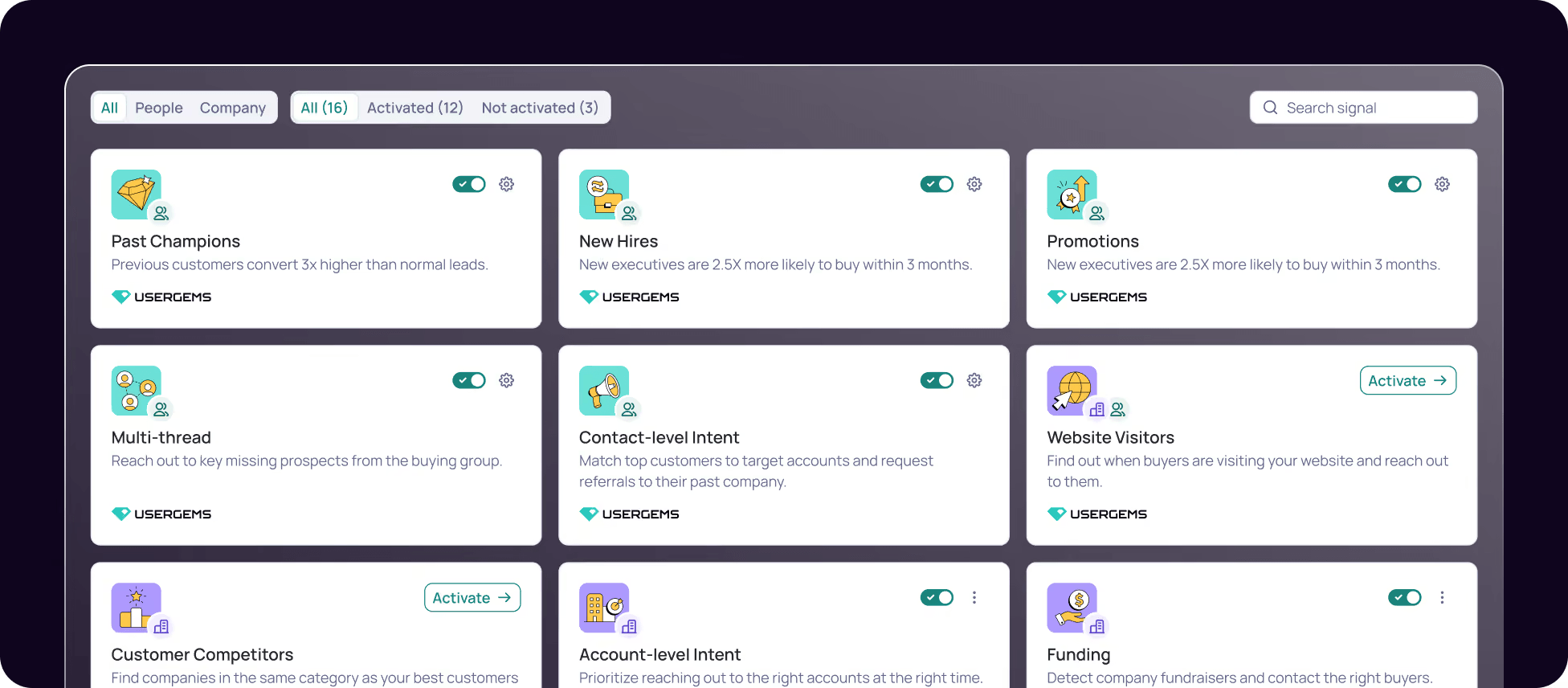
That job-change feed is still the core, but it is no longer the whole product. The homepage now calls UserGems "The AI Command Center for Outbound and ABM", and the signals page lists 30+ native signals and 600+ fit attributes. Role changes sit next to contact-level intent, website de-anonymization, G2 activity, closed-lost deals, call-transcript mentions, funding and M&A news, and product usage.
The people signals remain the strongest part: past champions, past evaluators, new hires at target accounts, promotions, and departures from current customers. That last one is a churn warning, and customer success teams often want it more than sales does.
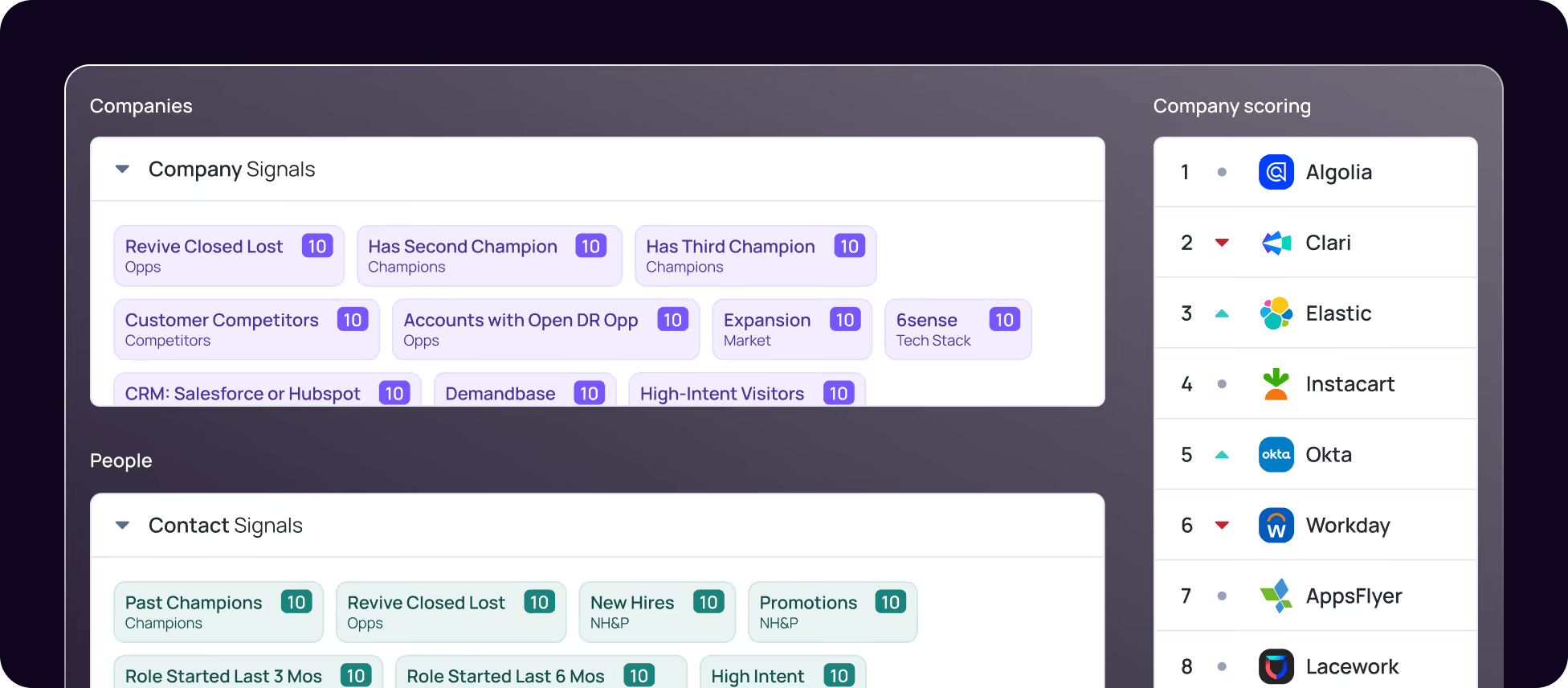
Scoring sits on top. UserGems reads your opportunities and deal outcomes, weighs them against those 600+ criteria, and ranks accounts and contacts. The vendor says the models are fully customizable and refreshed weekly. Buying Stages add weights with automatic decay, so an intent spike from three months ago stops propping up an account that has gone cold.
Pricing: published, and not small
Most tools in this category hide behind a sales call. UserGems still makes you take one - every plan button reads "Contact Us" - but it prints list prices. Checked on the pricing page in November 2026:
| Plan | Per year | Credits | What they buy | TAM coverage | Implementation (one-time) |
|---|---|---|---|---|---|
| Core | $40,000 | 4,000,000 | 40K data actions or 400K AI actions | 2-4k accounts | $3,000 |
| Advanced | $75,000 | 10,000,000 | 100K data actions or 1M AI actions | 4-10k accounts | $5,000 |
| Elite | $150,000 | 25,000,000 | 250K data actions or 2.5M AI actions | 10k+ accounts | $10,000 |
| Enterprise | Contact sales | - | - | - | - |
Two details reshape that table. Seats are not the limit: admins and end users are unlimited on every plan, so a 60-rep team pays the same as a 6-rep team on the same tier. Credits are the limit, and the exchange rate is lopsided. A data action costs 100 credits and an AI action costs 10, so a team that enriches heavily drains Core ten times faster than one that mostly drafts emails. The pricing page does not say what happens when credits run out; Vendr's buyer guide puts data enrichment overages at 10-25% on top of the annual bill.
First-year cost on Core is $43,000 at list once implementation is added. Add the optional $3,000 "Retroactive Job Change Leads" backfill and it is $46,000. A vendor-funded rep incentive ("UserGems Sponsored SPIFF", $300 to $1,000) quietly admits the leads only become pipeline if reps work them.
List is not what people pay. Vendr's guide, last updated in February 2026, puts the median buyer at $30,500 a year, across a range of $13,300 to $69,530, with buyers saving about 22% on average. Treat $40,000 as an opening position.
The page also promises "Money back if you don't get ROI in closed-won revenue." It does not define the measurement window or how revenue gets attributed to UserGems. Get both written into the order form before you count on it. Contract length, auto-renewal terms and overage rates are not published anywhere we could find.
Getting in: demo first, admin required
There is no free tier, no trial and no self-serve signup. The only door is "Book Demo". What UserGems offers instead is a data test: you send records and they "hand back the raw file and show you every record we got right - and every one we got wrong." Take it: it is free, and it is the only accuracy figure that is not a marketing claim.
After signing, an Implementation Manager sends the sign-up links and approves the connection. On Salesforce you need an SFDC admin to set up an integration user, because, in UserGems' own words, "All new records will be created via this user." UserGems writes into your CRM directly: new contacts and leads, plus custom fields such as "UG - No Longer at Company" and "UG - Created By UG". HubSpot gets a native integration through a connected integration user too.
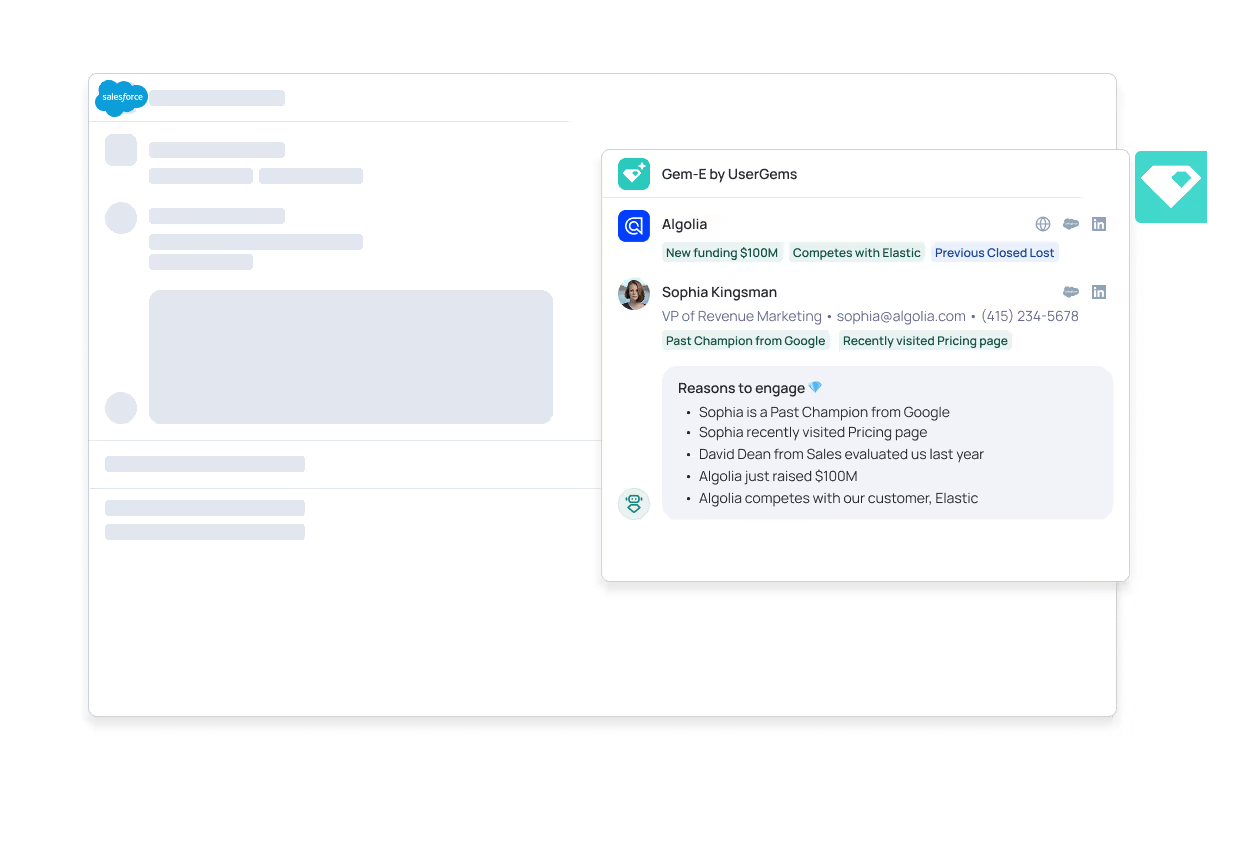
That is both the strength and the catch. Every contact UserGems creates lives in your own Salesforce or HubSpot, so the records stay if you cancel. But a tool that writes to the CRM on its own needs someone to own field mapping, dedupe rules and sandbox testing before it goes live. Reviewers rate UserGems highly overall - around 4.7 out of 5 on G2 from roughly 150 reviews - yet G2's summary of the complaints lands in the same place: occasional inaccurate data, and difficult setup on customized CRMs that eats real technical time.
Only Salesforce and HubSpot are supported. A team on Pipedrive, Dynamics or Zoho is out before the demo starts. Sequences go to Outreach, Salesloft or Gong Engage.
Gem-E, the agents and the MCP server
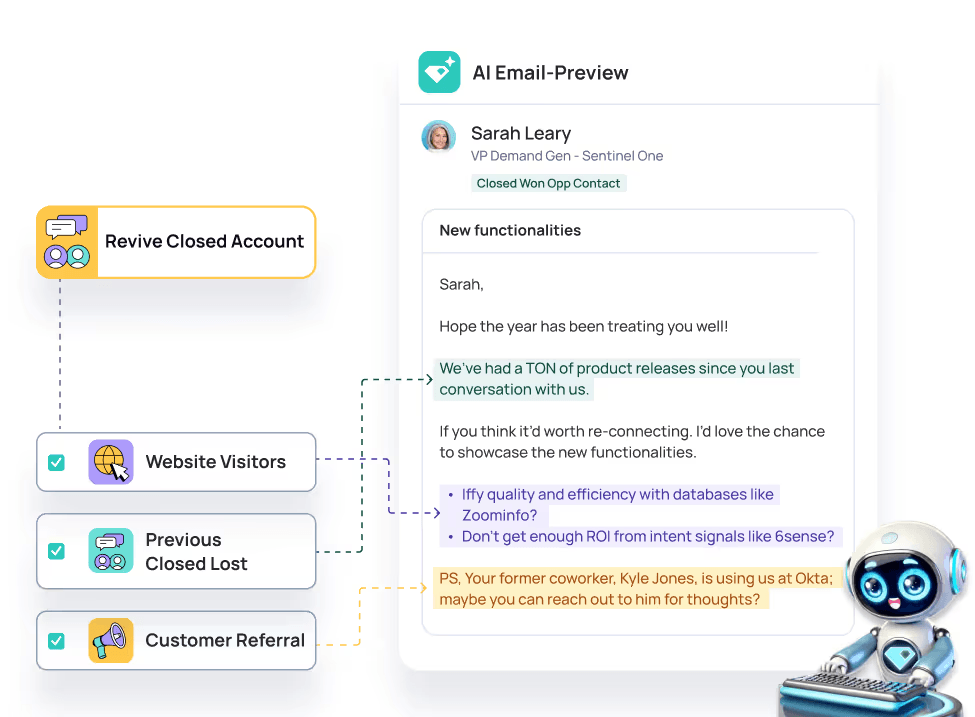
Gem-E arrived on January 15, 2025, pitched as an outbound agent that writes emails, call scripts and LinkedIn messages from buying signals and CRM history. Its edge is context: it knows the prospect used your product at their last job, a sentence no generic AI writer can produce. UserGems says Gem-E sequences reach 6-20% reply rates against an industry average of 1-2%. That is the vendor's number, measured on its customers' warmest leads.
The bigger change came in September 2026. At its Insiders session on September 15, UserGems launched a Research Agent, a rebuilt Writing Agent and UserGems MCP, with the press release following on September 18. The MCP server is a headless interface to the whole platform. Connect it to Claude or ChatGPT and an admin can build or edit campaigns by typing, or change one setting across many campaigns at once. The vendor's sample prompt builds a weekly past-champion campaign, writes five emails into Outreach and sends a Sendoso gift to anyone scoring above 85.
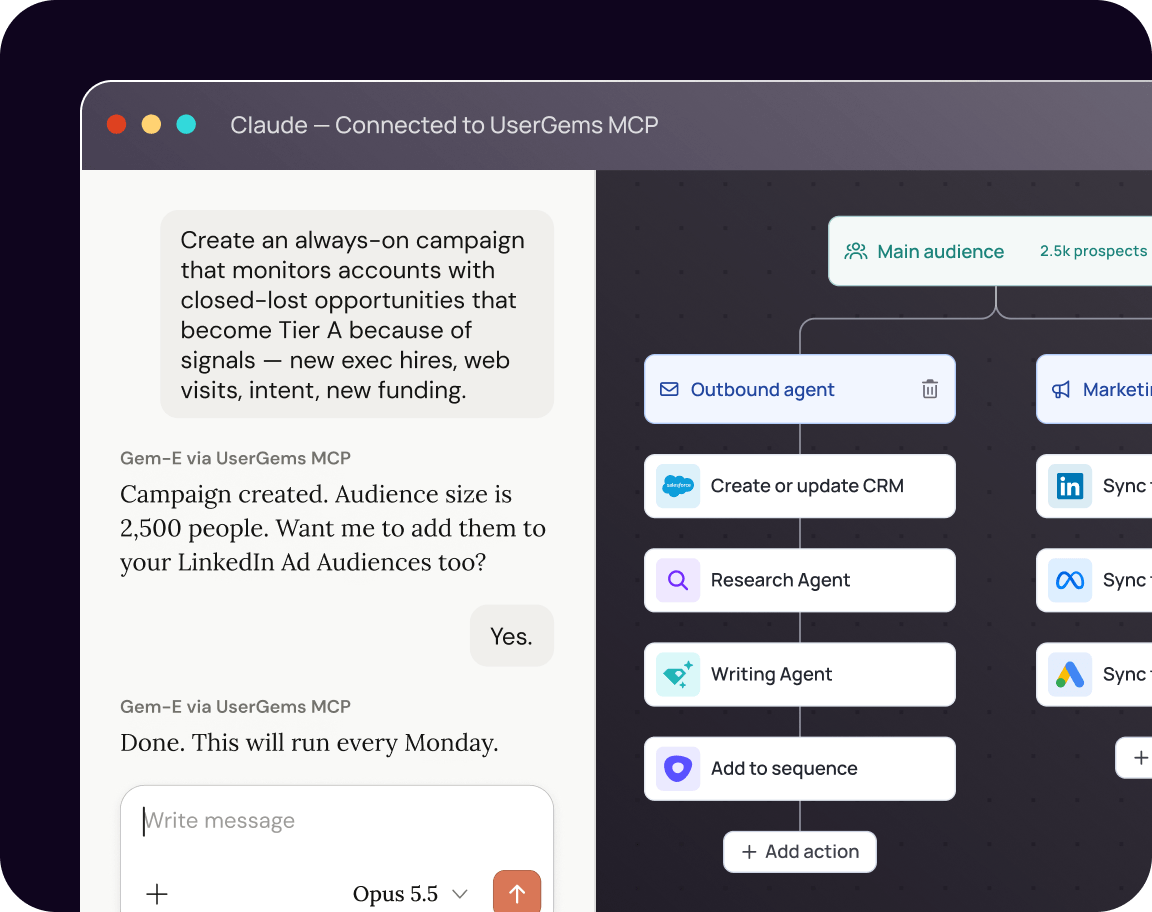
CEO Christian Kletzl framed it as acting rather than searching: "Most MCPs out there help you find data. We wanted to bring the intelligence to act, not just look things up." Inbound connections from Gong, Webflow and Sendoso let Gem-E pull a transcript or case study mid-campaign. But the MCP product page marks "Connect multiple agents" as coming soon, so not all of the cross-tool orchestration in the demos has shipped. Today, treat the MCP as a faster admin console.
Where the data comes from
UserGems says its agents collect from publicly available sources, checked by AI and humans, and that it rechecks every day while ZoomInfo, 6sense and Clay "refresh every 6-12 months". It claims an error rate under 3% and bounces under 5%. The privacy policy, last modified on November 3, 2026, is more specific about what is collected: names, titles, departments, current and past employers and employment dates going back up to seven years, taken from public professional profiles such as LinkedIn. Deleted people go on a suppression list so they are not collected again.
The security page lists SOC 2 Type 2, GDPR compliance as both processor and controller, AWS or Azure hosting, OAuth2 for integrations and annual third-party penetration tests. Standard at this price. EU buyers should notice the word controller: UserGems holds the people data in its own right, and your privacy notice has to say so.
UserGems vs Champify, Clay and Apollo
Champify is the closest like-for-like. Vendr puts a typical 25K-contact contract at $30,000-$50,000 for UserGems against $25,000-$45,000 for Champify. UserGems' comparison page says Champify "Missed 40% of correct job changes" - a competitor's claim, so run both vendors on the same data test before believing either. If champion tracking is all you need, Champify is the cheaper way to get it.
Clay is the build-it-yourself route. UserGems positions it for one-off enrichment that needs technical staff and estimates it at about $8,600-$21,000 a year in credits - again, UserGems' figure. For a team with a RevOps person who enjoys building tables, that covers job-change enrichment for a fifth to a half of Core's list price, without the scoring or the agents.
Apollo is for teams that cannot justify five figures: self-serve, a contact database you can search today, sequences built in. It will not watch your past champions for you. 6sense is the intent-data alternative for larger ABM budgets.
Verdict
UserGems is good at one thing that is hard to copy: turning years of CRM history into a list of people who already like you and just moved somewhere you can sell to.
Buy it if you run Salesforce or HubSpot, have several years of closed-won and closed-lost deals with real contacts on them, and can spend $43,000 in year one plus someone's time to own the CRM integration.
Skip it if your sales team is a handful of people, your CRM history is thin or lives on another platform, or you mainly want cheap enrichment. Champify does champion tracking for less, Clay does the enrichment for a fraction of the price if you will build it, and Apollo gets a small team prospecting this afternoon. Whichever way you lean, run the free data test first - it is the only accuracy number here that does not come from the vendor.
Ready to try UserGems?
Visit the official website to see the latest plans, pricing, and special offers.
Get Started - UserGems* Affiliate link - we may earn a commission at no extra cost to you.