Clay Review: Actions, Data Credits and What $167 to $495 a Month Really Buys
Clay review: Launch $167 and Growth $446 a month billed annually, Actions vs Data Credits, cost per enriched record, rollover and top-up rules, exit costs and the best alternatives.
Expert Review

Clay bills every record on two meters
Most data tools sell you one currency. Clay, the GTM spreadsheet that pipes 150 to 200+ data providers and its own AI research agent into a single table, has run on two since March 11, 2026. Actions pay for the platform's work: each enrichment step, each export, each lead pushed into a campaign. Data Credits pay for the data and AI that come from vendors in Clay's marketplace. One enrichment always costs 1 Action, plus anywhere from 0.5 to 10+ Data Credits depending on what it fetches.
The split arrived when Clay folded its Starter, Explorer and Pro plans into two new ones, Launch and Growth. Existing customers could stay where they were, and the window for switching between legacy plans closed on April 10, 2026. Clay says the change cut marketplace data costs by 50-90%; in its own example, a workflow that cost 20 Data Credits now costs 7.3. The community was less generous. LeadGenius, a competitor with an obvious stake, wrote in August that the pricing "didn't get more expensive in absolute terms - it got more uncertain."
That is the real question here. Clay is not going anywhere: it raised $115M at a $7.1B valuation on September 9, 2026, after 4x revenue growth in 2025, and counts more than 17,000 customers. Whether you can predict its bill is another matter.
Pricing: what $167 to $495 a month buys
Checked on clay.com/pricing on November 3, 2026. Annual billing saves 10%, and the annual prices below are monthly equivalents. Several third-party write-ups label the $185 and $495 monthly prices as annual. They are not.
| Plan | Billed annually | Billed monthly | Included each month | What it adds |
|---|---|---|---|---|
| Free | $0 | $0 | 500 Actions, 100 Data Credits | Unlimited seats and tables, waterfalls, Claygent; 200 rows per table, no phone numbers |
| Launch | $167 ($54 Actions + $113 credits) | $185 ($60 + $125) | 15,000 Actions, 2,500 Data Credits | Phone enrichment, job-change and signal tracking, email campaign integrations, 50,000 rows per table |
| Growth | $446 ($185 + $261) | $495 ($205 + $290) | 40,000 Actions, 6,000 Data Credits | CRM integrations, HTTP API, data warehouses, webhooks, web intent signals, ad audiences |
| Enterprise | Custom, annual commitment | Custom | SSO/SAML, SCIM, RBAC, IP allowlists, credit budgeting, Clay API, more than 50K records at once | |
The Actions/credits split inside each price is our arithmetic from Clay's add-on line items, which sum exactly. Launch can also grow without becoming Growth: at monthly rates, Actions go to 40K for $150 or 200K for $540, and Data Credits to 6K for $290 or 50K for $2,125.
Two rules on that page work in the buyer's favour. Seats are unlimited on every plan, Free included, so a ten-person team pays what one person pays, where Apollo bills per seat. And an enrichment that returns nothing costs nothing, across an entire waterfall. One number does not add up: Clay's FAQ and launch blog put Launch at 2,500 Data Credits a month, while the annual plan card shows 3K. Budget for 2,500.
The per-record math
Clay's own docs say a fully enriched record "typically costs 6-20 Data Credits". On Launch, 2,500 credits therefore buys between 125 and roughly 415 complete records a month; Growth's 6,000 stretch to 300-1,000. At Clay's 7.3-credit example, call it about 340 records on Launch and 820 on Growth.
In dollars, Launch's annual rate works out to about 4.5 cents a credit, so a full record lands between $0.27 and $0.90 before Actions. Actions barely register at around a third of a cent each. Building lists, importing from a CRM or warehouse, formulas and Sculptor cost none. Getting data out does: every exported record is 1 Action, and so is every lead added to a Clay Sequencer campaign (per lead, not per email).
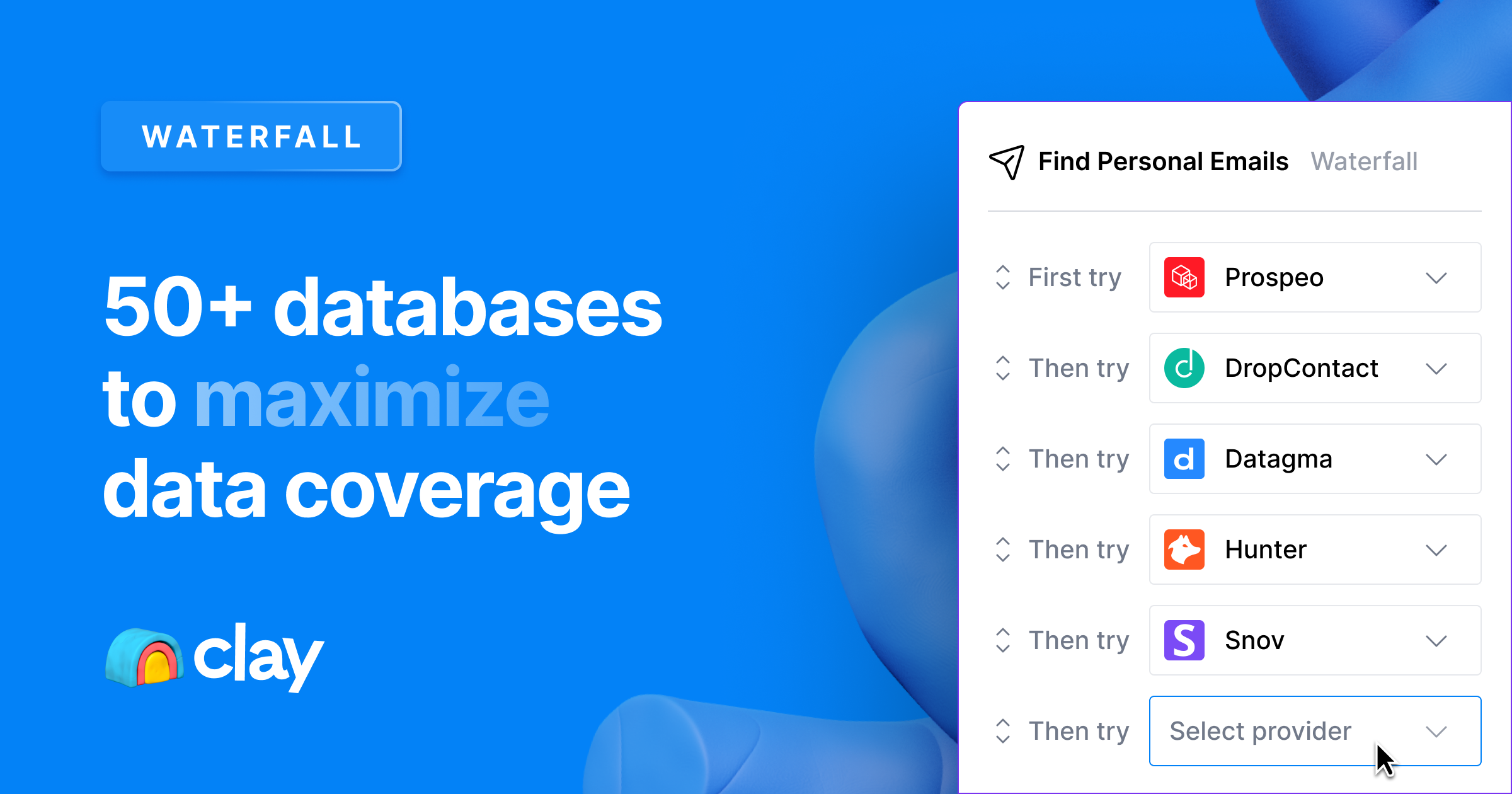
The waterfall is the feature worth paying for, and also where the meter spins. Clay asks provider after provider until one returns the email or phone number, and every step that returns data bills its own credits and its own Action. A record found on the first provider is cheap. One found on the fourth, after three partial hits, is not. That is how reviewers on Trustpilot come to describe Clay as "eating credits for no reason": the charges are real, just spread across steps nobody watched.
Bringing your own AI provider key stops AI runs from using Data Credits, though each run still costs 1 Action and Clay does not show you the token bill. Clay also says runs on its own keys are 2x faster because of higher rate limits. BYOK trades speed for cost.
Claygent, Sculptor and the AI layer
Claygent is the reason many teams put up with the rest. Point it at a column of company domains, ask something no database answers, such as whether a company sells to hospitals, and it researches each row on the open web. Clay's counter showed more than 5 billion runs when we checked. Every decision comes with a full reasoning trace, which matters when you are about to email 3,000 people on the strength of its conclusions.
The model list is unusually open: Clay's own Neon, Helium and Argon, OpenAI models from GPT-4o to GPT-5.1, Claude 4.5 Haiku up to 4.6 Opus, the Gemini 2.5 family, and open models such as Kimi K2.6 and GLM 5.2 through Fireworks. Since late October 2026 an auto mode picks the model per task. About 80% of models still cost a flat number of credits per task. Token-heavy ones like GPT-5.1 and Claude 4.6 Sonnet are billed by usage with no markup, and Clay reserves credits up front at the 75th percentile of past runs, so a long prompt can briefly hold more than it ends up spending.
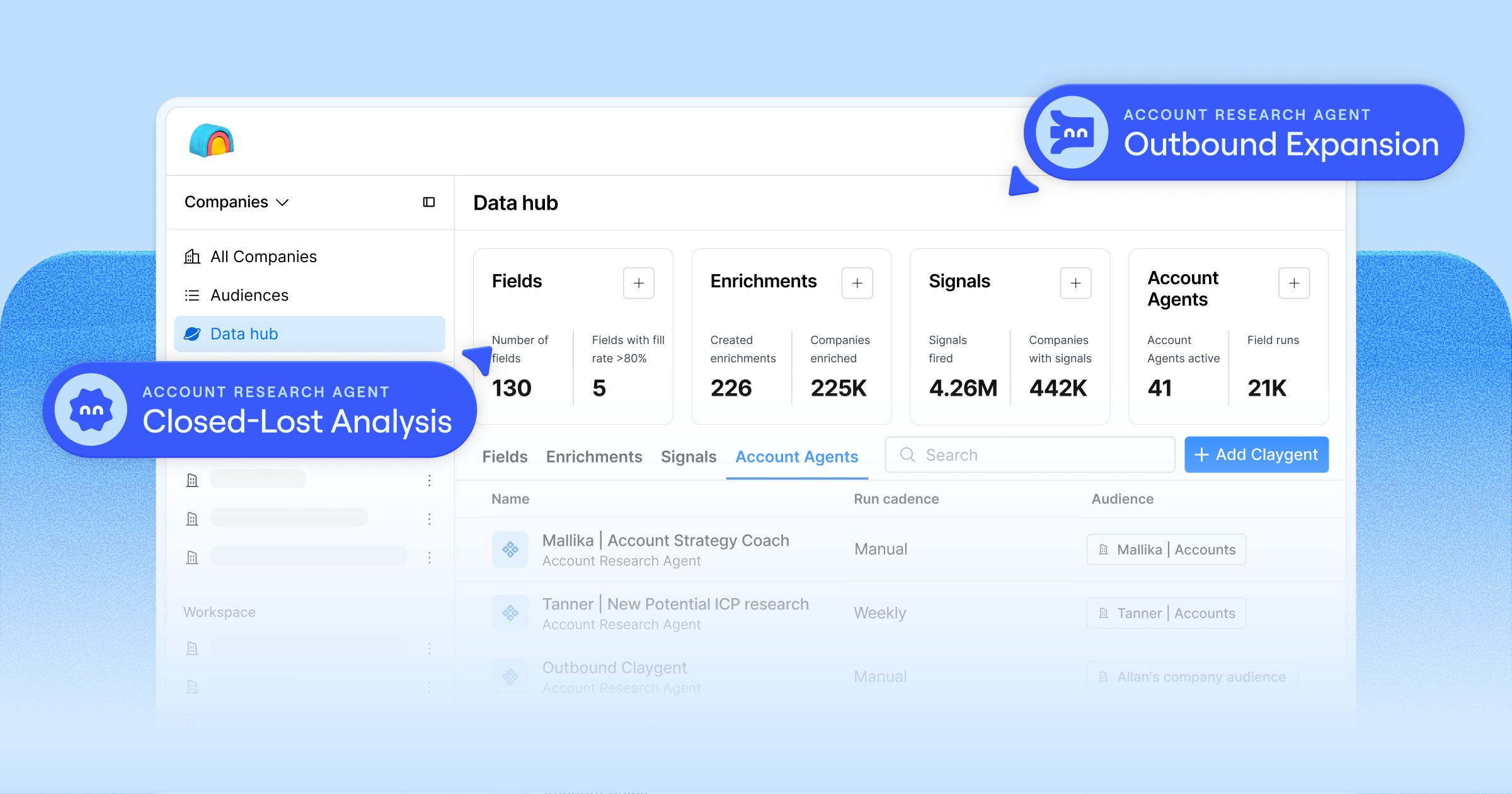
Sculptor, the co-pilot that turns a plain-English idea into a working table, costs no Actions and is the fastest way past the learning curve. A full "you set the goal, Clay builds the play" agent also exists, but it is in beta for a small group of users. Do not buy for it yet.
The limits the plan cards bury
The free plan is a demo, not a tier. It needs no credit card and includes waterfalls and Claygent, but 200 rows per table lets you test a workflow, not run one, and phone numbers are off entirely.
The bigger wall sits between Launch and Growth. CRM integrations, HTTP API calls and webhooks are Growth-only, so a Launch team cannot sync enriched records into Salesforce or HubSpot natively. It exports files at 1 Action a row, or it pays $446 a month. HTTP API used to sit on the old Explorer plan; anyone who depended on it now pays Growth prices. Audiences, which merges CRM, warehouse, signals and enrichment into one data layer, is a Growth feature too, with unlimited search and 250K imports. SSO is Enterprise-only, which a larger company's security review will flag before it reads the SOC 2 Type II report or the ISO 27001 and ISO 42001 certificates.
Running short mid-month is expensive in a specific way. Data Credits can be topped up at a 30% premium, 250 minimum. Actions cannot be topped up at all, so running out means upgrading or waiting for the reset. Rollover is murkier still, because Clay publishes three versions of it. The pricing table says "up to 1 month's credits", or 15% of annual credits on annual plans. The FAQ says unused credits can build up to 2x the monthly amount and Actions never roll over. The docs say the annual 15% only carries over if you renew on the same or a higher tier. Top-ups contradict each other the same way: the March blog says limits were "removed entirely", the docs still cap each top-up at $1,000 and all top-ups at $5,000 per rolling seven days. Assume the stricter reading of each until support confirms otherwise in writing.
Cancelling and getting your data out
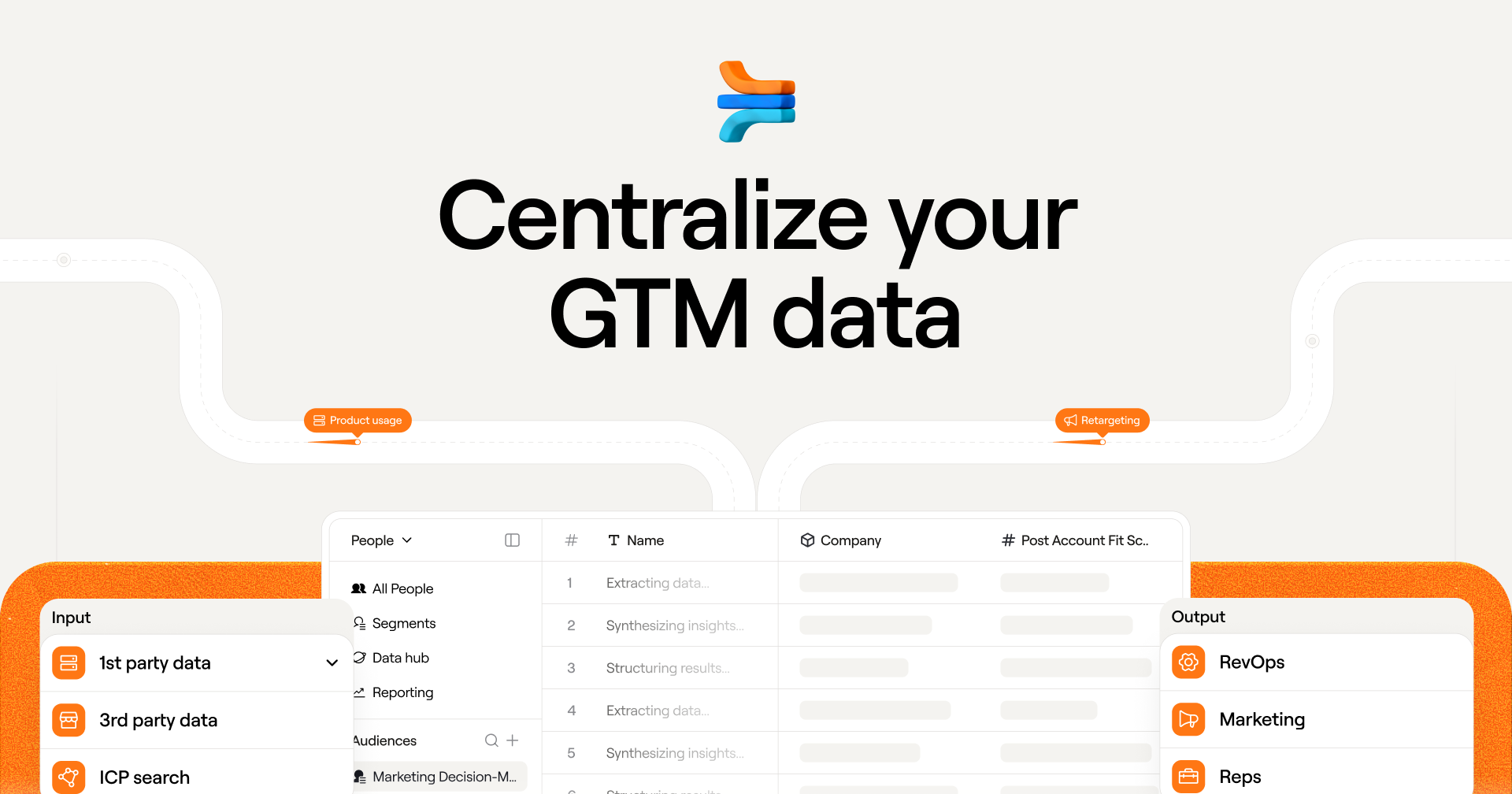
Clay's terms, last updated May 23, 2024, say all fees are non-refundable and that contracts renew automatically "at Clay's most-up-to-date-rates". After March, that clause has teeth. You cancel by emailing [email protected] or from the account itself. The workspace then drops to the free plan; your data stays stored, but Clay does not guarantee retention after extended inactivity.
Put those rules side by side. The free plan caps tables at 200 rows, and exporting costs 1 Action per record, so pull your data out before the paid plan lapses. A 30,000-row table needs 30,000 Actions to leave: two full months of Launch's allowance.
Support is the other complaint that keeps coming back. One Trustpilot reviewer paying $350 a month says the best answer they got was to "ask your LLM for help debugging"; another reports seven days and several chats without a fix. With a learning curve this steep, that matters. Clay rewards a team with someone who thinks in tables and formulas. Without one, it stalls.
Clay vs Apollo, Persana and Cargo
Credits are not comparable unit for unit across these tools, so compare what each one bills on rather than the headline number.
| Tool | Entry paid plan | How it bills | Better than Clay when |
|---|---|---|---|
| Clay | $167/mo billed annually (Launch) | Actions + Data Credits, unlimited seats | - |
| Persana | $68/mo billed annually (24K credits a year), or $85 monthly for 2,000 a month | One credit pool | You want AI enrichment without two meters and at less than half Launch's price |
| Cargo | From $165/mo for 1.5K credits ($0.25 a credit) | One credit pool | You want workflow automation priced on a single, readable unit |
| Apollo | Per-seat plans | Seats, with its own contact database | A small team mostly needs emails and phone numbers from one source |
| ZoomInfo | Quote only | Annual contract | A large sales org wants to buy a database outright and has the budget |
Persana and Cargo prices were checked on their pricing pages on November 3, 2026. What none of them matches is Clay's breadth: no other tool here lets one table chain dozens of providers and a browsing agent row by row.
Verdict: who should pay for Clay
Buy Clay if you run RevOps or growth for a team selling into a defined market, you have one person who will own the tables, and you need coverage no single database gives, plus CRM sync. That means Growth, at $446 a month on annual billing. For that team, unlimited seats and the no-result-no-charge rule make Clay fairer than its pricing page suggests, and Claygent answers questions nothing else in this category can.
Skip it if you are a founder or a three-person sales team that mainly needs verified emails and phone numbers. Launch will feel like paying $167 a month for a spreadsheet that cannot talk to your CRM, and watching two meters will cost more attention than the data is worth. Apollo's per-seat database is simpler for that job, and Persana gets you AI enrichment on one credit pool for $68 a month.
Either way, start on the free plan, build one 200-row table of real accounts, and read the credit log before paying for anything.
Ready to try Clay?
Visit the official website to see the latest plans, pricing, and special offers.
Get Started - Clay* Affiliate link - we may earn a commission at no extra cost to you.