Common Room Review: Buyer Signals, RoomieAI and the $30k Entry Price
Common Room review after the Zoom deal: the $2,500/mo Essential plan, US-only person-level visitor ID, add-on gating, and when RB2B, Clay or 6sense fits better.
Expert Review

Zoom owns it now, and the entry price went up
Earlier this year you could get into Common Room for roughly $1,000 a month, according to third-party pricing guides. Today the cheapest plan costs $2,500 a month, billed annually, and the only button on the pricing page says "Request demo". In between, Zoom bought the company.
Zoom announced a definitive agreement to acquire Common Room on July 2, 2026 and says the deal closed the same month. Terms were not disclosed. CEO Linda Lian, who started the company in Seattle in 2020 with Viraj Mody, Francis Luu and Tom Kleinpeter, moved to Zoom with her team. Her pitch for the deal: "Joining Zoom connects our graph to the conversations sellers have every day."
That graph is the product. Common Room calls itself "the AI-native go-to-market platform for buyer intelligence and action" and aims at mid-market and enterprise B2B companies. Zoom names Atlassian, Anthropic, Autodesk, Notion, Okta and Snowflake among its users. There is no free plan and no trial, so nobody can kick the tyres without a sales call. The limits below come from Common Room's own pricing matrix and documentation, checked on November 3, 2026.
Signals, Person360, RoomieAI and Prospector
Common Room collects buyer signals: website visits, community activity in Slack, Discord, Discourse and GitHub, product usage, third-party intent from Bombora, G2 and TechTarget, job changes, hiring trends and call transcripts. The vendor counts "dozens of out-of-the-box signals" and "50+ native signal integrations".
Person360 is the identity-resolution engine. It ties the GitHub handle that starred your repo, the Slack member asking about SSO and the visitor reading your pricing page to one person at one account, then runs waterfall enrichment across "dozens of providers" to fill in email and title. Common Room claims 30-50% higher match rates and up to 79% fewer duplicate records. Vendor numbers, no published method.
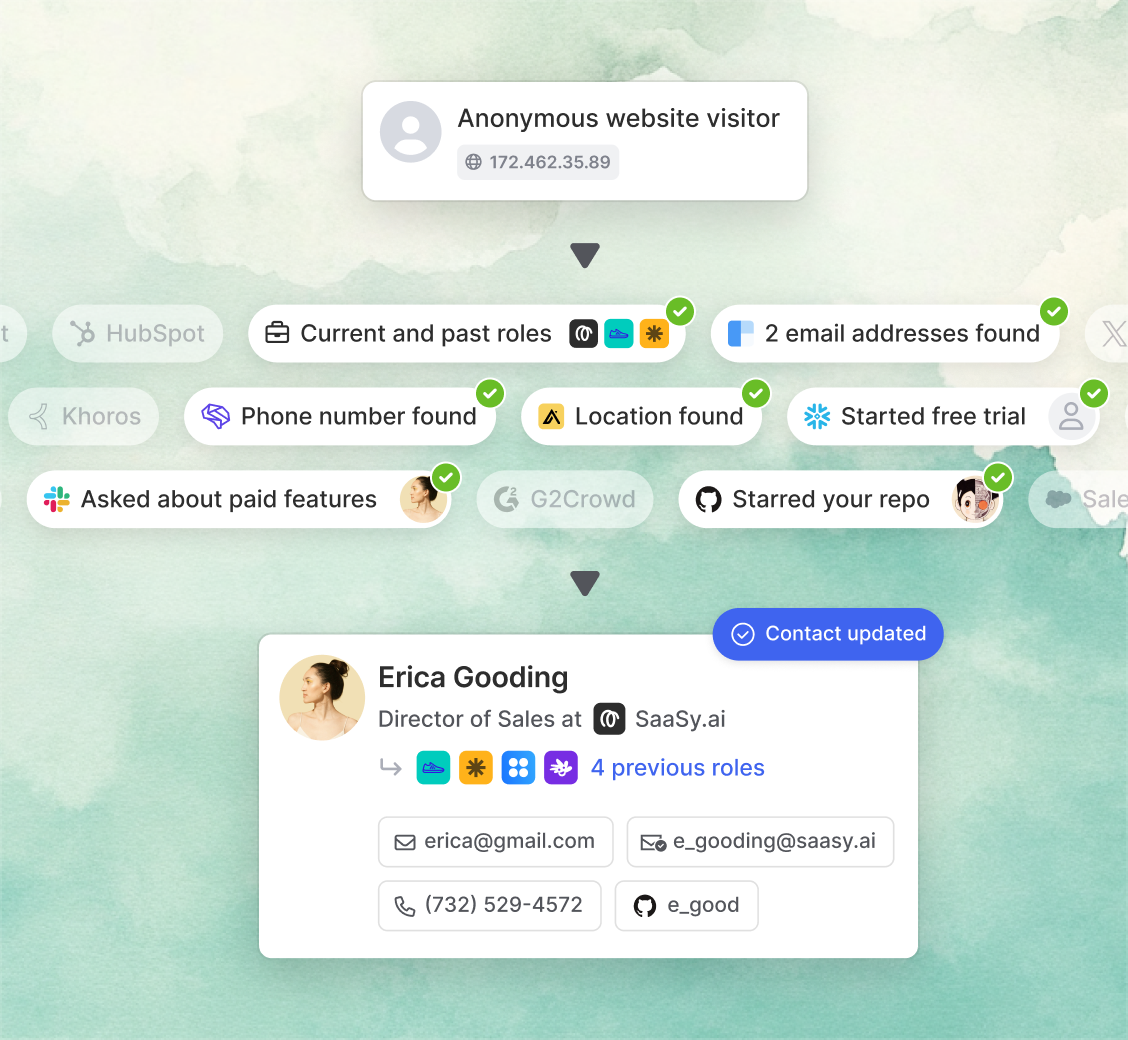
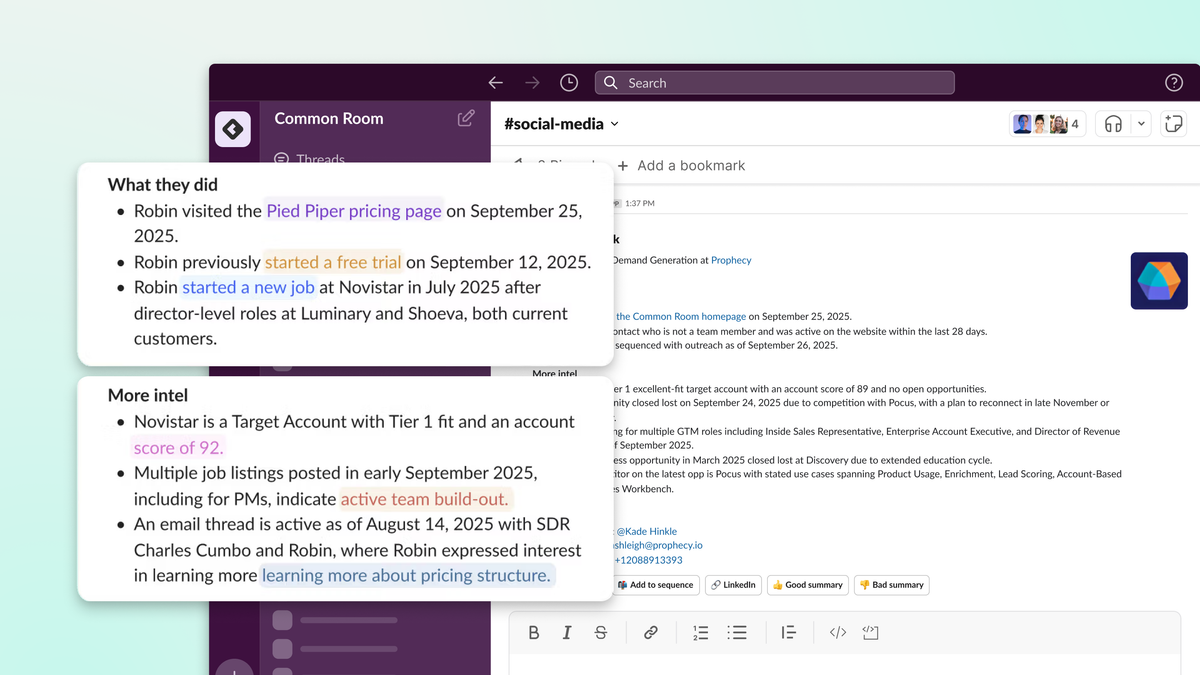
RoomieAI is the agent layer. Orchestrate and Spark Brief do overnight prioritization, so a rep starts the day with a ranked list instead of a dashboard. Capture runs account research and hunts for custom intent. Ask CR Anything is a chat box over your data, and the outreach agent drafts emails with "human-led review" kept in the loop. All of it is reachable through an MCP server, included on every plan, or a CLI. That matters if your team already works inside an AI assistant that speaks MCP.
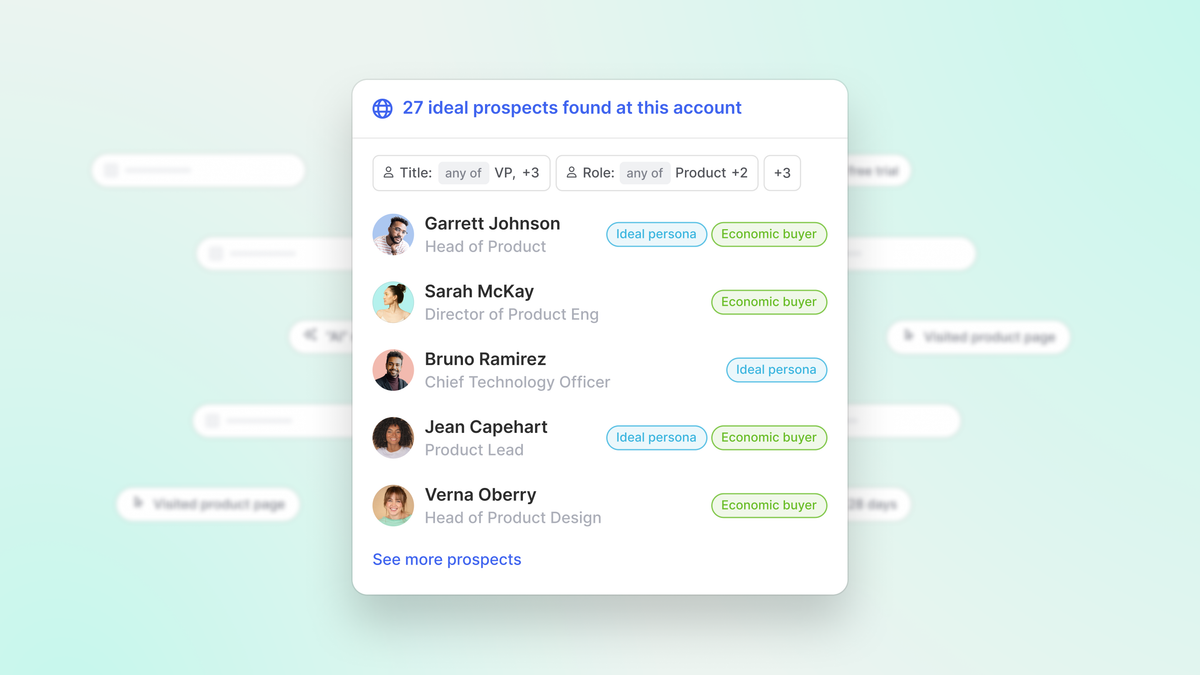
Prospector is the contact database: a "constantly refreshed database of 400M-plus B2B profiles", pitched as costing around 20% of ZoomInfo. That comparison is Common Room's own, and the add-on behind it has no list price.
Pricing: $30,000 before the first call
| Plan | Price | Seats | Contacts | RoomieAI research credits | Prospector credits | CSM |
|---|---|---|---|---|---|---|
| Essential | $2,500/mo, billed annually | 5 | 100k | 5k | 2.5k | Shared |
| Advanced | Custom | 15 | 250k | 7.5k | 7.5k | Dedicated |
| Enterprise | Custom | 30 | 750k | 10k | 15k | Dedicated |
Annual billing turns Essential into a $30,000 commitment. It was $2,100 a month in the May 20 and July 3 snapshots kept by CostBench, a third-party price tracker, and rose to $2,500 in August 2026. That is a 19% increase, landing a month after the Zoom deal closed. The old self-serve Starter plan, reported at about $1,000 a month, is gone; that figure comes from third-party guides, not from Common Room.
List price is an opening position. Vendr, which brokers SaaS contracts, puts the median Common Room deal at $20,544 a year across 37 purchases, with buyers saving 27% on average. Many probably predate the current list, so treat it as proof the number moves, not as a quote.
Everything past Essential is unpriced. Advanced and Enterprise say "Custom", and extra seats, extra Prospector credits and the add-ons in the next section have no public price at all.
What the plan matrix leaves out
Person-level visitor ID is US-only and capped
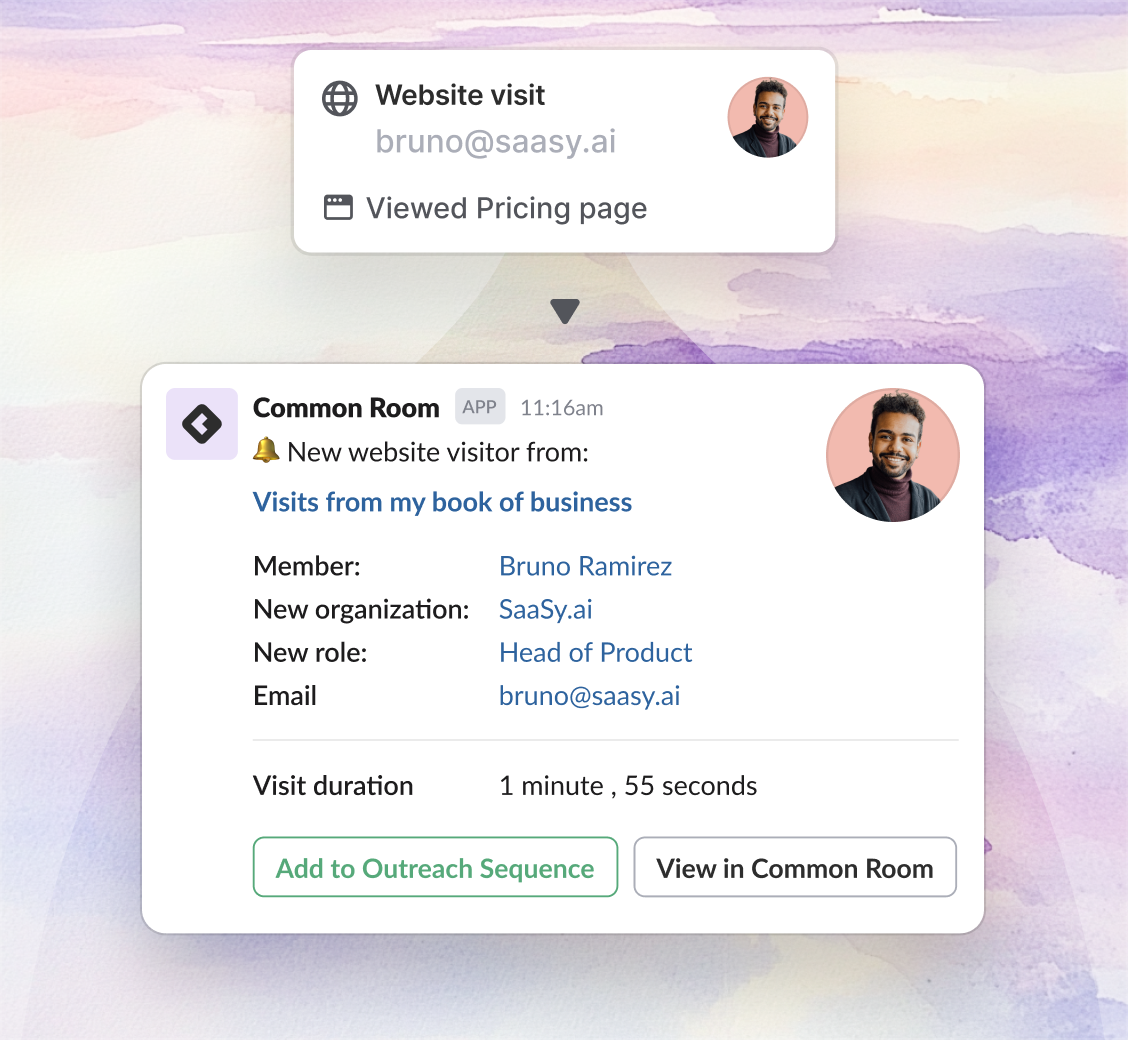
Common Room promises "up to 50% person-level visibility of US-based web traffic", with enhanced US identification "powered by Vector at no extra charge". Outside the US you get the company, not the person. Essential and Advanced both cap website deanonymization at 1,000 a month; only Enterprise is unlimited. If the advertised match rate held, 2,000 US visitors a month would already fill the cap. Website activity is capped too, at 240,000 events a year on Essential and 480,000 on Advanced, and Bombora intent stops at 6 surge topics on Essential.
You supply the cookie banner
The tracking script sets a one-year user cookie and a 30-minute session cookie, and the docs say plainly that "Common Room does not provide a cookie banner consent form". By default it identifies companies rather than people, and IP addresses "are not retained longer term". Anonymous traffic with no business context is hidden from your workspace, yet per the docs Common Room "does retain this data". The company is SOC 2 certified and says it is GDPR compliant. Consent on your own site is still your job.
Searching is included, acting is not
Prospector search comes with every plan. Adding those contacts to your workspace, syncing them to the CRM, pushing them to a sequencer or enriching them "requires the Prospector add-on". In-product exports and auto-recurring exports are add-ons on Essential and Advanced. Product signals are an add-on everywhere, which is awkward for a tool sold to product-led companies. DataAgent is view-only on every tier unless you buy its actions. None of these has a published price.
CRM sync is batch, not live
The fastest Salesforce sync is every 15 minutes, the recommended setting is daily, and syncs never run in parallel. An alert can hit Slack in real time while the record your rep opens in Salesforce is a day old. One Softwarefinder reviewer also found the HubSpot connection "a bit tricky to set up".
Support times are not published
Support runs through a portal and email, and "response times vary by support plan" with no numbers attached. Essential gets a shared CSM. A dedicated one starts at Advanced.
Revenue OS: now it wants your sequencer too
On September 16, 2026 Lian published "This Is Revenue OS", and the product grew sideways. Dial "works multiple calls at once, drops voicemails automatically". Engage is a sequencer. Ads pushes audiences to LinkedIn "without CSV exports". Buying Committee and AI Scoring replaced the old account and contact scoring, and Coach and Forecast arrived from Zoom Revenue Accelerator.
That puts Common Room up against Outreach and Salesloft as well as Clay and 6sense. Lian frames it as an industry pattern: "HubSpot bought Warmly. Apollo bought Pocus. Salesloft bought Clari. Gong bought RightBound. Zoom acquired Common Room." The dialer and sequencer are two months old, and a team already on Outreach or Salesloft loses nothing by keeping them, since both stay supported integrations alongside Apollo, Smartlead, Nooks and Gong.
One piece of history is worth carrying into the contract talk. Orbit, an early rival in community analytics, joined Postman in April 2024 and disabled all functionality three months later. Zoom is building on Common Room rather than shutting it, but an annual contract with a freshly acquired vendor is the moment to get export terms in writing.
Alternatives, and what you give up
RB2B if you only want to know who is on your website. It runs from a free tier through Starter at $79, Pro at $149 and Pro+ at $199 a month, per a third-party comparison, so a full year of Pro+ costs less than one month of Essential. Its person-level identification is US-only as well. You give up community, product and job-change signals, and any identity stitching across them.
Clay if you have a GTM engineer who wants to build enrichment waterfalls in a table. Even Common Room's comparison page calls Clay an orchestration layer "that GTM engineers configure per use case". Common Room's integration directory lists no native Clay connector, so running both means the API or Zapier.
6sense if account-level intent is enough. Common Room's own pitch is that "6sense tells you which accounts are in-market" while it also names the person inside them. If your reps find the people themselves, that difference may not be worth paying for twice.
Verdict
Common Room is strongest where it started: a B2B company with a developer community or a product-led funnel, where the buying signal is a GitHub star, a Discord question or a jump in workspace usage, and no other tool ties those to a named person at a named account. G2 reviewers rate it around 4.5 out of 5 from roughly 110 reviews and praise exactly that signal aggregation and the Slack and GitHub integrations, while noting "the UI can be clunky at times". TrustRadius is cooler, at 7.6 out of 10 from just 10 reviews.
Buy it if you are a mid-market or enterprise team with those signals, mostly US traffic, someone to own the setup and a budget comfortably above $30,000 a year once the Prospector and product-signal add-ons are priced in. Negotiate. The Vendr median says you can.
Skip it if website visitor ID is the whole job: RB2B does that for under $2,400 a year. Skip it if you want to design your own enrichment logic, which is what Clay is for. And skip it if most of your traffic is outside the US, because there the headline feature names the company and stops.
Ready to try Common Room?
Visit the official website to see the latest plans, pricing, and special offers.
Get Started - Common Room* Affiliate link - we may earn a commission at no extra cost to you.