Meta's Muse Ember Takes On Claude Haiku 5.5 at $0.10 per Million Tokens
Meta launched Muse Ember, its smallest Muse model, at $0.10/$0.50 per million tokens with a 1M context. Pricing bands, benchmarks vs Claude Haiku 5.5 and GPT-6 Luna, and who should switch.
News Report

What Meta launched
Meta announced Muse Ember on November 9, calling it "our smallest and most efficient model" and aiming it squarely at "the work agents repeat all day: tool calls, coding subtasks, routing, extraction, and long document parsing." It is live now on Muse Code and the Meta Model API under the ID muse-ember-1.0, and it supports the Responses API.
Meta also says that "Muse Ember, Muse Spark and Muse Wonder are now available on Google Cloud and Oracle Cloud," so teams already buying compute there do not need a new vendor contract to try it.

The lineage is the interesting part. Ember is the first model Meta has trained using Muse Wonder Full, the large model it promised to use for building smaller, specialised ones. That gives the Muse family three tiers: Wonder for the hardest problems, Spark for coding and agentic workflows, and Ember for the same kind of work repeated at volume.
Why the cheap tier matters
An agent rarely spends its budget on the one hard reasoning step. It spends it on the hundreds of small calls around that step: picking a tool, parsing a result, summarising a file, deciding where a request goes next. Those subagent calls are where a per-token price turns into a monthly bill, and until this week the serious options at the bottom of the price list were mostly Claude Haiku 5.5 and OpenAI's GPT-6 Luna.
Meta's pitch for Ember is that it gets near its own mid-tier model for a fraction of the cost. On the Artificial Analysis Intelligence Index, Meta puts Ember at 36 against 37 for Muse Spark 1.3. The cost to run one Artificial Analysis task drops from $2.39 to about $0.14. One index point for roughly a seventeenth of the money.
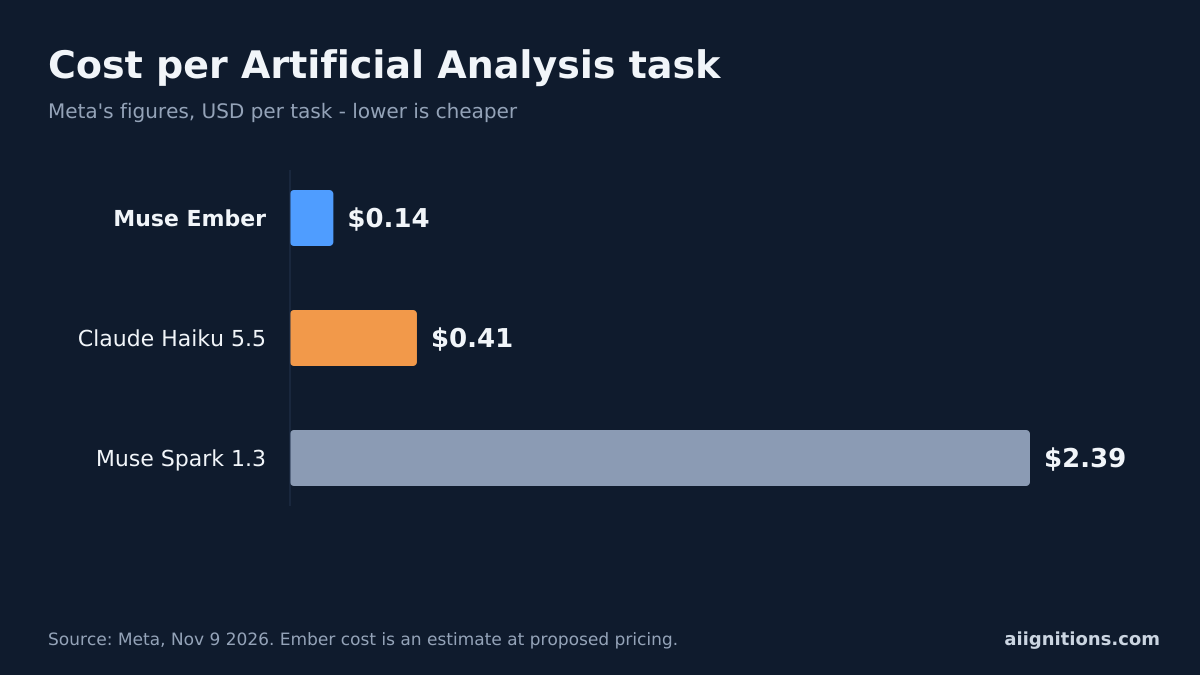
That is the before and after for anyone building on Muse: workloads that were routed to Spark by default can now be split, with Spark kept for the steps that need it.
Pricing and limits
These are the prices in Meta's announcement, checked on November 13, 2026. They come in two bands, and the split at 200K tokens matters more than the headline.
| Per million tokens | Prompts up to 200K | Prompts over 200K |
|---|---|---|
| Input | $0.10 | $0.30 |
| Cached input | $0.004 | $0.012 |
| Output | $0.50 | $1.50 |
The context window is 1M tokens and a single response can run to 512K tokens. Ember accepts text, images, audio and video as input; Meta does not list its output modalities.
Run the numbers on the long-context case before planning around that 1M window. A 150K-token prompt with a 10K-token answer costs about $0.02. A 500K-token prompt with the same answer costs about $0.165, because everything is billed at the higher band once the prompt crosses 200K. Long document parsing is one of the jobs Meta names, so this is the line that will decide many bills.
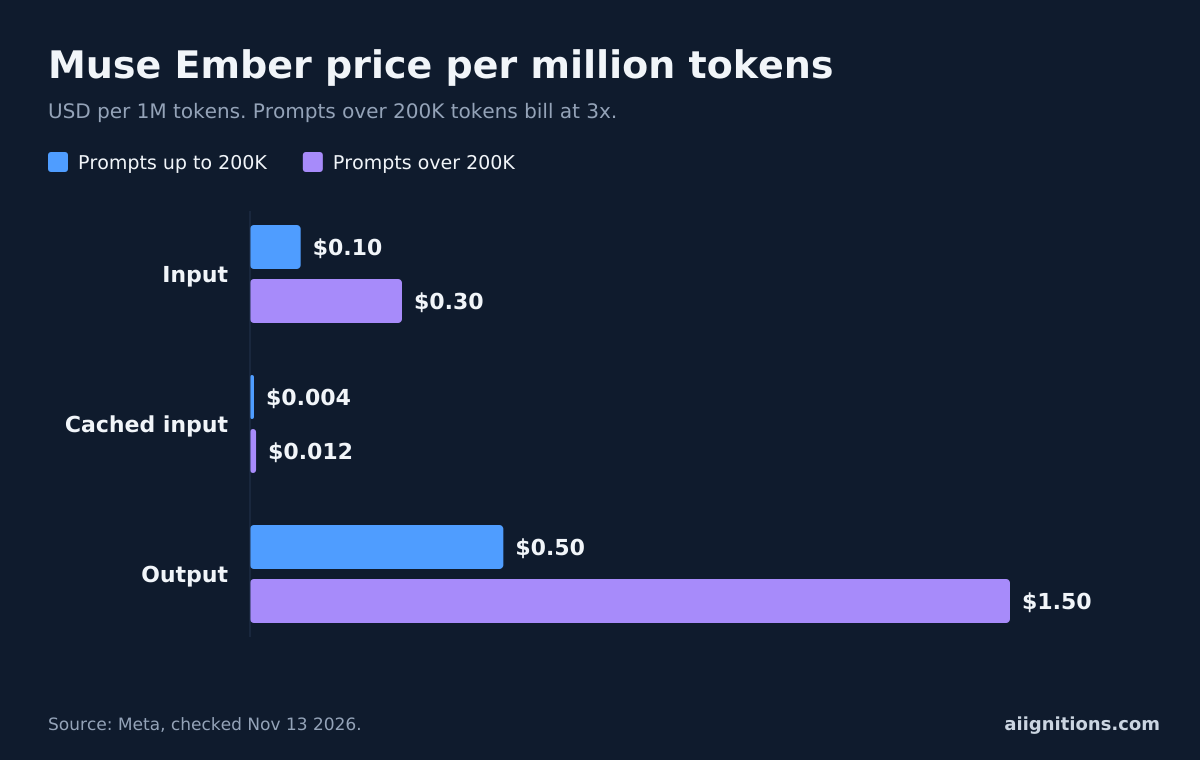
Cached input is the other figure to notice. At $0.004 per million it is 4% of the normal input price, which is what makes it cheap for an agent to resend the same system prompt and tool definitions on every call.
For comparison, Muse Spark 1.3 lists at $1.25 per million input tokens and $4.25 per million output tokens.
Benchmarks, by Meta's numbers
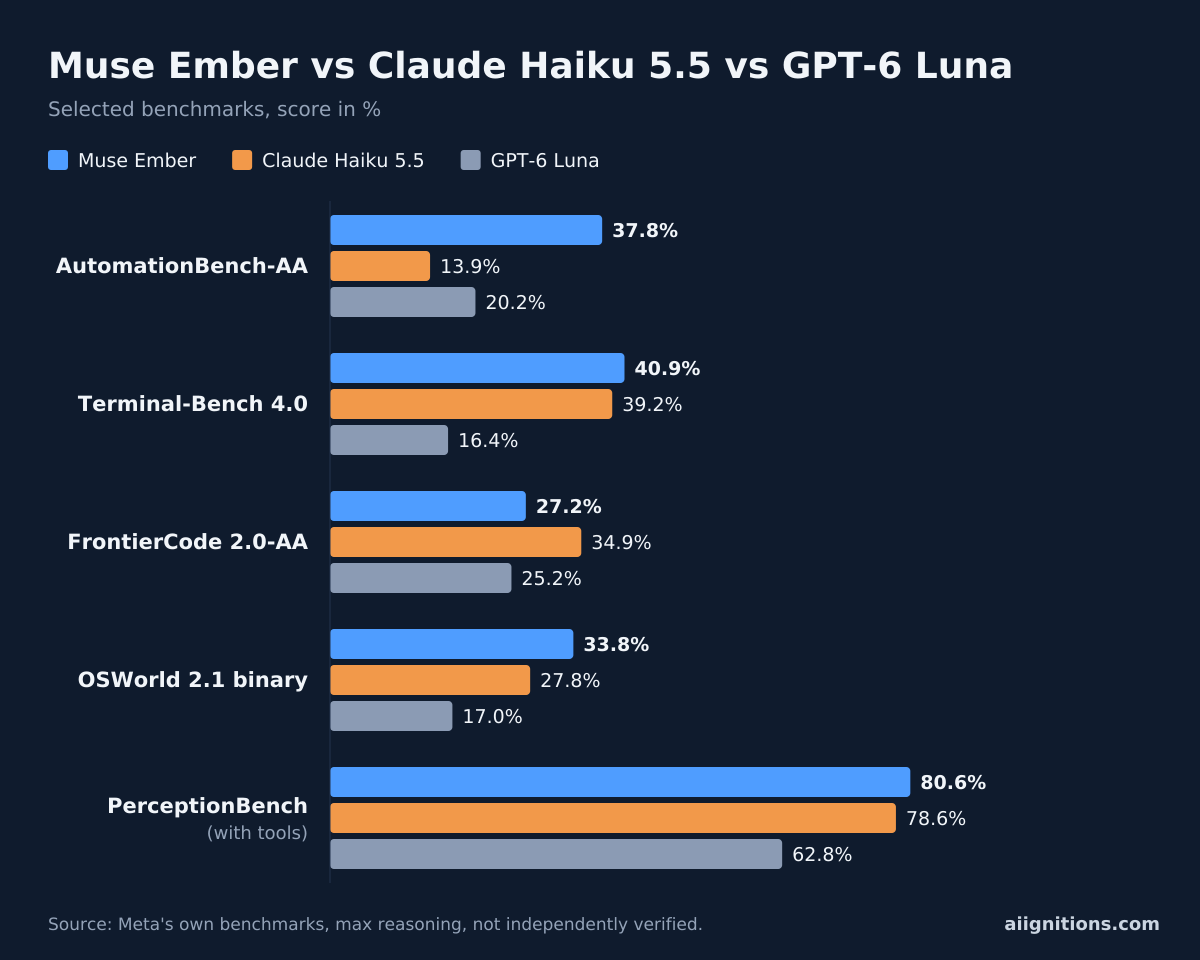
Every figure below comes from Meta's own table, with all three models at maximum reasoning. Several are Meta-run versions of Artificial Analysis tests (marked AA), and one is an internal Meta index. None had been independently reproduced at the time of writing.
| Benchmark | Muse Ember | Claude Haiku 5.5 | GPT-6 Luna |
|---|---|---|---|
| AutomationBench-AA | 37.8% | 13.9% | 20.2% |
| Agents' Last Exam | 61.6% | 57.0% | 57.1% |
| Personal Superintelligence Index (Meta internal) | 46.8% | 36.1% | 37.0% |
| Terminal-Bench 4.0 | 40.9% | 39.2% | 16.4% |
| Coding Agent Index-AA | 46 | 37 | 31 |
| FrontierCode 2.0-AA | 27.2% | 34.9% | 25.2% |
| GDP.pdf-AA | 22.8% | 20.8% | 22.8% |
| OSWorld 2.1 (partial credit) | 69.5% | 68.9% | 50.5% |
| OSWorld 2.1 (binary) | 33.8% | 27.8% | 17.0% |
| PerceptionBench (with tools) | 80.6% | 78.6% | 62.8% |
| Artificial Analysis Intelligence Index | 36 | 36 | 28 |
Ember leads most rows, and by the widest margin on AutomationBench-AA, where it scores almost three times Haiku's result. It does not lead everywhere. Haiku 5.5 wins FrontierCode 2.0-AA by 7.7 points, and Ember only ties Luna on GDP.pdf-AA. On Terminal-Bench 4.0 and partial-credit OSWorld the gap to Haiku is under two points, close enough that a different prompt setup could flip it.
The cost chart is where Meta makes its real argument. Ember and Haiku 5.5 land at the same Intelligence Index score, but Meta puts Ember at about $0.14 per Artificial Analysis task against about $0.41 for Haiku at its top setting, figures Interesting Engineering reports the same way. One caveat sits in the chart's own caption: Ember's costs are "estimates at proposed pricing."
What early testers report
Meta published quotes from launch partners. They were picked by Meta, so read them as the best case, but they are specific. Cloudflare CTO Dane Knecht said "Muse Ember ran up to 30% faster at the tail than the comparable model we tested, and it handled broad, multi-repo investigation tasks well."
You.com inference lead Chak Pothina gave the hardest numbers: Ember "completed every coding quest in our testing with the lowest latency of any model we tested: a p95 of 2.2 seconds, about 4x to 13x faster than leading open-weight models, and with 36-48% fewer output tokens." Fewer output tokens matters twice here. Output is the expensive side of the price list.
Cline founder Saoud Rizwan called it "purpose-built for, and excels at, subagent work like coding and document analysis," and Box said it can score a contract against a negotiation playbook clause by clause.
What it changes for builders
If you run high-volume agent loops with prompts under 200K tokens, Ember is worth a test this week. That goes double for computer-use and automation work, where Meta's lead on OSWorld 2.1 binary (33.8% against Haiku's 27.8%) and AutomationBench-AA is largest. If you already call the Responses API, trying it starts with changing the model ID.
Two groups should hold off. Teams whose subagents mostly write code should stay on Claude Haiku 5.5 until someone outside Meta re-runs these tests, since Haiku's FrontierCode lead is the one result that points the other way. And anyone who needs to self-host should know that Meta's post says nothing about weights: Ember is offered through APIs, unlike Muse Spark Open, whose weights Meta released in October.
On safety, Meta says it tested Ember under its Superintelligence Scaling Framework for chemical and biological, cybersecurity and loss-of-control risk, and that it stayed below the high-risk threshold in every category. Its behavioural tests also covered resisting instructions hidden in web pages or tool output, which is the exact attack surface a subagent reading untrusted files is exposed to.
What to watch next: independent benchmark runs, and whether the "proposed pricing" in Meta's cost chart is the price that sticks.