SerpApi Review: The Priciest SERP API, and What the Premium Buys
SerpApi review: plan-by-plan cost per 1,000 searches, what billing skips, the $2M Legal Shield and the Google lawsuit, and when Serper or Bright Data is the better buy.
Expert Review

The price of one search
SerpApi sends a search query to Google, Bing, Amazon, YouTube or one of dozens of other sites, solves whatever stands in the way, and hands back the result page as JSON. Plenty of APIs do that. What sets SerpApi apart first is the bill: on its entry plan you pay $25 for 1,000 searches, while Serper.dev sells the same 1,000 Google results for $1.00. That gap is the whole review in miniature - the question is what the extra money buys, and whether you need it.
The plans below were checked on the SerpApi pricing page on October 14, 2026. All are month-to-month, and the cost per 1,000 searches is our own arithmetic from the published price and volume, not a figure SerpApi quotes.
| Plan | Price / month | Searches / month | Per hour | Cost per 1,000 |
|---|---|---|---|---|
| Free | $0 | 250 | 50 | - |
| Starter | $25 | 1,000 | 200 | $25.00 |
| Developer | $75 | 5,000 | 1,000 | $15.00 |
| Production | $150 | 15,000 | 3,000 | $10.00 |
| Big Data | $275 | 30,000 | 6,000 | $9.17 |
| Searcher | $725 | 100,000 | 20,000 | $7.25 |
| Volume | $1,475 | 250,000 | 50,000 | $5.90 |
| Infrastructure | $2,750 | 500,000 | 100,000 | $5.50 |
| Cloud 1M | $3,750 | 1,000,000 | 110,000 | $3.75 |
| Cloud 10M | $21,125 | 10,000,000 | 200,000 | $2.11 |
Cloud plans keep climbing in 1M steps up to a listed 54M searches for $106,050, and Enterprise is quoted by sales. There is no published annual discount: the FAQ says a yearly option can be set up "upon request manually" by email, and the same goes for university and student pricing.
Watch the hourly column. Below 1M searches a month, your throughput cap is 20% of the plan's volume per hour, so the $25 Starter plan can only fire 200 searches in any hour. A batch job that wants 1,000 rank checks before the morning stand-up needs either five hours or the $75 plan.
What the premium buys: breadth
The pricing page lists 116 API endpoints. That counts sub-APIs, so it is not 116 search engines, but the spread is still the widest we have seen in this category. Google alone splits into Search, Light, AI Mode, AI Overview, Maps, Shopping, Scholar, Jobs, Lens, Flights, Hotels, Trends, Patents and News. Beyond Google sit Bing (including a Bing Copilot endpoint), Baidu, Brave AI Mode, DuckDuckGo, Naver, Yahoo, Yandex, YouTube with video transcripts, Amazon, Walmart, eBay, Home Depot, the Apple App Store, Apple Maps, Tripadvisor, Yelp, OpenTable, Zillow and Airbnb. Airbnb arrived on October 6, 2026; Yahoo Trends on October 12.
The AI endpoints are the reason many teams are looking at SerpApi now. engine=google_ai_mode returns Google's AI Mode answer as nested JSON, with its cited sources, and the AI Overview endpoint does the same for the summary box above the blue links. If you track how your brand shows up in AI answers, or feed live results to an agent, that parsing is the hard part, and SerpApi has already done it.
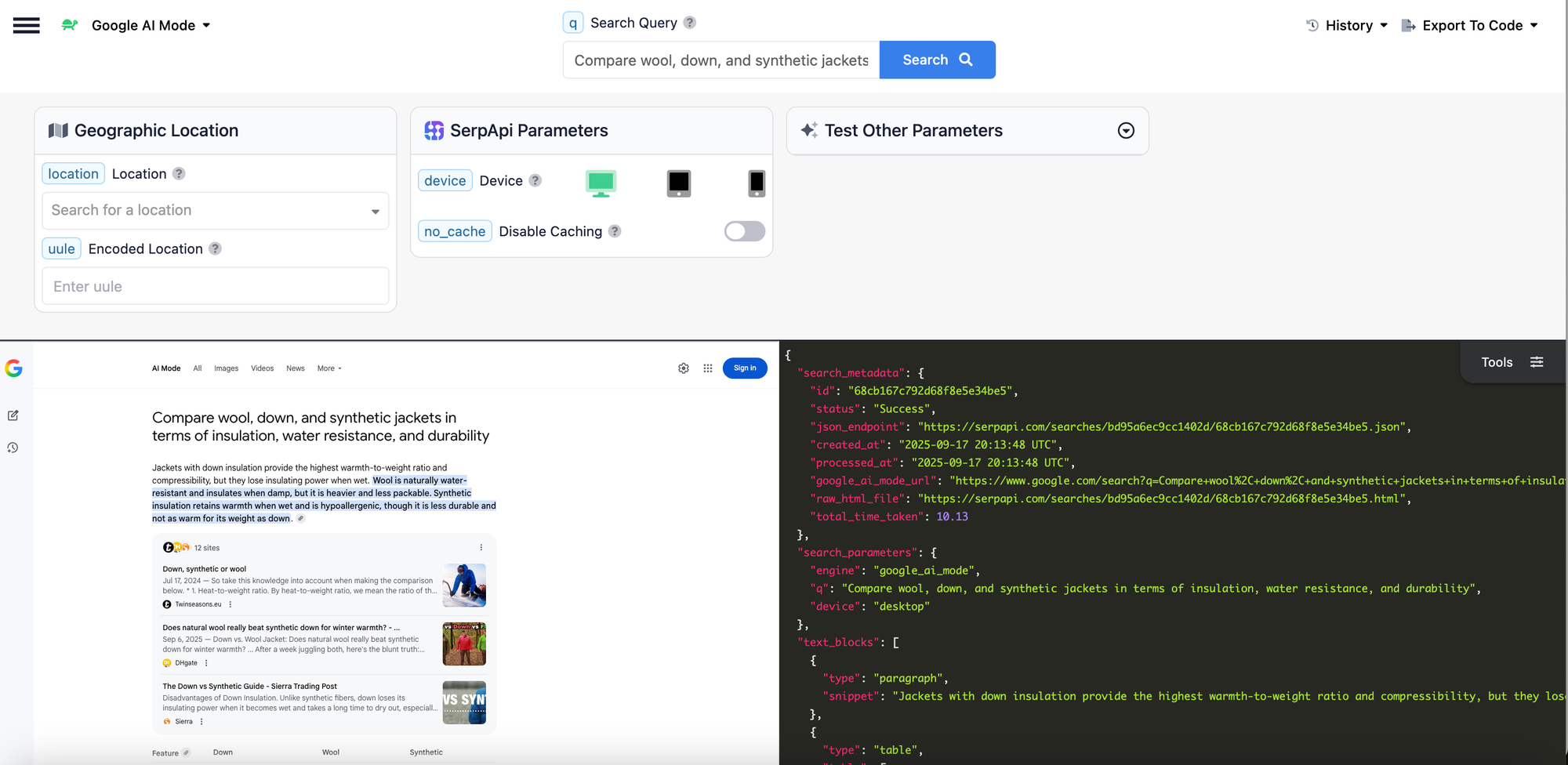
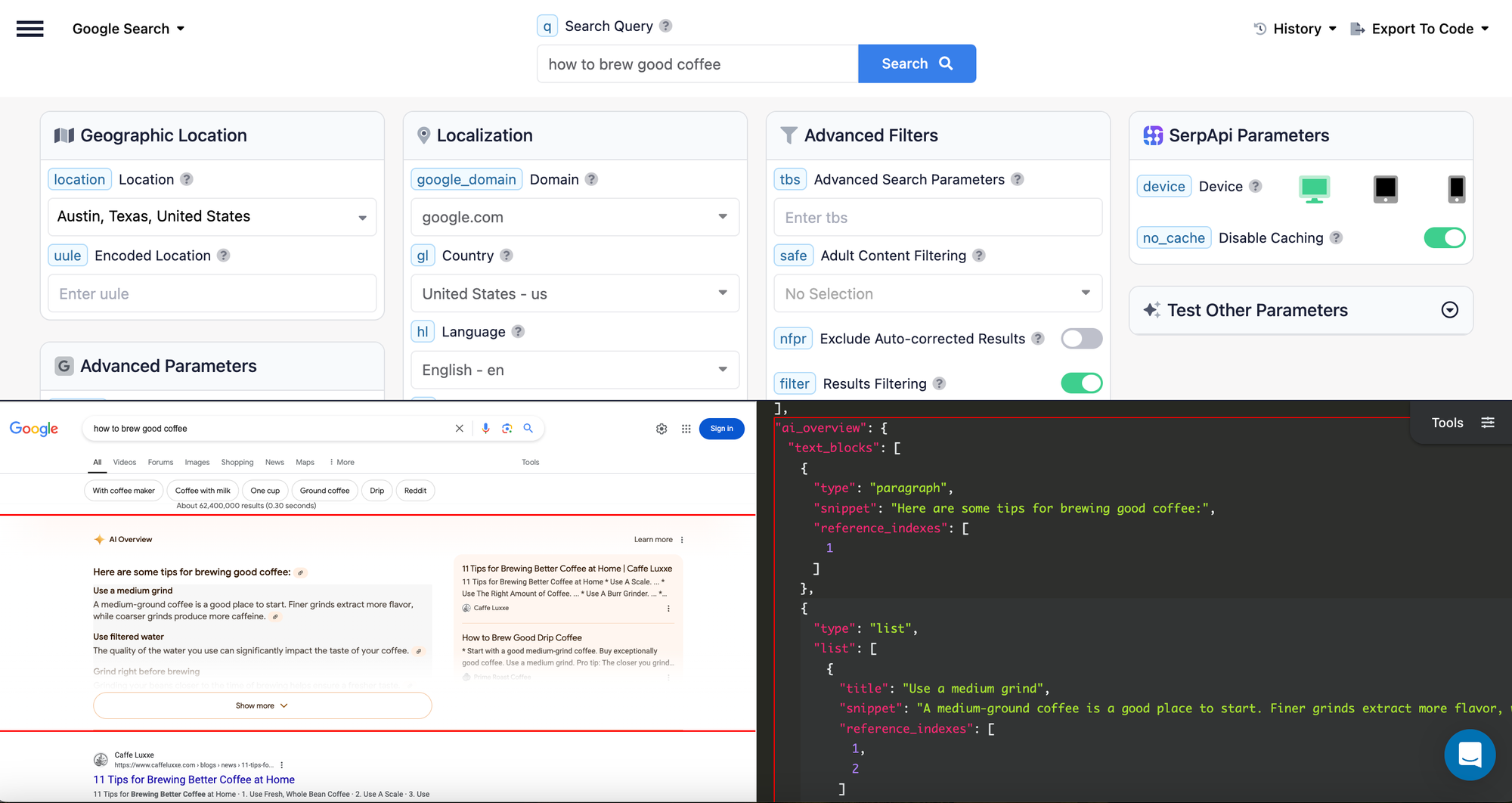
You can try any engine without writing code. The public Playground takes a query, a location and a device, then shows the raw JSON next to a rendered view of the page it parsed. It is the quickest way to see if the field you need comes back at all.
Output is JSON by default, with Markdown available for feeding text straight to a language model. Official libraries cover Ruby, Python, JavaScript, Go, PHP, Java, Rust, .NET, Swift and C++, plus a CLI. There is also an open-source MCP server (MIT licence) for Claude Desktop, VS Code and Cursor. One detail to know before you paste it into a shared config: its URL takes the form mcp.serpapi.com/YOUR_SERPAPI_API_KEY/mcp, so the API key travels inside the URL path and ends up anywhere that URL is logged.
How billing works in practice
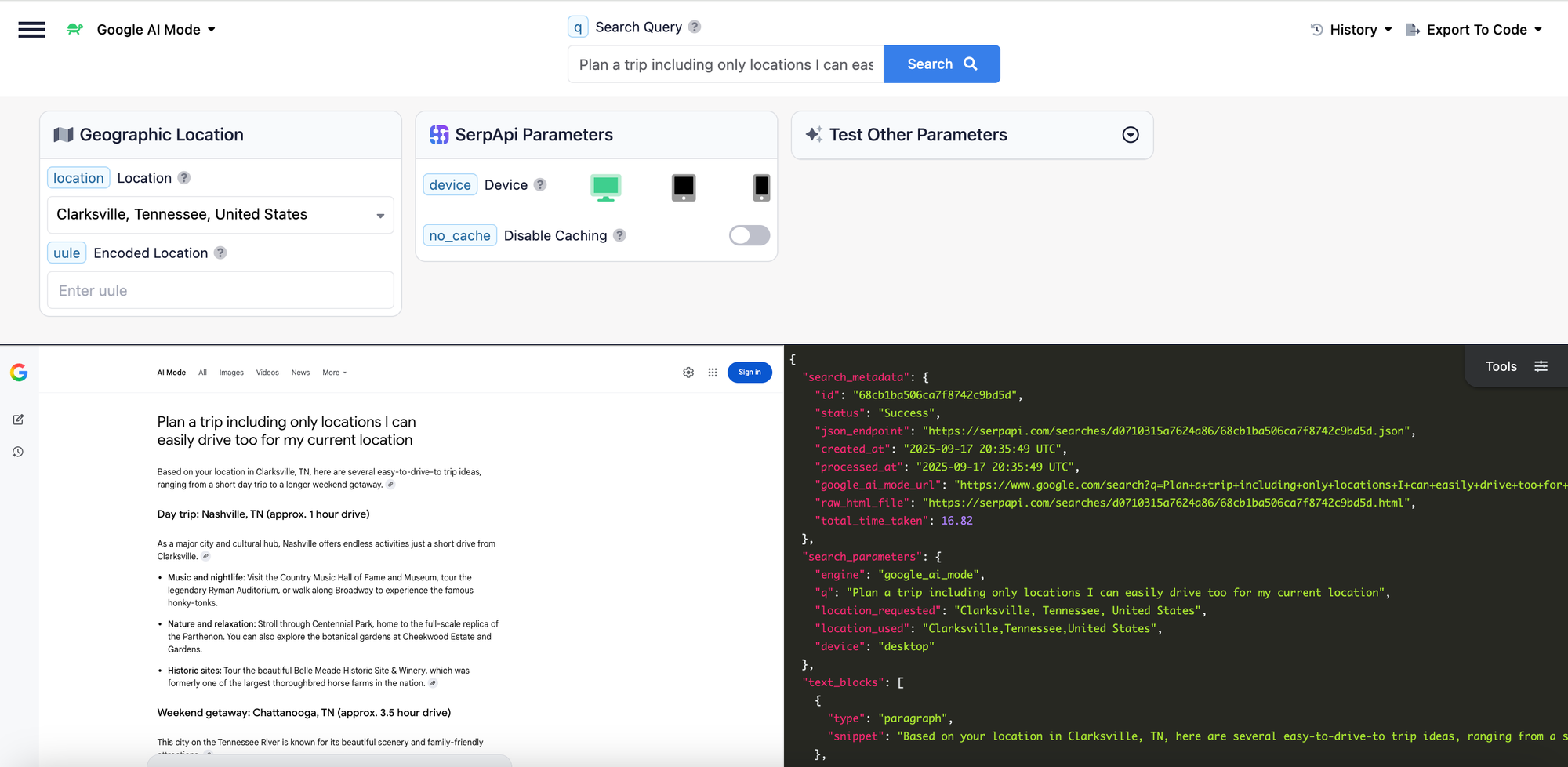
SerpApi charges only for successful searches. Its pricing page says "Cached, errored, and failed searches are not" counted, and a search that returns nothing costs the same single credit as one that returns 100 results. Every parameter counts toward that match, so the same query run from a different location, as in the Playground run below, is a new search and a new credit. The cache matters more than it sounds: an identical query with identical parameters inside one hour is served from cache for free. Dashboards that refresh the same keyword set every few minutes cost far less than the headline rate suggests. Re-reading old results through the Search Archive API is free too.
The catch runs the other way. Unused searches do not roll over - the allowance resets on the first day of each billing cycle - and there is no overage billing. When you run out, searches stop until you renew, unless you switch on Automatic Early Renewal, which starts a new paid cycle the moment the allowance hits zero. A team with a quiet month followed by a heavy one pays for both. "Credits expire with every renewal" is the complaint that recurs in G2 reviews, next to cost for students and academics, and it is a fair one. Serper.dev's prepaid credits, by contrast, last six months.
Two smaller points. Speed is a paid toggle: "Ludicrous Speed" costs 2x the normal plan price and "Ludicrous Speed Max" 4x, so Starter becomes $50 or $100. And the refund window is short: a full refund within 7 days of subscribing, but only if you have used no more than 20% of your searches.
The Legal Shield, and the Google lawsuit testing it
Scraping search engines sits in a legal grey zone, and SerpApi sells a promise about it. The U.S. Legal Shield "provides up to $2 million in coverage for the scraping and parsing of search engine data, as long as your use of the data or service is not illegal." The pricing page limits it to claims under U.S. law in a U.S. court, while the terms of service (updated August 27, 2026) extend it to international customers. Either way it is a contractual indemnity from the vendor, not an insurance policy, and it starts at the $150 Production plan. Free, Starter and Developer customers get none of it. SerpApi says that since 2017 "no SerpApi customer has paid a single dollar in damages" for scraping with its tools.
That promise now has a live test. Google sued SerpApi in the Northern District of California on December 19, 2025, with claims under the DMCA's anti-circumvention rules tied to its SearchGuard anti-bot system. On July 20, 2026 the court granted SerpApi's motion to dismiss; claims over non-copyrighted search results were dismissed without leave to amend, but Google was given 21 days to replead claims tied to Knowledge Panel content. Google filed an amended complaint on August 10, adding content-licensing terms, and SerpApi moved to dismiss again on August 25. Its general counsel says the theories covering Google Shopping and Google Maps "are gone."
As of October 14, 2026 there is no ruling on the second motion. The October 13 hearing was vacated on October 5, according to press coverage rather than the docket. The case is not won and not over. For a buyer that means two things: the Legal Shield is a real reason to choose SerpApi over a cheaper rival if your legal team asks the question, and a ruling against SerpApi could change what some Google endpoints return.
Privacy, uptime and support
By default SerpApi keeps the JSON, Markdown and HTML of every search for 31 days. ZeroTrace mode skips storing the parameters, files and metadata, but the FAQ says it is "only included in Enterprise plans", while the pricing table also marks it on the Cloud plans from 1M searches up. Assume you need to be spending at least $3,750 a month, and confirm with sales. If your queries reveal client names or unreleased products, that 31-day log is the limit to plan around on every cheaper tier.
The live metrics page showed a 98.956% average success rate and a 1.38-second average response time on October 14, 2026. Those are SerpApi's own numbers, and failed searches are not billed, so a 1% failure rate costs you retries rather than credits. The FAQ promises a 99.95% SLA on all plans with credits of up to 100% of the monthly price; the pricing page says "up to 99.97%". SerpApi holds SOC 2 Type II, SOC 3 and ISO 27001 certifications. Support is email and live chat with a one-business-day target, and priority support is reserved for Cloud and Enterprise.
SerpApi vs the cheaper options
| Service | Entry paid price | Cost per 1,000 | Free tier | Billing model |
|---|---|---|---|---|
| SerpApi | $25/month | $25.00 (Starter) to $2.11 (Cloud 10M) | 250 searches/month | Monthly allowance, no rollover |
| Serper.dev | $50 for 50k credits | $1.00 | 2,500 queries, no card | Prepaid credits valid 6 months |
| Bright Data SERP API | Pay as you go | $1.50 | 5,000 requests, no card | Pay per 1,000 requests, no subscription |
| SearchApi.io | $40/month | $4.00 | 100 requests | Monthly plan, 10,000 searches at $40 |
Competitor prices were checked on each vendor's pricing page in October 2026, and none of the three advertises a legal indemnity like SerpApi's. Yet even SerpApi's 10M-search Cloud plan costs more per search than Serper.dev's $50 starter pack.
Verdict
Buy SerpApi if you need more than Google organic results: AI Mode and AI Overview answers, Maps and local packs, Shopping, Amazon or YouTube, all from one key and one JSON style. Buy it if your legal team wants a vendor to stand behind the scraping, and budget for at least the $150 Production plan, because that is where the Legal Shield starts. Repeat-heavy workloads also do well here, since the one-hour cache and free failed searches pull the real cost well below the table.
Skip it if what you need is plain Google results in volume. At $1.00 per 1,000 searches, Serper.dev costs a tenth of SerpApi's Production rate and a twenty-fifth of Starter, and Bright Data at $1.50 per 1,000 is close behind. Skip it too if your usage swings month to month: credits that vanish at renewal punish bursty work, and a prepaid pack is the better fit. If you would rather click than code, our Browse AI review covers a no-code scraper, and our Serpstat review covers rank tracking without building anything yourself.
Ready to try SerpApi?
Visit the official website to see the latest plans, pricing, and special offers.
Get Started - SerpApi* Affiliate link - we may earn a commission at no extra cost to you.