Whatfix Review: No Public Price, and Every Employee With Access Counts as a Licence
Whatfix review: how its platform-fee-plus-licence pricing works, what buyers pay (Vendr median $31,950/yr), the ScreenSense AI agents, Mirror, and who should skip it.
Expert Review

Pricing: a platform fee, then everyone with access
Whatfix's pricing page lists three plans for web and desktop apps - Standard, Premium and Enterprise - and not a single number. The Standard and Premium buttons say "Get a Demo". Enterprise says "Talk to Sales". That is the page as checked on 28 November 2026, and there is no free plan underneath, only a free trial of unstated length.
What the page does spell out is the formula. Every product is priced as "a flat fee, plus user license fees", and the licence definition is the line to read twice. For employee-facing applications, a user licence equals "the total number of users with access to such application". Only customer-facing apps are counted by monthly active users. Put Whatfix on Workday for 8,000 employees and you license 8,000 people, even in the month when 1,500 of them open it.
The only dollar figures in public come from buyers. Vendr's buyer data, last updated August 2025, puts the median Whatfix contract at $31,950 a year, with reported deals between $26,210 and $37,914. Those are contract values for the deals Vendr saw, not list prices, and they say nothing about a multi-app enterprise agreement.
Vendr's negotiation notes are more useful than the median. Whatfix "will waive onboarding fees for new purchases", which tells you onboarding fees are on the quote by default and can be taken off. Quick signatures earn discounts, one buyer got "a $1,000 credit for an additional year", and 36-month terms with services swapped mid-agreement have been signed. The pricing page itself says Whatfix offers "discounts based on your specific needs". Ask for the onboarding waiver and the discount together.
What changes between plans
| Standard | Premium | |
|---|---|---|
| Content aggregation | Capped at 2,000 articles | Unlimited |
| Translation | Manual only | Auto translation |
| Surveys | Out-of-the-box | Custom |
| Product Analytics | Standard included, 25 tagged user actions | Standard included; Analytics Premium (unlimited actions) sold separately |
Standard also limits you to two integrations. Enterprise is the multi-app plan, for companies that want one contract covering Salesforce, SAP and an HR system at once. Mobile apps, Product Analytics Premium and Mirror are separate products with their own quotes.
Then the add-ons: On-Premise Authoring, White-Label, Professional Services, a Digital Adoption Assistant, a Digital Adoption Program Manager and 24/7 Customer Support. That last one matters more than it looks. A rollout that spans Europe, India and the US will hit a broken flow outside someone's office hours, and round-the-clock support is a line item, not part of the plan.
The AI agents, and where your prompts go
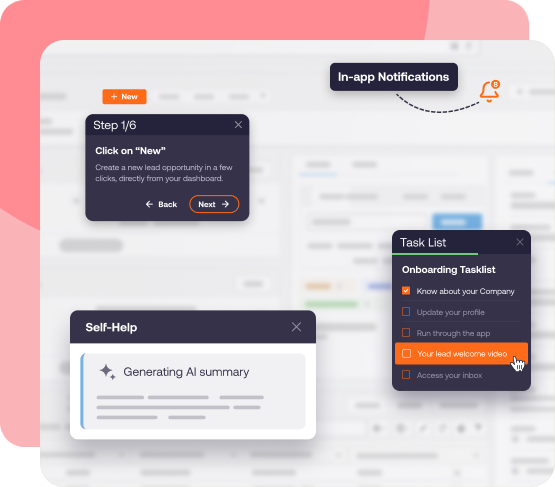
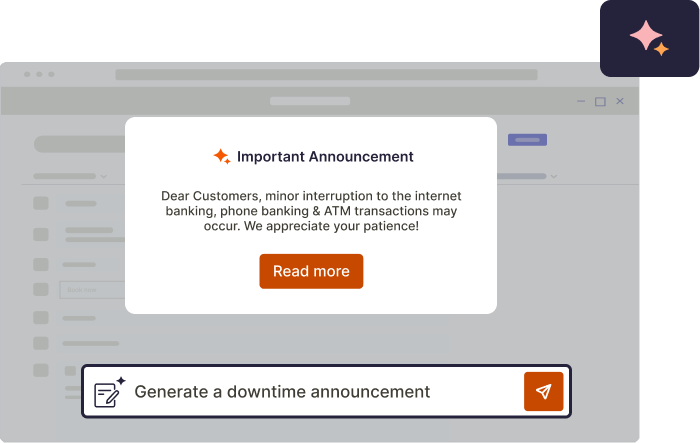
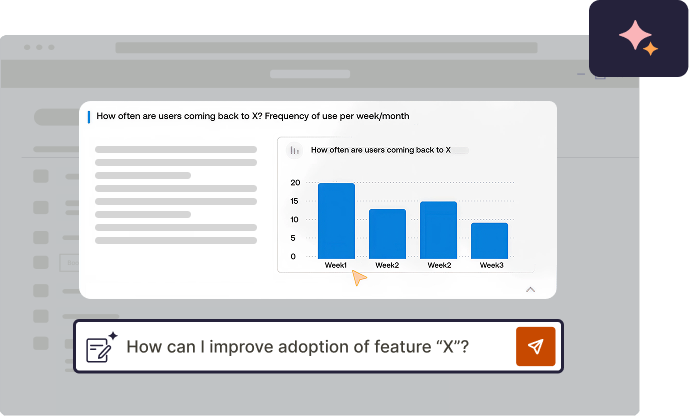
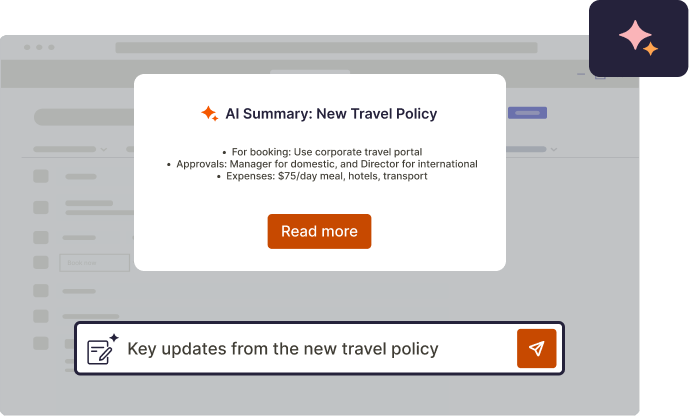
Whatfix has rebuilt its pitch around AI. Whatfix AI now has four parts: an Authoring Agent ("Turn simple prompts into in-app guidance"), a Guidance Agent that answers questions and walks users through steps inside the application, an Insights Agent that takes natural-language questions about how people use your software, and AI Roleplay, which lives in Mirror. The first three sit on what Whatfix calls ScreenSense, its screen-context layer, and Whatfix says they cover "content creation, maintenance, contextual assistance, enterprise knowledge retrieval, and behavioral analysis".
Maintenance is the word in that list that counts. The expensive part of a digital adoption platform is rarely the licence. It is the person rebuilding forty walkthroughs after every Salesforce release moves a button. If the Authoring Agent cuts that work, it pays for itself; the demo is where to make Whatfix show it repairing a flow, not just drafting a new one.
On data, the support documentation is direct: "No, Whatfix does not use your content or data to train the AI model." Models run on private or dedicated Azure OpenAI instances, EU customers' queries go to EU-region instances, and Microsoft Azure, OpenAI and Google Vertex AI are the named providers. The AI terms forbid training or fine-tuning on customer content without your prior written consent. Two caveats sit next to that promise. Whatfix "stores queries and responses generated by the AI features", and the terms keep the right to use "de-identified, aggregated usage data". If employees paste customer names into the Guidance Agent, those prompts are retained until you ask for deletion, which Whatfix processes within 30 days.
Mirror: training on a copy of the app
Mirror, launched in 2024, builds replicas of your applications so a new hire can practise in a copy of SAP instead of in production. AI Roleplay, added in 2025, lets them rehearse a conversation against a simulated counterpart. In a March 2026 press release Whatfix said Mirror's ARR grew more than 200% year over year, reached $3M in six quarters, and is expected to triple in 2026.
That is small next to the core platform. It is also where the product attention is going. Mirror is sold separately, with a single Standard plan that includes AI Roleplay and unlimited author licences - so the people building training content do not each need a seat.
What a rollout asks of your IT team
Whatfix runs on web, native desktop, mobile, custom apps and supported VDI environments. It deploys four ways: a JavaScript snippet, a browser extension, a desktop client or a mobile SDK, in the cloud or, where eligible, self-hosted.
The snippet is the clean option, and most internal buyers cannot use it. It needs "access to source code to be able to inject the Whatfix script on the application and all embedded iFrames", and nobody renting Salesforce or Workday has that. So internal rollouts mostly run on the browser extension, which needs "a mass deployment mechanism" - Group Policy, JAMF or PowerShell. Endpoint management belongs on the project plan from week one, and contractors on unmanaged laptops will not see any guidance unless someone installs the extension by hand.
Self-hosting has its own catch: analytics are "Not enabled by default" on that deployment. Data residency is offered from two regions, the EU and the USA - none in Asia-Pacific, despite the company's Bengaluru roots, which matters to an Australian or Indian public-sector buyer with in-country rules. After you leave, Whatfix keeps customer data for two years unless you request deletion, so put that request on the exit checklist.
The certificate stack is long enough for most procurement teams: ISO 27001:2022, ISO 27701, ISO 27017, ISO 27018, CSA STAR and SOC 2 Type 2 attestations, with GDPR and CCPA compliance. In October 2026 Whatfix added ISO/IEC 42001, the AI management standard.
The company after Khadim Batti
Khadim Batti and Vara Kumar founded Whatfix in 2014; it runs from Bengaluru and San Jose. Batti, co-founder and CEO, died suddenly on 1 September 2026. On 8 September Kumar was appointed CEO, effective immediately. He had been, in the company's words, "the architect of the company's product and research strategy", so the roadmap stays with the person who was already setting it.
The business behind it is not fragile. Whatfix raised a $125 million Series E in September 2024, led by Warburg Pincus with SoftBank Vision Fund 2. It says 600 enterprises use it, more than 80 of them in the Fortune 500, and Gartner named it a Representative Vendor in its August 2026 Market Guide for Digital Adoption Platforms for the fifth consecutive year. This year's announcements show where it sells: an EHR suite for healthcare in February, a PLM partnership with PTC in July, Generali's rollout across 27 countries and LKQ Europe's deployment in October.
What users praise and what they complain about
Review scores are high and consistent: about 4.6 on G2 across 500+ reviews, and 4.6 on Capterra across 77, where customer support scores 4.9 and ease of use 4.5. Support is the thing reviewers mention unprompted. One TrustRadius reviewer wrote that "the support and engineering teams are outstanding - responsive, helpful and nothing is ever too much trouble."
The complaints are specific. G2 reviewers describe a "steep learning curve", worst during initial setup and when managing multiple applications - exactly the multi-app situation Enterprise is sold for. Some flows "sometimes timeout". The cohort feature "takes almost 8 hours to reflect", so guidance aimed at a user segment you built this morning reaches it around the end of the working day. Branding customisation is called limited, which is why White-Label is an add-on. On TrustRadius, a reviewer notes that "sometimes there is a delay to showcase all whatfix elements" on page load. And small companies call the price "slightly high", which the licence-everyone-with-access model guarantees.
Verdict: who should buy Whatfix, and who should not
Buy Whatfix if you are rolling Salesforce, SAP, Workday or an EHR out to thousands of employees, your IT team can push a browser extension to every managed machine, and procurement wants EU data residency and an ISO 42001 certificate for the AI features. Mirror is the reason to pick it over the alternatives if training new staff is half the problem. The other name on that shortlist is WalkMe, now SAP's digital adoption platform.
Skip it if you are a SaaS startup onboarding your own customers. You would be paying a platform fee built for enterprise IT rollouts, against a buyer median of $31,950 a year. Userpilot starts at $299, Appcues Grow starts at $9,000 a year, and Pendo still has a free door to walk through. Skip it too if you have a few hundred employees: licensing everyone with access, plus a flat fee, plus paid 24/7 support, is a lot of money for a company that could train its people in a meeting room.
Ready to try Whatfix?
Visit the official website to see the latest plans, pricing, and special offers.
Get Started - Whatfix* Affiliate link - we may earn a commission at no extra cost to you.