ClientSuccess Review: A Cheaper Gainsight Alternative With Hard Plan Caps
ClientSuccess review: no public prices (Vendr median $19,500/yr), plan caps of 500 customers and 10 seats on Startup, paid AI add-ons, Baton onboarding and a read-only Claude MCP server.
Expert Review

What you are actually buying
ClientSuccess sells one idea to customer success leaders: the structure of Gainsight without the Gainsight bill. The Lehi, Utah company, run by founder and CEO Dave Blake, says on its pricing page that it is "typically 30-50% less expensive than enterprise customer success platforms like Gainsight" and "priced for SaaS companies between $5M and $500M ARR". The second line matters more. It is built for B2B SaaS teams with named accounts and recurring contracts, not high-volume B2C.
The shape around the core has changed. Three acquisitions - Status (November 2023), Baton (June 2024) and Product Signals (January 2025) - added onboarding projects and feature-request tracking to what was mostly a health-score and renewal tool. And this year it opened an early-access MCP server so Claude can read live account data.
Every claim below was checked in November 2026 against the vendor's pricing page and help centre. There is no self-serve trial, so where a figure comes from a third party or user reviews, it says so.
Pricing
There is no price list. The pricing page explains: "We don't publish public pricing because each plan is scoped to your team size, contract length, and required integrations." The quote is built from the number of CSM seats plus the modules you add, and sales promises a number within 24 hours of the demo - "30 minutes with a CS practitioner", per the homepage.
The best outside figure is Vendr's buyer data, last updated February 2026: a median of $19,500 a year, with recorded deals from $5,781 to $30,750 and an average negotiated saving of 19.75%. Treat it with care: the same page also says 5-10 user contracts "typically fall in the range of $25,000-$60,000" and mentions annual escalation clauses of 3-7%, which does not sit neatly with a $30,750 high. Expect low five figures for a small team, more once seats and add-ons stack up.
Setup cost is disputed. ClientSuccess states that it "does not charge setup fees or implementation fees". Vendr says implementation fees "typically range from $5,000-$20,000" and that premium support can add $5,000-$15,000 or more a year. Ask for a line-item quote, not a total.
Annual contracts run "typically 15-20% off month-to-month rates", so month-to-month exists if you push for it. Implementation takes 4-6 weeks, or 8-12 for enterprise deployments, by the vendor's count.
Where the plan caps bite
All three packages - Startup, Growth (marked Most Popular) and Enterprise - include the Client 360 dashboard, health scoring, playbooks, automations, the integration library and prebuilt reports. What separates them is ceilings, and the ceilings are hard numbers.
| Package | Max customers | Max full licences | Goals tracked per customer | Custom reports and customer portal |
|---|---|---|---|---|
| Startup | 500 | 10 | 1 (sample) | Not listed |
| Growth | 5,000 | 50 | 3 | Add-on |
| Enterprise | Unlimited | Unlimited | No cap stated | Included |
The licence count is where small teams get caught. The help centre says "Any full Users (non-Sales User) will count towards your seat limit", and API users count too. Eight CSMs, a CS ops admin and one integration user already fill Startup's ten seats, so the next hire forces a move to Growth. A product-led company with 600 paying accounts outgrows Startup on customer count alone.
On Startup the assigned CSM is "Onboarding Only". After go-live, support is email, and no plan publishes a response time.
Health scores, playbooks and renewals
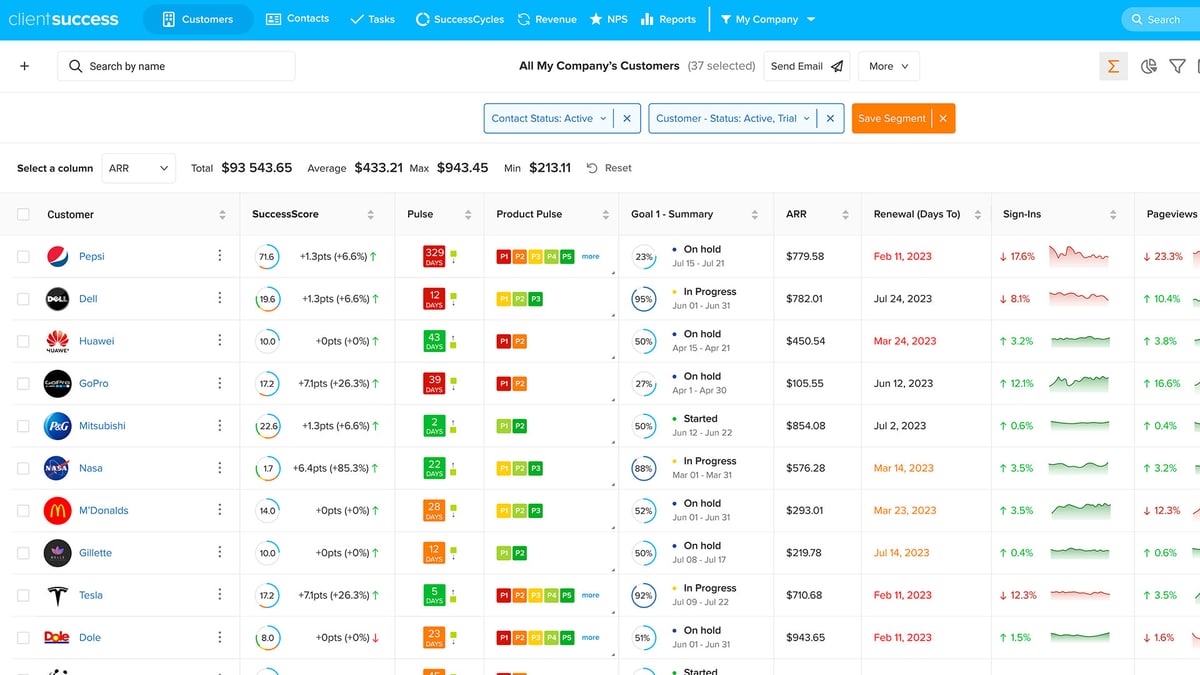
The core is better than the marketing because it is transparent. The health score, SuccessScore, weights signals your team picks - product usage, NPS, support ticket volume, billing status, executive engagement. "Each signal is weighted by your team and scored against thresholds you control - no black-box algorithms," the product page says. Next to it sits Pulse, the sentiment rating a CSM sets per account. Playbooks, called SuccessCycles, fire task sequences off those signals, and the renewal view rolls contracts into a pipeline and a waterfall forecast.
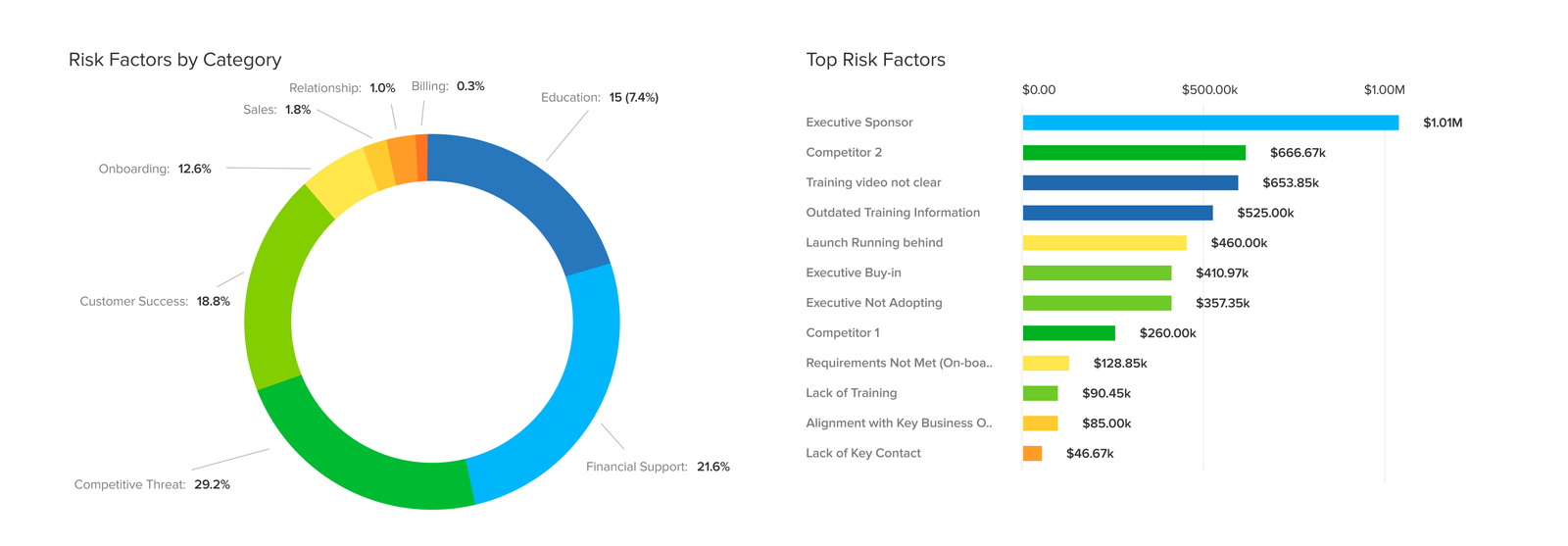
The same page promises a "15-25% reduction in gross churn within 12 months". No data backs it, so ignore it. What matters is what feeds the score. Zendesk tickets are not stored in ClientSuccess: the support view is a live window that shows at most 100 tickets. Usage data arrives through the Usage API or a connector such as Pendo, and reviewers on Capterra mention that getting clear usage metrics in is the hard part. If your product data sits in a warehouse with nobody to wire it up, the score will lean on Pulse. That is a CSM's opinion with a colour on it.
SmartCS and Meeting Intelligence cost extra
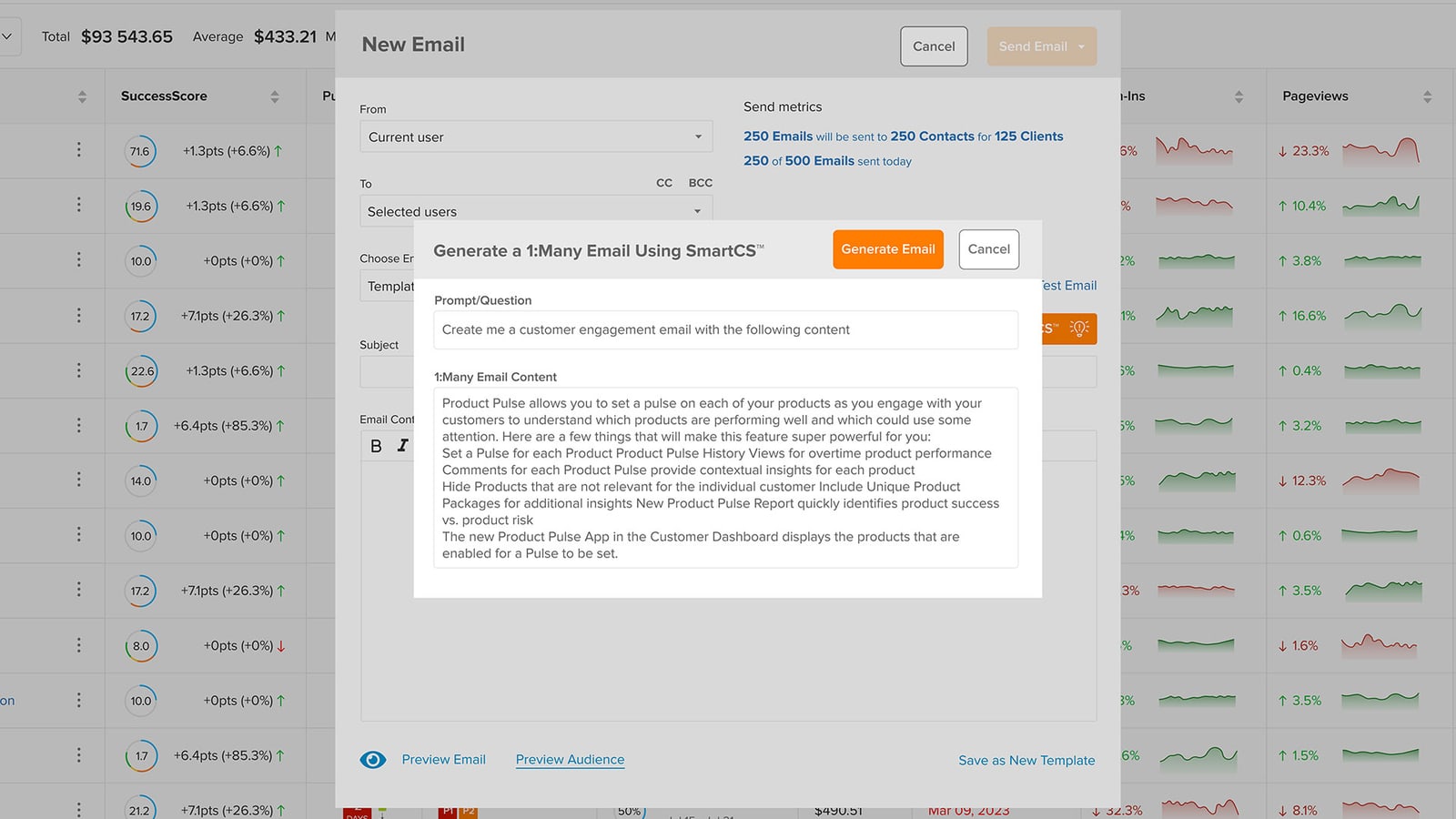
ClientSuccess shipped AI earlier than most of its peers. SmartCS launched in May 2023 and picked up two more features that October. It now does five things: NPS Analyzer, Pulse Summary, Engagement Insights, Email Assist and Customer Segment Analyzer. In practice: a one-to-many email drafted from a prompt, and per-account summaries of "the top 5 things that are going well and the top 5 areas of improvement".
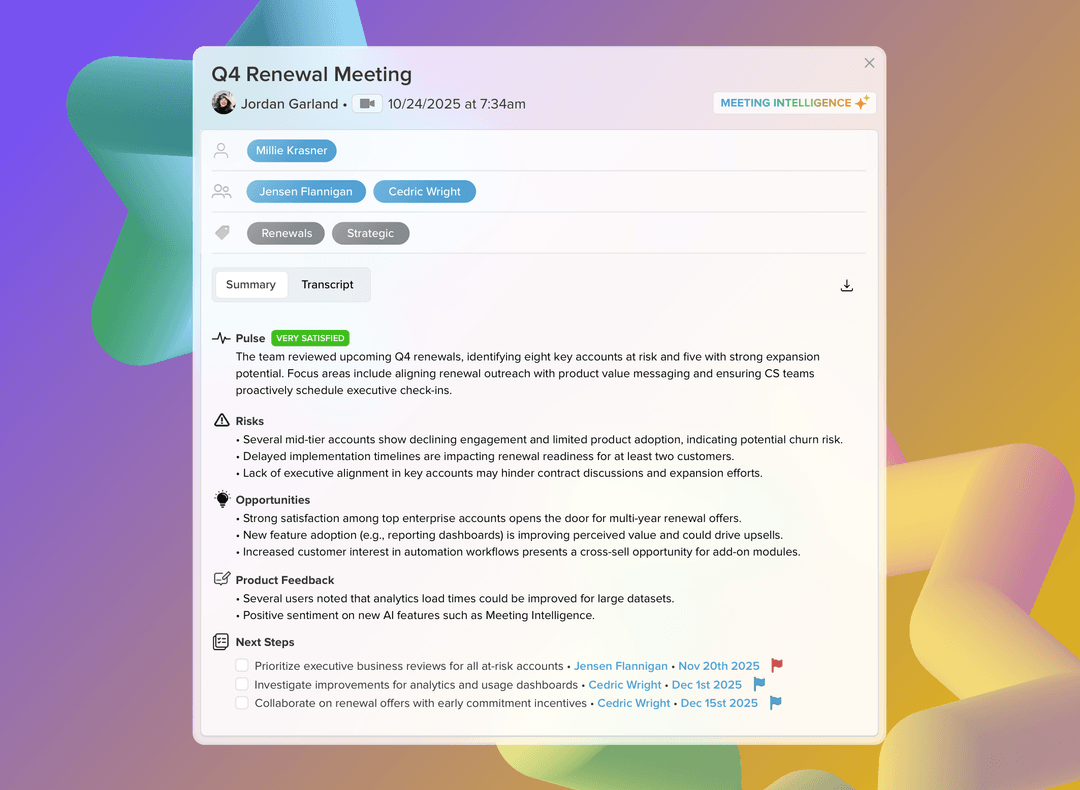
None of it is in the base plan. The pricing page lists "Meeting Intelligence, Automation & AI, and Customer Onboarding Portals" as add-ons, so the AI you see on the sales call is a separate line on the quote. Meeting Intelligence records, transcribes and summarises calls from Zoom, Google Meet or Microsoft Teams, but the help centre tells you to "Enable only one" provider. Custify at least prices its AI in published credits, so you know the cost before the demo.
The Claude MCP server: read-only, 30 days deep
The newest piece is an MCP server, described as "a read-only connection that lets an AI assistant retrieve your ClientSuccess customer success data". Claude is the only supported client today; others are on the roadmap. It is in early access, switched on through your CSM, and the page gives no plan or price for it.
An admin enables it ("Turning it on is your organization's decision, not a default"), then each user adds the connector in Claude and signs in with their own credentials - about two minutes each - so answers follow that user's permissions. Claude can see customer records, Pulse and sentiment, SuccessScores, contracts and renewals, contacts, tasks, NPS feedback and recent engagements.
The limits are stated plainly. "It can only read. It can never change anything." Engagements are "restricted to the last 30 days", and it cannot reach SuccessCycles, usage data, long-range history or the contents of files. "Salesforce, Zendesk, Zoom recordings, email inboxes, and Slack are all out of reach." So "which renewals next quarter have a red Pulse and no engagement this month?" works. "Why has usage at this account fallen since spring?" does not. One item for your security review: once data reaches Claude, it is handled under the AI provider's own retention and training terms, which ClientSuccess says it does not control.
Baton onboarding and Product Signals
Baton, bought in June 2024, is now the Onboard stage: templated implementation projects with milestones, a customer-facing portal, and project health that feeds the account's score. It is still sold on its own as well. For a team running onboarding in a spreadsheet, it is the strongest reason to pick ClientSuccess over a pure health-score tool. The customer portal, again, is an add-on on Growth and only included on Enterprise.
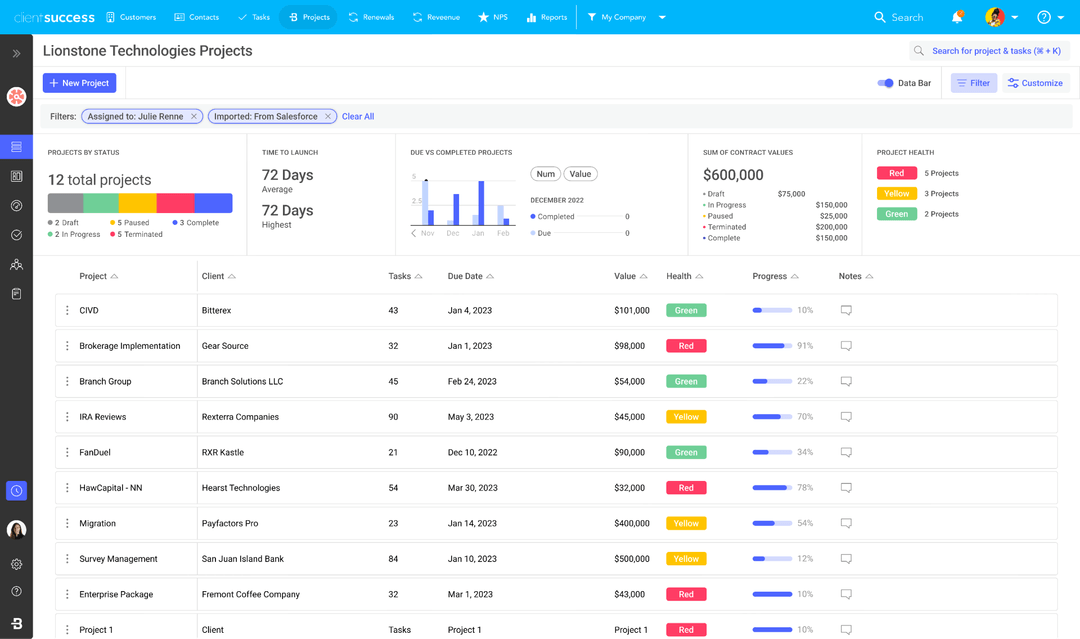
Product Signals, acquired in January 2025, collects feature requests and product feedback and pushes them to Slack and Jira. Its help collection runs to nine articles against Baton's 76, which tells you how far it has been folded in.
Integrations, API and leaving
CRM sync runs on a new integration platform that covers Salesforce, HubSpot, Zoho and Pipedrive, and moving to it costs nothing. Reviewers on TrustRadius want a stronger Salesforce integration, and G2 reviewers mention field limitations and limited customisation. The Open API v2.0 reads and writes clients, contacts and contracts and accepts usage data through the Usage API. You need the Admin role for a key, and no rate limits are published.
Leaving is reasonably clean. Admins, Executives and Managers can export engagements, clients, contacts, pulses, subscriptions, SuccessCycles and tasks from Global Settings > Data Exports, with no limit on on-demand runs. Each file is a point-in-time snapshot that stays downloadable for 30 days, so run the final export the week you cancel, not the month before. Compliance: SOC 2 Type 2 (no audit date published), AWS hosting, a GDPR DPA. There is no HIPAA claim anywhere, so a health-tech company that puts patient details in CSM notes should look elsewhere.
Verdict
Buy ClientSuccess if you are a B2B SaaS company inside the $5M-$500M ARR band it targets, with fewer than 50 CS users, and you want onboarding projects, health scores and renewal forecasting in one place for well under Gainsight money. Baton is the differentiator. The transparent health score is the safety net. Negotiate add-ons and the escalator up front.
Skip it if your health model depends on deep product-usage data, if you need more than 50 seats, or if you will not buy software without a price page. Custify publishes its pricing, Vitally is built for product-led teams that live in usage data, and ChurnZero has gone much further with AI than a read-only connector. If you are already past $500M ARR, buy what ClientSuccess benchmarks itself against: Gainsight.
Ready to try ClientSuccess?
Visit the official website to see the latest plans, pricing, and special offers.
Get Started - ClientSuccess* Affiliate link - we may earn a commission at no extra cost to you.