Cloudflare Gives AI Agents an Identity and a Wallet
Cloudflare launched cloudflare.pay and agent wallets on August 4, 2026, giving AI agents an identity and stablecoin funds to shop within limits their owners set.
News Report

What Cloudflare launched
On August 4, 2026, Cloudflare announced two tools built for software that shops on its own: a payment service called cloudflare.pay and a wallet system that lets an AI agent hold money and spend it. The pitch is blunt. If people are going to send agents out to book travel, restock supplies, or buy a birthday gift, those agents need a way to prove who sent them and a way to pay without being handed a human's credit card number.
The identity half gives every Cloudflare account a permanent, bot-readable web address that works as a stable ID. You can assign that ID to individual agents, and the merchant on the other end can see which person authorized the request. Owners who would rather stay anonymous can operate pseudonymously instead. The money half is a set of virtual wallets, one per agent, funded in dollar-pegged stablecoins.
"The Internet is shifting from human-driven browsing to agent-driven commerce, and the infrastructure needs to keep up," co-founder and CEO Matthew Prince said in the announcement.
How agent payments work
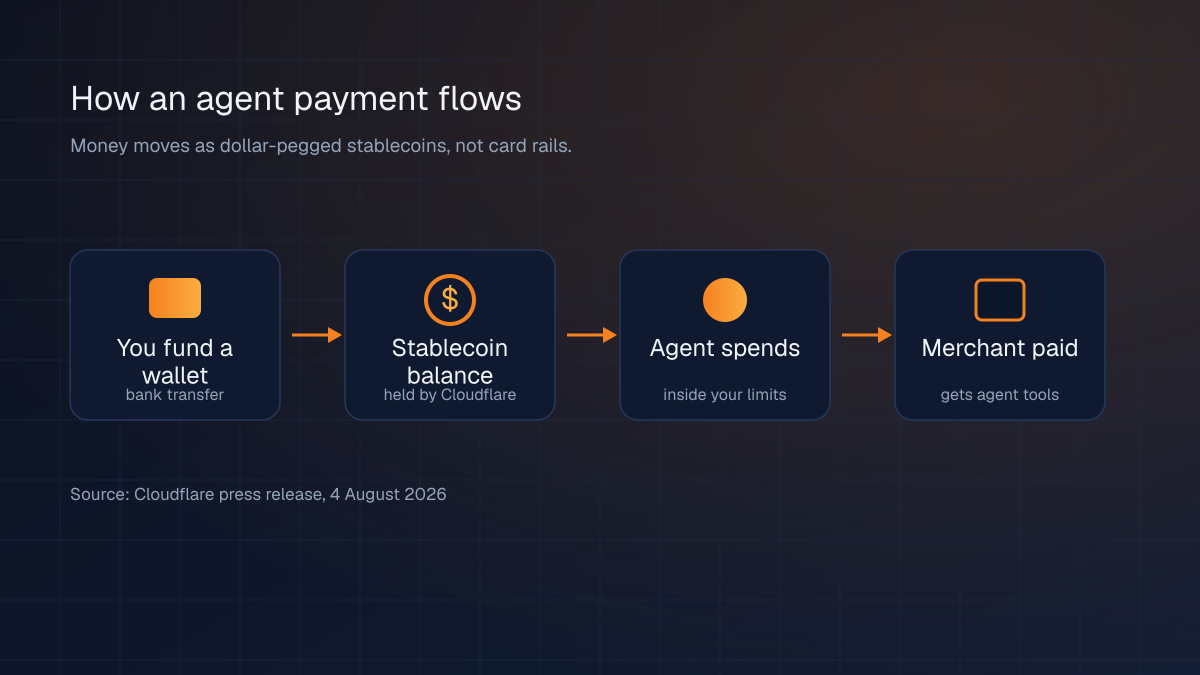
The flow is deliberately simple. You move money into a wallet by bank transfer, and Cloudflare converts it into stablecoins the agent can spend. You then grant a specific agent permission to draw on that balance. When the agent buys something, payment settles over stablecoin rails rather than the card networks.
Underneath sits x402, an open payment protocol developed by a group that includes Coinbase, Cloudflare and Stripe. The name nods to HTTP's long-dormant 402 "Payment Required" status code, and the idea is that any agent and any merchant can transact without a closed, proprietary middleman. Merchants get the other side of the deal too: tools to advertise prices and terms to agents, which Cloudflare frames as a two-sided market rather than a checkout button.
The guardrails
The obvious fear with an agent that can spend money is an agent that spends too much of it. Cloudflare's answer is to make every wallet controllable before the first purchase clears.
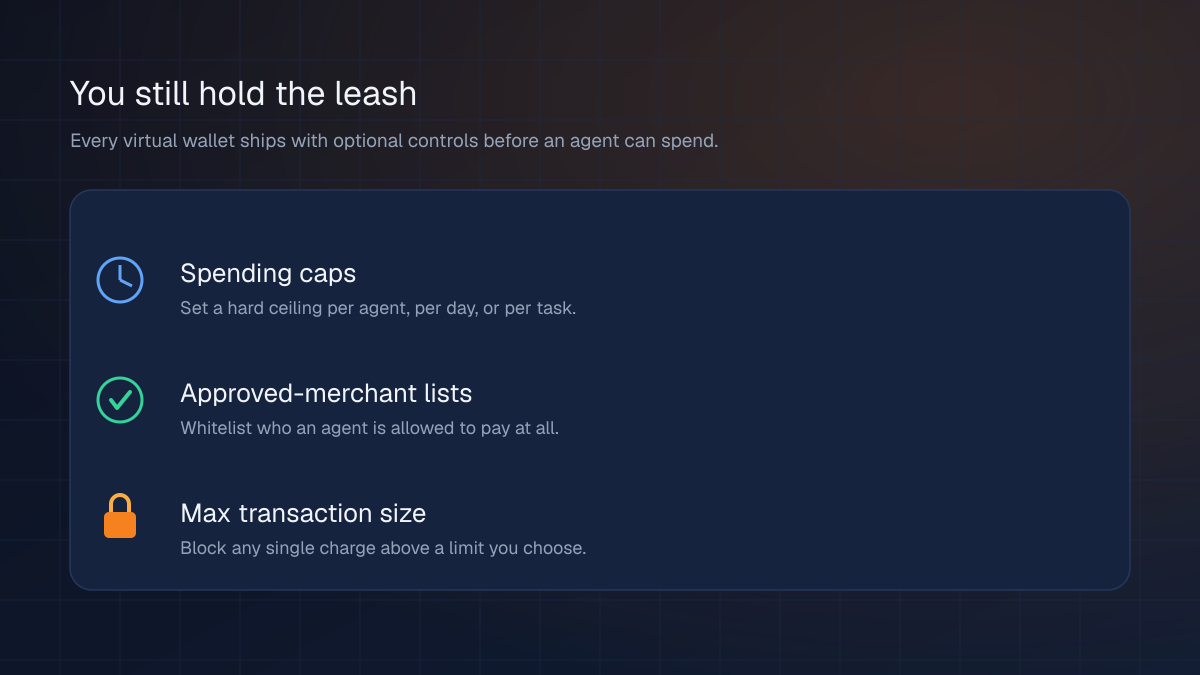
Owners can set a spending cap per agent, keep an approved-merchant list so an agent can only pay vendors you have vetted, and block any single charge above a size you pick. None of that is on by default in the sense of being automatic. It is a toolkit, and the burden of configuring it sensibly lands on the person deploying the agent. That distinction matters, because a badly scoped agent with a funded wallet is a new kind of mistake to make.
Part of a bigger push
Payments did not arrive alone. Cloudflare spread a run of agent-focused releases across the same week in early August 2026.
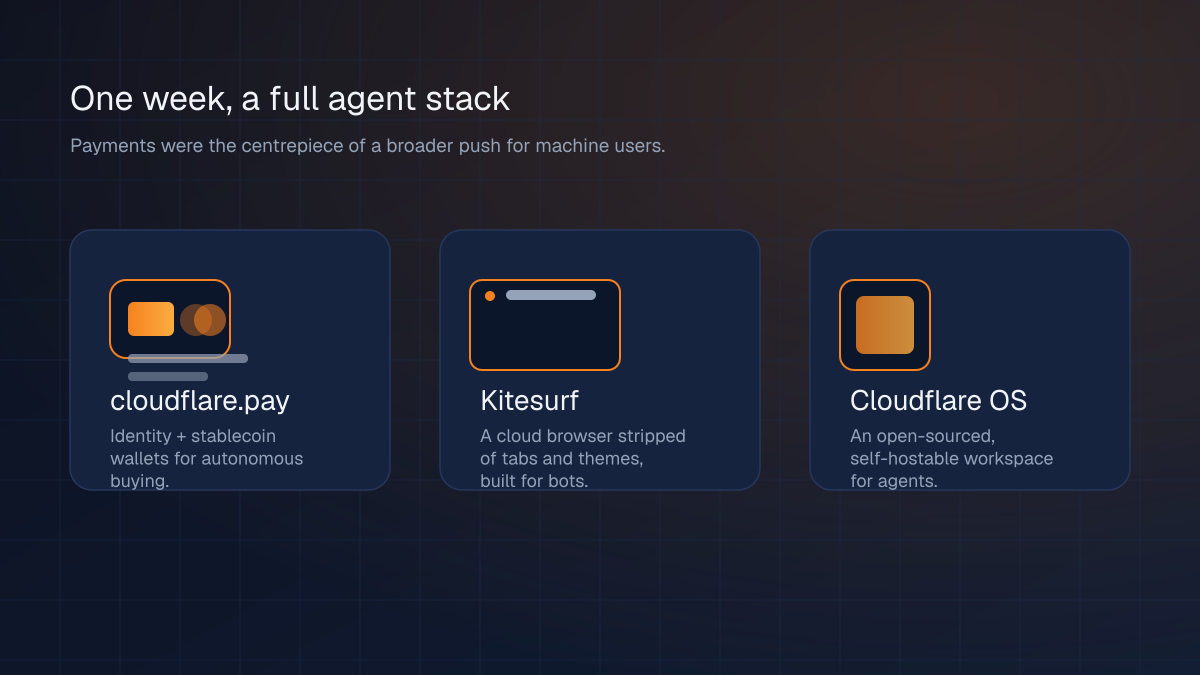
On August 5 it open-sourced Cloudflare OS, a self-hostable workspace for agents with per-instance sandboxes. On August 7 it launched Kitesurf, a cloud browser stripped of the tabs, themes and extensions a bot never uses, tuned instead for token cost and speed. Cloudflare says it built Kitesurf in twelve weeks and that it passes more than 215,000 web-platform tests. Taken together, the three releases sketch a full stack for machine users: a browser to read the web, a workspace to run in, and a wallet to pay with.
The open questions
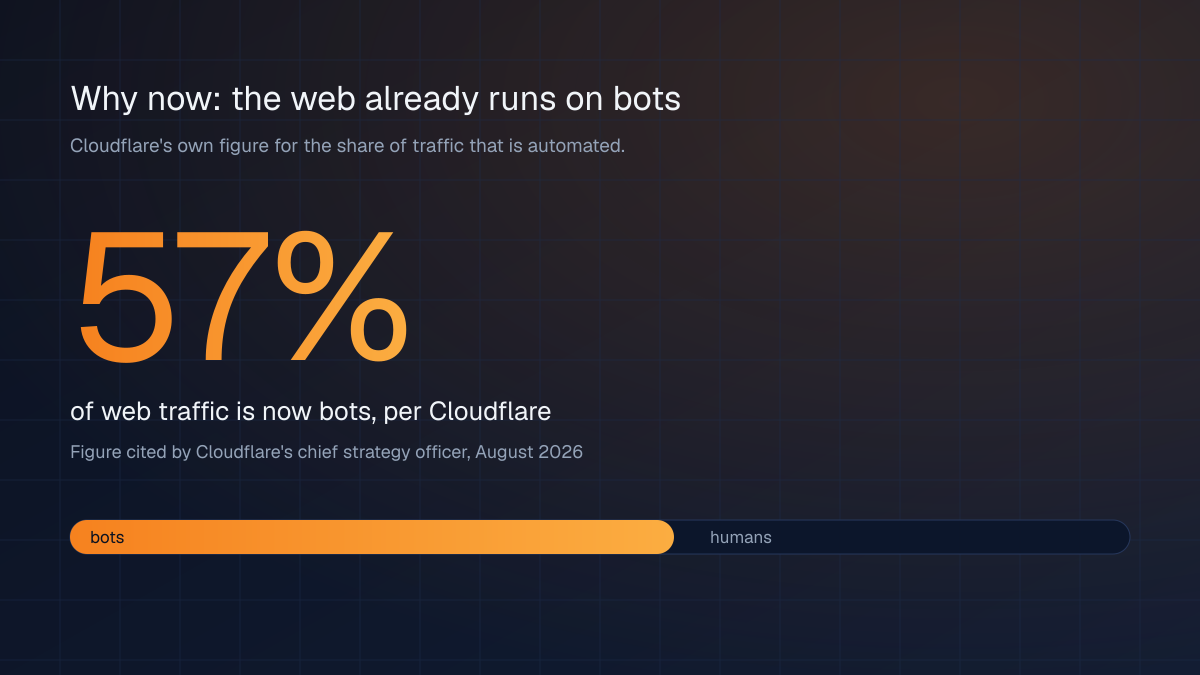
Why build this now? Cloudflare's own framing leans on a striking figure. Its chief strategy officer put the share of current web traffic that comes from bots at roughly 57 percent, so the company argues the human-first web is already the minority case.
Cloudflare is not alone at the table, which is part of why it moved. MoonPay recently launched PayBox, a wallet aimed at non-technical shoppers using Claude and ChatGPT, and both Visa and Mastercard are retooling their networks for agent-driven purchases. Routing that spending through stablecoins rather than cards is the aggressive bet here, and it invites hard questions. Who is liable when an agent buys the wrong thing? How do consumer-protection rules built around chargebacks apply to a stablecoin transfer that clears instantly? Regulators have not answered those yet, and the technology is shipping first.
What comes next
As of the announcement, this is a staged rollout rather than a finished product. Cloudflare opened wallet-handle reservations on August 4, 2026, with full wallet access, the ability to move funds on and off the platform, and the issuance of per-agent virtual wallets promised over the coming months. The real test is adoption on both sides: enough merchants willing to accept an agent's payment, and enough people willing to trust a bot with a funded balance.
If that trust materializes, the checkout page as a human designs it starts to look optional. If it does not, cloudflare.pay becomes an elegant answer to a question most shoppers were not yet asking. Either way, the plumbing for agents to spend real money now exists, and it is being laid by the company that already sits in front of a large slice of the web.
Read the original source
Head to the original source for the full announcement and complete details.
Read Original Source