CrowdStrike Agrees to Acquire Zscaler in $43.9 Billion All-Stock Deal
CrowdStrike agreed on November 23 to acquire Zscaler in an all-stock deal worth about $43.9 billion. The terms, what changes for Falcon and Zscaler customers, the risks analysts flag and when it closes.
News Report

The deal
Graphic: aiignitions.com. Logos are trademarks of CrowdStrike, Inc. and Zscaler, Inc.
CrowdStrike said on Monday, November 23, 2026 that it has signed a definitive agreement to acquire Zscaler in an all-stock transaction valuing the zero trust vendor at an enterprise value of about $43.9 billion. Zscaler shareholders will receive 1.135 CrowdStrike shares for each Zscaler share. That works out to roughly $260.41 per share based on CrowdStrike's closing price on November 20, a premium of about 34% to Zscaler's close that day, according to the merger announcement filed with the SEC.
Forrester calls it the largest cybersecurity acquisition ever. It is bigger than Google's $32 billion Wiz deal, Cisco's roughly $28 billion purchase of Splunk and the $25 billion CyberArk acquisition Palo Alto Networks closed earlier this year, the three megadeals CNBC set it against. For CrowdStrike, which has mostly made small tuck-in purchases and folded them into Falcon, it is a different kind of bet entirely.
Both boards approved the deal unanimously. Jay Chaudhry, Zscaler's founder, CEO and chairman, and his affiliates hold about 34% of Zscaler's shares and have signed voting agreements supporting it. After closing, existing CrowdStrike shareholders would own about 84.1% of the combined company and Zscaler shareholders about 15.9%.
Why the endpoint leader wants the network
CrowdStrike built its business on the Falcon sensor, the agent that runs on laptops, servers, phones and cloud workloads. Zscaler sits somewhere else. Its Zero Trust Exchange is an inline cloud service between users, AI agents and applications that checks every connection before letting it through. The company says it protects half of the Fortune 500, runs more than 200 service locations and processes over 750 billion transactions a day.
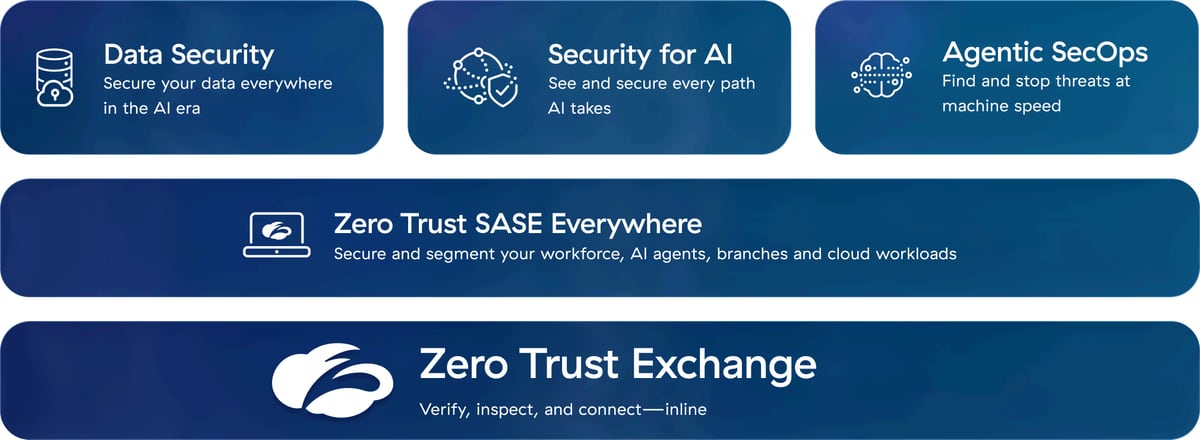
Image: Zscaler, Inc.
Owning both means owning the two places where an attack can be seen and stopped: on the device and on the wire. CrowdStrike's pitch, set out in its press release, is that device and network telemetry converge into one data set, which its SafeMind frontier security models can train on across the full attack path. Falcon Next-Gen SIEM would pull that data together for what the company calls the "agentic SOC". The marketing frame is "Zero Trust for AI Safety": applying the same per-connection checks to AI agents that zero trust already applies to people.

George Kurtz, CrowdStrike co-founder and CEO. Photo: CrowdStrike, Inc., CC BY-SA 4.0, via Wikimedia Commons
"Security used to be about keeping the adversary out. Today, safety is required to let AI in," CrowdStrike CEO George Kurtz said. Chaudhry was blunter: "In the AI era, Zero Trust security has become non-negotiable, and AI agents are rapidly becoming the new weakest link."
What changes for security buyers
Nothing, yet. The two companies keep operating independently until the deal closes, so contracts, consoles and support stay where they are today.
The changes CrowdStrike has described after closing are mostly commercial. Customers of either company could add the other's products on a single Falcon Flex contract, CrowdStrike's subscription and licensing model, and Zscaler would be sold through CrowdStrike's system integrators, resellers, distributors and cloud marketplaces. The overlap is already large: the companies share more than 2,000 customers and 16 existing integrations. Roughly 8,000 Zscaler customers do not use CrowdStrike at all, and those accounts are the cross-sell the revenue targets depend on.

Jay Chaudhry, Zscaler founder, CEO and chairman. Photo: BluBayou, CC0, via Wikimedia Commons
Chaudhry will keep running the Zscaler business and join CrowdStrike's board. Kurtz stays on as CEO.
What analysts are warning about
In a note published November 24, Forrester analysts argued that the near-term benefit is commercial and that the day-to-day product experience will not change quickly. CrowdStrike has never integrated a company this size. Part of the promised $500 million in cost savings depends on merging Zscaler's data center infrastructure, which carries traffic for every connected user, and Forrester flags that as a performance risk.
Product overlap comes next. Both companies sell cloud security posture tools (CNAPP and SSPM), browser security and data security, and Forrester expects some of those lines to be cut. Then there is concentration: one endpoint agent and one zero trust access path from the same vendor, a setup the analysts tie directly to memories of the July 2024 CrowdStrike outage. They also expect European and UK regulators to examine Falcon Flex bundling and whether Zscaler keeps working with rival EDR products such as Microsoft Defender and SentinelOne.
The advice to buyers is direct. "Having a single contract, agent, or console isn't, by itself, proof of integration," the analysts wrote, adding: "Use renewal discussions to hedge against future changes." In practice that means asking for price protection, integration continuity, termination and data-export rights and change-of-control terms, getting roadmaps from both vendors for the overlapping products, and keeping standalone SASE options on the shortlist.
The numbers behind the bet
The combined company is expected to start with more than $10 billion in annual recurring revenue at closing. Zscaler reported $3.9 billion of ARR for its most recently completed quarter. CrowdStrike reported ending ARR of $6.26 billion, up 27% year over year, in fiscal third-quarter results it moved up from December 1 to the same morning. Revenue for the quarter ended October 31 was $1.58 billion, up 28% and ahead of the $1.53 billion analysts expected; non-GAAP earnings were 34 cents a share against 31 cents expected, per CNBC. Kurtz called it "the best quarter in CrowdStrike's history."
CrowdStrike is targeting about $1 billion in annualized revenue synergies built over 30 months and $500 million in annual cost synergies within 18 to 24 months of closing. It also says the deal widens its addressable market by more than $185 billion in calendar 2029.
Investors were not sold on day one. CrowdStrike stock fell about 9% on Monday after an 80% run this year, while Zscaler rose nearly 18%, CNBC reported. At Friday's close the two were worth more than $265 billion combined, still behind Palo Alto Networks at $282 billion.
What happens next
The deal needs Zscaler shareholder approval and regulatory clearance, and is expected to close in the second half of CrowdStrike's fiscal 2028. Because CrowdStrike's fiscal year ends January 31, that window runs from August 2027 to January 2028; TechCrunch put it at "around this time next year."
Until then, existing Zscaler and CrowdStrike deployments carry on as they are. For teams with a renewal due in the next twelve months, the timing matters more than the headline: a contract signed now will still be running when the product lines start to merge, and that is the moment to write the protections in. Deal terms and financial figures here come from the companies' announcements and SEC filings, checked on November 25, 2026.
Top photo: CrowdStrike's office at 150 Mathilda Place, Sunnyvale, California, by Coolcaesar, CC BY 4.0, via Wikimedia Commons.