Datadog Review: Every Product Is Its Own Meter, and the Meters Add Up
Datadog review with list prices checked in October 2026: per-host, per-GB and per-event meters, a worked $1,445/month example, six billing traps, Bits AI credits, and who should pick Grafana Cloud or New Relic instead.
Expert Review

The short version
Datadog can watch nearly everything a software team runs: hosts, containers, traces, logs, real browser sessions, databases, serverless functions, synthetic tests, and now LLM calls and AI agents. Few competitors cover that much ground from one agent and one query language. The business is doing well on it, too - revenue for the quarter ended June 30, 2026 was $1.12 billion, up 36% year over year, with about 4,720 customers paying $100,000 or more a year.
The catch is the invoice. Every product runs on its own meter, and the meters are counted in different units: per host, per GB ingested, per million log events indexed, per 100 custom metrics, per 1,000 browser sessions, and now per AI credit. Each list price looks small. None of them tells you what the month will cost. This review is mostly about how those meters stack, because that is the part the pricing page leaves you to work out.
Pricing, checked in October 2026
All figures below are list prices from Datadog's public pricing list, checked on October 1, 2026. The page carries no last-updated date. Annual means billed on a yearly commitment; on-demand is the no-commitment hourly rate, and month-to-month usually matches it for hosts.
| Product | Unit | Annual | On-demand |
|---|---|---|---|
| Infrastructure Pro | per host / month | $15 | $18 |
| Infrastructure Enterprise | per host / month | $23 | $27 |
| APM | per APM host / month, on top of infra | $31 | $36 |
| APM Enterprise (adds Continuous Profiler) | per APM host / month | $40 | $48 |
| Log ingestion | per GB | $0.10 | $0.10 |
| Log indexing, 15-day retention | per 1M events | $1.70 | $2.55 |
| Custom metrics over allotment | per 100 | $5 | - |
| RUM Measure | per 1,000 sessions | $0.15 | $0.22 |
| Session Replay | per 1,000 sessions | $2.50 | $3.60 |
| Database Monitoring | per database host | $70 | $84 |
| Bits AI credits | per 500-credit bundle | $500 | $1.30 per credit |
Two things in that table decide most bills. APM is not an upgrade to the infrastructure fee; it is a second fee on the same machine, so a traced host costs $46 a month on annual terms, not $31. And logs are charged twice - once to send them in, and again, per million events, for every event you keep searchable. Each Pro host comes with 5 containers, 100 custom metrics and 500 custom events before overage starts; Enterprise doubles those.
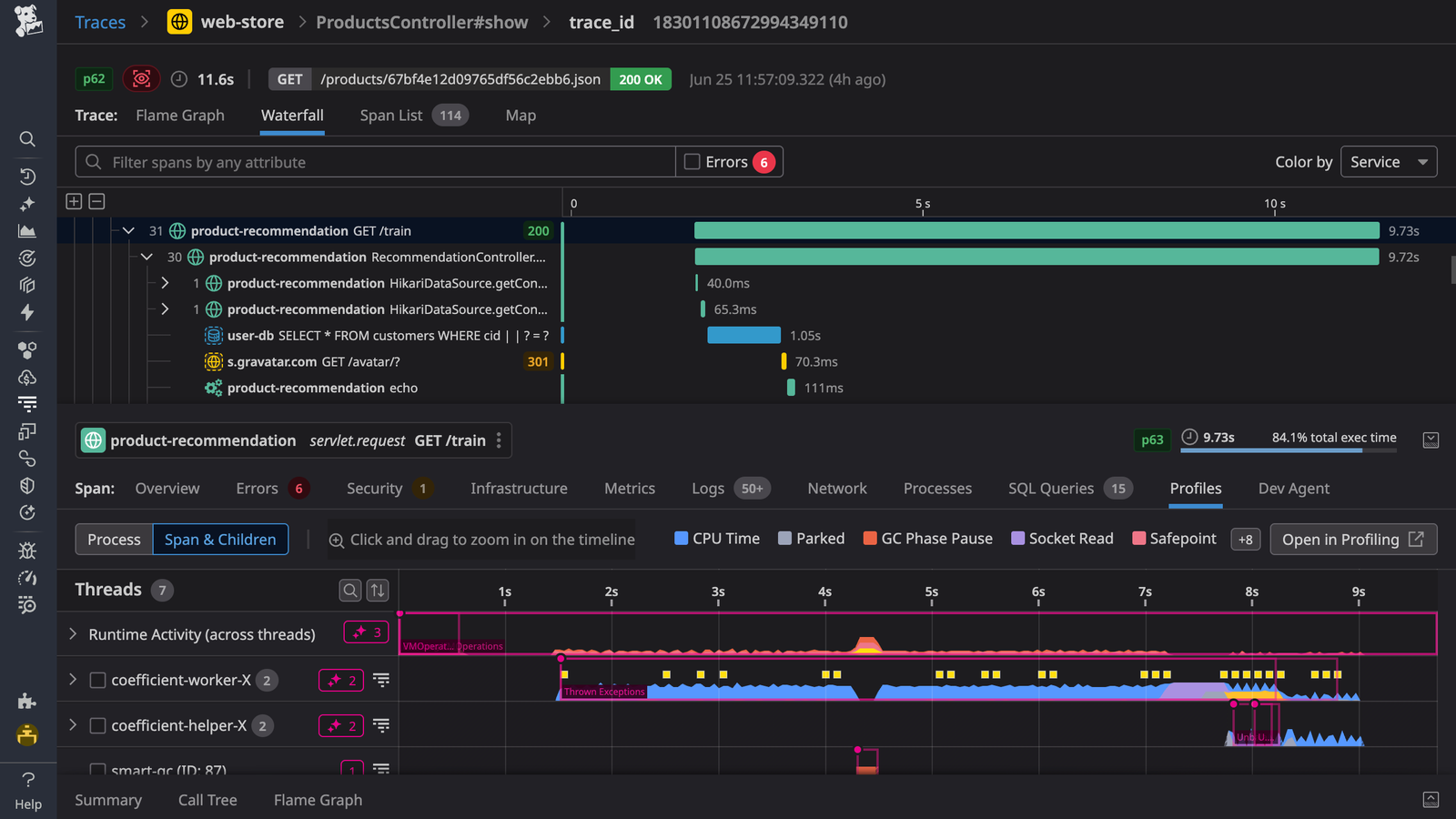
How a $300 line becomes a $1,445 month
Here is our own illustration, built from annual list prices - Datadog does not publish it, and your contract may differ. Take a 20-host team that turns on the products most teams actually use.
| Line | Usage | Monthly cost |
|---|---|---|
| Infrastructure Pro | 20 hosts x $15 | $300 |
| APM | 20 hosts x $31 | $620 |
| Log ingestion | 500 GB x $0.10 | $50 |
| Log indexing (15-day) | 100M events x $1.70 | $170 |
| Custom metrics | 5,000 used, 2,000 included | $150 |
| RUM Measure | 200K sessions | $30 |
| Session Replay | 50K sessions | $125 |
| Total | about $1,445 |
The infrastructure fee, the number people quote when they say Datadog starts at $15, ends up as roughly 21% of the bill. Add Database Monitoring on two Postgres hosts and it is another $140. Move from annual to on-demand and nearly every line rises by 15% to 50%.
This is the pattern behind the complaints. One Hacker News user wrote in July 2025 that "after one or two completely surprising bills (thanks to their granular but unintuitive pricing model), I wouldn't recommend it to anybody any more." Another, in January 2026, described the "datadog billing problem" where the bill "starts reasonable and then grows to a non-trivial percent of saas budget, and then theres a scramble to refactor."
Six lines in the billing docs worth reading twice
On-demand APM is metered by the hour. Each APM host includes 150 GB of ingested spans and 1 million indexed spans a month, which sounds generous. On on-demand, though, Datadog's pricing page says the allotments "are metered each hour and are not aggregated across all use throughout the month." A traffic spike at 2 p.m. is billed as overage even if the host sat idle all night. Annual contracts do not have this problem, which is one more push toward committing.
Span-based metrics count as custom metrics. Generate a metric from your traces and it draws down the same 100-per-host allotment as everything your code emits. Custom metrics are averaged across the whole account rather than per host, so a single high-cardinality tag - a user ID, a request path - can push you over for everyone.
An agent inside each container is a host. Datadog's container billing docs say it directly: "If you choose to install the Agent directly in each container, each container is counted as a host from a billing perspective." One Hacker News user said sidecar containers would have "doubled our datadog bill"; that is their account, but it matches the docs. Run one agent per node, not per container.
Host counts use a high-water mark. Hosts are counted hourly, and the month's bill uses the highest count after dropping the top 1% of hours. A few hours of autoscaling are forgiven. A week-long launch surge is not - it sets the price for the whole month.
Orders renew on their own. Datadog's master agreement (s.6.1) says orders "automatically renew" for another term of the same length, and usage is invoiced monthly in arrears. Put the renewal date in a calendar the day you sign.
The billing month starts on the 1st, UTC, whatever day you signed up.
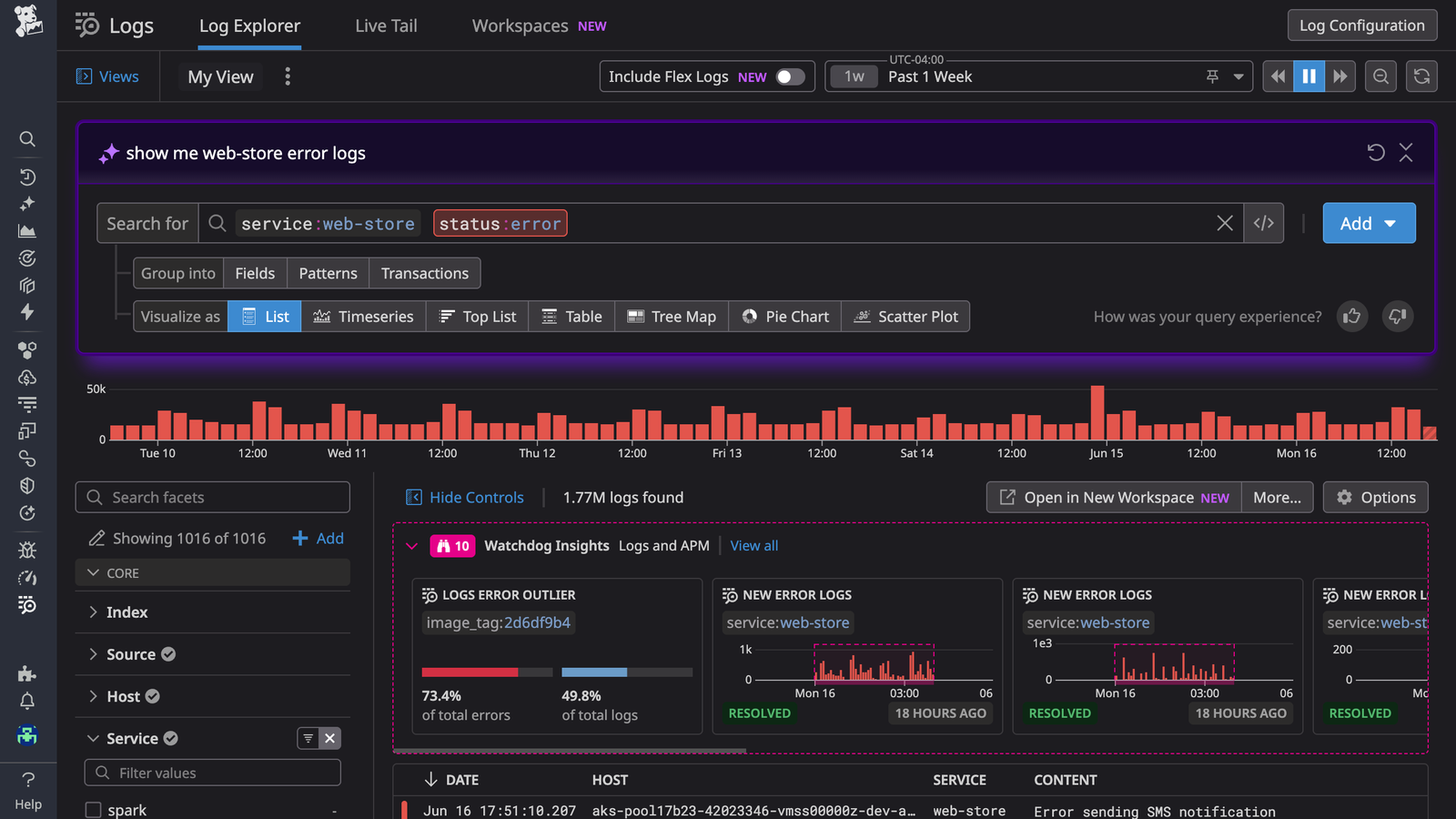
The fix for logs is the one Datadog itself sells: ingest everything at $0.10 per GB, but only index what you search. Exclusion filters and Flex Logs, stored at $0.05 per million events on annual terms, keep the $1.70-per-million line from growing with your traffic.
What the money buys
The reason teams stay despite the bills is correlation. A latency alert opens on a trace, the trace links to the logs from that request, the logs link to the host's CPU graph and the browser session of the user who saw the slow page. In a stack of separate tools, that is four tabs and a timestamp copied by hand. In Datadog it is one click each way. Metrics keep full resolution for 15 months on paid plans, which is long enough to compare this year's Black Friday against last year's.
Coverage keeps widening. At its DASH conference on June 9, 2026, Datadog announced more than 100 capabilities, including Bring Your Own Cloud, which deploys the platform into a customer's own environment, and an Agent Console for watching coding agents such as Claude Code, Cursor and GitHub Copilot. LLM Observability has a free tier of 40,000 LLM spans a month at 15-day retention, then $160 for the first 100,000 spans on annual terms.
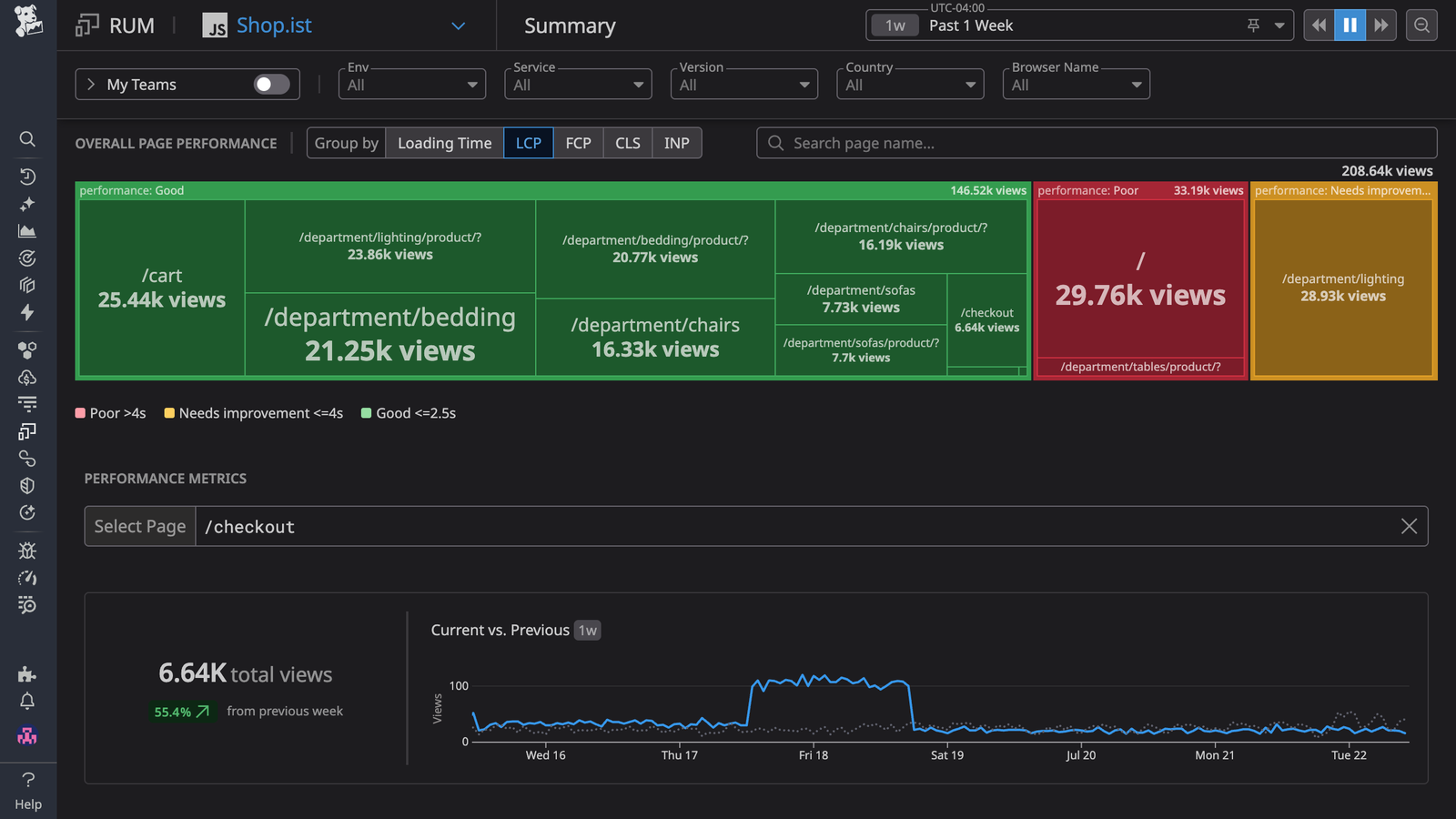
Bits AI: an on-call agent paid in credits that expire
Bits Investigation, launched as Bits AI SRE and generally available since December 2, 2025, picks up an alert, pulls the relevant metrics, traces and logs, and returns ranked hypotheses about the cause. Bits Chat, Bits Code and Bits Agent Builder reached general availability by the second quarter of 2026.
They all draw on one pool of AI credits: $500 for 500 credits a month on annual terms, $600 month to month, or $1.30 per credit on demand. The pricing page is blunt on two points - "Unused credits do not roll over to the next month," and usage above the bundle is "billed automatically at the On-Demand rate." What it does not say is how many credits one investigation consumes. So there is no way to estimate the line before you run it. Buy the smallest bundle, watch a month of real alerts, then size up.
Free plan and trial
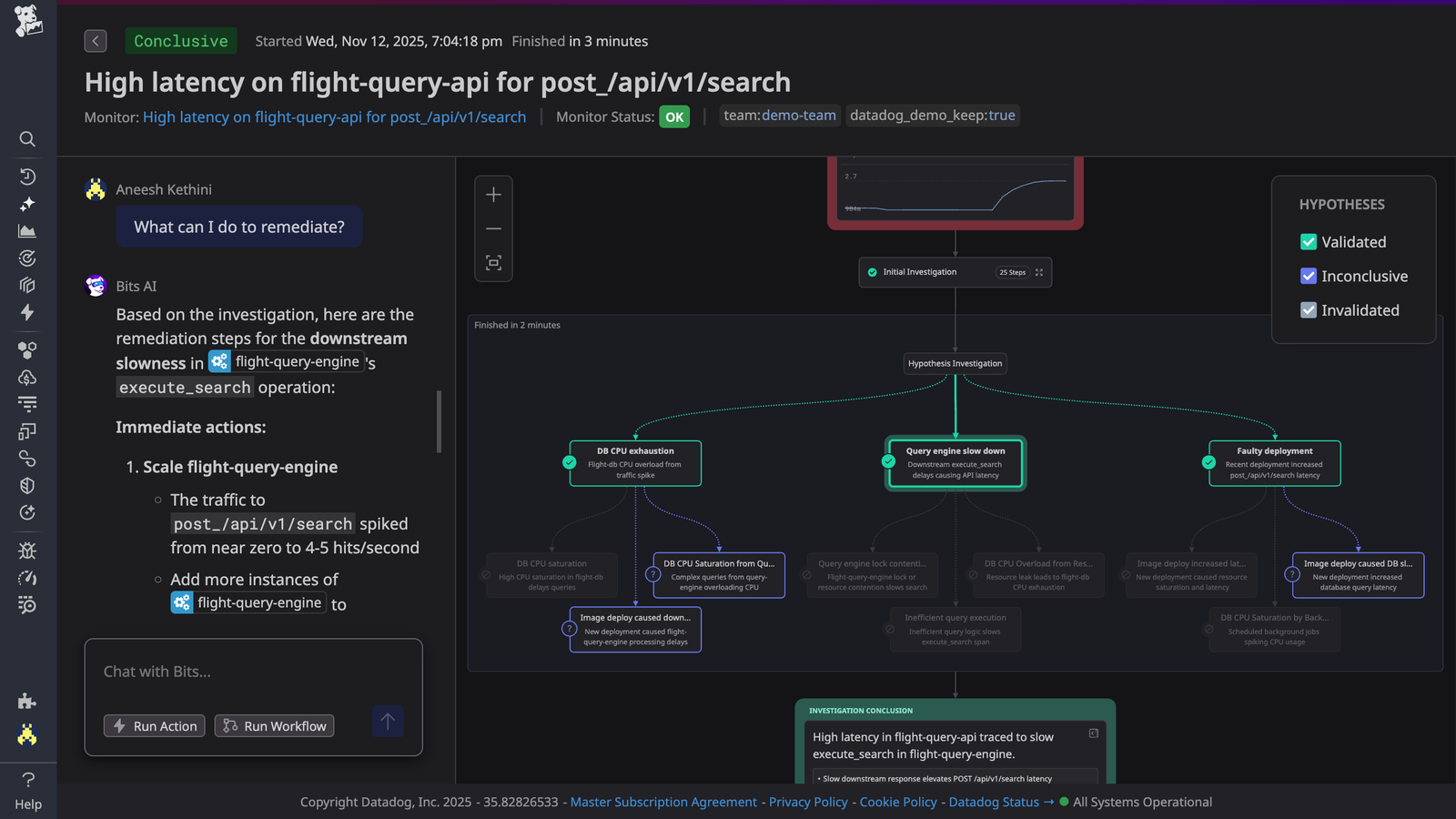
The free plan covers up to 5 hosts with core collection and dashboards, but metrics are kept for one day. That is enough to try the agent on a side project, not to run production - you cannot look back at last Tuesday. The 14-day trial opens every product with no credit card, and it is the better test: turn on APM and logs against real traffic and read the usage page on day 10, before the numbers become an invoice.
Verdict: who should buy it, and who should skip it
Buy Datadog if you run dozens of services in production, need traces, logs and front-end sessions tied together, and can sign an annual commitment. The annual discount is real, and it also removes the hourly APM metering that makes on-demand bills jumpy. Assign someone to own the usage page, the same way someone owns the cloud bill.
Skip it if you are a small team watching every dollar, or if nobody will police custom-metric tags and log indexing. Grafana Cloud gives you the same metrics, logs and traces on open-source tooling you can leave with. New Relic includes 100 GB of ingest free and prices mostly by seat, which is easier to forecast for a team of five. And if what you really need is error alerts, Sentry does that for a fraction of any line above.
Datadog is the most complete observability platform on the market. It is also the one where the price on the page is furthest from the price on the invoice.
Ready to try Datadog?
Visit the official website to see the latest plans, pricing, and special offers.
Get Started - Datadog* Affiliate link - we may earn a commission at no extra cost to you.