Gemini 4 Hydrogen: Google's Cheaper Daily Driver Resets the Gemini Price Ladder
Gemini 4 Hydrogen launched Nov 12 at $1.50/$7.50 per 1M tokens. What it changes for developers: new price ladder, benchmarks, migration catches, Search.
News Report

What Google launched
Google released Gemini 4 Hydrogen (model ID gemini-4-hydrogen) on November 12, in a launch post signed by Koray Kavukcuoglu, SVP of Google DeepMind. Google pitches it as a "daily driver for agentic workflows": the model you run for everyday coding and agent tasks, while Gemini 4 Carbon and Gemini 4 Argon keep the deep, long-horizon reasoning.
It costs $1.50 per million input tokens and $7.50 per million output tokens, flat across the full 1M-token context window. It is live in the Gemini API, Google AI Studio, Android Studio, Gemini Enterprise and the Gemini app, and it is now the model behind Google Search for every user worldwide.
The price is the bigger story. Hydrogen arrives just as Google ends two discounts, and together the three changes reorder which Gemini model a developer should default to.
The new Gemini price ladder
All figures below are the paid Standard tier per 1M tokens, checked on Google's Gemini API pricing page on November 16, 2026.
| Model | Until Nov 30 | From Dec 1, 2026 | From Jan 1, 2027 |
|---|---|---|---|
| Gemini 4 Hydrogen | $1.50 / $7.50 | $1.50 / $7.50 | $1.50 / $7.50 |
| Gemini 4 Argon and Carbon | $2.00 / $10.00 | $4.00 / $20.00 | $4.00 / $20.00 |
| Gemini 3.8 Flash | $0.75 / $3.75 | $0.75 / $3.75 | $1.50 / $7.50 |
Read it as a job. Ten million input tokens plus two million output costs $30 on Hydrogen. On 3.8 Flash it costs $15 today, and $30 from January 1. On Argon it is $40 now and $80 from December 1. So the frontier models go from 1.33x Hydrogen's price to about 2.67x in two weeks, and 3.8 Flash's only remaining advantage, being half the price, expires in about six.
Batch and Flex halve Hydrogen to $0.75 / $3.75, which matches what 3.8 Flash costs today. Priority runs $2.70 / $13.50. There is a free tier, but Google uses free-tier content to improve its products; paid-tier content is not used. Grounding with Google Search is paid-tier only: 5,000 free requests a month, shared across all Gemini 3 and newer models, then $14 per 1,000.
What the benchmarks claim
Every number in this section is Google-reported. None has been run independently yet.
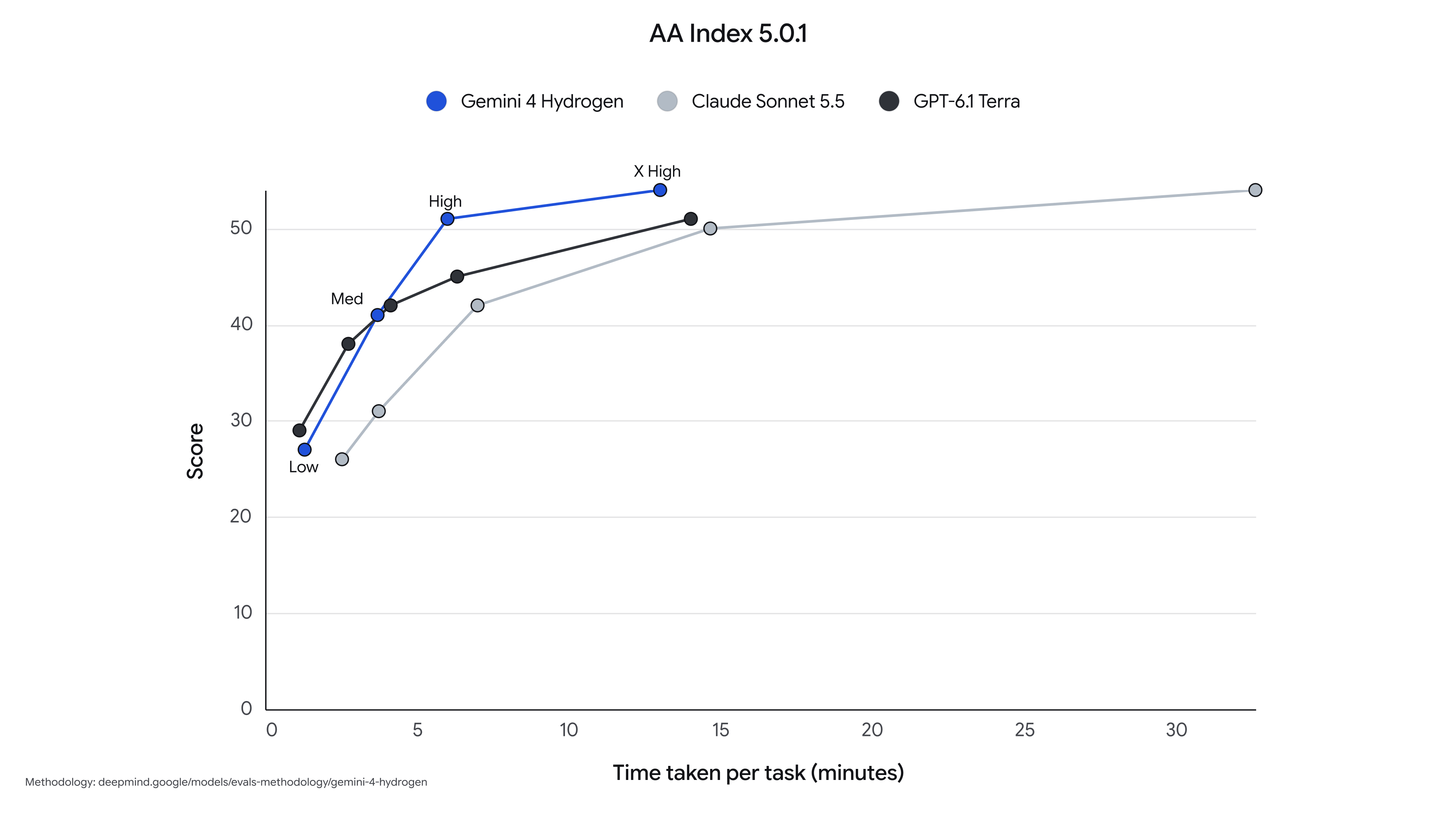
The headline is the Artificial Analysis Intelligence Index: 51 at the default "high" thinking level, against 50 for Argon, and 54 at a new "xhigh" level. One point is not a rout. What it does mean is that the model priced at $1.50 roughly matches the one that will cost $4.00. On Terminal-Bench 4.1 Hydrogen scores 57%, up from 18.2% for Gemini 3.8 Flash, and Google says it finishes tasks about 2.5x faster than 3.8 Flash at the default level.
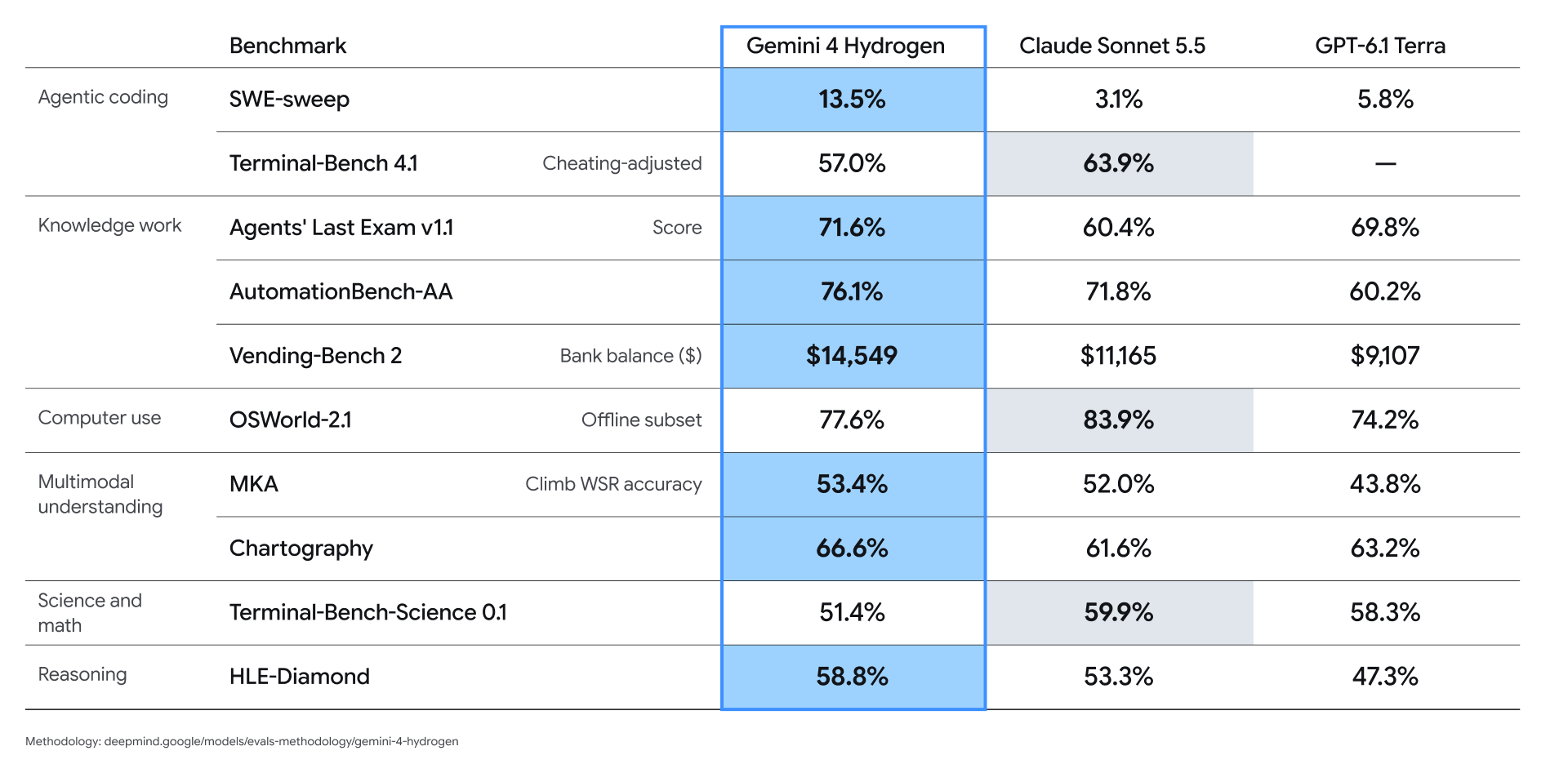
Partners reported 2x to 2.8x faster runs and 12% to 23% lower token use than 3.8 Flash. Google also lists 58.8% on HLE-Diamond, 52.3% on Vals Tax Agent Bench and 71.6% on Agents' Last Exam v1.1. It ranks #5 on Agent Arena, so it is not the top model there. Google's own table also shows where it loses: Claude Sonnet 5.5 leads on Terminal-Bench 4.1 (63.9% vs 57.0%), OSWorld-2.1 (83.9% vs 77.6%) and Terminal-Bench-Science 0.1 (59.9% vs 51.4%).
Carbon plans, Hydrogen works
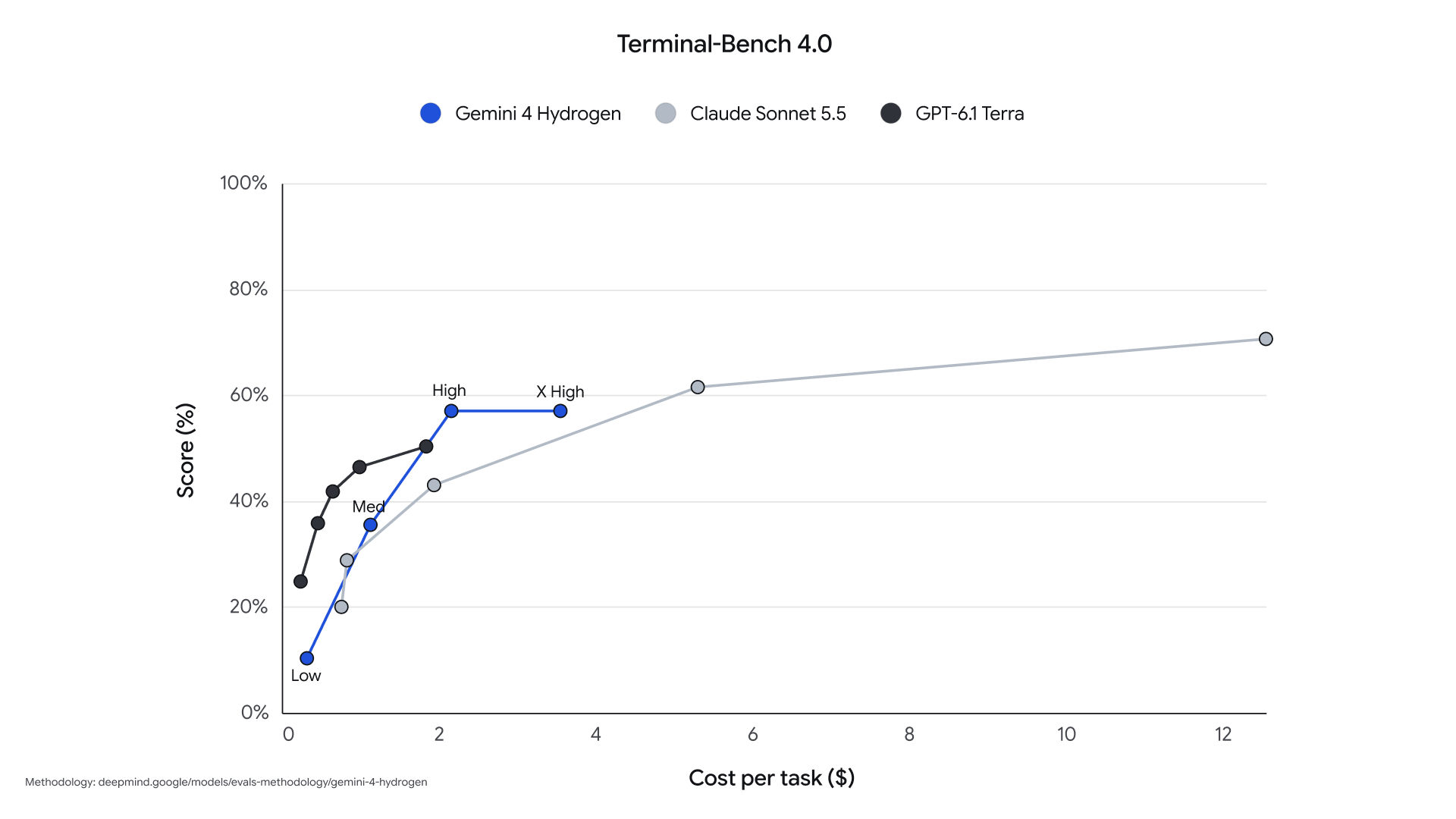
The more practical claim is about mixing models. In Google Antigravity, the Orchestrator now switches between Carbon and Hydrogen inside one session: Carbon coordinates, Hydrogen runs the worker and verifier agents in isolated workspaces. On Terminal-Bench 4.0 Google reports near-Carbon task success with about 24% less quota used and 19% faster completion. If that holds outside Google's harness, the December 1 price rise matters less to teams that only send the planning step to Carbon.
What breaks when you switch from Flash
Hydrogen is not a drop-in swap for code written against older Flash models. Google's Cloud model page lists the catches.
Setting thinking_budget, or thinking_level to MINIMAL, returns HTTP 400. The four valid levels are low, medium, high (default) and xhigh. Sampling is fixed at temperature 1.0, topP 0.95 and topK 64, and custom values are ignored, so a pipeline tuned to temperature 0 for repeatable output will not get it.
Caching is implicit only, with a 4,096-token minimum. There are no explicit cache objects, so code that creates and reuses named caches needs rewriting. Cached input bills at $0.075 per 1M tokens. RAG Engine, tuning and the Live API are not supported either.
The context window is 1,048,576 tokens, shared between input and output. A single foreground response tops out at 65,536 tokens; longer output needs the background long-decode mode. Google labels the model "short-term generally available" with a minimum 45-day retirement notice, which is a short horizon to build a product on.
Hydrogen now answers Google Search
Robby Stein, VP of Product for Search, called the switch "the biggest model upgrade to Search yet", rolling out globally to all users. Google says it handles multi-part questions, typos and very specific requests better, and that query fan-out now runs simultaneous searches across subtopics and links to a wider range of sites. Answers carry more images, comparison tables and custom tools. The language gains apply "across all supported AI Mode languages"; the post does not mention AI Overviews.
For publishers that means a different model now decides which pages a Search answer cites. Google says the citations reach more sites; no traffic data exists yet to check that.

The safety fine print
The model card is more mixed than the launch post. Against 3.8 Flash, safety scores improved on text (+0.80 points), multilingual (+1.10) and image-to-text (+7.00). Unjustified refusals got worse by 5.57 points, "particularly for multimodal prompts". For an app that sends user images, expect more false refusals than on Flash.
Under Google's frontier safety framework, Hydrogen reached the alert threshold for both biological and cybersecurity uplift, though not the critical capability level. Google says mitigations continue and that the full Safety and Security Report is "coming soon". The launch post's agent claims, such as up to 81% less overreach and 2.3x more resilience on the Gray Swan prompt-injection benchmark, are again Google's own evals.
What happens next
Three dates matter. Argon and Carbon double to $4 / $20 on December 1. Gemini 3.8 Flash doubles to $1.50 / $7.50 on January 1, 2027, the same as Hydrogen. TTL-based cache controls arrive on Hydrogen on January 12, 2027. Google lists no price change or deprecation date for Hydrogen itself.
Our read: if you run coding agents or tool-calling workloads on 3.8 Flash, test Hydrogen now and plan to move before January, since price will no longer be a reason to stay. Keep Argon or Carbon only for the planning steps that measurably need them. Teams that depend on deterministic sampling, explicit caching, tuning or the Live API should hold off. For them 3.8 Flash stays usable until Google sets a shutdown date, and none is listed yet.