ChatGPT Wallet Lets OpenAI's Dots Agents Pay Without Seeing Your Card Number
ChatGPT Wallet, launched November 13, lets OpenAI's dots agents pay with tokenized cards from Amex, Mastercard and Visa. Who gets it, how approval works, and what merchants face.
News Report

What OpenAI switched on
On November 13, OpenAI started rolling out ChatGPT Wallet, a payment layer for dots, the always-on agents it introduced at DevDay on September 29. Until now a dot could research a purchase, compare options and fill a cart. Paying was the step it handed back to you. Wallet closes that gap.
OpenAI calls it the "first wallet that lets agents pay without access to users' actual card details" and says it is "setting a new bar for secure payments by agents," according to 9to5Mac. Those claims are OpenAI's own. No outside audit of the system has been published.
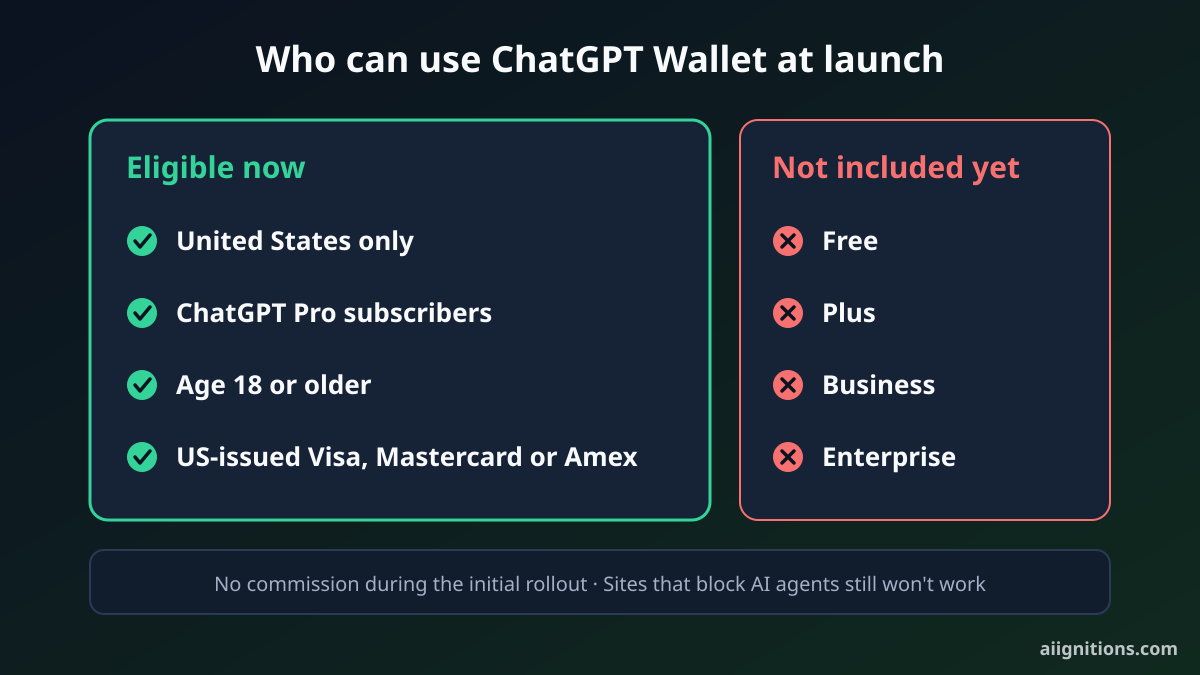
The launch is narrow. It is limited to ChatGPT Pro subscribers in the United States, aged 18 or older, with a US-issued Visa, Mastercard or American Express card. Free and Plus users are not included, and OpenAI gave no date for wider availability.
How a dot pays without the card number
Wallet was built with American Express, Mastercard and Visa, and it runs on a mechanism those networks already use for phone wallets: tokenization. You add a card once. When you approve a purchase, the payment network issues a token that stands in for the card number, security code and expiry date. The charge lands on your real card, but neither the merchant nor the agent ever receives its details.
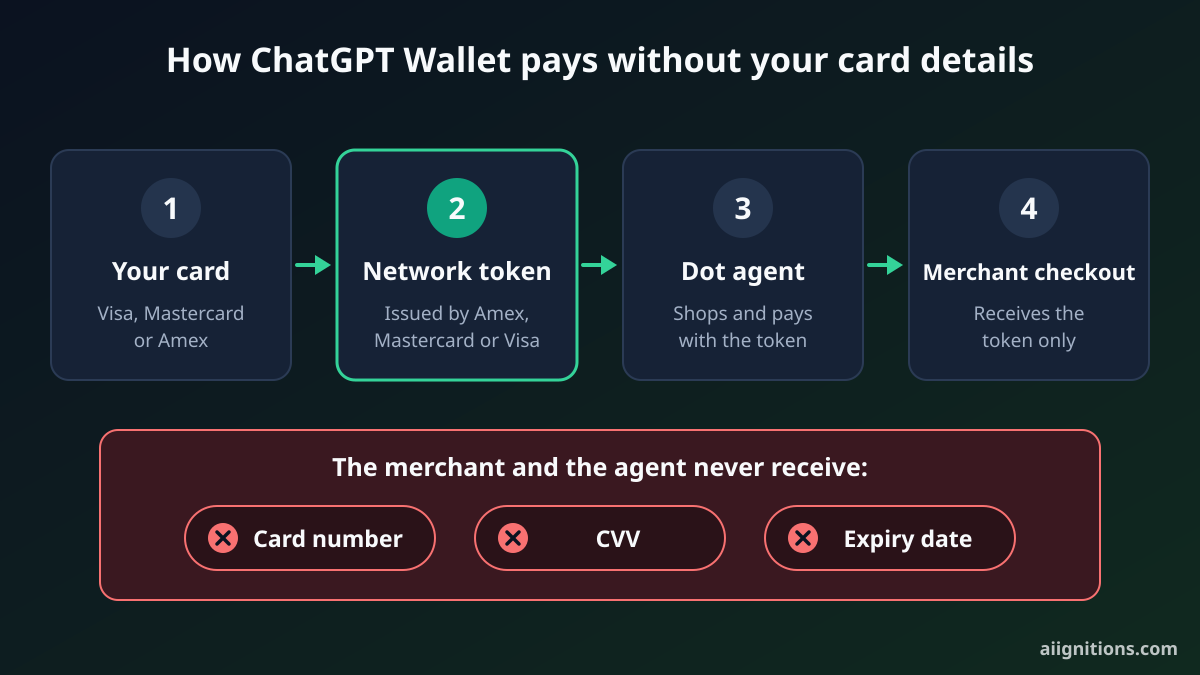
Approval is per purchase. The dot does the shopping, then shows you the merchant, the items, the total and the card it plans to use. You confirm with Face ID, a fingerprint or a similar check. "Every purchase requires a security check," OpenAI says. Each approval leaves a record of what you authorized, and one approval does not carry over to the next order, iGeeksBlog reports.
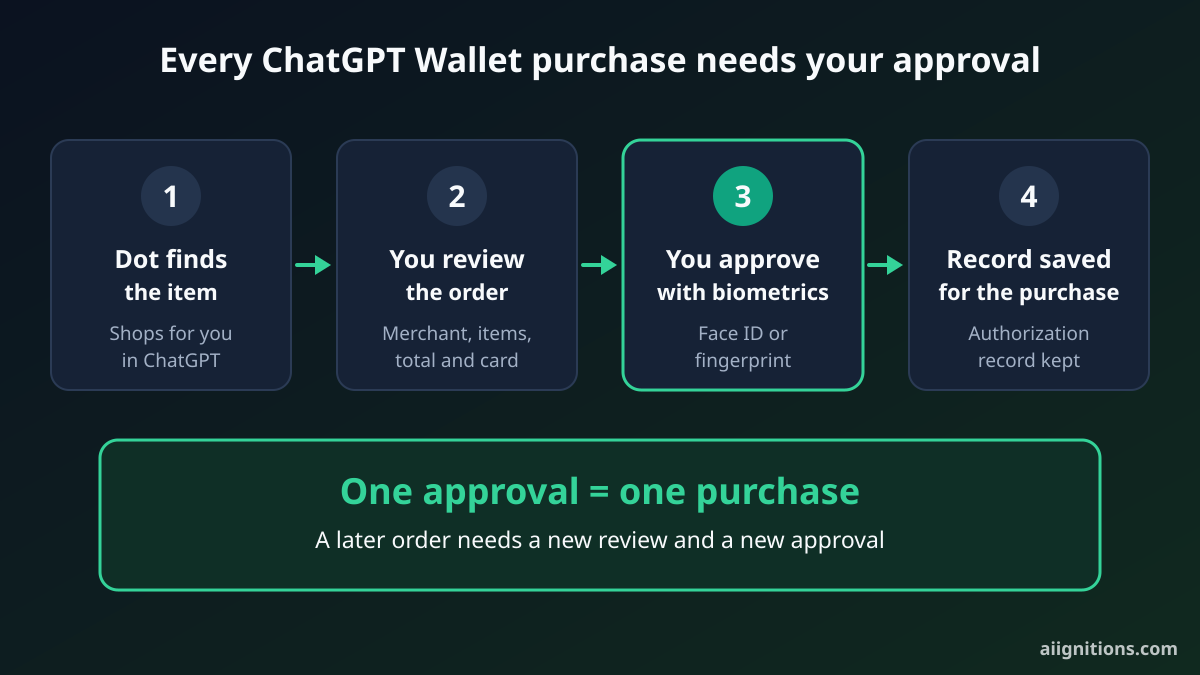
That design keeps the human in the loop on every transaction. It also means Wallet, at launch, is not the hands-off "buy my groceries every Friday" agent the dots pitch implied. The dot does the legwork. You still press the button.
Card rewards keep accruing as normal, and the usual card protections for eligible disputes, such as a defective item, are unaffected. OpenAI says it takes no cut or commission on Wallet transactions during the initial rollout. That is a launch term, not a promise that it stays free.
Who this changes things for
For Pro subscribers, the change is small but concrete: a dot can now finish a checkout instead of stopping at a link. Everyone else gets nothing yet. That includes Business Premium and Enterprise workspaces, even though dots themselves are available there. Reports also say Wallet works only inside dots, not in ordinary ChatGPT chats or in ChatGPT Work.
For merchants, the before/after is sharper. Wallet tokens go through a store's existing checkout, so there is no new protocol to integrate and no new payment processor to sign. But a site that blocks AI agents still blocks them, and fraud systems may flag a purchase made by an agent even when the token is valid. Many retailers already turn agents away. Android Authority points to Amazon blocking Meta's Muse agent (covered in our piece on Muse Ember) and to United Airlines restricting agent access, travel agencies and aggregators included. OpenAI's answer is a "Commerce Partner Playbook" with "tools and practical guidance to help businesses support customers using agents."
For developers building agentic checkout, the takeaway is that OpenAI chose the card rails over a new standard. Instead of asking every store to adopt an agent-specific API, it moved the trust problem to the networks, which already know how to issue and revoke tokens. That puts it on a different path from crypto-style approaches such as Cloudflare's agent wallets. If you run a store, your bot rules matter more than any integration work right now. Whether a dot can buy from you comes down to whether your bot defenses let it reach the checkout at all.
For the card networks, Wallet is a way to keep agent spending on their rails, with their dispute rules and their rewards programs, rather than losing it to a new payment method.
What OpenAI has not said
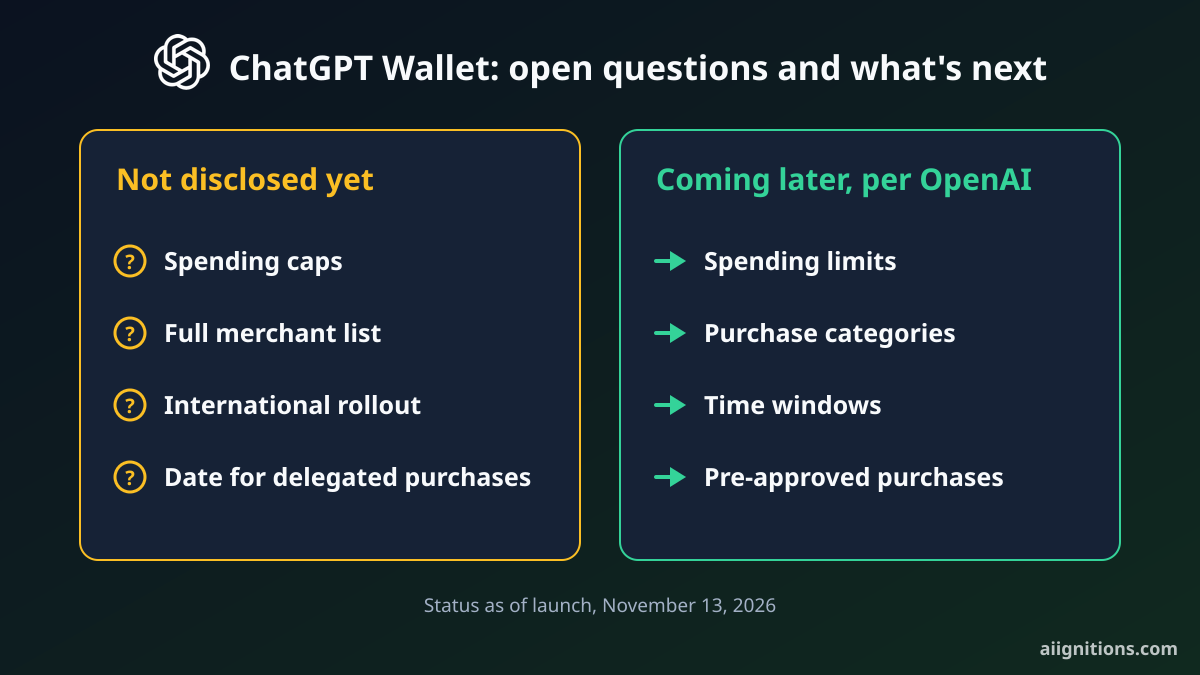
As of November 15, 2026, several basics are undisclosed. There is no published per-purchase or monthly spending cap, no list of merchants known to work, no international rollout date and no timeline for hands-off purchasing. OpenAI described the limited launch as a way "to learn from real-world use and work with businesses, banks, and payment networks."
Trust is the other open question. Android Authority names two hurdles: AI models still hallucinate, and OpenAI has its own disclosed security incident, involving a Hugging Face model evaluation, on the record. A tokenized card limits what a leak can expose. It does not stop an agent from confidently putting the wrong item in the cart, which is why the per-purchase review screen matters.
The feature had been visible before launch. RuntimeWire found an unreleased "Introducing ChatGPT Wallet" screen, with card-entry and save states, inside the Windows ChatGPT and Codex app.
What comes next
OpenAI says that "over time, we expect users to be able to delegate purchases entirely to their agent by setting clear parameters." In practice that means spending limits, allowed purchase categories, time windows and pre-approved purchases with extra safeguards. None of it has shipped, and no date has been given.
That later step is the one that matters. A wallet that needs a fingerprint on every order is a faster checkout. A wallet that spends inside limits you set is an agent that shops for you. And it will only be useful if merchants stop treating agents as bots to block. Until then, the practical test for any Pro user is simple: ask a dot to buy something specific, and see whether the store lets it through.