Googlebook Goes on Sale: Google's Android Laptops Start at $899 as ChromeOS Gets a 2034 End Date
Googlebook is on sale: five Android laptops from $899, Gemini built in, 10 years of updates. What it means for buyers, Chromebook fleets facing a 2034 ChromeOS cutoff, and Android developers.
News Report

Googlebook is on shelves
The first Googlebooks went on sale in the U.S. on October 4, 2026, and in Canada, the U.K., Ireland, France, Germany and Australia today, October 5. They are the hardware half of the Android-based desktop platform Google announced on May 12 as the successor to the Chromebook, developed under the codename "Aluminium OS" and now shipping as Googlebook OS.
Pre-orders opened on September 21 at the Google Store, Best Buy and other retailers, in a post by John Solomon, Google's VP and general manager for laptops, tablets and Android Enterprise. Five laptops from Acer, ASUS, Dell, HP and Lenovo make up the first wave. None costs less than $899.
That price is the headline. The Chromebook built its name on cheap classroom laptops; Googlebook starts in premium-laptop territory. Chromebooks are not being pulled from sale, but Google has now put a date on how long ChromeOS keeps getting updates, and it has told Android developers their phone apps are about to run on laptop screens.
The five launch models and their prices
All five use either Intel Core Ultra Series 3 (Panther Lake) or Qualcomm Snapdragon X Elite chips, start at 16GB of RAM and, per Google, carry NPUs rated at over 45 TOPS. U.S. starting prices as of October 5, 2026, from Digit's launch rundown and Lenovo's own release:
| Model | From | Chip | Screen |
|---|---|---|---|
| Acer Googlebook 14 | $899 | Intel Core Ultra 5 | 14-inch 2.8K OLED touch |
| Dell XPS Googlebook | $999 | Snapdragon X Elite | 13.4-inch 2.5K LCD touch |
| Lenovo Googlebook 15 | $1,099.99 | Intel Core Ultra 5 | 15.3-inch 2.8K OLED |
| ASUS Googlebook 14 | $1,299 | Intel Core Ultra 5 | 14-inch 2.8K OLED touch |
| HP Googlebook 14 | $1,299 | Snapdragon X Elite | 14-inch 2.8K OLED touch |
The Acer, ASUS, Dell and HP base configurations all ship with 512GB of storage. Some early coverage listed the Lenovo at $1,299; Lenovo's press release says $1,099.99. It is the odd one out in other ways too: a 15.3-inch OLED in a 1.29kg body that Lenovo calls the lightest 15-inch device it sells, a haptic touchpad, quad Dolby Atmos speakers, up to 32GB of memory and a 47 TOPS NPU. Its rated battery life is up to 12.5 hours, below the "up to 14 hours" of video playback Google quotes for the line.
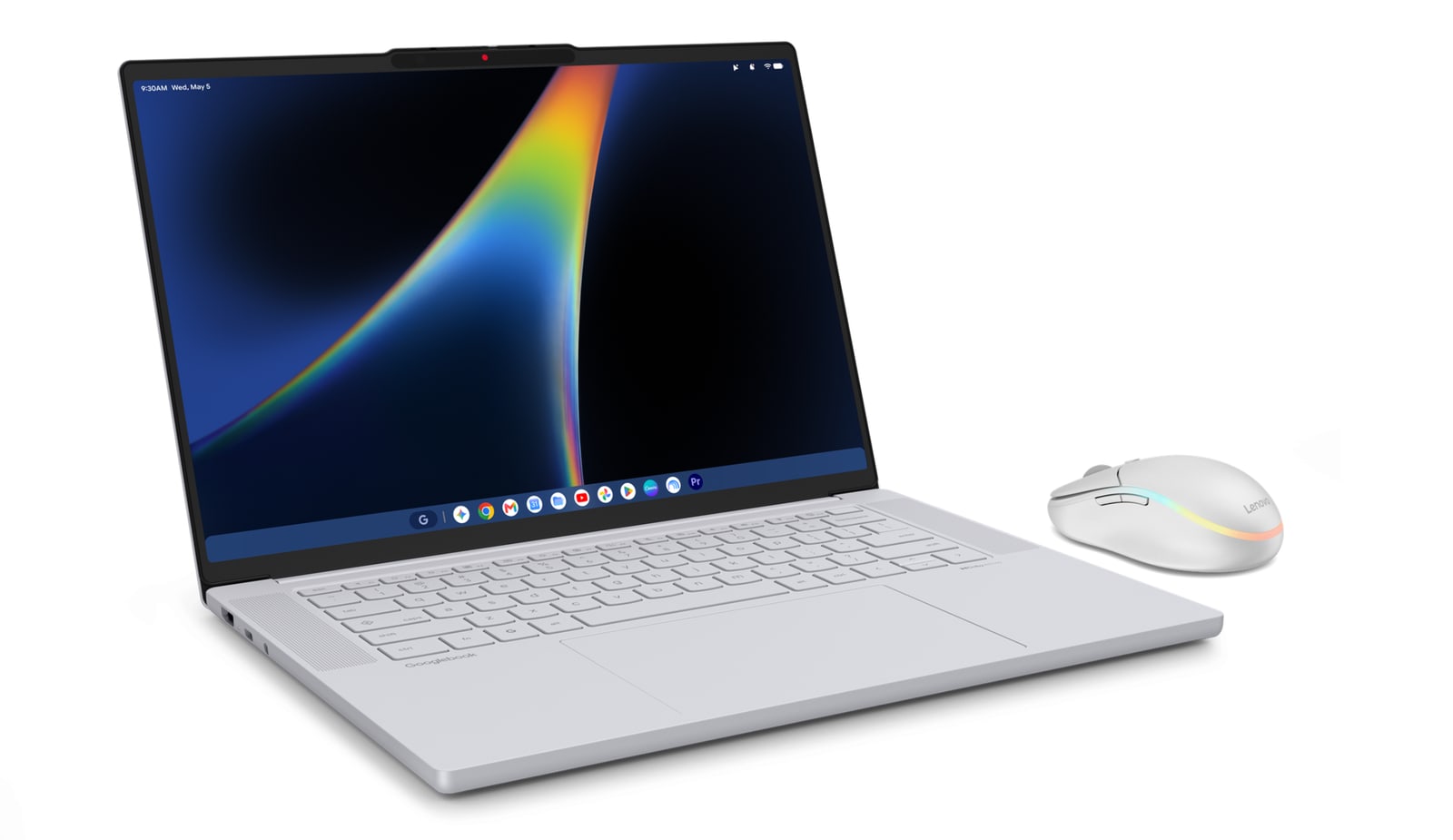
Every Googlebook comes with 12 months of Google AI Pro, which includes 5TB of cloud storage and higher Gemini limits, plus three months of YouTube Premium, three months of Adobe Photoshop and a year of GeForce NOW. Google also promises up to 10 years of OS updates, which 9to5Google reports will come with quarterly feature drops.
Android underneath, Chrome and Gemini on top
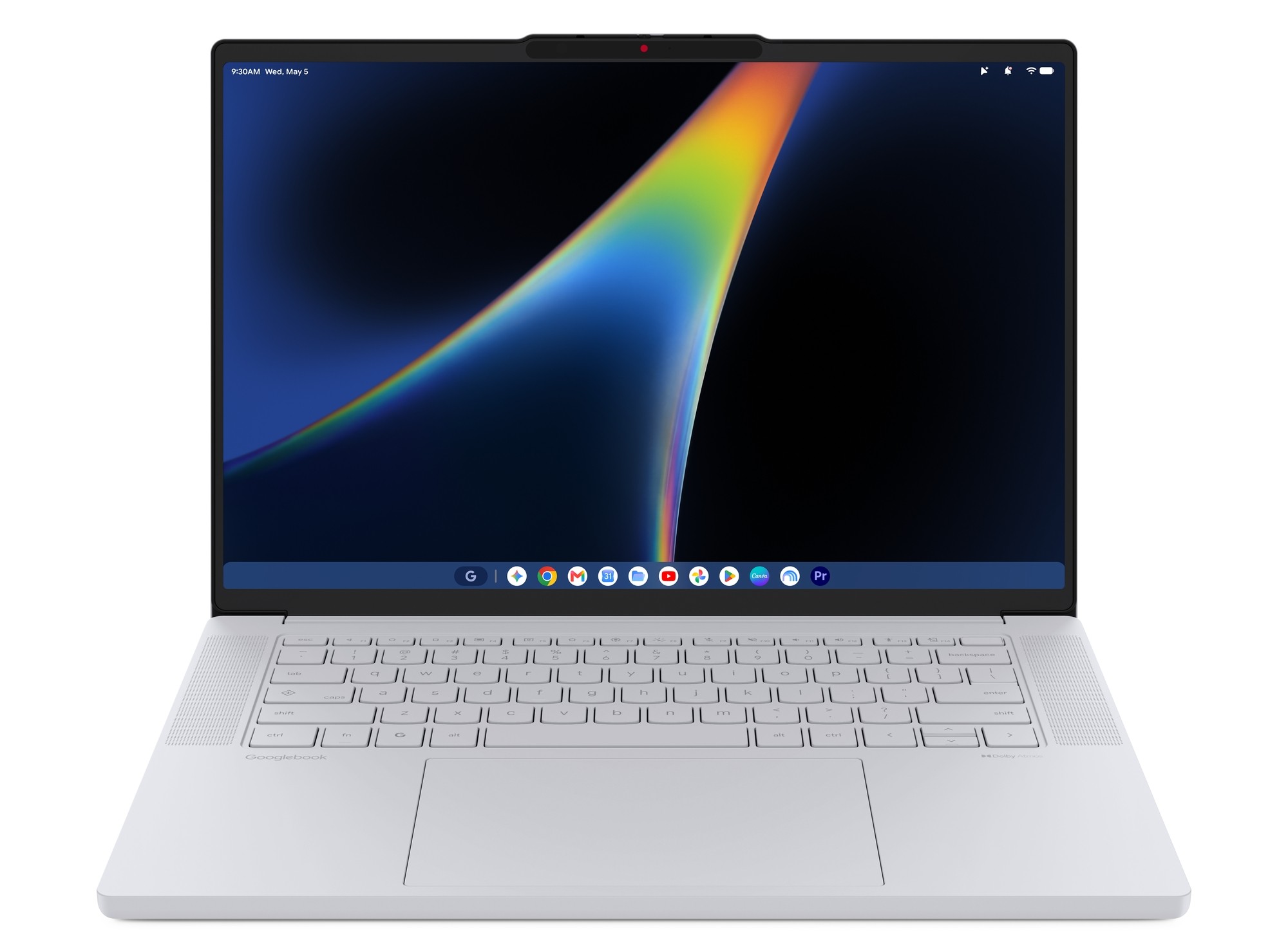
Googlebook OS is built on Android with ChromeOS desktop foundations. In practice that means the full Chrome browser with extensions, Play Store apps, and an isolated Linux environment with terminal access running on a pKVM hypervisor. Google's agent and app-building platform, Antigravity, comes preinstalled.
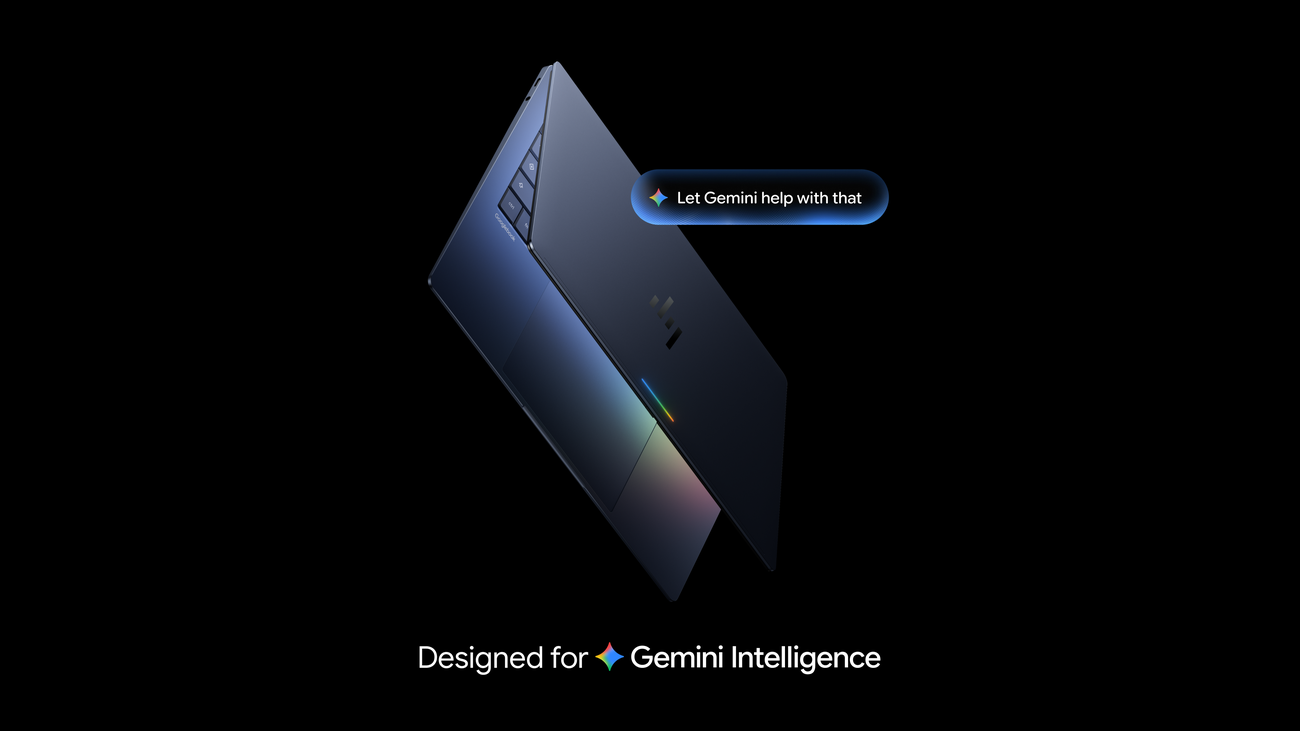
The AI features have names, though Google has not said which Gemini model runs any of them. In a post by Alexander Kuscher, Google's senior director for laptops and tablets, the company describes Magic Pointer, a Gemini-powered cursor you wake by wiggling it, which reads the text or image under it and can, for example, turn an email into a calendar entry. Rambler is dictation that cleans up false starts and turns speech into bullet points in more than one language. Create My Widget builds a home-screen widget from a description. Gemini Live, automations and a background agent, Gemini Spark, round it out.
For Android phone owners the bigger change may be the plumbing. Continue On resumes a task from the phone on the laptop, the Files app reaches the phone's photos and files, and Cast My Apps streams phone apps to the bigger screen. Passwords, Wi-Fi networks, settings and messages sync with end-to-end encryption. Apple users have had this kind of continuity for years; Google's version has yet to be tested outside a demo.
What it means for Chromebook owners and IT fleets
A week after pre-orders opened, Google updated a support page with the date ChromeOS has been waiting for. "ChromeOS devices will continue to receive regular updates and security patches through mid-2034," it reads, as reported by 9to5Google on September 28.
That cutoff collides with the 10-year update promise on recent Chromebooks. A model bought in 2026 would be covered until 2036 on paper, so Tom's Hardware framed it as a support lifetime "cut short for some devices." Google's answer is migration: for qualifying devices whose lifecycle runs past 2034, it is "committed to supporting your transition to Googlebook OS, with many devices offering direct migration paths," and "many of our newest Chromebook devices will be eligible."
The catch is the word "many." Google has not published a list of eligible models. A school district or company buying Chromebooks this quarter is therefore buying hardware with a known ChromeOS end date and an unknown upgrade path. Until that list exists, the safe planning assumption is mid-2034, not the date on the device's spec sheet.
What changes for Android developers
For app makers, the same app now lands on a laptop with a keyboard, trackpad and resizable windows. Google's Android Developers Blog post of September 22 says no separate app is required: an adaptive app scales from one codebase.
Before, a phone-only layout locked to portrait was a minor sin on tablets. On a 14-inch laptop it looks broken. Google is asking developers to lay out by window size class rather than physical screen size, use multi-pane layouts from Navigation 3, and support free-form resizing, multiple windows, drag-and-drop between them, keyboard navigation, right-click menus and hover states. Continue On handoff is exposed through HandoffActivityData, and Android Studio's Canary builds include a desktop emulator for testing.

None of this is mandatory, and the post sets no deadline. The incentive is distribution: optimized apps get dedicated Play Store badging, better search placement, prominence when users transfer apps during phone-to-laptop setup, and eligibility for Google's Apps Experience Program. Google pitches the market as more than 580 million large-screen devices, and says people using several devices spend up to 14 times more on apps. The guide lives at developer.android.com/googlebook.
What's next
The immediate question is whether $899 and up finds buyers for an operating system with no track record on laptops. Independent reviews will show whether Magic Pointer and Cast My Apps hold up off the stage.
Three things to watch. First, Google's list of Chromebooks eligible to move to Googlebook OS, which decides whether current fleets get the full 10 years. Second, how quickly big Android apps adopt desktop layouts, since a laptop full of stretched phone apps would undercut the whole pitch. Third, cheaper models: the launch lineup tops out at $1,299, and the Chromebook's old territory below $500 has no Googlebook in it yet.
For buyers today: if you want an Android-first laptop with Gemini built in and will use the year of AI Pro, the $899 Acer is the cheapest way in. If you need a proven desktop OS at that price, a MacBook Air or a Windows ultrabook remains the safer pick until Googlebook OS has a few feature drops behind it.