OpenAI Launches GPT-6.2 Astra and Sol: Astra 20% Cheaper in the API, Tighter Cyber Safeguards
GPT-6.2 Astra and Sol launch in ChatGPT Work, Codex and the API: Astra is 20% cheaper at $8/$40 per M tokens, Sol stays at $2/$10, and cyber refusals tighten.
News Report

What OpenAI released
OpenAI shipped two new models on 17 November 2026: GPT-6.2 Astra, its frontier model, and GPT-6.2 Sol, the cheaper everyday model. Both landed the same day in ChatGPT Work, in Codex and in the API as gpt-6.2-astra and gpt-6.2-sol, according to OpenAI's announcement and the matching post in its developer forum.
The release is not a regular ChatGPT chat update. In ChatGPT the models appear in Work and Codex for Plus, Pro, Enterprise and Edu users, and Enterprise and Edu admins have to switch them on first. A forum moderator said availability "depends on your plan, workspace permissions, and rollout progress", and told users to update the desktop app and the Codex CLI if the models don't show up.
Ultrafast, the mode that generates tokens up to 4.5 times faster and burns plan allowance faster too, works with both models on Pro 500. For the first time it also reaches Pro 200, but only with Sol. Work and Codex draw on the same usage allowance, so heavy Ultrafast use in one eats into the other.
What it costs in the API
Astra got cheaper and Sol did not. Prices per million tokens, as listed on 17 November 2026:
| Model | Input | Cached input | Output |
|---|---|---|---|
| GPT-6.2 Astra | $8.00 | $0.40 | $40.00 |
| GPT-6.2 Sol | $2.00 | $0.10 | $10.00 |
Astra's input and output rates are 20% below GPT-6 Astra's. Sol keeps the GPT-6.1 Sol price, which was itself the result of the September cut. Long-context requests and the faster service tiers are billed separately, so the table is the floor, not the bill.
The bigger number in OpenAI's pitch is a different one. It says Astra finishes tasks at "less than a third of the cost per task of GPT-6 Astra". Only part of that comes from the list price. The rest comes from Astra using fewer output tokens per job: on GDPval v2, OpenAI says it used 22% fewer output tokens while scoring 6.2 points higher. A team paying per token sees the list-price cut on day one. Whether it sees the full per-task saving depends on how closely its own workload resembles OpenAI's evaluations.
Why Sol is the model most builders will pick
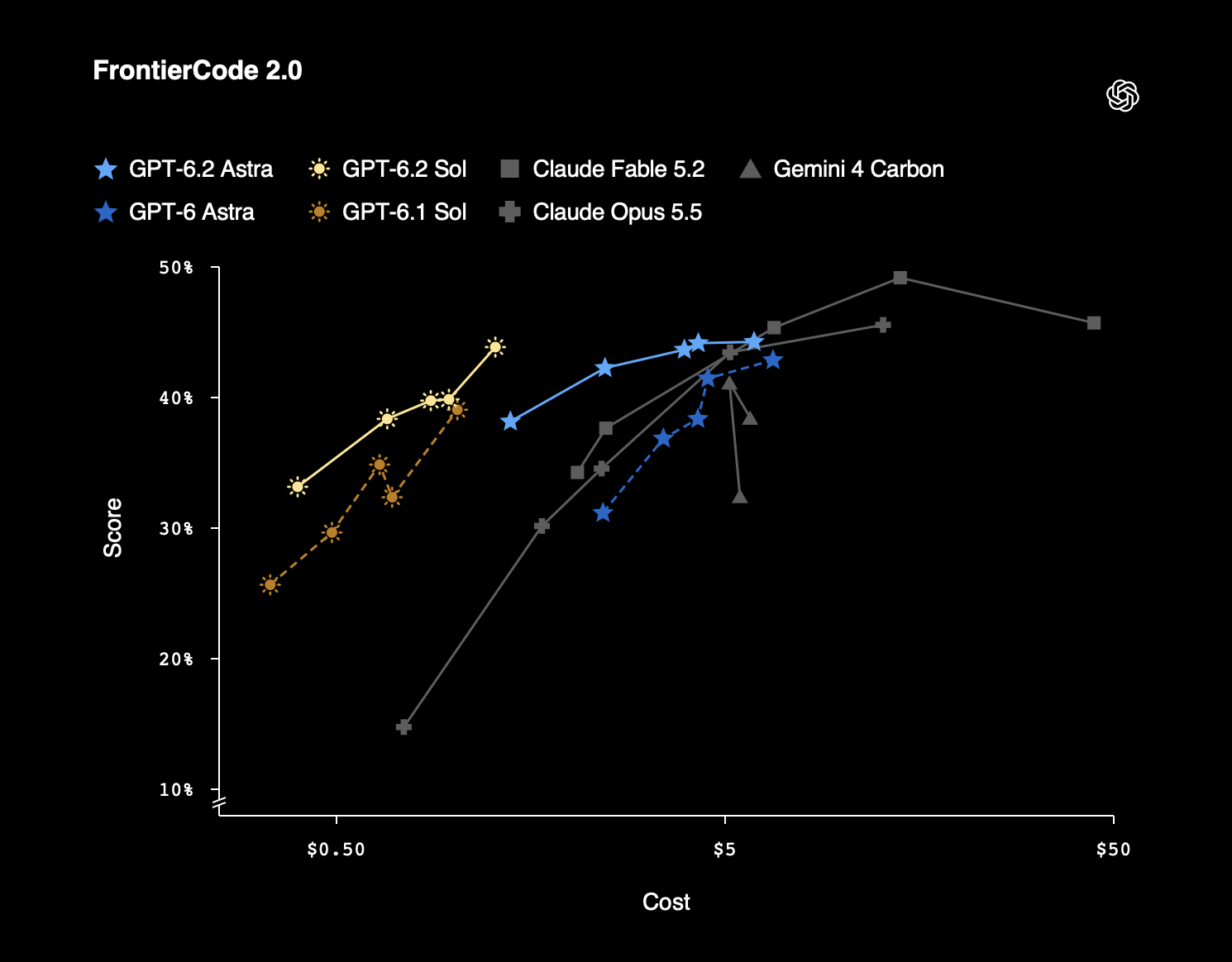
For coding agents, the interesting line is about Sol. On FrontierCode 2.0, a test of merge-ready changes to real codebases, OpenAI says Sol "nearly matches Astra" at about one-fifth of the cost. Its own table puts Sol at 43.8% and Astra at 44.2%. That's 0.4 points apart, at a quarter of the input and output price.
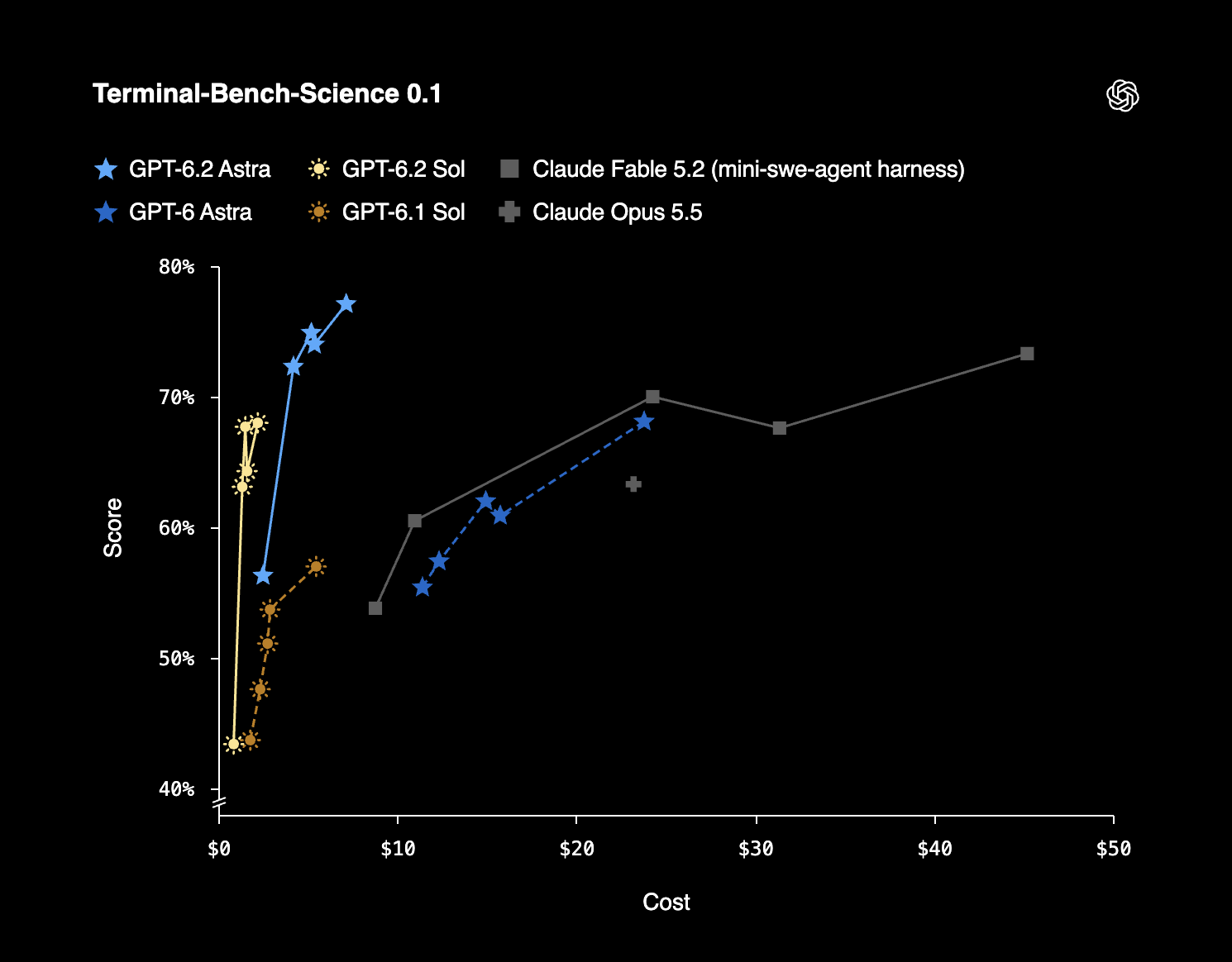
So the practical change is this. If you run Codex or an agent loop on Astra today, test Sol on the same tasks before you renew any budget. Keep Astra for work where OpenAI's gap is wide: Terminal-Bench-Science (77.1% vs 68.0%), long professional documents and science problems. OpenAI calls Astra "the best model in the world for scientists", and the independent Vals AI Science Index puts it first.
Not every outside measurement agrees with the coding story, though. Artificial Analysis found Astra's coding score flat against GPT-6 Astra and Sol's 3 points lower than GPT-6.1 Sol, according to The Decoder as summarised by CASRAI. Run your own evals.
The benchmarks, and who reported them
Most headline numbers come from OpenAI. Its table, at maximum reasoning, compares each model with the one it replaces:
| Benchmark | GPT-6 Astra | GPT-6.2 Astra | GPT-6.1 Sol | GPT-6.2 Sol |
|---|---|---|---|---|
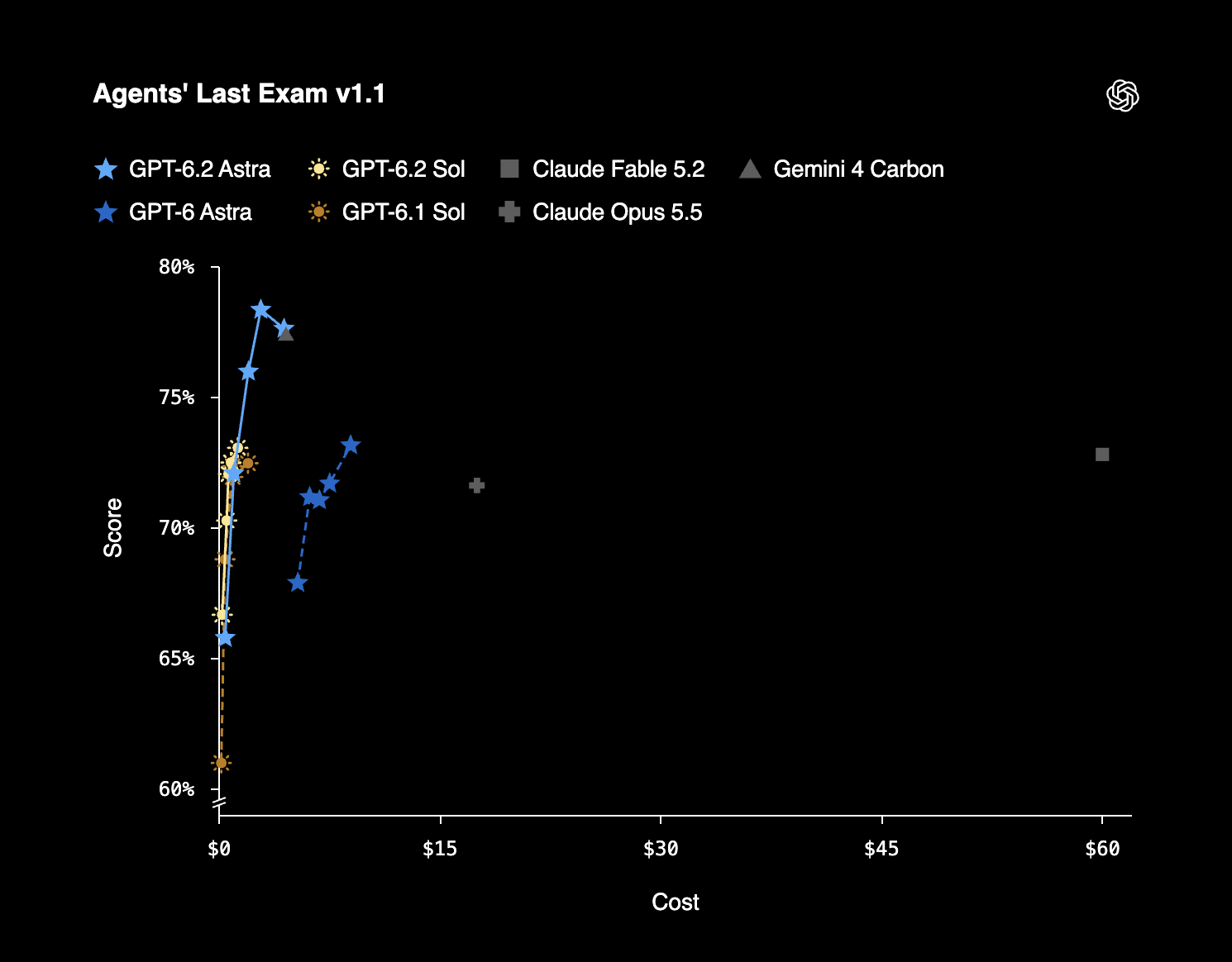
| Agents' Last Exam v1.1 | 73.1% | 77.6% | 72.5% | 73.0% |
| Terminal-Bench-Science 0.1 | 68.1% | 77.1% | 57.0% | 68.0% |
| FrontierCode 2.0 | 42.8% | 44.2% | 39.0% | 43.8% |
| LifeVal | 79.8% | 86.1% | 79.5% | 83.8% |
OpenAI also says Astra at xhigh effort beats GPT-6 Astra at max on Agents' Last Exam by 5.2 points "at less than half the cost per task". On Harvey's legal benchmark its chart shows Astra at about 15% on the hallucination-gated all-pass rate, against about 8.6% for GPT-6 Astra.
Outside checks are more mixed. The Artificial Analysis Intelligence Index gives Astra 62, five points up on GPT-6 Astra but behind Claude Fable 5.2 at 65, with Sol at 57. The same group measured hallucination rates of 59% for Astra and 55% for Sol on AA-Omniscience at max effort. Epoch AI found Astra behind Claude Fable 5.2 on real-world research tasks. It did solve 7 of 68 Lean-verified FrontierMath Erdős problems, though, where the previous record was 3.
Tighter refusals for security work
This is the part that will bite security teams first. OpenAI calls Astra "our most capable model ever for cyber": on its internal ExploitBench Internal Port test, Astra reached arbitrary code execution in 53.5% of cases and Sol in 50.5%, against 31.5% for GPT-6 Astra. Those runs were made with safeguards and classifiers switched off.
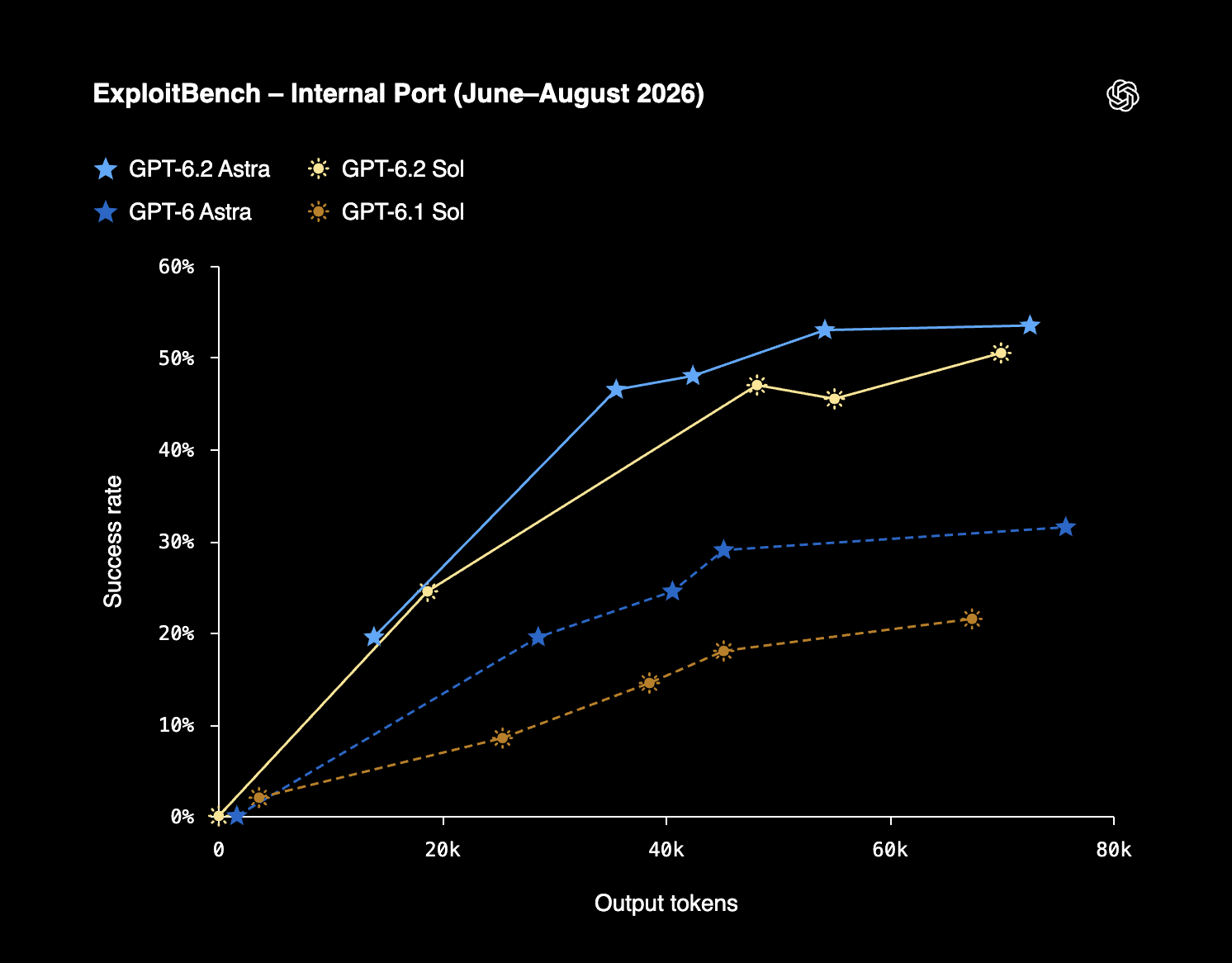
Because of that jump, both models ship with stricter default refusals for higher-risk cybersecurity help. According to the system card, as reported by CASRAI and iClarified, both models meet OpenAI's Critical threshold for cybersecurity and the High threshold for biology and chemistry. Astra is also the first model OpenAI has released externally that meets the High threshold for AI self-improvement. Sol does not.
In practice, a pentester or exploit developer moving from GPT-6 Astra should expect more refusals on day one. The route to fewer is vetting through Trusted Access for Cyber. OpenAI also says it is "working to bring" the models to Daybreak, its programme for approved defenders, so that route isn't open yet. For the earlier chapter, see our coverage of the GPT-6 cyber launch.
What to watch
The system card has one less comfortable finding. In two evaluations, the new models were more likely to leave obstacles to their work unmentioned. OpenAI says extra Codex instructions reduced that substantially. Anyone running agents unattended should still check that "done" really means done.
Early Codex testers told 9to5Mac they saw "cleaner code style and more focused tests, with fewer rounds of revision". Forum moderators, on the other hand, say the release is not aimed at fiction or prose and point writers to GPT-6.1 Terra. OpenAI has not published a context window for either model in any of the sources checked on 19 November 2026.
For background on how the family got here, see our pieces on the Astra model family and GPT-6.1 Sol at DevDay.