Hunter.io Review 2026: The Email Finder That Knows Its Lane
Hunter.io review for 2026: real credit pricing, how domain search works, the catch-all accuracy trap, and who should pick Apollo or Smartlead instead.
Expert Review

What Hunter actually is
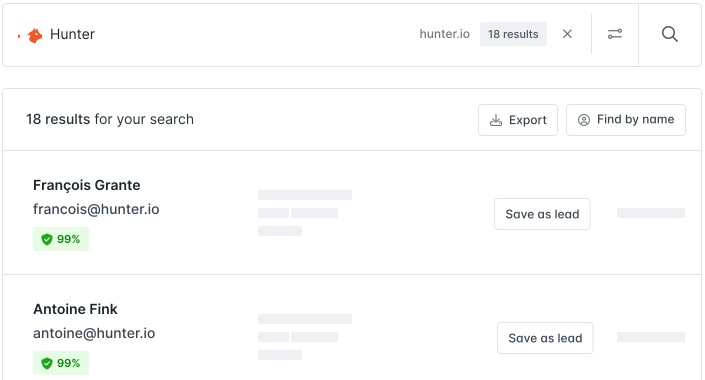
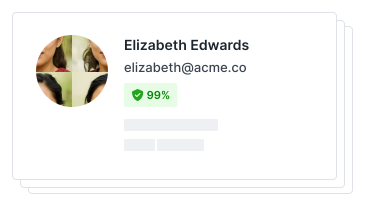
Type a company domain into Hunter and it hands back the email addresses it has found there, each with a confidence score and, more usefully, the pattern the company writes addresses in: {first}@domain, {first}.{last}@domain, and so on. That pattern is the part most people underrate. Once Hunter tells you a company uses {first}@acme.com, you can work out the VP of Sales' address before you have spent a credit on it.
Hunter is not a CRM and does not pretend to be one. It is the email-finding layer that sits underneath sales and recruiting work. The company has been doing this since 2015, when Antoine Finkelstein and François Grante launched it (originally as Email Hunter), and it now claims more than 7 million user accounts. The data comes from crawling the public web: Hunter says it has indexed 81 million websites, which is why it is strongest for companies with a real online footprint and weakest for the ten-person consultancy that barely maintains a contact page.
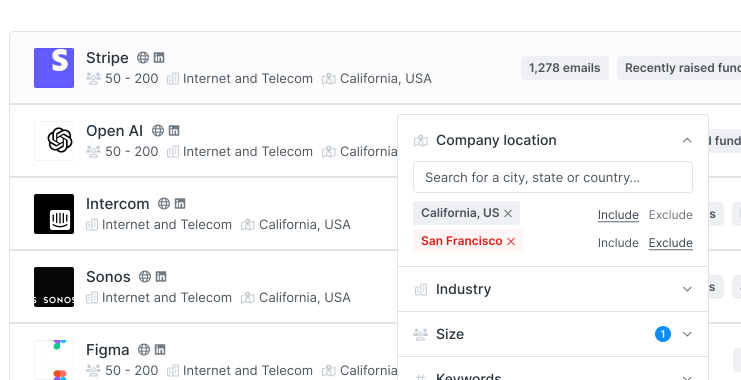
Four tools do the actual work. Domain Search returns every address on a domain, grouped by department, with an "Export in CSV" button and the most common address pattern up top. Email Finder pulls one named person's address. Email Verifier checks whether an address will accept mail. Discover finds companies matching filters, then lets you pull their people. A Chrome extension, a Google Sheets add-on, and an API wrap the same data for anyone who would rather not sit in the dashboard.
How the credit system works
Everything in Hunter draws on one shared pool of monthly credits, and the exchange rate matters more than any feature list. Finding an email costs one credit. Verifying one costs half a credit. A domain search charges per address it reveals, not per search you run. When the pool empties the tools drop to read-only until your billing date resets it. There is no overage fee, which is honest, but it also means a campaign can stall mid-list with no way to buy your way through until the next cycle.
The practical read: a plan's headline credit number is really a "how many emails can I touch this month" number. Ten thousand credits sounds generous until you are enriching a 4,000-row list and verifying each hit. At 1.5 credits per contact, that pool runs dry around 6,600 people. Budget by contacts, not by the marketing number.
Pricing, checked August 2026
Checked on Hunter's pricing page in August 2026, there are four public tiers plus a custom Enterprise plan. Paying annually cuts roughly 30% off every paid tier.
| Plan | Monthly | Billed yearly | Credits/mo | Mailboxes | Recipients/sequence |
|---|---|---|---|---|---|
| Free | $0 | $0 | 50 | 1 | 500 |
| Starter | $49 | $34/mo ($408/yr) | 2,000 | 3 | 2,500 |
| Growth | $149 | $104/mo ($1,248/yr) | 10,000 | 10 | 5,000 |
| Scale | $299 | $209/mo ($2,508/yr) | 25,000 | 20 | 15,000 |
The Free plan is usable, not a teaser. Fifty credits a month, no card required, sign-up with a Google account took under a minute, and you get real domain searches and verifications rather than a locked preview. For a founder firing off a handful of targeted emails a week, that ceiling is often enough to never pay a cent.
There is also a separate Data Platform for API-heavy use, priced by volume rather than by seat. Hunter's own calculator quotes 1,000 search credits plus 200,000 verification credits at $6,500, which tells you who it is for: products embedding email lookup, not a salesperson working a pipeline.
Start on Hunter's free plan and burn the 50 credits before deciding whether the data is good enough for your industry. That is the only test that counts.
Accuracy and the catch-all trap
Hunter's find quality is good. A widely cited third-party test of 501 addresses found roughly 97% validated as legitimate, and that matches its reputation: at the domain level, for mid-size and larger companies, Hunter is dependable.
The verifier is where you read the fine print. It runs SMTP and pattern checks, and Hunter claims a sub-1% bounce rate on addresses it marks Valid. The problem is catch-all (accept-all) domains, where the mail server says yes to every address whether or not the mailbox exists. On those domains Hunter can show a high confidence score for an address that will bounce, because nobody can confirm the specific mailbox without actually sending. Teams that treated the confidence percentage as a green light on accept-all domains have reported sharply higher bounce rates than the Valid figure suggests. The score is a probability, not a promise, and Hunter does flag catch-all results if you look. So look.
Campaigns: fine for a trickle, not a firehose
Hunter added Campaigns to move from "find the email" to "send the email." You connect a Gmail, Google Workspace, or Outlook mailbox, build a short sequence with follow-ups, and personalise with merge fields. For light outreach from your own inbox it works and saves you a second subscription.
It is not a cold-email engine, and Hunter does not market it as one. There is no inbox warmup, no mailbox rotation, no sending-domain management. Push real cold volume through one mailbox and you land in spam fast. The recipient caps make the intended scale plain: 500 per sequence on Free, 2,500 on Starter, 15,000 on Scale. If you are running true cold outreach at volume, use Hunter to build and verify the list, then hand the sending to a tool like Smartlead or Instantly that actually manages warmup and rotation.
Who should use Hunter, and who should not
Buy Hunter if your work is targeted rather than high-volume: a founder, recruiter, agency, or small sales team that needs accurate B2B addresses tied to real companies, cares about verification quality more than raw database size, and does personalised outreach in the low thousands per month. The clean API and the genuinely free tier make it painless to start, and the domain-pattern feature alone saves real time.
Skip it, or pair it, in three cases. Want a huge prospecting database with deep firmographic filters and a built-in dialer? Apollo.io gives you more raw reach for the money. Sending cold email at scale? Keep Hunter for finding and verifying, but send through Smartlead or Instantly. Need nothing but cheap bulk verification? A dedicated verifier such as ZeroBounce or NeverBounce costs less per address than spending Hunter credits on it. Hunter is a precise instrument, not a swiss-army platform. Judge it as one and it rarely disappoints.

Ready to try Hunter?
Visit the official website to see the latest plans, pricing, and special offers.
Get Started - Hunter* Affiliate link - we may earn a commission at no extra cost to you.