IP2Location Review: The Geolocation Vendor That Sells You a File, Not an API
IP2Location review: a geolocation vendor that sells downloadable database files, not API calls. LITE free tier limits, $99-$2,799 Standard License pricing, accuracy claims, licence traps, and how it compares to MaxMind and ipinfo.
Expert Review

What you are actually buying
Most IP geolocation vendors sell you an endpoint. IP2Location sells you a file. You choose a database code, pay for a year, and download a binary or CSV that you query on your own hardware: no per-request billing, no network hop, no rate limit. That decision explains most of what follows, including a licence stricter than any API key.
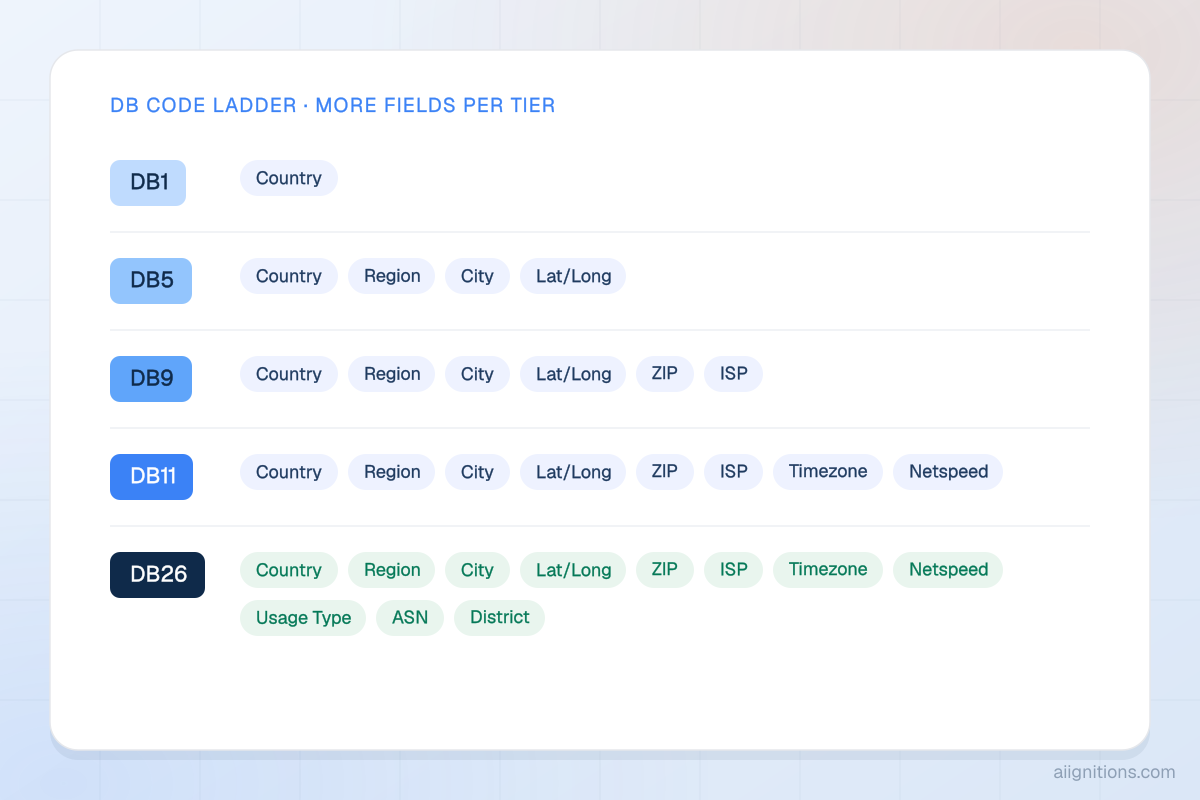
There are 26 codes. DB1 is IP-to-country and nothing else. Each step up adds fields until the product name becomes a sentence: DB26 is titled "IP-Country-Region-City-Latitude-Longitude-ZIPCode-TimeZone-ISP-Domain-NetSpeed-AreaCode-Weather-Mobile-Elevation-UsageType-AddressType-Category-District-ASN Database". City arrives at DB3, coordinates at DB5, ZIP at DB9, timezone at DB11, mobile carrier codes at DB19.
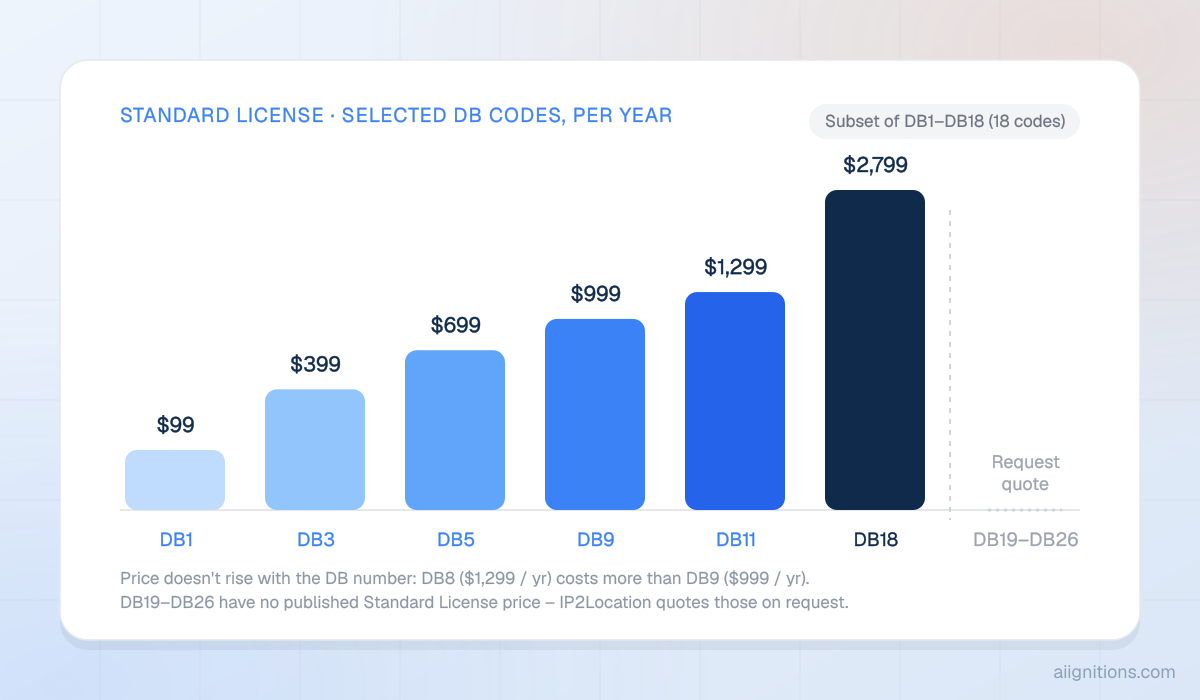
The ladder does not climb in a straight line, which trips up first-time buyers. DB8 costs more than DB9 because the codes trade one field group against another rather than stacking: the even codes carry ISP and domain, the odd ones spend the same money on ZIP and timezone. Pick by the fields you need, not by the number.
The free LITE database, and where it stops
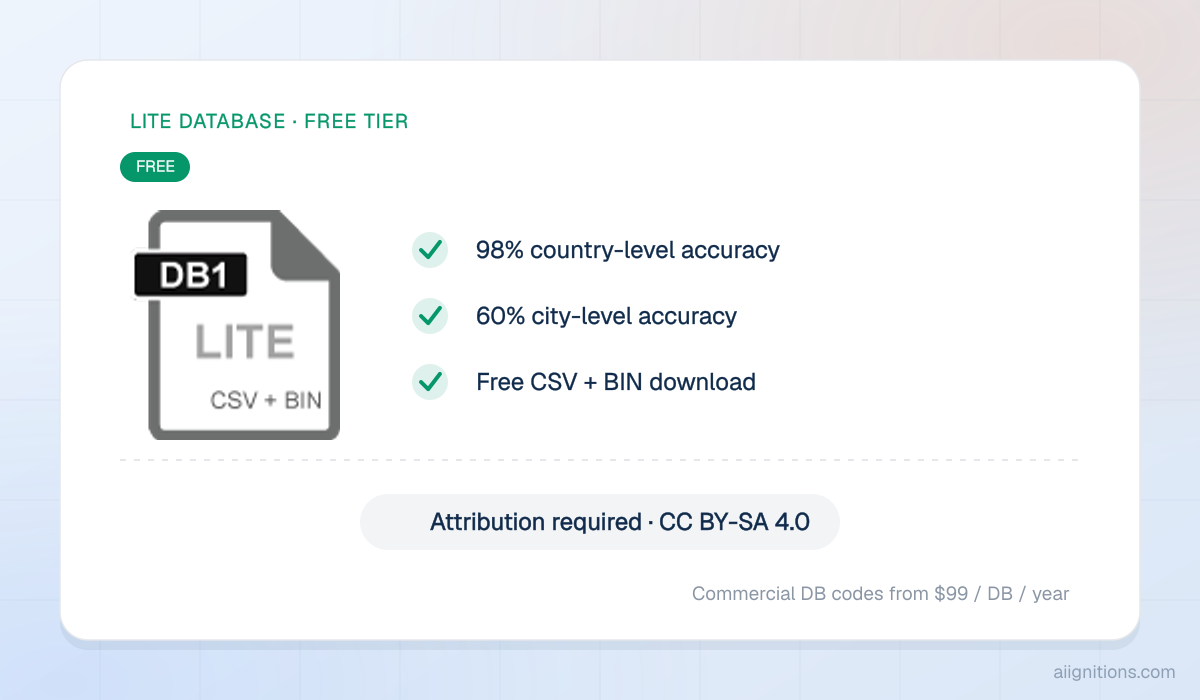
IP2Location LITE is why most developers have heard of the company. One signup gives you three downloads: the geolocation database, IP2Proxy LITE for VPN, proxy and Tor exit detection, and an ASN database. All three are released under Creative Commons Attribution-ShareAlike 4.0, free for personal or commercial use, provided you display a specific attribution line naming IP2Location and linking to the site.
Two limits decide whether that is enough. The vendor's comparison table puts LITE at "98% country accuracy" and "60% city accuracy" against "99.5%" and "80%" for the commercial files. The limit that matters more sits in the same table as an IP depth of 1.2.3.x: LITE resolves to a /24, so all 256 addresses in a block return one answer. The commercial file is accurate to the individual address.
For an analytics dashboard or a currency default, a /24 is fine. For anything that decides something about a single user, it is not, and the ShareAlike half of the licence deserves a lawyer's eye before you build a derived dataset on it.
Pricing: per code, per year, per licence tier
Two tiers sit side by side, both labelled "Yearly Price". The Standard License covers one server. Checked on the pricing page on 1 September 2026, it runs DB1 at $99, DB3 at $399, DB5 at $699, DB9 at $999, DB11 at $1,299 and DB18 at $2,799. The Site License covers unlimited servers you own or control and costs roughly ten times as much: $980 for that same DB1, $27,980 for DB18. Codes DB19 to DB26 carry no public price and route to a quote form. IP2Proxy is a separate purchase, $399 for PX1 up to $3,999 for PX8.
The tier also buys update frequency, which is easy to miss. Standard licensees get releases on the 1st and 15th of each month, Site licensees on the 1st, 8th, 15th and 22nd, and only a Redistribution License receives daily updates. Given the vendor's own warning about how fast the data decays, that cadence is part of the price.
Settle one thing before paying. The licensing page describes the Standard License as "no longer supported" and heads that section "Standard License (Existing Customers Only)", while the pricing page still lists Standard prices with working purchase buttons. Both were live and contradicting each other when checked on 1 September 2026.
The accuracy numbers, read closely
IP2Location publishes more about its own error rate than most competitors do, and the figures do not entirely agree. The FAQ claims "over 99.5% accuracy at the country level and over 75% accuracy at the city level". The comparison table on another page puts commercial city accuracy at 80%. Neither carries a date.
The dedicated data accuracy page is the useful one. It defines its threshold plainly ("The threshold of accuracy is less than 50 miles"), publishes per-country tables rather than one global number, and states that "the accuracy will degrade by about 1%-5% for each month that an outdated database is being used". It also concedes the test samples an address space of nearly 4.3 billion, so the published values are not guaranteed in production.
Take the decay claim seriously. A DB11 file refreshed twice a month is a different product from the same file left in place for a quarter. Budget for the drift.
The hosted API is priced on different logic
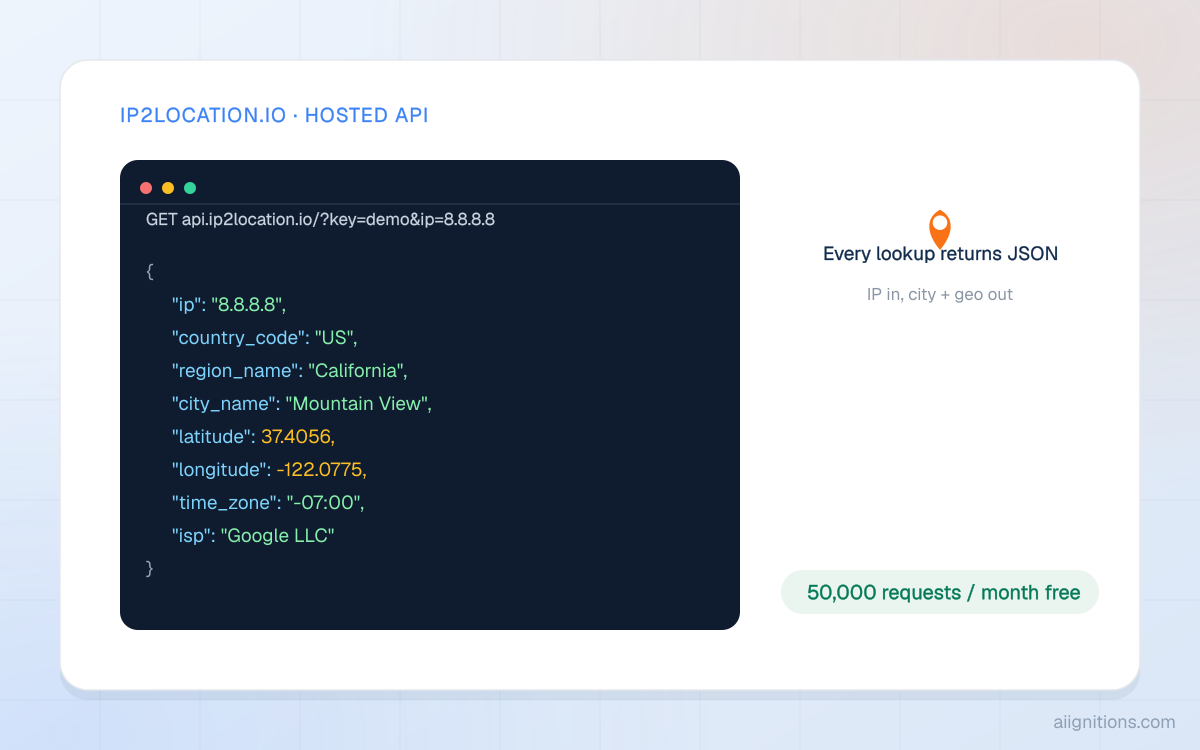
IP2Location.io is the sibling product for people who want a request rather than a file. You can call it with no account: the documentation allows "up to 1,000 queries per day without the need to sign up for an API key", resetting at 00:00 UTC. Register for the free plan and that becomes 50,000 queries a month with 11 IP attributes, against support the pricing page itself describes as "72 hours or longer response".
Paid plans are Starter at $49/month for 150,000 queries, Plus at $249 for 300,000, and Security at $499 for 600,000, with proxy, fraud-score and mobile data reserved for the top two tiers. Security includes a seven-day trial needing no card. No annual billing appeared anywhere on the pricing page when checked on 1 September 2026, which is unusual: most of this field discounts a yearly commitment by 15% or more.
Overage behaviour differs by plan, and the free tier is the honest one. Run out on free and the service stops. Run out on a paid plan and it keeps answering, then bills $10 for every additional 30,000 queries on Starter. Cancelling takes effect immediately, and the page is blunt about the consequence: "all unused queries will be forfeited without refund".
The licence clauses that decide this purchase
Three clauses in the Master License Agreement matter more than any feature comparison, and none appear on the pricing page. You are renting the file: failure to renew triggers automatic termination, and termination obliges you to remove the product and destroy all copies, so the last download you took has no read-only afterlife. Fees are "not refundable", with a pro-rated refund only when Hexasoft itself ends the agreement. Redistribution to third parties is prohibited on both tiers, and exposing the data through your own product requires a Redistribution SaaS License, which the licensing page calls "the only supported licensing model" for information security, social networks, search engines and advertising platforms.
That last restriction has consequences downstream. The OpenRA project rejected the commercial package outright, recording in its issue tracker that "we cannot use this as it is under a proprietary license and imposes arbitrary restrictions (a random time delay) on queries", and shipped against the CC-licensed LITE data instead. If your architecture puts the lookup anywhere a customer can reach, price the SaaS licence before you price the file. The vendor is Hexasoft Development Sdn. Bhd. of Penang; Malaysian law governs the agreement.
How it compares on price
Against MaxMind, IP2Location wins the downloadable-file comparison decisively. GeoIP2 Country costs $418 a year; DB1 is $99, a saving of $319 for the same question answered. The extra money at MaxMind buys a more specific claim: "99.8% accurate on a country level, 80% accurate on a state level, 68% accurate on a city level for the US within a 50 kilometer radius", stated with the radius attached. MaxMind's free GeoLite2 is also the weaker free tier, capped at 30 database downloads a day and carrying the vendor's own note that it is "not recommended for commercial use cases".
The hosted API loses the same comparison. ipinfo's Core plan is $31/month for 150,000 requests, or $310 billed annually, against $49/month for identical volume on IP2Location.io Starter: $18 a month more, with no annual discount to close the gap. ipstack undercuts both at $12.99/month for 50,000 requests, and ipapi.co asks $15/month for 60,000. Where IP2Location.io does win is the free tier, at 50,000 queries a month against ipstack's 100.
The verdict
Buy IP2Location if you want geolocation as data you hold. At $99 a year for a country file you query locally, with no per-request cost and no dependency on someone else's uptime, DB1 is the cheapest credible commercial option in this market, and DB3 to DB11 covers what most applications need. Take LITE for free if a /24 is precise enough and you can display the attribution line.
Skip it if you want a hosted API: ipinfo answers the same 150,000 requests for $18 a month less and discounts an annual commitment, which IP2Location.io does not offer. Skip it if you need city-level certainty for fraud or billing decisions, because 75-80% within 50 miles is not a number to act on alone, and MaxMind at least tells you the radius it measures. Skip it if your product exposes the lookup to customers, or if you need the file to keep working after you stop paying: the licence forbids both.
An unglamorous product, sold honestly, with published error rates and a licence that gives away nothing it did not intend to. Read it first.
Ready to try IP2Location?
Visit the official website to see the latest plans, pricing, and special offers.
Get Started - IP2Location* Affiliate link - we may earn a commission at no extra cost to you.