LambdaTest (Now TestMu AI) Review: The $29 Grid Under an AI Rebrand
LambdaTest (now TestMu AI) review: $29 per parallel Linux grid, $199 real devices, KaneAI credit plans, a 2-minute free tier and non-refundable annual billing.
Expert Review

LambdaTest is now TestMu AI
Type lambdatest.com into a browser today and you land on testmuai.com. On January 12, 2026 LambdaTest renamed itself TestMu AI and began selling itself as "the world's first full-stack Agentic AI Quality Engineering platform", with a nod to "vibe coders". Checked on September 29, 2026, the old homepage, pricing page, blog and terms all 301-redirect to the new domain. Only the support docs at lambdatest.com/support/docs/ still answer on their own.
Underneath, very little moved. The company is still incorporated as LambdaTest, Inc., the new name comes from the TestMu conference it has run since 2022, and the homepage promises that existing API keys, webhooks, Selenium and Appium grid endpoints and "120+ third-party integrations... function identically". If your CI config points at the old hub, it keeps working. What changed is the shop window: the pricing page now opens with KaneAI, an AI test-writing agent, while most teams still come for what LambdaTest always sold - a hosted browser and device grid, priced by the parallel.

That grid is where the money goes, so that is where this review starts.
Pricing: you pay per parallel, not per seat
Automation is priced "by parallel session (concurrency), not per user or per test". One parallel is one browser or device running at a time. A 20-test suite you want to finish five at a time needs five parallels, which is five times the card price. Every figure below is per month, billed annually, read from testmuai.com/pricing on September 29, 2026 (the page was last modified August 13). The annual toggle promises savings of "upto 20%".
| Plan | What it covers | Per parallel, per month |
|---|---|---|
| Web Automation - Desktop (Linux only) | Selenium, Playwright, Cypress on Linux browsers | $29 |
| Web Automation - Desktop | Adds Windows and macOS browsers | $79 ($99 billed monthly) |
| Virtual Automation Cloud | Emulators and simulators | $139 |
| Real Device Plus Automation Cloud | Physical iOS and Android, geolocation in 150+ countries | $199 |
| Virtual Live (manual) | 3,000+ virtual browsers, emulators, simulators | $15 |
| ChromeOS Live (manual) | ChromeOS browsers | $29 |
| Real Device Plus Live (manual) | 10,000+ real Android and iOS devices | $39 |
The $29 Linux plan is the headline. As our BrowserStack review found, it is half what BrowserStack asks for its Chrome-only automation tier, and paid automation carries unlimited minutes. The catch is in the plan name. The moment you need Safari on macOS or Edge on Windows you are on the $79 plan, and the moment a real iPhone joins the loop it is $199. Manual testing is closer to even: the $39 real-device live plan matches BrowserStack's $39 single-user live plan, and the $15 virtual tier undercuts it if emulators are enough.
Monthly billing is published for only a few plans. For Linux automation, the live plans and real-device automation the page showed annual prices alone, so budget as though you are signing for a year.
The free tier is a demo, not a plan
Signing up needs no credit card and the free plan has no trial clock. It also runs dry fast. Live testing gets one parallel "free forever", but sessions on the 200+ desktop browsers are capped at 2 minutes each, and real devices give you five 2-minute sessions a month. Automation is 100 minutes on 2 parallels - for the life of the account, not per month. A mid-sized Selenium suite can burn that in one afternoon of debugging.
The 2-minute cap is what catches people out. "My free trial expires after two minutes! They want me to sign up for a year!!" wrote one Trustpilot reviewer in May 2026. Two minutes confirms that a login page renders in Safari. It does not tell you whether the grid is fast enough for your suite, so spend the 100 automation minutes on your slowest spec rather than your smoke test.
The side products are more generous. SmartUI visual regression gets 2,000 screenshots for life, Test Manager is free with unlimited projects, and HyperExecute gets 300 minutes on 2 concurrent sessions.
Real devices and HyperExecute
The device cloud claims 10,000+ physical iOS and Android devices, geolocation in more than 150 countries and SIM-enabled phones for SMS and OTP flows. That last one matters. Testing a two-factor login on an emulator means stubbing the text message; a real SIM means you test what your users actually receive. Mobile framework support covers Appium, Espresso, XCUITest, Maestro and Detox, and web covers Selenium, Playwright, Cypress, Puppeteer, WebdriverIO, Nightwatch and Robot.
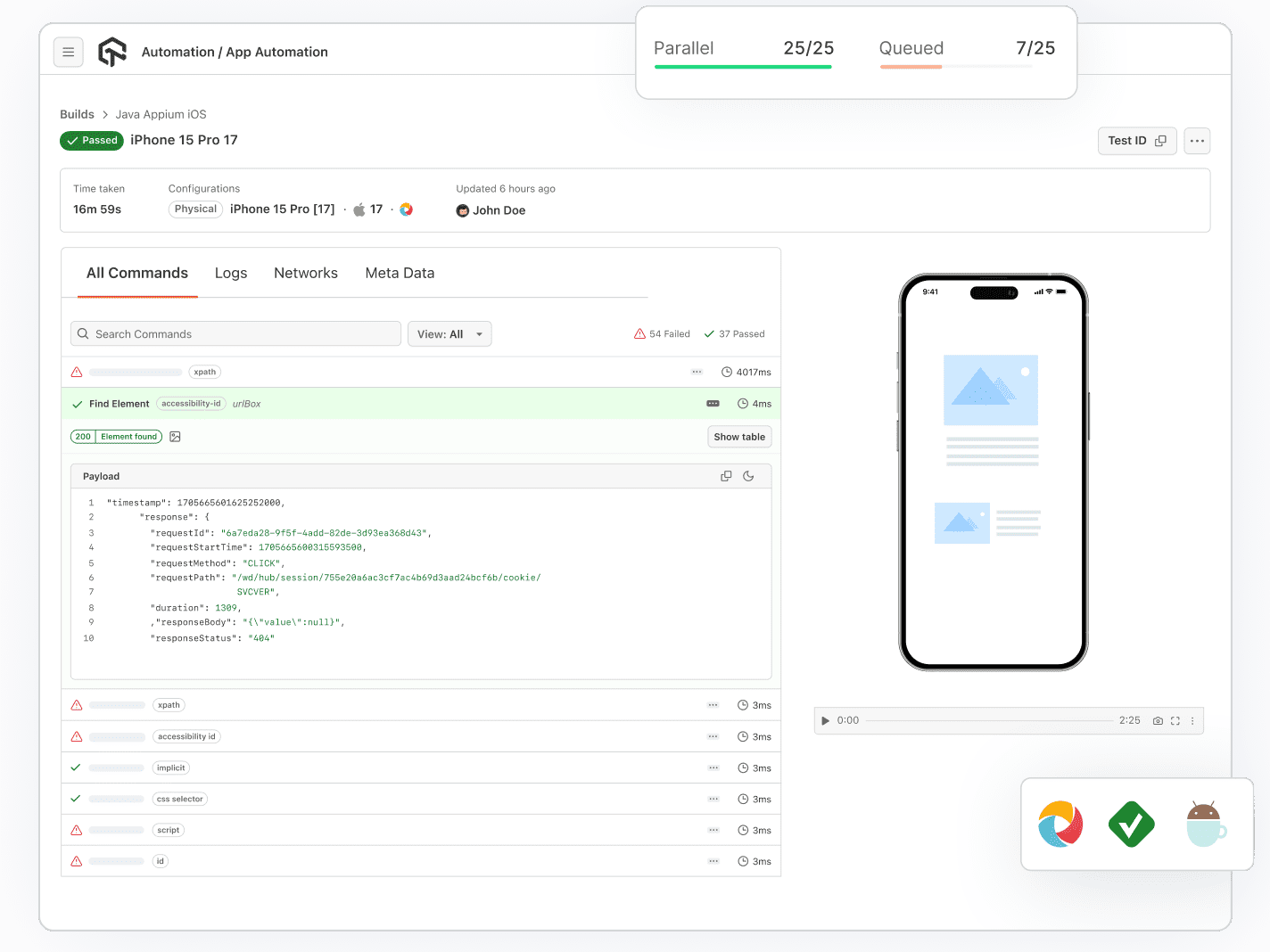
Availability is the weak point. A Capterra reviewer in February 2026 called real devices "inconsistent, especially for new iPhones and Ultra devices", and a Trustpilot review the same month described devices that "show as available in the dashboard" but return "Device not available" on launch. If your release gate depends on the newest iPhone, try booking that exact model during the free sessions before you pay $199 a parallel for it.
HyperExecute is the other product worth knowing, and it is not a grid. You add one YAML file to an existing Selenium, Playwright or Cypress suite and run it from CI; it splits the tests across machines, retries the flaky ones and fails fast. TestMu says suites finish "up to 70% faster" - its number, not a result we measured. It is licensed per concurrent test, so 50 tests in parallel need 50 licenses, at $103 a month on Linux or $159 on mixed operating systems, billed annually ($129 and $199 billed monthly).

KaneAI: natural-language tests on a credit meter
KaneAI is the reason for the new name. You describe a flow in plain English - something like "log in, add the blue hoodie to the cart, check the total" - and it plans and writes the test, runs it on desktop browsers, mobile web and native apps, and exports it as Selenium, Playwright, Cypress or Appium code. The export is what makes it defensible. A test you can take with you is not a test locked into a vendor.

It is billed per agent, in credits, and there is no free plan. Starter is $17 a month billed annually ($19 monthly) for 2,000 credits, with authoring only through the local Kane CLI. Pro is $89 ($99 monthly) for 12,000 credits and cloud authoring on the web. Max is $179 ($199 monthly) for 25,000 credits and adds mobile. TestMu's own estimate is roughly 25, 150 and 313 test creations of 40 steps a month on those three tiers. Twenty-five new tests is a light week for one QA engineer, so Starter is a trial in practice. The annual discount on KaneAI is only about 10%, and the current promotion is 10,000 Kane CLI credits free for a month.
The usual AI questions get thin answers. TestMu does not say which language models power KaneAI, so a silent model swap could change how your tests are written without notice. It does not say whether your test data trains anything. Its retention policy lists KaneAI and Test Manager data as "No retention limit", which means your plain-English flows - often a step-by-step description of an internal app - stay until you delete them. The platform is SOC 2 Type 2, GDPR and CCPA compliant and runs on Cloudflare and AWS, but it names no data-centre locations and mentions no ISO 27001.
Refunds, renewal and 30-day artifacts
Read the terms before the card goes in. "All fees and payments made by Customer to TestMu are non-refundable," and subscriptions "automatically renew unless otherwise noted." The pricing FAQ says you can cancel or downgrade from the billing portal, with the change landing at the next billing cycle. The terms of service describe a stricter route: 30 days' prior written notice to terminate an account, or switching auto-renew off yourself. On an annual plan, the day you turn off renewal matters far more than the day you stop using the product.
This is what fills the bad reviews. TestMu's Trustpilot score was 3.2 out of 5 from 96 reviews on September 29, 2026, and it is split hard: 56% five-star, 31% one-star. The one-star pile is mostly billing. "Won't allow me to cancel my account. Keeps billing me monthly despite repeated cancellation requests," wrote one reviewer on September 15, 2026. Another said in July they were charged "for a subscription that cannot be canceled from the account dashboard". Capterra, where the product is still listed as LambdaTest, is kinder at 4.6 from 547 reviews; its complaints are about slow device sessions and sessions that "disconnect unexpectedly whilst in the middle of testing".

One more limit the pricing page leaves out: automation videos, logs and screenshots are deleted 30 days after they are created. If you need test evidence for an audit, export it on a schedule or negotiate longer retention on an Enterprise contract.
Verdict: buy the grid, pilot KaneAI
Buy TestMu AI if you run Selenium, Playwright or Cypress against Chrome and Firefox and want a hosted grid for less than BrowserStack charges: $29 a parallel on Linux, unlimited minutes, and your old LambdaTest endpoints still work. Buy the real-device plan if you need SIM cards and geolocation for OTP and regional flows - after you have checked that the models you care about can actually be booked.
Skip it if you are a solo developer or a small team with a Playwright suite. Playwright already ships Chromium, Firefox and WebKit, and running it on the CI runners you pay for today costs nothing extra; a grid earns its price only when you need real Safari, real devices or more parallelism than your runners give. Skip it too if you cannot commit to a year, because annual billing is where the prices live and nothing is refunded. For a longer evaluation, BrowserStack's free tier includes Percy with 5,000 screenshots and Test Management, and Sauce Labs is the enterprise alternative, with no free tier listed.
KaneAI is the optional extra, and the rebrand oversells it. Exporting to real framework code is the right design, but 25 test creations a month on Starter, an undisclosed model and no retention limit on what you type make it something to pilot on Pro, not something to roll out to a team on day one.
Ready to try TestMu AI (LambdaTest)?
Visit the official website to see the latest plans, pricing, and special offers.
Get Started - TestMu AI (LambdaTest)* Affiliate link - we may earn a commission at no extra cost to you.