Zapier Central Review: Where Zapier's AI Agents Went, and What They Cost Now
Zapier Central is now Zapier Agents, moving into AI by Zapier. Pricing checked November 2026, the 5x Premium task multiplier, migration gaps and who should switch.
Expert Review

What happened to Zapier Central
Type zapier.com/central into a browser and you land on zapier.com/agents. It is a permanent 308 redirect, checked on 10 November 2026, and it is the first sign that the product you searched for has changed names twice since it launched.
Zapier Central arrived in March 2024 as "an experimental workspace where you teach AI bots to handle tasks in your apps". You gave each bot "behaviors" (plain-language instructions it ran with or without you watching), chatted with it and pointed it at Google Sheets, Docs or Notion.
On 22 January 2025 it became Zapier Agents, launched in beta with a Chrome extension, web browsing and 9,000+ connected apps. In May 2025 behaviors went too: "Each behavior will become an individual agent, and multiple agents can be grouped within a pod."
Then on 6 October 2026 Zapier announced the second move. "Zapier Agents is now AI by Zapier": tool calling, reasoning and autonomous action now live in a single AI step inside the ordinary Zap editor. The old name survives only in the plumbing: the pricing page's product catalog still uses the ID central-free.
Standalone Agents is still running: Zapier "has not set a date to turn off Agents yet" and promises email notice first. So this review covers both the add-on you can still buy and the AI step it is turning into.

How it works now
Every migrated agent becomes a Zap: a trigger (a schedule or a webhook) plus one AI by Zapier step holding the prompt, the tools and the reasoning. Zapier's mapping:
| In Zapier Agents | In AI by Zapier |
|---|---|
| Instructions | The prompt field on the AI by Zapier step |
| Tools | The step's tools picker |
| Agent trigger | The Zap trigger |
| Chat / on-demand agent | A webhook trigger |
| Agent calling another agent | A Sub-Zap trigger |
| Approval | "Require approval before running", set per tool |
| Run history | Zap History |
| Activities | Tasks |
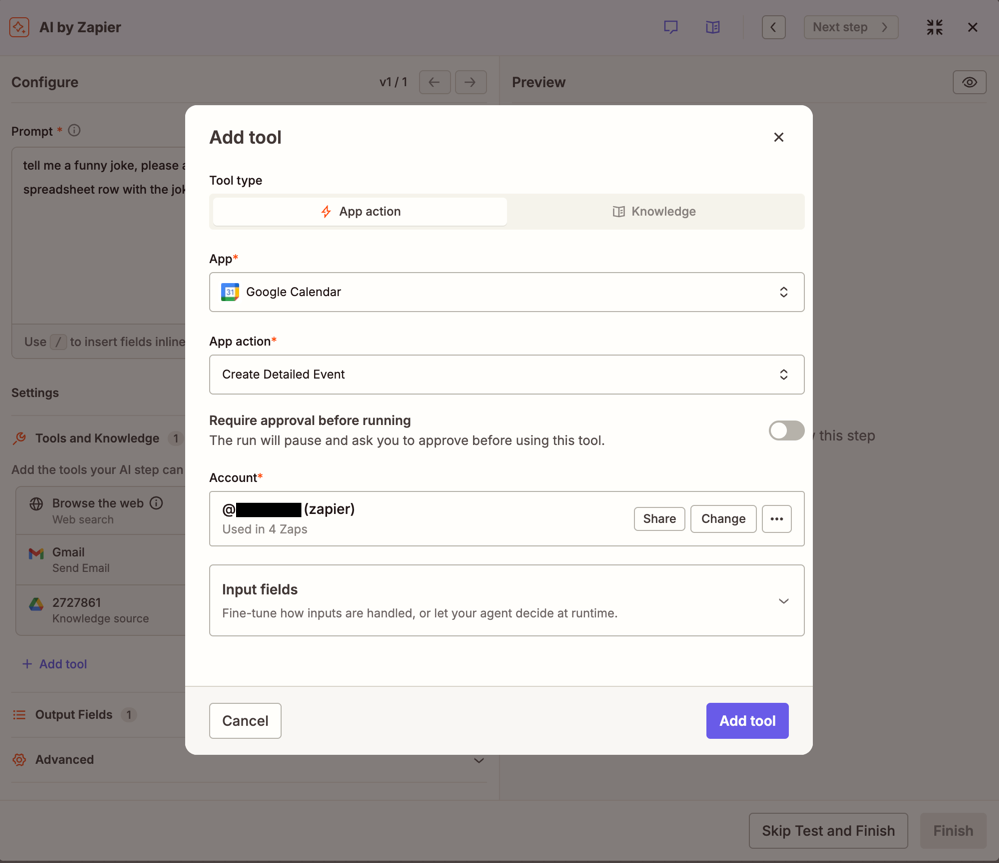
The approval change is the real improvement. In Agents, approval was all or nothing. Now each tool gets its own switch, so an agent can read a spreadsheet freely and still wait for a human before it sends an email. The catch is the default: the switch is off for every tool, and Zapier itself advises turning it on for anything that creates, updates or deletes data. Nobody will remind you.
There is a second guard. A step that burns 75 tasks in a single run pauses the Zap and asks for approval, and you can raise that ceiling to 500. One limit to plan around: an AI by Zapier step cannot use another AI by Zapier step as a tool, which is why agent-to-agent work goes through Sub-Zaps instead.
Pricing: activities versus tasks
Prices were checked on zapier.com/pricing and Zapier's help center on 10 November 2026. Two units are in play, on two separate bills.
Standalone Zapier Agents
Agents is sold "as an add-on to your Zapier account" and does not touch your Zap tasks. Agents Free gives 400 activities a month with a cap of 10 per run, and tests count against the quota. Agents Pro costs $400 billed annually ($33.33 a month) for 1,500 activities, 40 per run, and tests are free. Enterprise is "Contact for pricing" and adds agent sharing and audit logs. There is no Team tier, and on Team or Enterprise accounts everyone draws from one shared pool.
An activity is "any billable action that your agent takes": a trigger, a knowledge lookup, an action, a search or scrape. At the monthly limit agents stop doing anything except chat, but a run that crosses the line finishes free and there is never an overage bill. A mid-cycle upgrade raises the cap without resetting usage.
AI by Zapier
After migration there is no add-on. "AI by Zapier uses the same task-based pricing as the rest of Zapier," which means your agent now spends from the same pool as every other Zap you run. Since 15 June 2026 each step is priced by model tier:
| Tier | Multiplier | Tools | Two tool calls cost |
|---|---|---|---|
| Standard | 1x | No | - |
| Advanced | 3x | Yes | 9 tasks |
| Premium | 5x | Yes | 15 tasks |
| Bring Your Own Key | 1x | Yes | 3 tasks + your model bill |
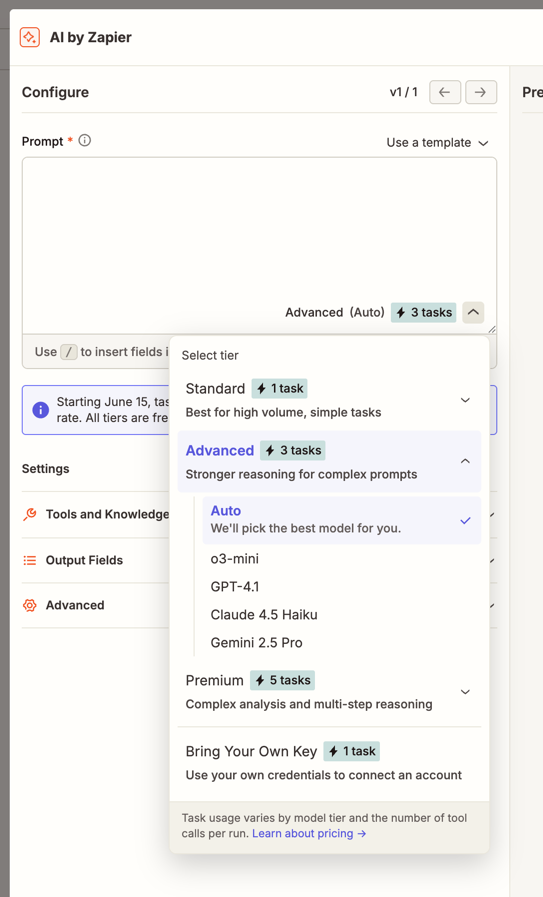
The formula is "(1 x model rate) + (number of tool calls x model rate)". And per Zapier's help center, updated in November 2026, a new AI step on a paid plan defaults to Premium. Leave it there and a routine agent that looks up one record and writes one row costs 15 tasks a run.
Put that against the plans. Professional starts at 750 tasks a month for $19.99 billed annually or $29.99 billed monthly. That is about 50 runs of the default two-tool step, before any of your other Zaps take their share. Drop the step to Advanced and you get about 83 runs; bring your own API key and it is about 250, plus whatever OpenAI or Anthropic charges you. Team starts at 2,000 tasks for $69.00 a month annually or $103.50 monthly. Past the cap, paid plans bill per task at 1.25x the base rate on annual plans and 2.5x on monthly plans, and everything pauses at 3x your subscription.
The free route is gone entirely. "On a Free plan, you cannot add tools or publish a Zap with an AI by Zapier step." Agents Free users who migrate go from 400 activities at no cost to needing Professional. Also note that steps created before 15 June 2026 do not update on their own and cannot use tools or knowledge.
What does not migrate yet
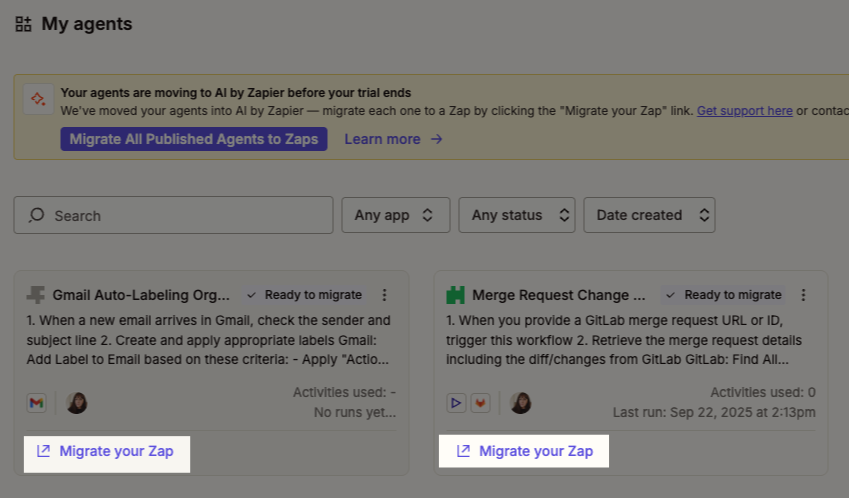
Eligible agents show a "Ready to migrate" badge and a link that builds the Zap for you. Several kinds of agent cannot make the trip cleanly, and the migration guide (last updated 27 October 2026) lists them.
Chat-triggered agents have "no direct equivalent" yet, so a support bot people talk to becomes a webhook you have to wire to some front end yourself. Agents that call other agents have to be rebuilt by hand as Sub-Zaps. Knowledge sources from HubSpot, Asana, Zendesk, Zoom and Jira are not supported at all, with support planned for Q4 2026 - if your agent answers from Zendesk tickets, it loses its memory on migration. Notion workspaces with more than 1,000 pages may fail to add, and some Notion blocks cause indexing errors.
Admins lose two things for now. Admin-level Bring Your Own Model is not available (user-level API keys work), and full-Zap tests consume tasks exactly like production runs, which Zapier says it is fixing. On Agents Pro, tests were free. In return, admins can restrict models and switch tool calling off account-wide.
If you stay on standalone Agents for now, know the limits its marketing page leaves out. Knowledge syncs cap at 75,000 rows across the account and 96,000 words per document, and several apps sync only "up to 2 months in the past". The Chrome extension "does not work on Chromium-based browsers", so Edge and Brave users are out.
Models and your data
Standard runs small models such as GPT-5 nano/mini and Gemini 2.5 Flash. Advanced adds GPT-4.1, o3-mini, Claude 4.5 Haiku and Gemini 2.5 Pro. Premium is where GPT-5.4, Claude 4.5/4.6 Sonnet and Claude 4.5/4.6/4.7/4.8 Opus live. The "Auto" option picks Claude 4.5 Haiku in Advanced and Claude 4.6 Sonnet in Premium. Auto is Zapier's choice, not yours, so if an agent's output has to stay consistent, name the model.
On training, Zapier's own pages disagree. The security FAQ says: "We don't train on the data that runs through your workflows, on any plan." The legal page dated 2 July 2026 says: "Enterprise customers are automatically opted out of Zapier using their content for model training and improvement purposes. All other customers may opt out at any time," and it counts "support tickets processed by an Agent" as customer content. Until those line up, anyone below Enterprise should opt out explicitly rather than rely on the FAQ.
Enterprise accounts can route inference through their own cloud provider instead: AWS Bedrock is supported, with Google Vertex AI and Microsoft AI Foundry on request.
Verdict
Zapier Central is no longer a product so much as a lineage. What it became is sound engineering with an unfriendly default. Folding agents into Zaps gives you one bill, one history and per-tool approval, all of which Agents lacked. Leaving new steps on Premium is how a $19.99 plan runs dry after about 50 agent runs.
Migrate now if you already pay for Professional or Team, your agents run on a schedule or an app trigger, and you are willing to set each step to Advanced or bring your own key. Turn on approval for every tool that writes data before you publish.
Hold off if your agents are chat-driven, call each other, or answer from HubSpot, Asana, Zendesk, Zoom or Jira. Hold off too if you live on Agents Free: there is no free equivalent on the other side, and Zapier has promised notice before anything is switched off.
Use something else if you plan to run agents at volume and the per-task meter is the problem. Self-hosted n8n has no per-task bill, only the server you run it on. Relay.app is built around human-in-the-loop steps, which is what Zapier's approval toggle is catching up to, and Activepieces is the open-source route if you want to own the stack. For the rest of Zapier beyond its AI features, see our Zapier review.
Ready to try Zapier?
Visit the official website to see the latest plans, pricing, and special offers.
Get Started - Zapier* Affiliate link - we may earn a commission at no extra cost to you.