Parabola Review: Prowork's AI Agents for Finance and Ops Teams, and What Replaced the Old Canvas
Parabola review: the June 2026 relaunch as Prowork, credit pricing history, hard limits like 10-minute schedules and no self-hosting, and when Zapier, Make or n8n fit better.
Expert Review

Parabola is now Prowork
If you last used Parabola a year ago, the company has since retired that product. On June 17, 2026 it launched Prowork, and its about page is blunt about the decision: "We tabled Parabola, a tool we'd poured ourselves into for nearly a decade, and we built Prowork." The site title now reads "Prowork by Parabola", and the homepage pitch is "Your hardest finance & ops work, on AI you can trust."
The canvas did not disappear. It moved behind a chat box. You describe a process in plain language, an agent builds the steps, and what it builds stays visible and editable as a Flow. That matters more than the new name. Plenty of AI agent tools hand you an answer. Prowork hands you the pipeline that produced it, which is what a finance team needs when an auditor asks where a number came from.
The customer list leans toward direct-to-consumer brands and logistics: the launch release names WHOOP, Fabletics, On Running, Away, Uber Freight, Oura, Caraway, Ruggable and Brooklinen, among others. The company, founded in 2018 and run by CEO Alex Yaseen, raised a $24 million Series B in 2023 led by OpenView, Matrix and Thrive Capital. Everything below was checked on September 26, 2026.
How Flows, Artifacts and AI steps fit together
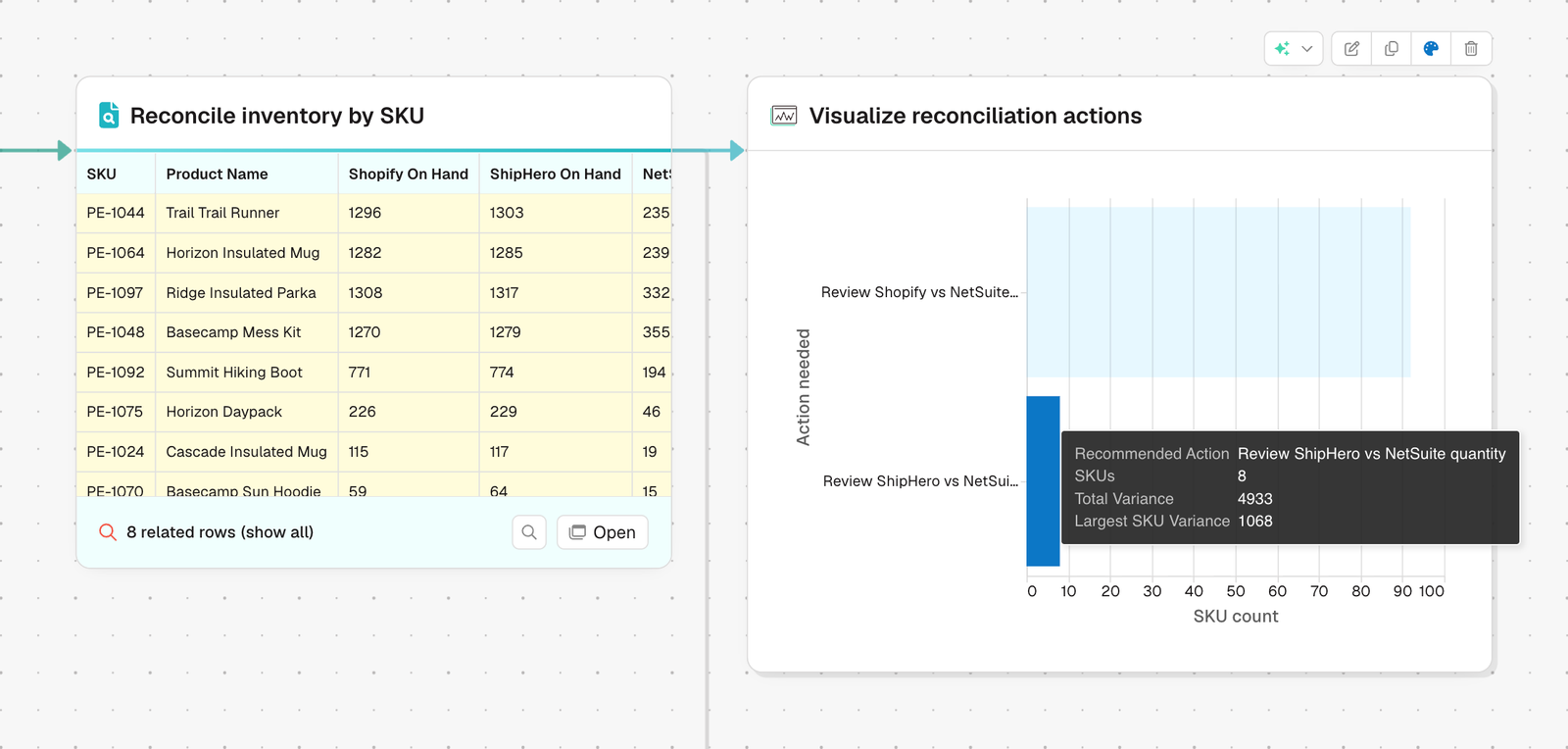
Prowork's docs split the product into three layers. A Flow is "the visible, code-backed implementation of the work" - sources, joins, calculations, rules and the exceptions they raise. An Artifact is what a Flow produces for people to look at: a report, a dashboard, an exception queue, a small interactive interface. A managed agent is a Flow deployed with triggers, permissions, monitoring and run history attached.
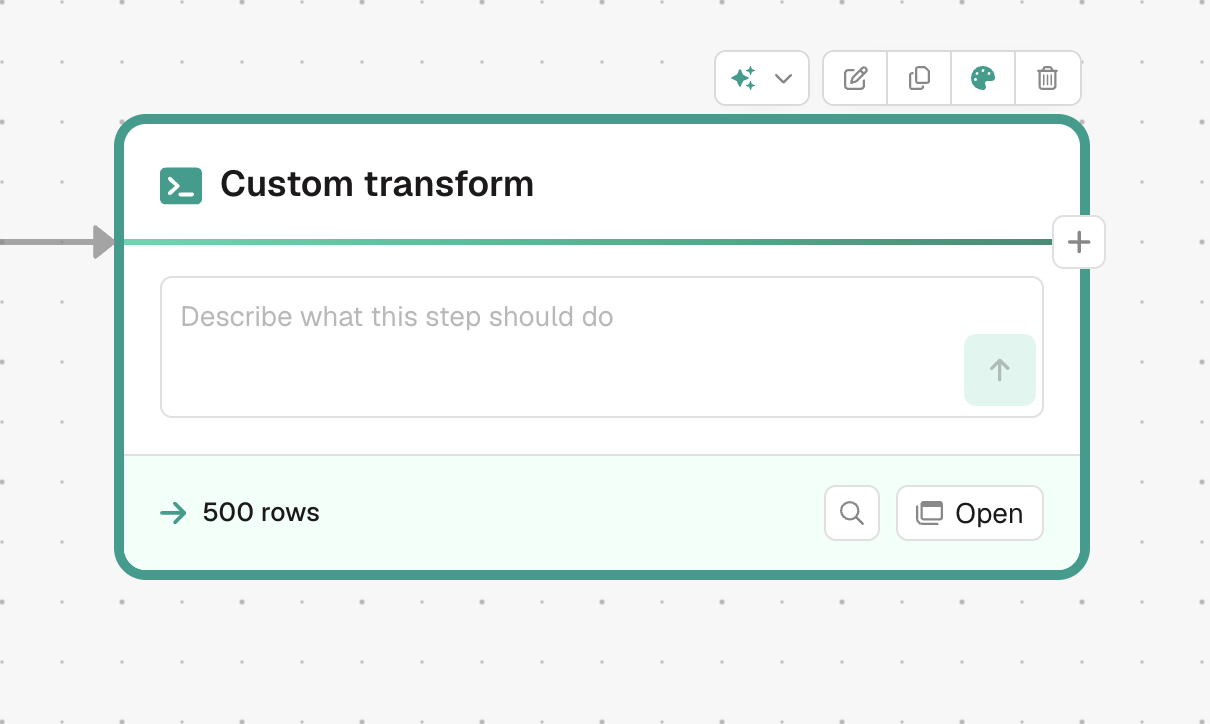
The chat agent builds whole Flows, and it can also be opened from a single step to fix or extend one part instead of starting over. Inside a Flow, AI steps do the jobs old Parabola needed formulas for. They categorize rows, pull fields out of free text, standardize messy values, or run a transformation you describe in a sentence. Vision extraction reads PDFs, invoices, packing lists and purchase orders - the attachments that arrive from 3PLs and suppliers by email, and that most automation tools cannot open at all.
The models underneath are not Parabola's own. The company "does not train its own AI models" and runs on third-party providers "incl. OpenAI and Anthropic" under contracts that bar them from training on your data. No model versions are published, so you will not know when the model behind a step changes. What leaves your account is narrower than in many tools: the Extract, Categorize and Standardize steps send only the columns you select. Experiment with AI is the exception. It sends the entire dataset, so keep it away from a payroll export.
Auditability is the strongest argument for the product. Data Tracing highlights which upstream rows fed a given value, step by step, and version history keeps a live and a draft copy of each Flow so an edit cannot quietly break a running agent.
Pricing: the dollar figures are gone
The live pricing page shows no prices. There is a Self-serve tier ("Start with the Basic Plan: 1 user, 1,000 credits, and limited AI") with pay-as-you-go credits on top, and a Business tier that says "Talk to sales". Business customers start with a proof of concept, advertised elsewhere on the site as risk-free for 30 days. The archived pricing pages fill in what the current one leaves out.
| Snapshot | Free | Entry paid plan | Team plan | Overage |
|---|---|---|---|---|
| January 2025 | Basic: 3 flows, 200 steps/month | Solo $80/month, 1,000 steps | Team $800/month, 10,000 steps | - |
| September 2025 to March 2026 | Basic $0, 1,000 credits/month | Explorer $20/month, 1,500 credits | Collaborator $400/month, 3 users, 30,000 credits | $0.15 per 10 credits |
| May 2026 | Basic $0 | Explorer $20/month | Collaborator $400/month | $0.18 per 10 credits |
| September 2026 | Basic, 1,000 credits/month | Not published | Business: talk to sales | Not published |
The overage rate rose 20% in spring 2026, then the prices came off the page. The billing docs, updated August 28, 2026, say paid plans are billed "at the plan's per-credit rate" without naming it, and they still refer to Explorer, Team, Advanced and Enterprise plans that the pricing page no longer shows. Budget against $0.018 a credit, the last published figure, and ask sales to put the current rate in writing.
The credit rules themselves are fairer than the old step pricing. Credits are spent when agents run, never while you build or edit a draft, and a step that fails or has zero input and output rows costs nothing. That fixes a real grievance: a Bubble forum user complained in 2021 that failed runs were billed anyway - "So you paid to fix their bugs." AI steps draw from the same pool as everything else, and a multi-page PDF extraction burns more than a simple join.
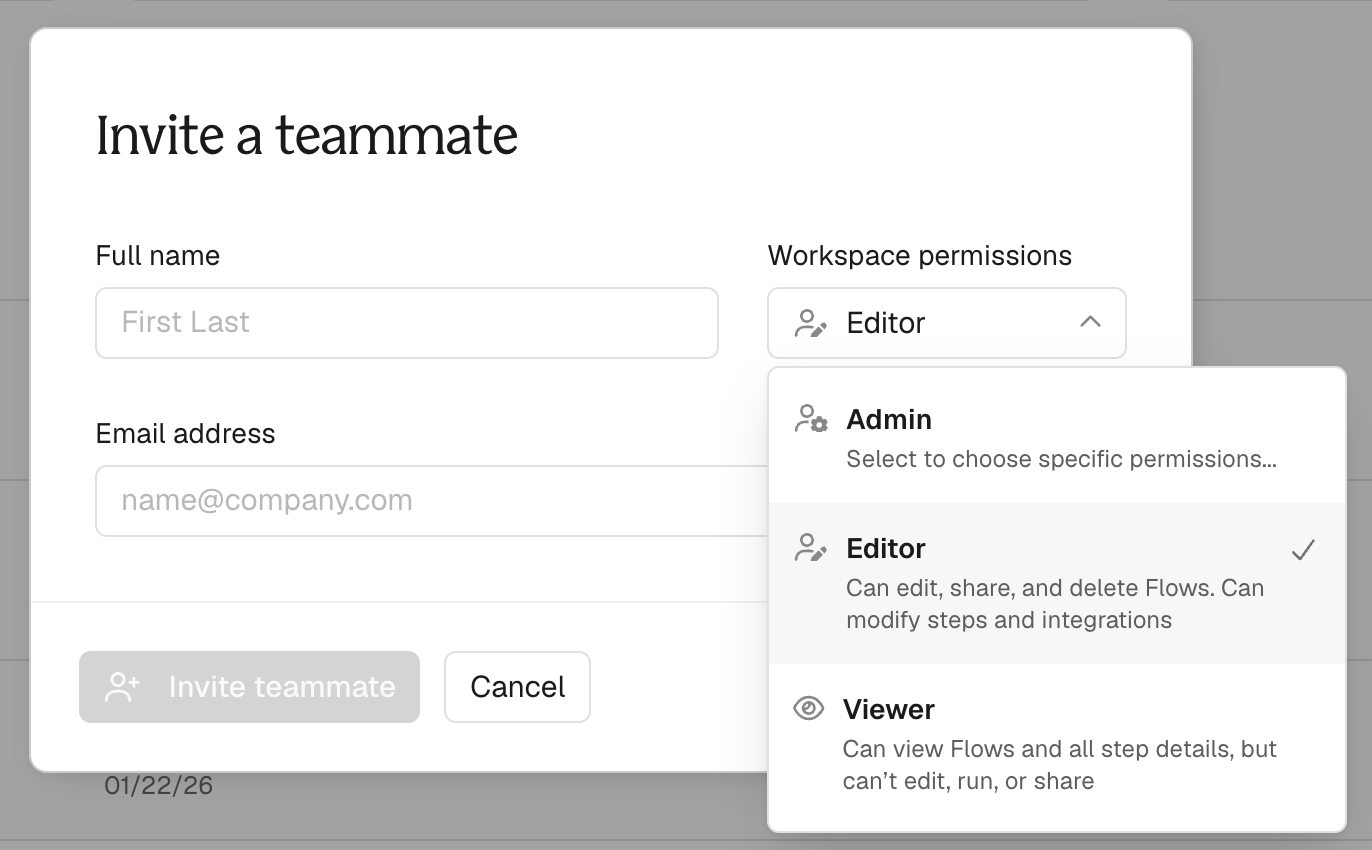
The free tier stops hard. "Basic is capped at 1,000 credits per month", and when you hit the cap Prowork stops working until the billing period resets. There is no overage and no grace period. Scheduled flows also need a paid plan, so Basic is for trying the builder, not for running anything unattended. Business plans add 7,500 monthly chat credits per user for the builder itself, plus viewer, editor and admin roles.
Leaving is easy on paper. Cancel and you drop to Basic at once: scheduled flows pause, but the flows themselves stay in your account. Deleting your data from Prowork and its subprocessors takes an email to [email protected].
Hard limits the pricing page leaves out
These come from the limitations page in the docs, updated August 28, 2026. They decide whether Prowork fits before any feature does.
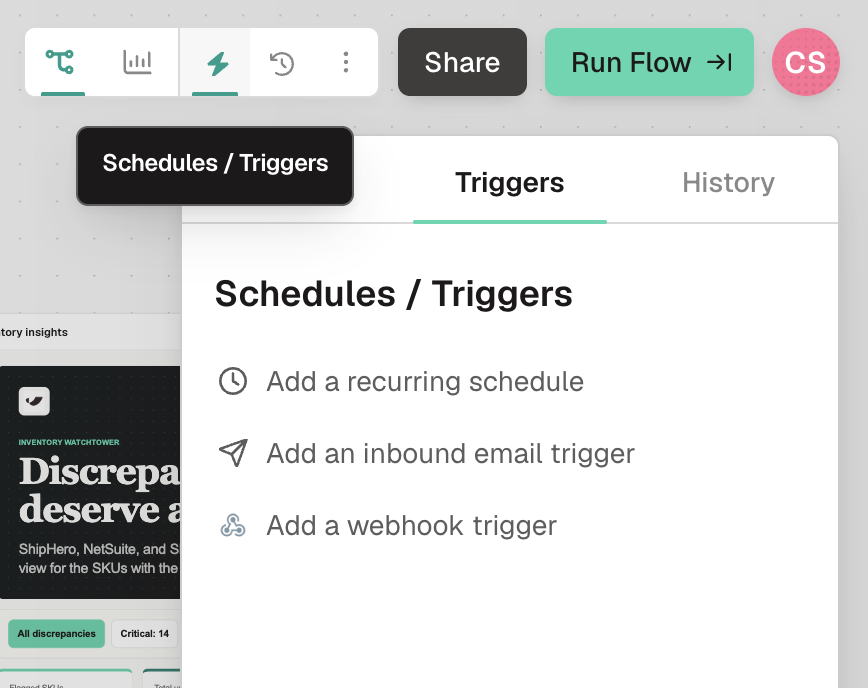
- Schedules run at most every 10 minutes, and only on plans that allow it. Webhook and inbound-email triggers exist, but each queues at most 1,000 pending runs, and nothing streams in real time.
- A dataset tops out at 5 million rows, 150 million cells and 5,000 columns.
- AI steps have a 100,000-row ceiling, yet the docs admit runs above roughly 70,000 rows "will often fail".
- A Flow can run for 3 hours, a single step for 60 minutes, and an API step fetches at most 1,000 pages.
- Files: 1 GB for CSV, Excel and SharePoint; about 200 MB for other file steps; about 20 MB through email.
- Roughly 400 steps per Flow, with "performance issues present at lower amounts".
That last line matches the oldest complaint in user reviews. A Capterra reviewer noted back in 2022 that larger workflows are sometimes slow to load, and third-party reviews repeat it next to two others: fewer ready-made connectors than Zapier or Make, and a learning curve on API setups and complex transforms.
Hosting is AWS in the United States, with no alternative. There is no self-hosted edition and no EU data residency, a point Parabola's own comparison page concedes to n8n. Flow data is kept for up to 14 days or until the next run, backups for 30 days and server logs for six months. SOC 2 Type II is in place and SSO is supported. MFA, though, exists only through your SSO provider, so without SSO there is no second factor on Prowork's side.
Who should pick something else
Parabola's comparison pages are unusually candid about where it loses, and they line up with the limits above.
Zapier is the better buy when the job is moving a record from one app to another the moment something happens. Parabola says as much: "Zapier moves data between apps. Parabola reshapes it." Zapier counts every action step as a task, which gets expensive for long jobs, but a five-step trigger is simpler there and the connector library is far larger. Make suits technical builders who want cheap branching and error handling; Parabola concedes that one too. n8n is the answer when data cannot leave your servers or the EU. Workato fits when IT owns automation company-wide and needs governance across hundreds of apps - our Workato review covers that tier. And if your data already lives in one base, Airtable automations can act on it without a second tool.
Alteryx is the expensive neighbour. Parabola puts its list price at around $5,195 per user per year, and it still wins on statistical and spatial analytics that Prowork does not attempt.
Verdict
Buy Prowork if you run finance or operations at a brand that reconciles Shopify, NetSuite, a 3PL portal and a pile of emailed spreadsheets every week, and nobody on the team writes SQL. The chat builder gets you to a first Flow faster than old Parabola did, the code-backed Flow lets you check the logic instead of trusting it, and Data Tracing answers the auditor's question. The vendor's numbers - Caraway saving 150 hours a month, Fabletics cutting ten-hour jobs to one - are plausible for that kind of work. They are customer quotes, not measurements anyone else has checked.
Skip it if your data must stay in the EU or on your own servers (n8n), if you need anything faster than a 10-minute schedule, if your AI steps will routinely touch more than 70,000 rows, or if you want to see a price before a sales call - Zapier and Make still publish theirs. Watch the direction of travel, too. The overage rate went up 20% in a year and then stopped being public, which is not what a buyer planning a three-year budget wants to see.
Ready to try Parabola?
Visit the official website to see the latest plans, pricing, and special offers.
Get Started - Parabola* Affiliate link - we may earn a commission at no extra cost to you.