SpyFu Review: The Competitor-Spying Tool That Undercuts Semrush
A hands-on SpyFu review checked in August 2026: what the Kombat report and 18-year PPC archive do well, current pricing, and where it loses to Semrush and Ahrefs.
Expert Review

What SpyFu actually is
Most SEO platforms sell you a monthly quota. Semrush counts your reports, Ahrefs counts your "credits," and you learn to ration them by the third week of the billing cycle. SpyFu does the opposite: every plan, including the cheapest, runs unlimited searches and unlimited results. That single design choice is the reason a lot of agencies keep it open in a second browser tab.
The company has been at this longer than almost anyone. Mike Roberts started SpyFu out of a garage around 2005 and still runs it from Scottsdale, Arizona, which matters here because SpyFu's real asset is time. It has been recording who bids on what in Google Ads since before most of its rivals existed. As of August 2026 the marketing page claims 13.1 billion keywords, 152 million websites, and 18-plus years of historical paid-search data across 38 countries. The headline numbers are unverifiable from the outside, but the depth of the paid-search archive is genuinely hard to find elsewhere.
What SpyFu is not is an all-in-one suite. It is a competitive-intelligence tool that happens to do keyword research, not a keyword-research tool that happens to show competitors. Keep that framing and the product makes sense. Expect it to replace Ahrefs and you will be disappointed for reasons I get to below.

Kombat: the report worth the money
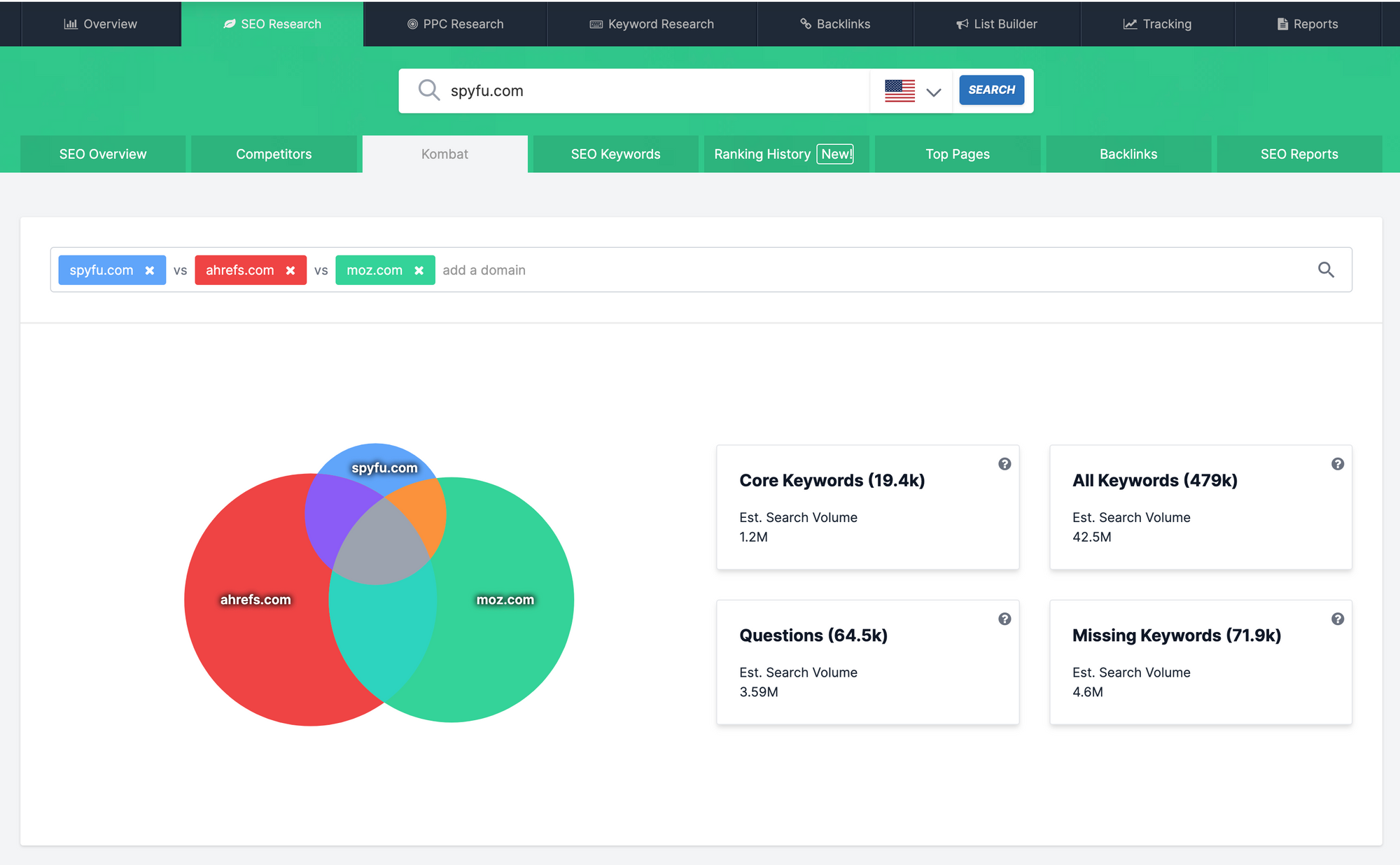
If you only ever use one screen in SpyFu, make it Kombat. You type in your domain and up to two competitors, and it draws a Venn diagram of the keyword universe: what all three of you rank for, what any pair shares, and the slice each domain owns alone. That last slice is the point. The keywords a rival ranks for that you don't are, quite literally, your content gap written out as a list you can export and hand to a writer.
Plenty of tools now do some version of this. SpyFu's advantage is that it runs the same comparison on paid keywords, so you can see which terms a competitor is buying ads against but not ranking for organically. That's an opening: they are paying for traffic you might be able to win for free with a page. I have not seen another tool surface that particular gap as cleanly.
The 18-year ad archive
This is the part SpyFu does better than the two market leaders, full stop. For any domain it will show you the ad copy a competitor has run, roughly when they ran it, and which variations they kept versus quietly killed. An ad that a company has been running unchanged for two years is a tested, profitable ad. You are reading the results of someone else's A/B budget.
For a PPC manager taking over a new account, that archive collapses weeks of guesswork. You can see the terms a competitor abandoned (probably because they lost money), the ones they've defended for years, and the negative keywords worth borrowing. SpyFu also estimates ad spend and click values. Treat those as directional rather than exact, because they are modelled, not reported. Nobody outside Google sees a competitor's real invoice.

SEO research, rank tracking, and leads
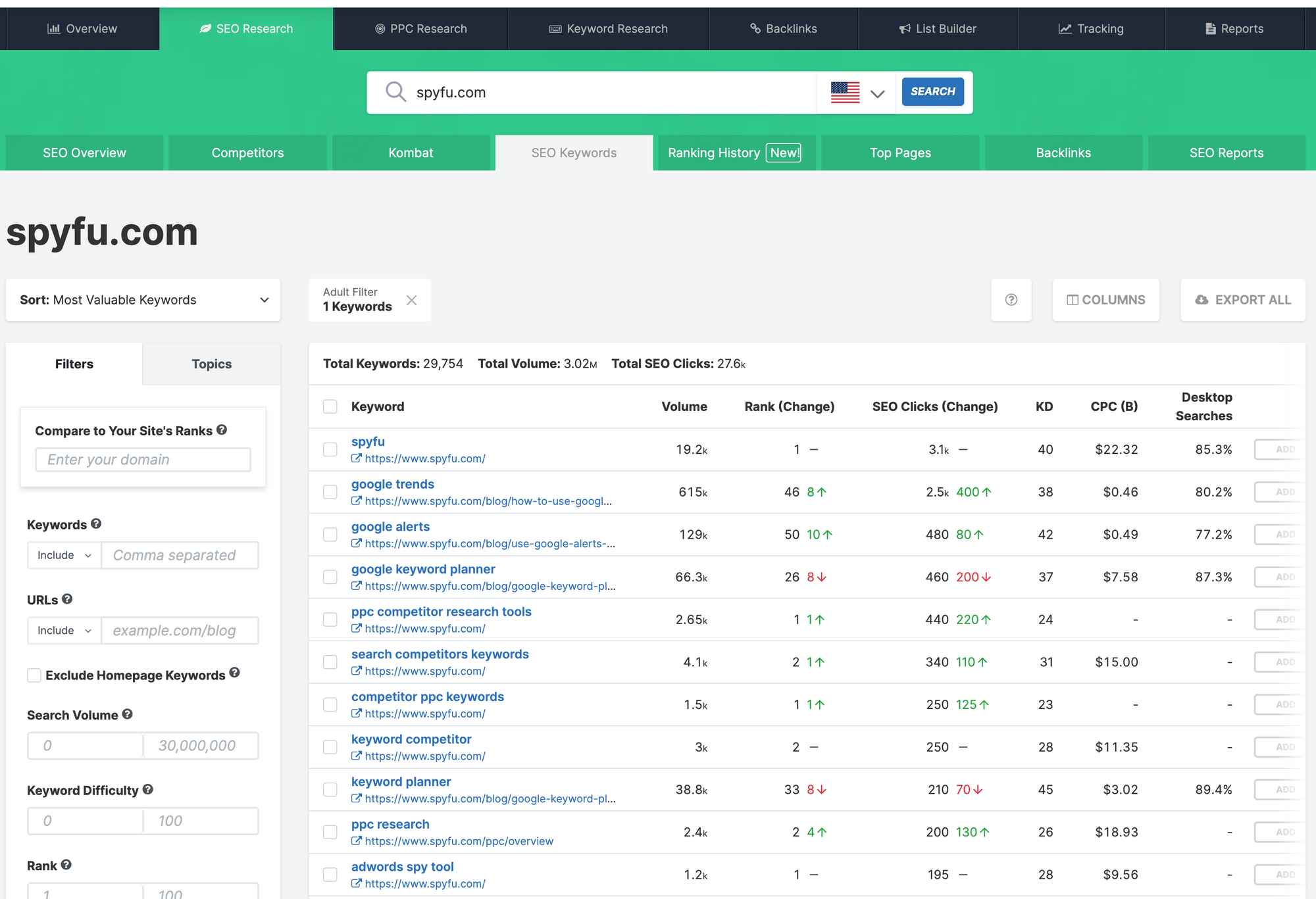
On the organic side you get the expected kit: a domain overview with estimated traffic and top pages, keyword research with difficulty scores, and weekly rank tracking for your own terms. Weekly, not daily, is worth flagging. If you're chasing a volatile SERP or checking the morning after a Google update, weekly cadence will feel slow next to a dedicated rank tracker.
The one feature people forget SpyFu has is sales leads. Search a keyword, filter by industry and location, and it returns the domains ranking or advertising for that term along with contact details, which you can export. For an agency prospecting for clients who already spend on search, that is a lead list disguised as a keyword report. The Basic plan caps this at 250 leads a week as of August 2026.
Pricing
Prices below were on the plan page in August 2026; SpyFu discounts about 25% for paying annually, so two numbers apply to each tier.
- Basic: $39/month, or $29/month billed annually. Unlimited searches and results, roughly 10,000-row exports, tracking for about 5,000 keyword rankings, 250 weekly sales leads, and around six months of history.
- Professional: $79/month, or $59/month annually. This is the tier most agencies actually want. It adds API access, unlimited data exports, full historical data, and white-label branded reports you can hand to clients.
- Team: $299/month, or $249/month annually. Five user logins, higher API allowances, and the top data limits.
There is also a Pro + AI bundle near $119/month that folds in RivalFlow, Mike Roberts' separate AI tool for rewriting underperforming pages. Skip it unless you specifically want that workflow. SpyFu offers no free trial, but it runs limited searches without an account and backs every paid plan with a 30-day money-back guarantee, which is the closest thing to a risk-free trial here.
For scale: Semrush's entry plan sat at $165/month in early 2026, and it meters your usage. SpyFu Basic is roughly a quarter of that and never makes you count reports. On price per search, nothing mainstream is close.

Where it falls short
The cheap price buys a narrower tool, and you feel the edges quickly.
Backlinks are an afterthought. SpyFu has a backlink report, but its index is small and shallow next to Ahrefs, which built its whole business on link data. If backlink analysis is central to how you work, SpyFu will not carry it.
There is no technical SEO audit. No site crawler flagging broken links, redirect chains, or Core Web Vitals problems. That's table stakes on Semrush and Ahrefs and simply absent here.
Accuracy thins out on the long tail and abroad. For keywords under roughly 200 monthly searches, and for markets outside the US and UK, the volume and difficulty estimates get noticeably less reliable. If you run campaigns in, say, Germany or Brazil, verify everything against a local source.
The index lags. SpyFu's data can trail the fastest competitors by a couple of weeks. For historical ad research that's irrelevant. For "what changed in the SERP yesterday," it isn't.
Verdict: who should buy it
Buy SpyFu if you do paid search or competitive research and want a specialist that won't ration you. A PPC manager who lives in the ad-history archive, or a marketer who wants a low-cost second opinion running alongside a primary platform, gets more from $39 a month here than from almost anything else at the price. The Kombat report and the 18-year ad archive are the two things it does better than tools costing four times as much.
Skip it if you need one platform to do everything. If backlinks drive your strategy, buy Ahrefs. If you want technical audits, daily rank tracking, and reliable international data in a single subscription, pay up for Semrush and don't look back. SpyFu is a sharp, affordable scalpel. It was never meant to be the whole toolbox.
Try SpyFu and start with a Kombat report against your two closest competitors; if that one screen doesn't tell you something useful, the 30-day guarantee has you covered.
Ready to try SpyFu?
Visit the official website to see the latest plans, pricing, and special offers.
Get Started - SpyFu* Affiliate link - we may earn a commission at no extra cost to you.