Writesonic Review: The Old AI Writer Is Now an AI Search Tracker
Writesonic review: pricing from $79 to $499/month, what each plan tracks (only 3 of 9 AI platforms below Enterprise), the AI article allowance, refund rules and who should skip it.
Expert Review

Writesonic is not the AI writer you remember
If you last looked at Writesonic when it was a cheap GPT copywriter with a free tier, forget that version. The homepage now calls it "The AI Search Growth Engine", and the pitch is about whether ChatGPT, Gemini and Google AI Overviews mention your brand when someone asks a question your product could answer. The writing tools are still there, but they ride along as a monthly article allowance.
That shift has a price attached. As checked on the pricing page on October 22, 2026, there is no free plan, the cheapest tier is $99 a month ($79 billed annually), and the self-serve plans track three AI platforms, not the eight or nine the marketing headline promises.
The product splits into two halves. The first is AI visibility tracking, which some call GEO (generative engine optimization): you give it prompts your customers might type, it asks the AI platforms every day and records whether you are mentioned, cited or recommended against named competitors. The second half is the fixing: site audits, a content planner, AI-written articles and an "Action Center" that suggests on-page and off-page work. Writesonic says more than 10,000 marketing teams use it, by its own count, with Amazon, Unilever and Acer named on the homepage.
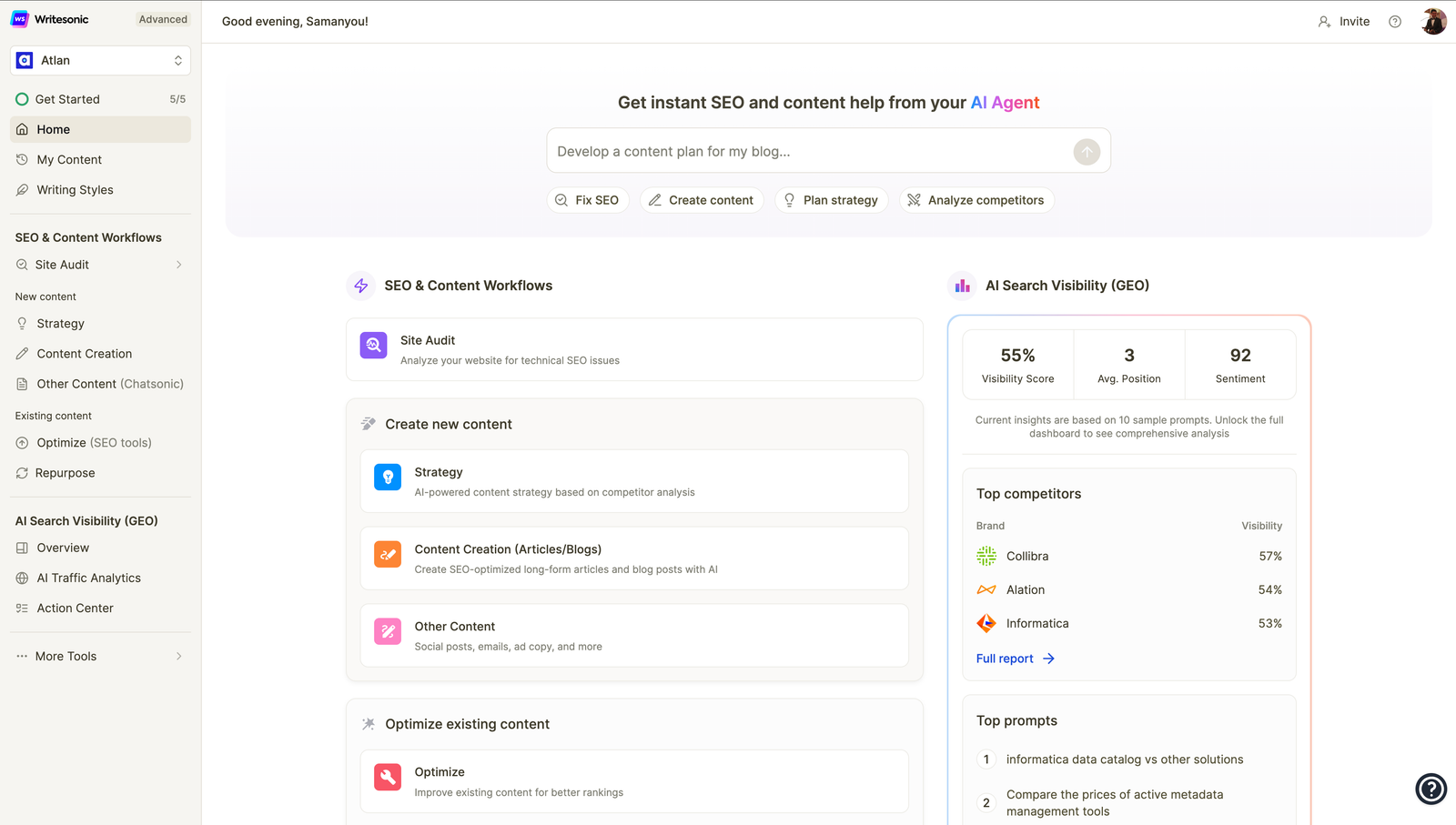
The screenshots in this review are Writesonic's own, from its help centre in 2025, not from our account. The interface may have moved on since.
Pricing and plan limits
All figures below were taken from writesonic.com/pricing on October 22, 2026. Annual billing saves 20% and is paid for 12 months upfront.
| Plan | Monthly | Billed annually | Prompts / answers tracked daily | AI articles a month | Site audits | Users / projects |
|---|---|---|---|---|---|---|
| Starter | $99 | $79/mo | 50 / 50 | 15 | 10 (100 pages each) | 1 / 1 |
| Basic | $249 | $199/mo | 100 / 300 | 25 | 20 (1,200 pages each) | 2 / 1 |
| Growth | $499 | $399/mo | 200 / 600 | 50 | 50 (2,500 pages each) | 3 / 2 |
| Enterprise | Custom, demo required | Custom | Custom | Custom | Custom | |
Extra seats cost $50 per user per month, capped at five users in total on Basic and Growth. Growth can buy 20 more articles for $100 a month. Every self-serve plan covers exactly one market, meaning one language-and-country pair, so a brand selling in the US and Germany needs Enterprise or two separate subscriptions. Brand voices are limited too: one on Starter, five on Basic, ten on Growth.
The agentic features are trials on every self-serve tier. Starter gets 10 "trial runs" of agentic workflows, Basic 50, Growth 100, and Growth adds an Action Center trial of five off-page and five on-page actions a month. The full Action Center, sentiment analysis below Growth, and a human AI search strategist sit on Enterprise. The terms also let Writesonic rate-limit, throttle or charge overage fees when you exceed plan limits, and a "fair usage policy applies" footnote sits under the add-ons.
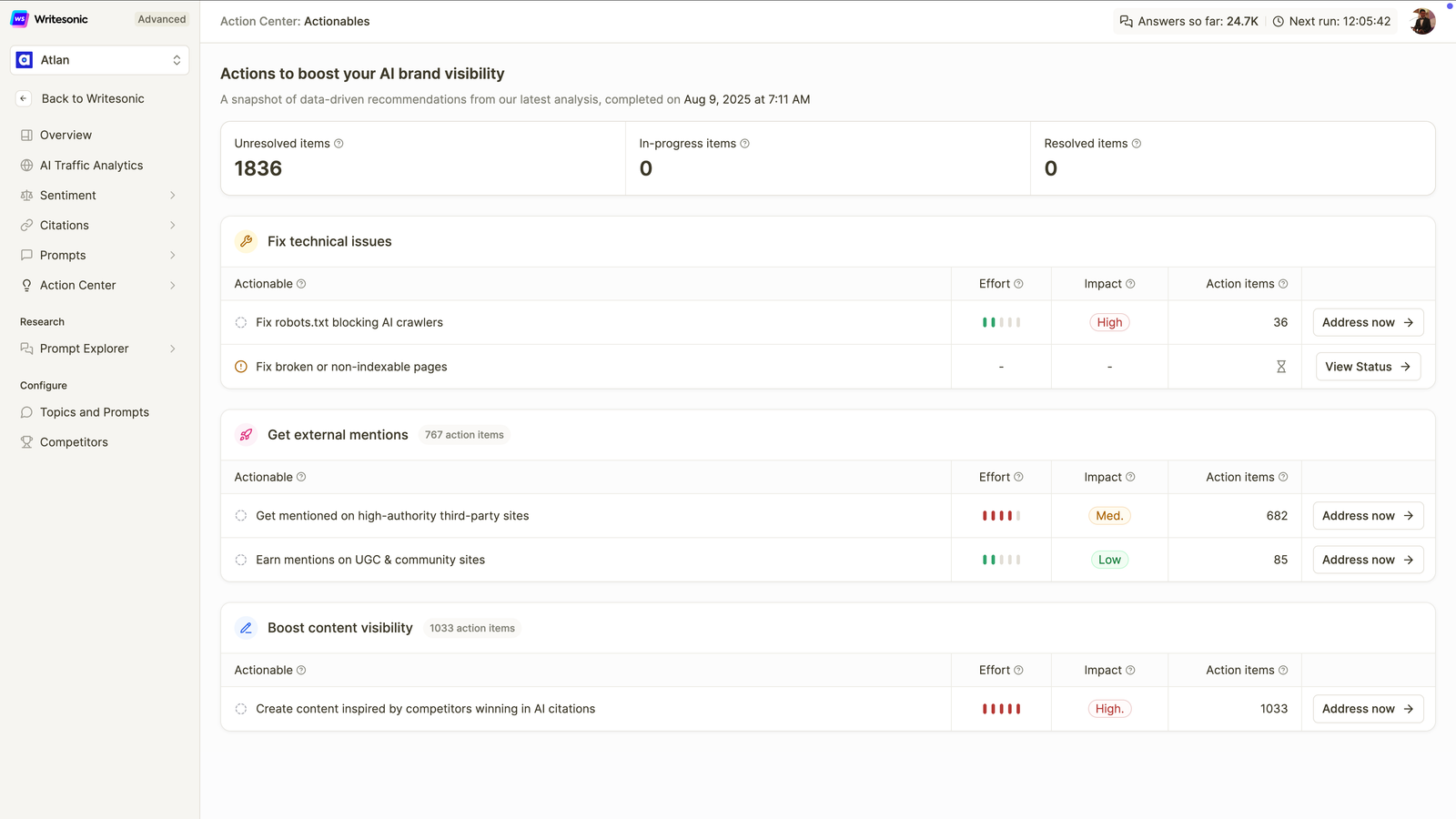
One warning about the allowances: Writesonic's own help centre, last updated in March 2026, lists Basic with 100 articles, 40 audits and 2 projects. The pricing page now says 25, 20 and 1. Read the pricing page on the day you buy, not a help article or a review, this one included.
The catch: three platforms, not nine
This is the limit that matters most and the one the marketing hides best. The homepage says "Track 8 AI platforms". The pricing page meta says nine. Writesonic cannot agree with itself on the number, but the pricing FAQ is clear on what self-serve buyers get: "Basic and Growth track ChatGPT, Gemini, and Google AI Overviews." The Starter card lists the same three.
Perplexity, Claude, Microsoft Copilot, Grok, Google AI Mode and Muse Spark are Enterprise-only. If your buyers are developers who live in Claude, or researchers who start in Perplexity, the $499 Growth plan cannot tell you whether those tools recommend you. That answer is behind a sales call.
Three platforms is not useless. ChatGPT is the chatbot most people mean when they say "AI", and Google's AI Overviews sit on top of ordinary search results, so those two alone cover a lot of the questions your customers ask. A daily record of whether you appear there against named competitors is real data. But $99 for 50 prompts on three engines in one country is a narrow window, and you should budget for it as exactly that.
The AI writer that is left
The writing side survives as an allowance: 15, 25 or 50 AI articles a month, fed by the Content Strategy Planner, which proposes topics with keyword, difficulty and traffic-potential columns and a Build button. That works out to $6.60 an article on Starter at the monthly price, before counting the tracking you are paying for. Anyone who only wants articles is buying the expensive half of the product to get the cheap half.
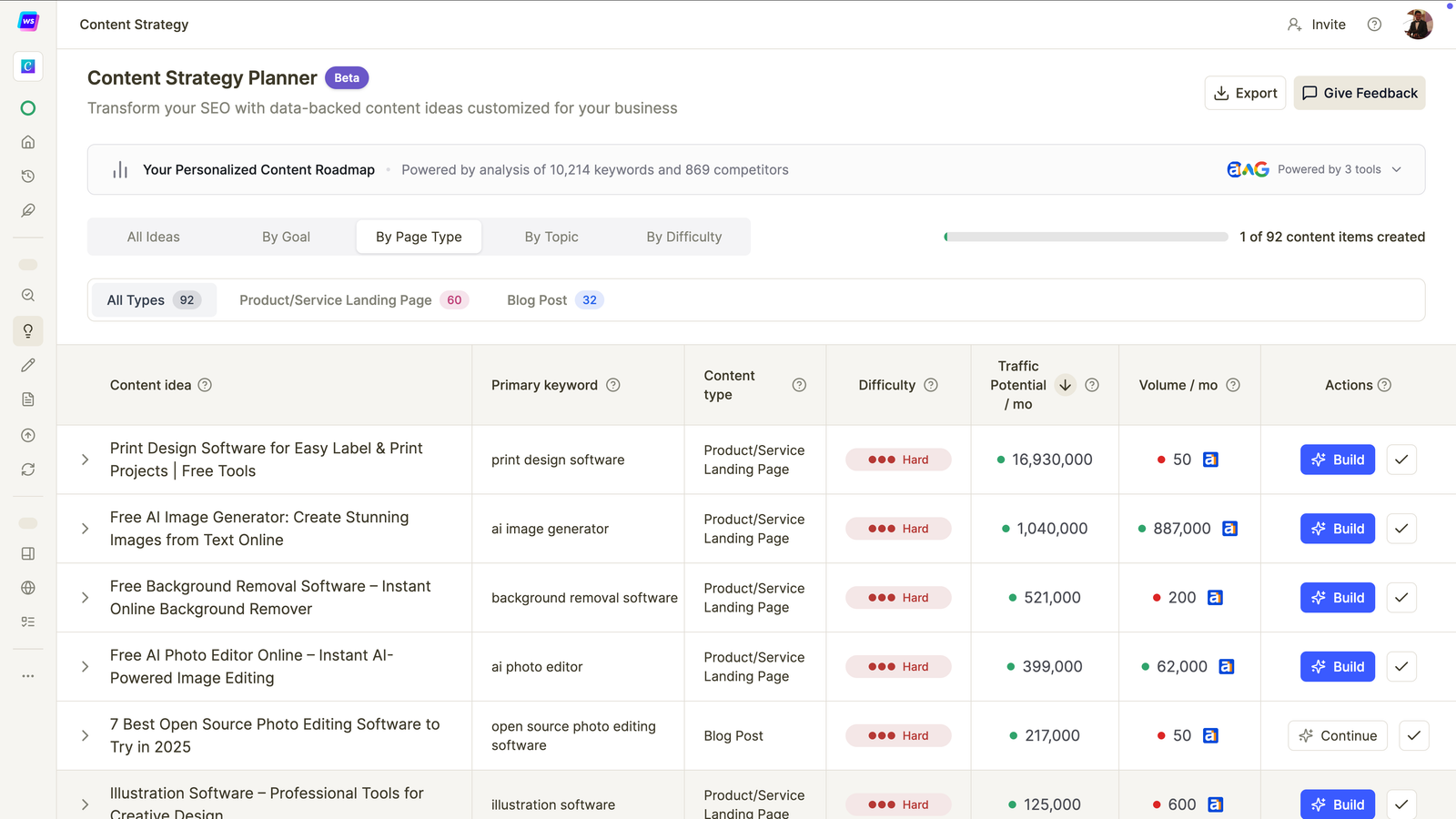
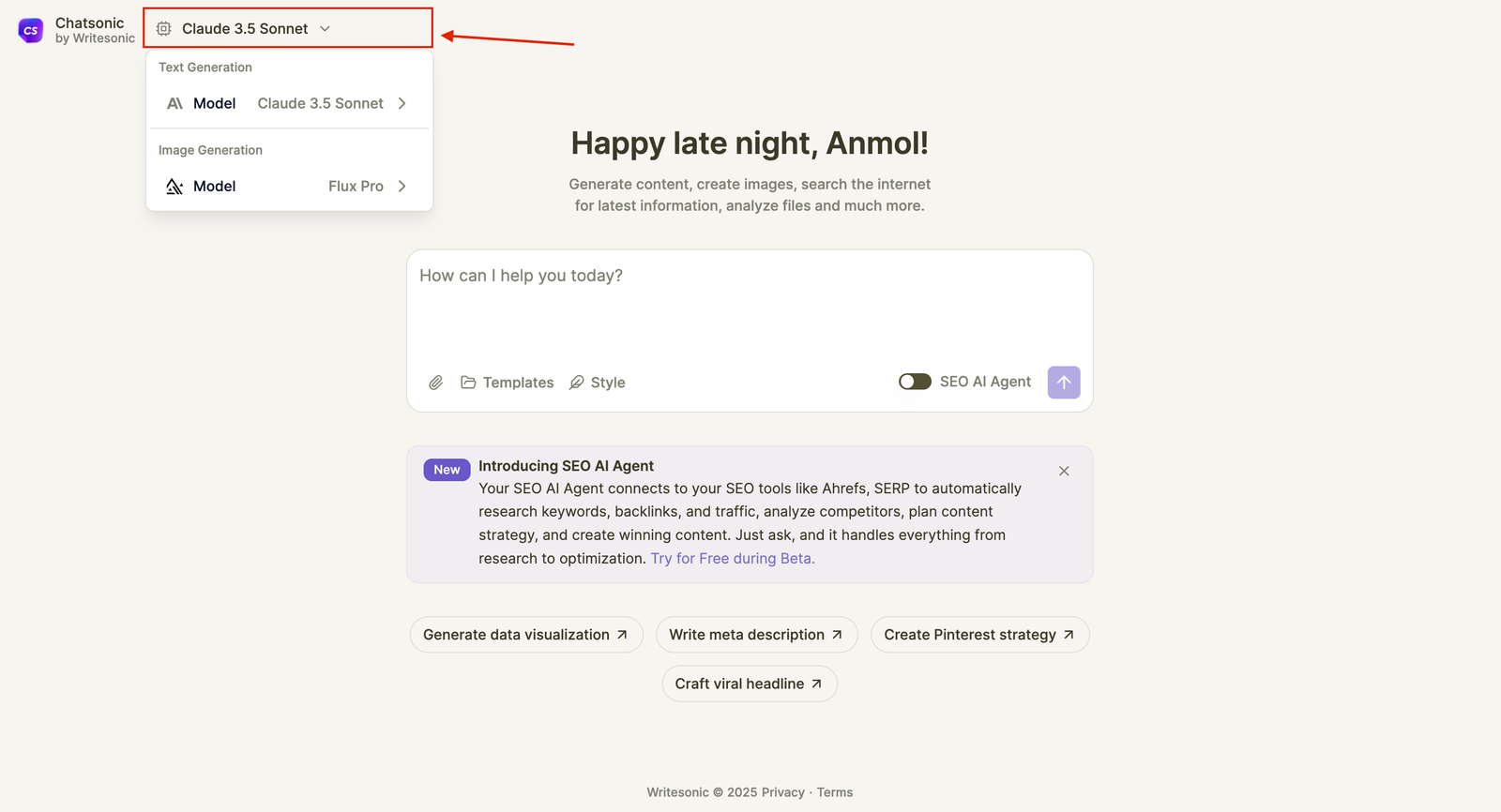
Which model writes them is not stated. The current AI Article Writer page names none, and the terms list OpenAI, Anthropic, Azure-hosted models, Writesonic's own models on Azure and AWS, Stability AI, OpenRouter and Google Cloud as possible providers, adding that the provider "may vary based on capability, performance, cost, region, and availability". The model under your articles can change without notice, and you cannot pin it.
The data terms are better than average. Writesonic's terms (updated May 12, 2026) say it does not use customer data to train or fine-tune any general-purpose model, its own or a provider's, unless you opt into a separate program; it may use de-identified, aggregated data to improve the service. You own the outputs, but the terms add that "Identical or similar Outputs may be generated for other customers", so do not count on exclusivity.
The same terms bar customers from publishing benchmarks or comparative analyses of the service without Writesonic's written consent, which is why you will find no output-quality scores here. What follows is what the documents and user reviews show.
What happened to Chatsonic, Photosonic and the rest
Writesonic used to sell a family of "-sonic" tools. Checked on October 22, 2026, the family has mostly dispersed. Photosonic, the image generator, returns a 410 Gone page. Audiosonic's address redirects to the homepage. Botsonic, the chatbot builder, lives on as a separate site at botsonic.com and does not appear on Writesonic's pricing page.
Chatsonic is the odd one. Its address now leads to writesonic.com/chat, an older page that still advertises "o1 preview, GPT-4o, Anthropic's Claude 3.5, and Gemini" and shows a $0 Free and $16-a-month Individual plan. Neither plan appears on the main pricing page, and those models are long superseded. Writesonic has published no shutdown date, so treat Chatsonic as legacy: do not buy Writesonic expecting a cheap multi-model chat app.
Trial, billing and refunds
Signing up costs nothing upfront. The pricing page says "Start free. No credit card needed", and the homepage button calls it a 7-day free trial. That is the right way to judge the tracking: load your own prompts and competitors and check that the three-platform data tells you something before you pay.
After you pay, the rules tighten. The terms give a full refund of the initial fee only within seven days of the first online purchase; after that, fees are non-refundable except where the law requires otherwise. Cancellation runs from the in-product account page and takes effect at the end of the current billing cycle, and a help article states that "No prorated refunds are available for partial months or unused time." On an annual plan, that means a cancellation on day eight still leaves you paying for the remaining eleven-plus months. Prices can also change at renewal with 30 days' notice.
Users have noticed. Trustpilot shows a TrustScore of about 4.6 out of 5 across roughly 5,760 reviews, but the recent one-star reviews cluster on billing rather than output quality. A reviewer on September 17, 2026 wrote that they "submitted an official cancellation request via email on September 9th...Support has ignored my emails." On May 11, 2026 another wrote: "THEY WILL NOT RETURN ANY OF YOUR MONEY IF YOU PAY ANNUALLY AND WANT TO CANCEL." An earlier complaint from November 2025 describes a sales call that "keeps pitching me an AI visibility analysis", a fair summary of where the company has gone. Cancel from the account page rather than by email, and screenshot the confirmation.
Verdict: who should buy it, and who should skip it
Buy it if you run marketing for a brand or an agency, can spend $200 to $500 a month, and need a daily, defensible number for how often ChatGPT, Gemini and Google AI Overviews mention you against named competitors in one market. Growth at $399 a month billed annually is the first tier with sentiment analysis and a taste of the Action Center, and it is where the product starts to make sense. Use the free trial on your real prompts before you commit to a year.
Skip it if what you want is an AI writer. Paying $99 a month for 15 articles plus tracking you will not read is the wrong trade: Copy.ai, Jasper and Rytr cover copy and long-form for less, and the best AI writing tools roundup lists more. If you want content scored against search results on a small budget, Frase, Scalenut or NeuronWriter do that job without the GEO surcharge. And if Perplexity or Claude visibility is the thing you need to measure, no self-serve Writesonic plan will show it, so either book the Enterprise demo or compare the other trackers in our AI SEO tools roundup.
Writesonic made a sensible bet: AI answers are taking clicks from search results, and someone has to measure that. The tracking is real, but the self-serve version sees three engines in one country, and the strict refund rules mean you should decide during the trial rather than after paying.
Ready to try Writesonic?
Visit the official website to see the latest plans, pricing, and special offers.
Get Started - Writesonic* Affiliate link - we may earn a commission at no extra cost to you.