Catalyst Review: A Customer Success Platform Its Owner Now Calls Legacy
Catalyst review: two-way Salesforce sync and warehouse data, but no public price, no HubSpot connector, 6-hour refresh, and an owner that calls it legacy.
Expert Review

A product with a login page and no sales page
Go to catalyst.io and you land on a page that no longer tries to sell you anything. The headline reads "Catalyst is now a Totango product", the footer still says © 2024, and the links that matter go to the help centre and the sign-in screen. The pricing page redirects to totango.com. Totango.com now says "Totango is now Odie". All of this was checked on November 20, 2026.
That chain decides whether the rest of this review matters to you. Catalyst merged with Totango on February 28, 2024, in a deal that created a business serving "nearly 600 organizations", backed by Great Hill Partners and led at first by co-CEOs Alistair Rennie (Totango) and Edward Chiu (Catalyst). Catalyst brought customers such as Braze, Fivetran and Heap, a $25M Series B led by Spark Capital, and an investment from Databricks Ventures. In October 2024 Totango said Catalyst "continues as a separate product line". On September 10, 2026, Totango renamed itself Odie.
The Odie CEO letter, signed by Keith Frankel, has one paragraph for anyone reading this: "If you're currently a legacy Totango or Catalyst customer: nothing about your account changes today. Same contract, same pricing, same product, same people." It ends with "for now it will be business as usual." Odie's site menu still lists Catalyst as the "Customer Growth Platform", but the link opens app.catalyst.io. That is the login page. There is no product page behind it.
None of this means Catalyst is shut down. It means its owner's own word for its customers is "legacy", and the promise stops at "for now". Our Totango review covers the sister product and the rename in more detail.
What Catalyst still does well
Catalyst was built for CS teams that live in Salesforce and keep product data in a warehouse, and on both counts it is still good. Synced Salesforce fields are populated in both directions, and objects such as cases, conversations and survey responses can sync both ways too. When a field mapping changes, Salesforce is treated as the source of truth, the right default for a sales-led company. Health scores are written back to Salesforce nightly through the Bulk API V2, so they do not eat into your daily API request limit - the first thing a Salesforce admin will ask about. That write-back works in Lightning Experience only.
The warehouse list is long for a CS tool: Snowflake (Data Sharing included), BigQuery, Redshift, PostgreSQL, Amazon S3 and Google Cloud Storage. Databricks described Catalyst as its first investment in a company "whose core product is built on top of Databricks". If your usage data is already modelled in the warehouse, Catalyst reads it there rather than making you pipe events through Pendo, Mixpanel or Segment, though all three are supported, along with Zendesk, Jira and Gong.
Layouts, health profiles and workflows
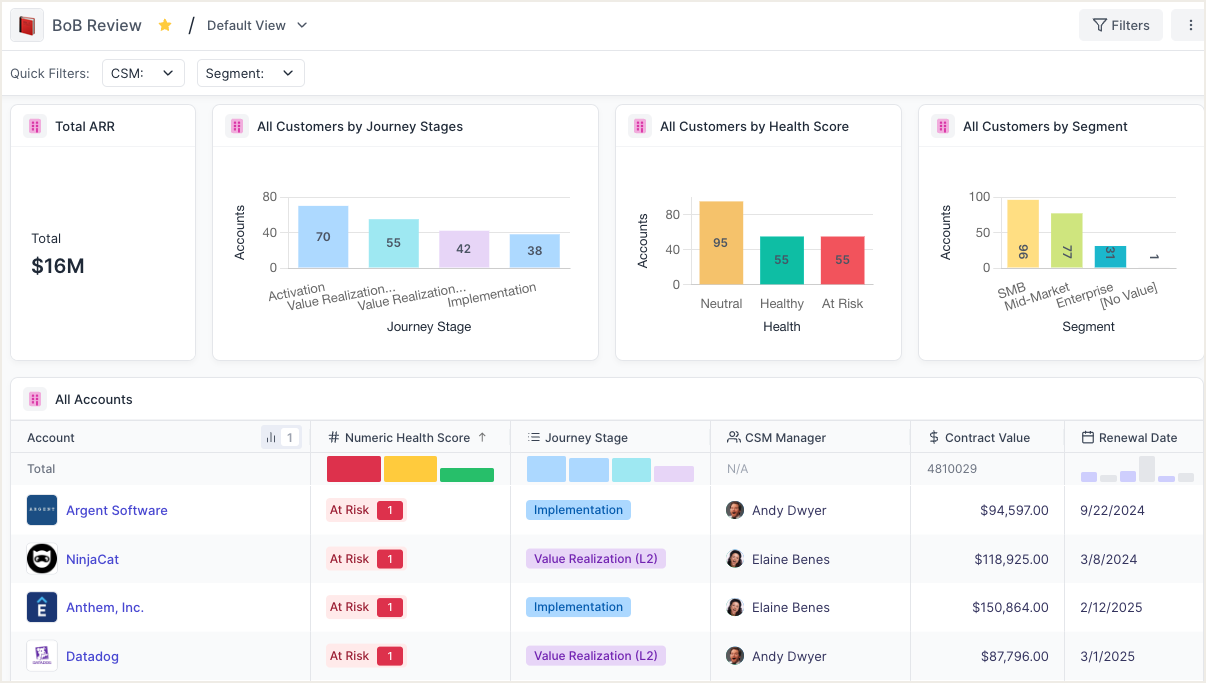
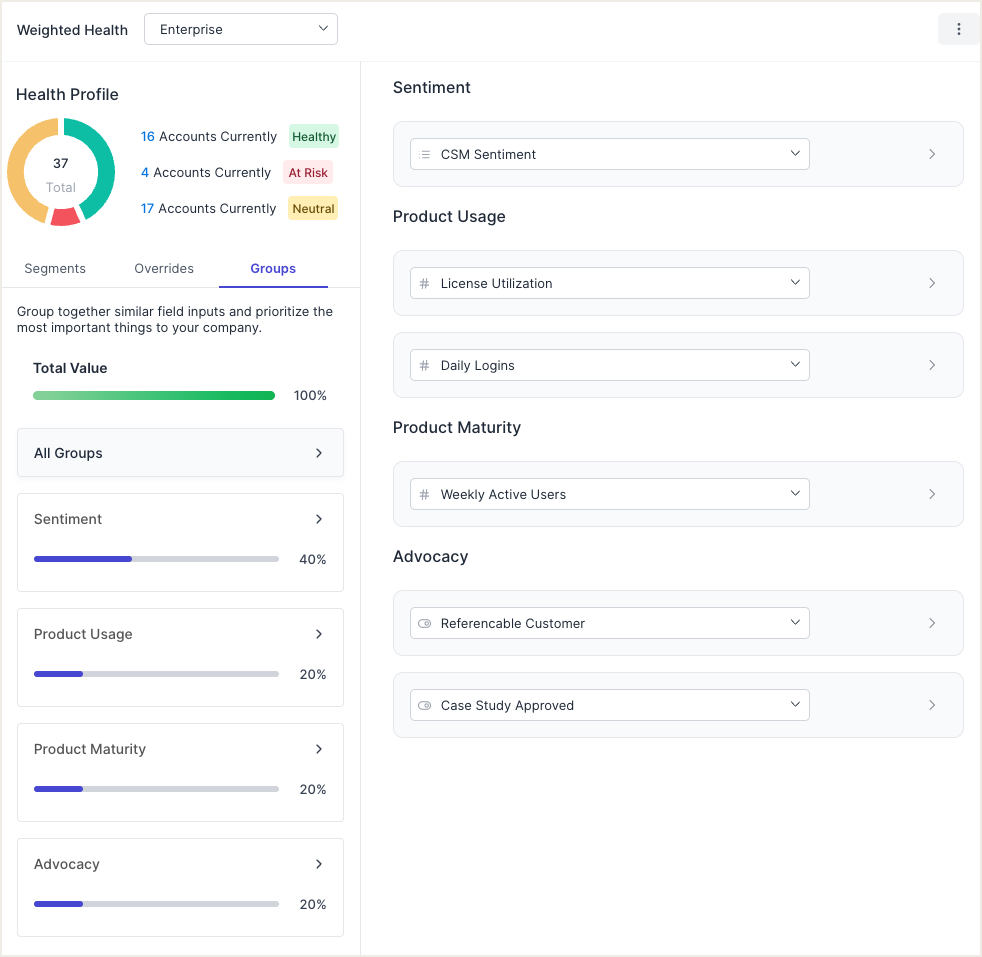
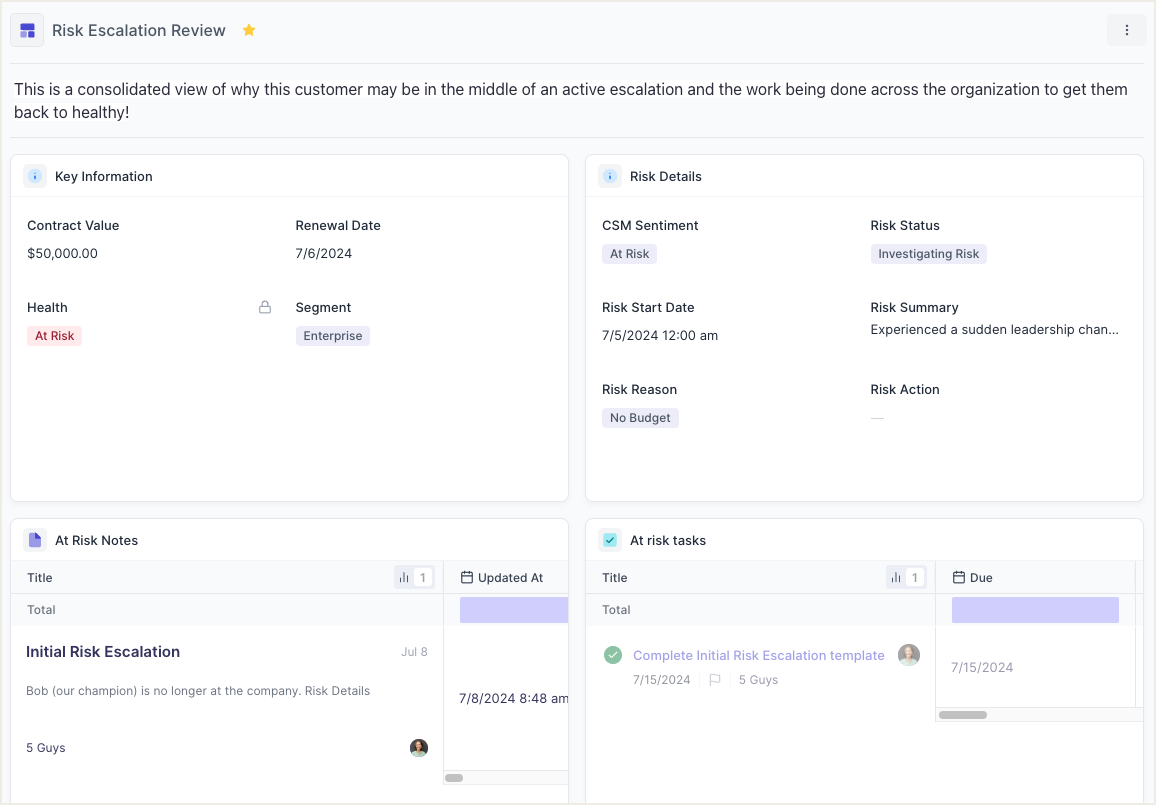
Most of the daily work happens in layouts: account and portfolio views configured for one job, such as a renewal forecast, a risk review for stakeholders or EBR prep. A Customer Hub is a layout you can share with the customer's own contacts, which saves building a separate slide deck for every QBR. Health profiles accept an unlimited number of inputs per group. Catalyst's own guide recommends no more than five. Good advice, and a hint at how messy health scores get without it.
Workflows, called playbooks until recently and still called that in the API, trigger tasks and emails from expansion signals and health changes. Email activity syncs every six hours and meetings roughly every 24.
The product is still maintained. The latest release note found is dated February 2, 2026 (cross-object queries on contact fields), and the terminology and API guides were updated on March 6, 2026. Nothing newer turned up. On G2, reviewers rate Catalyst about 4.5 out of 5 across roughly 660 reviews; the complaints that recur are integration and data-sync problems and a steep learning curve for teams new to CS platforms.
The limits the old sales page never listed
The data is not live. Warehouse integrations refresh every six hours, four times a day. A customer who files three angry tickets at 9am may not move their health score until the next sync, and that delay hits hardest when your escalation workflow keys off the score.
Salesforce is the only CRM. A help-centre search for HubSpot returns nothing, and the integrations catalogue lists no connector. A HubSpot shop would have to push account data in through the warehouse or go without.
Slack is one-way. The integration posts completed notes into your workspace. Nobody can update an account from Slack.
The API is narrow. It allows 100 requests per minute per customer instance, shared across every token. Four integration tokens get 25 calls a minute each, and call 101 gets a 429.
Smaller accounts get software instead of a person. Cadence, the AI CSM released in April 2025, is "currently available only to Catalyst customers without a dedicated CSM", and it "can't audit customer-specific data or perform work inside of your Catalyst instance". Support otherwise starts with an AI chatbot and an email address. No support tiers or response times are published.
Security paperwork is thin in public. Totango's security hub has a Catalyst section with links titled SOC 2, ISO 27001 and GDPR and subprocessors, but states no report dates and no data residency. The help centre also carries a notice titled "Security update - Snowflake notification of data theft - July 17, 2024". Ask for that notice and the current SOC 2 report before you renew.
Pricing: there is none to read
Catalyst never published a price, and now it has no page that could hold one. As of November 20, 2026, no plan name, seat price, minimum or contract term appears on any Catalyst or Odie page. Help articles say features are "Available on all plans" without naming a single plan. The one documented rule is how seats are counted: "Each Catalyst user profile consumes a license", so every person you add to the instance is a seat on the invoice.
Odie does publish prices, for its own products. The Customer Knowledge Engine starts at $500 a month with no seat pricing, and the Customer Operating System starts at $1,500 a month, priced on portfolio size and how deep and often the analysis runs. Neither of those is Catalyst. What carries over is Odie's contract style: no month-to-month billing, terms that start at one year, "most customers sign for two years", and "about eight weeks" to go live. The same page still contains the unfilled line "Dedicated customer success coverage comes with contracts above [insert threshold]", which says something about how settled any of this is.
The Catalyst prices quoted on third-party sites contradict each other by two orders of magnitude, so they are not repeated here. Get a written quote, and get the renewal cap in writing too.
What leaving Catalyst looks like
Plan the exit before you need it, because the export tools are modest. Segment data leaves as a CSV emailed to the address on your Catalyst profile, one segment at a time, with no documented row limit. The other route is the API at 100 requests a minute, which is slow going for an account base in the thousands. For most teams the cleanest copy of their data is the warehouse they already sync into Catalyst. Check first what was created inside Catalyst and nowhere else - notes, activities, health history - because that is the part the warehouse does not hold.
Workflows will not port anywhere. Gainsight, Vitally and Planhat each have their own automation model, so budget time to rebuild every workflow by hand, and to rebuild layouts as dashboards.
Who should skip it, and what to buy instead
Anyone shopping for a new CS platform should skip a multi-year Catalyst contract, even if a rep offers one. You would be onboarding onto a product its owner calls legacy, sold on two-year terms by a company whose roadmap letter does not mention it. One third-party buyer guide, from BuildBetter, claims new customers are now put on Totango instead; Odie has not said so publicly.
| If you are | Look at | Why |
|---|---|---|
| On HubSpot | Vitally, Planhat or Custify | Catalyst has no HubSpot connector at all |
| A large Salesforce CS team | Gainsight | The depth Catalyst offered, from a vendor still selling it |
| Warehouse-first | Planhat | Keeps the warehouse at the centre without a six-hour wait being the norm |
| A small team on a budget | Custify or ClientSuccess | Smaller contracts than an enterprise CS suite |
| Usage and churn focused | ChurnZero | An actively sold product with in-app engagement built in |
Verdict
Catalyst is still a capable CS platform for a Salesforce and Snowflake shop, and nothing broke on the day its owner changed its name. That is not the same as having a future. Existing customers who are happy should renew, but on the shortest term offered, with a price cap and a written commitment about the product's status for the length of the contract. Spend that year exporting notes and health history and trialling a replacement.
New buyers should not sign for Catalyst at all. Take Gainsight if you are a large Salesforce team, Planhat or Vitally if you want warehouse-friendly tooling from a vendor that still has a pricing page, and Custify if the budget is small.
Ready to try Catalyst?
Visit the official website to see the latest plans, pricing, and special offers.
Get Started - Catalyst* Affiliate link - we may earn a commission at no extra cost to you.