GreenGeeks Review: Real Green Credentials, Steep Renewal Price
GreenGeeks review: its 300% renewable energy certificate, the $2.95-to-$13.95 renewal jump, fair-use limits, conflicting backup policies and who should skip it.
Expert Review

What the green claim actually is
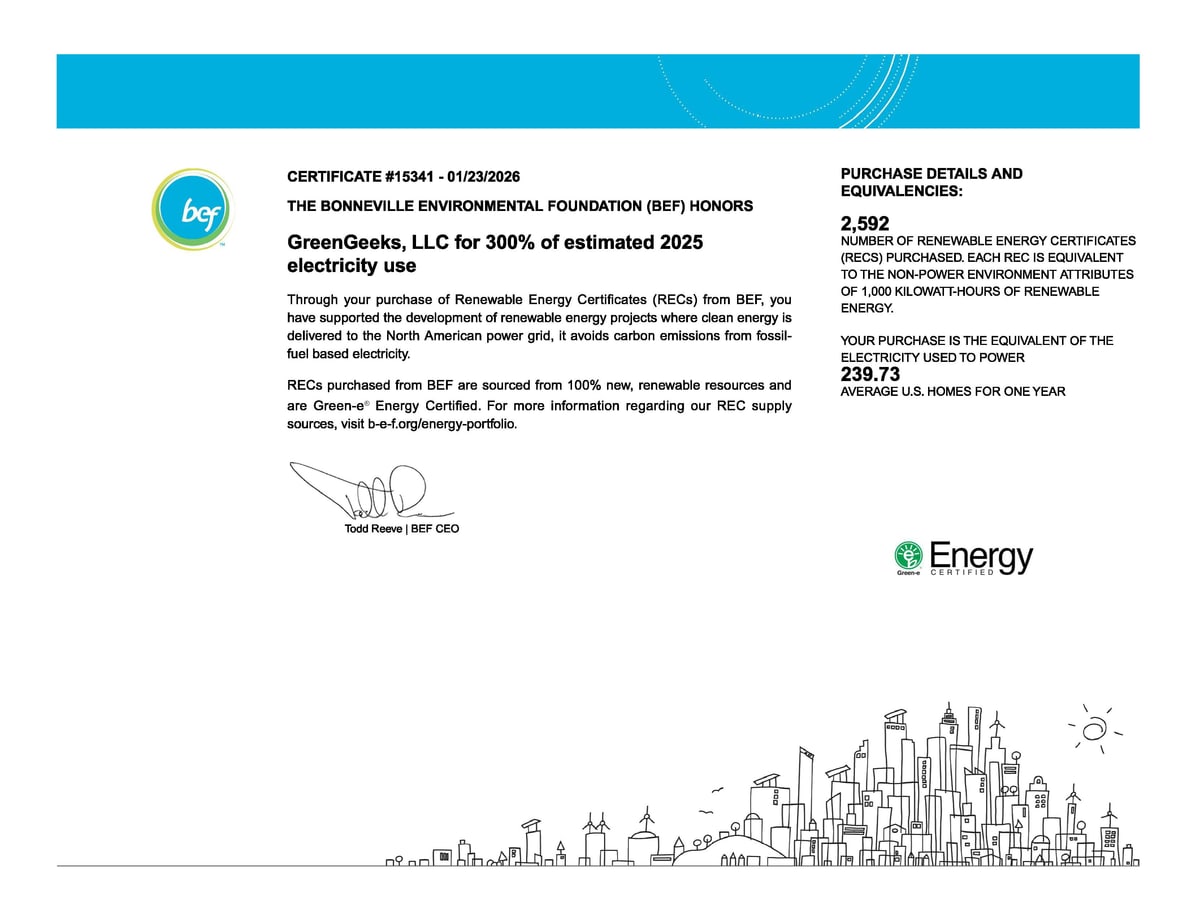
Most hosts that call themselves green stop at a leaf icon. GreenGeeks publishes a certificate. The current one, #15341 from the Bonneville Environmental Foundation (BEF), is dated January 23, 2026 and covers "300% of estimated 2025 electricity use" - 2,592 renewable energy certificates (RECs), which BEF equates to a year of power for about 240 average US homes. GreenGeeks says the figure is sized against its "servers and staff workstations", and that buying three times its usage covers its own consumption "as well as 2 other companies our size."
Be clear about what a REC is. It is a credit for renewable power fed into the grid somewhere else, bought to offset what you use. Your site does not run on a wind farm. It runs in a third-party data centre in Chicago, Montreal, Amsterdam or Singapore, on whatever mix that local grid supplies. That is how nearly every "green" host works, and GreenGeeks is more open about it than most: the certificate is linked from its Going Green page, it has been an EPA Green Power Partner since 2009, and it plants one tree through One Tree Planted for each hosting account it sets up (50,000+ so far, by its own count).
So the claim holds up. The real question is what the rest of the package costs.
Pricing: $2.95 is a one-year price
Checked on the GreenGeeks pricing page on October 3, 2026, there are three shared plans and one way to buy them: 12 months paid up front. No monthly price is shown and no 24- or 36-month term is offered. The WordPress hosting page sells the same three plans at the same prices.
| Plan | Websites | Storage | First year (prepaid) | Renews at | Year two |
|---|---|---|---|---|---|
| Lite | 1 | 25 GB | $2.95/mo = $35.40 | $13.95/mo | $167.40 |
| Pro | Unlimited | 50 GB | $4.95/mo = $59.40 | $18.95/mo | $227.40 |
| Premium | Unlimited | 100 GB | $8.95/mo = $107.40 | $30.95/mo | $371.40 |
Lite renews at 4.7 times its intro price. GreenGeeks does say so in its pricing FAQ ("your plan renews at the regular rate"), yet it is the fact behind most of its angry reviews. One Trustpilot reviewer in September 2026 expected a renewal "for $160" and then saw "a charge to my card" for $235. Nor is the intro price a passing promotion: a GreenGeeks support article from March 2021 lists the identical $2.95/$4.95/$8.95 and $13.95/$18.95/$30.95 pairs. The regular rate is the price. The intro rate is a first-year discount.
The fine print around signup matters too. The domain is free for the first year only. The terms call the 30-day money-back guarantee "unconditional", but the refund is "all hosting charges ... minus any setup fees, domain name or add-ons", so cancelling in week three still costs you the domain. The guarantee never applies to a renewal, which makes month eleven the moment to decide, not month thirteen. The 2021 article also says early cancellations are refunded "at the monthly rate"; current pages don't repeat that line, so ask support before counting on a full refund. Website Planet reports a $15 setup fee on monthly plans, waived on annual terms - no current GreenGeeks page mentions one.
Free migration is real but time-boxed. The terms give you 30 days from signup; after that, migrations are charged and the fee is non-refundable. Have the old site ready to move before you pay.
What "unlimited" means here
Pro and Premium advertise unlimited websites, and every plan advertises unmetered traffic. The terms narrow that to "normal operation of a personal or small business website", and enforce it by throttling: an account that exceeds its computing resources "will be slowed down automatically for as long as the resources are being overused." A separate resource-alerts article goes further - "your account may be suspended for excessive use."
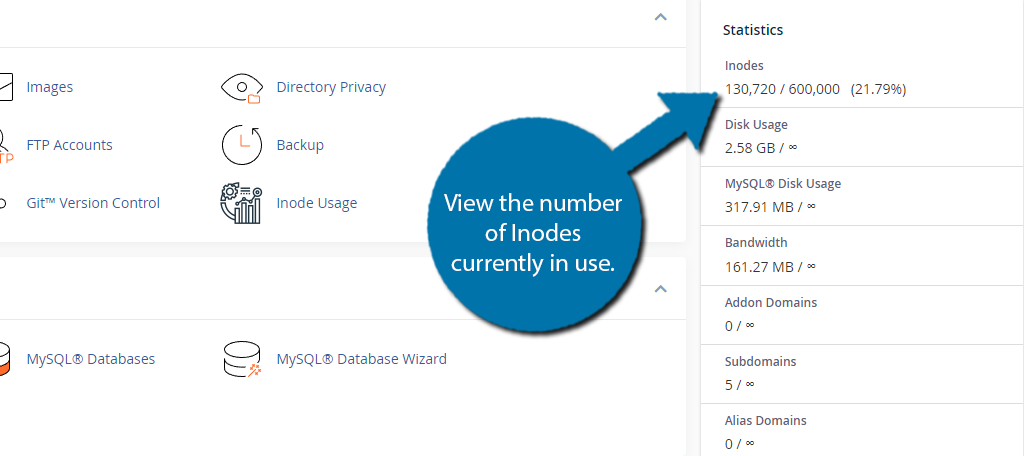
The resources that count are CPU, memory, disk I/O and the number of files (inodes, labelled "File Usage" in cPanel). The only per-plan numbers GreenGeeks has published are in that same March 2021 plan sheet, and nothing newer replaces them.
| Limit (2021 plan sheet) | Lite | Pro | Premium |
|---|---|---|---|
| CPU cores | 2 | 3 | 4 |
| Memory | 1 GB | 2 GB | 3 GB |
| Disk I/O | 10 MB/s | 15 MB/s | 20 MB/s |
| Inodes (files) | 200,000 | 400,000 | 600,000 |
| Emails per hour | 100 | 300 | 500 |
The file count bites first. A WordPress site with a few years of uploads and their thumbnail sizes, a cache plugin writing thousands of small files, and a couple of busy mailboxes can pass 200,000 files on Lite long before it fills 25 GB. And 100 outgoing emails an hour rules out sending a newsletter from the server. Use a mail service for that.
Backups: three pages, three answers
Here GreenGeeks' own documentation disagrees with itself. The pricing page promises "Automatic daily backups" with recovery "one click away". The platform page says data is "backed up nightly" with "several copies". The terms of service say the company "backs up its hosting platform and retains a copy for 24 hours for disaster recovery purposes only." And a 2023 backup-policy article says it "aims to keep approximately 30 sets of recovery backups".
That policy article is the one that tells you what you can actually do. Pro and Premium customers "can restore data on-demand". Lite customers get one free manual restore a month, then pay $25 per restore, and the add-on price list charges $5 for each manual cPanel backup request. VPS plans get no backups at all under the terms. Read together, the restore you need is probably there, but the contract only commits to disaster recovery. If the site matters, keep your own copy off the server - a backup plugin pushing to cloud storage costs less than two paid restores.
The platform and where it runs
Under the plans sits a standard modern shared stack: the LiteSpeed web server with LSCache, MariaDB, Redis on the shared plans, HTTP/3 (QUIC), PHP 8 on every server and free Let's Encrypt SSL that renews itself. Storage is SSD in RAID-10 arrays; GreenGeeks claims NVMe nowhere. The control panel is cPanel, which makes leaving easy - a full cPanel backup restores on most other cPanel hosts, so you are not locked in.

You pick a data centre at signup from four: Chicago, Montreal, Amsterdam and Singapore, all open to every plan. That covers North America and Europe well and Southeast Asia adequately. There is nothing in South America, Australia or India, so a site whose readers live there pays latency on every uncached request. We did not run speed tests for this review, so there are no TTFB figures here; pick the location nearest your audience and let LiteSpeed caching do the rest.
One advertised feature needs a caveat. GreenGeeks still lists a "Free CDN powered by CloudFlare", while Website Planet's June 2026 review says the free CDN has been discontinued despite still being advertised. We could not confirm either way. Cloudflare's own free plan sits in front of any host, so losing it would cost little.
Support and what customers complain about
Support is listed as 24/7 by live chat, phone and ticket, the same on every plan, and in English only. Billing problems and anything on a VPS go through tickets. Phone hours are disputed: Website Planet says phone support is unavailable from midnight to 9 AM, and an older GreenGeeks article only promised phone help "during most hours of the day". At night, use chat.
On Trustpilot, GreenGeeks scored about 4.6 from roughly 1,700 reviews when we checked on October 3, 2026 - most of them five stars, about one in eight a single star. The one-star reviews from September 2026 repeat three complaints: outages that took long to fix (one customer still had "26 out of our 28 websites" down), renewal charges higher than expected, and tickets that sat untouched ("2 days went by... they had done nothing"). Website Planet adds an outdated dashboard, and notes that new accounts can be held overnight for a fraud check before going live. Don't sign up at 11 PM the night before a launch.
Verdict: who should buy GreenGeeks
Buy GreenGeeks if the environmental commitment is part of why you are choosing a host, you want plain cPanel shared hosting on LiteSpeed, and you are fine prepaying a year and reassessing at month eleven. The REC purchase is documented, dated and three times the company's own usage, which is more substance than most green-hosting claims carry. It is also an independent company, founded in 2008 by CEO Trey Gardner, and as far as we could find it has not been absorbed into one of the big hosting groups such as Newfold Digital, owner of Bluehost and HostGator.
Skip it if the year-two bill decides things for you: Lite goes from $35.40 to $167.40, and no multi-year term is offered to stretch the intro rate. Skip it too if you need a backup guarantee in writing, or plan to run several client sites inside one shared resource allowance. For the lowest running cost, look at Hostinger; for managed WordPress with restores built into the dashboard, SiteGround. Our hosting roundup compares more.
If you do buy, take Pro rather than Lite. For $24 more in the first year you get unlimited sites, double the storage and file allowance, and on-demand restores instead of one free restore a month.
Ready to try GreenGeeks?
Visit the official website to see the latest plans, pricing, and special offers.
Get Started - GreenGeeks* Affiliate link - we may earn a commission at no extra cost to you.