OpenAI and Cisco Open-Source Shirudo, Agent-Written Shields for Unpatched Linux
OpenAI and Cisco open-sourced Shirudo, which lets AI agents build signed eBPF and bytecode shields for unpatched Linux. What it does, the Java4Shell demo and its limits.
News Report

What happened
On Monday, November 23, OpenAI and Cisco released Shirudo, an open-source Linux runtime meant to protect running systems in the gap between a vulnerability becoming known and its patch actually landing. The name is Japanese for "shield", and that is the unit of work: a small, signed piece of code that blocks one vulnerable path on a live machine, with no restart.
The engineering comes from Isovalent, the eBPF company Cisco owns. In the Isovalent announcement, CTO Thomas Graf and Chief Open Source Officer Liz Rice call it "a rewrite of Tetragon designed for agents". Tetragon, open-sourced in 2022, is Isovalent's eBPF security platform and still sits under Cisco's Live Protect mitigation. Shirudo drops the thing Tetragon was built around - a policy language a human writes - and lets a coding agent write the mitigation as code instead.
"So many teams rely on the same software that it makes sense to build these tools in the open," said Greg Brockman, OpenAI's President and co-founder. The code is on GitHub under BSD-2-Clause, with the BPF programs dual-licensed BSD/GPL.
Why it matters: the patch gap went negative
Isovalent's case rests on one chart. Citing Mandiant's M-Trends reports, it shows the mean time to exploit falling from 63 days in 2018 to about -7 days in 2025. Read plainly, attackers now exploit the average flaw a week before a fix exists. Linux Foundation CEO Jim Zemlin said the same thing to Security Boulevard: "Exploitation is happening before a patch is even released."
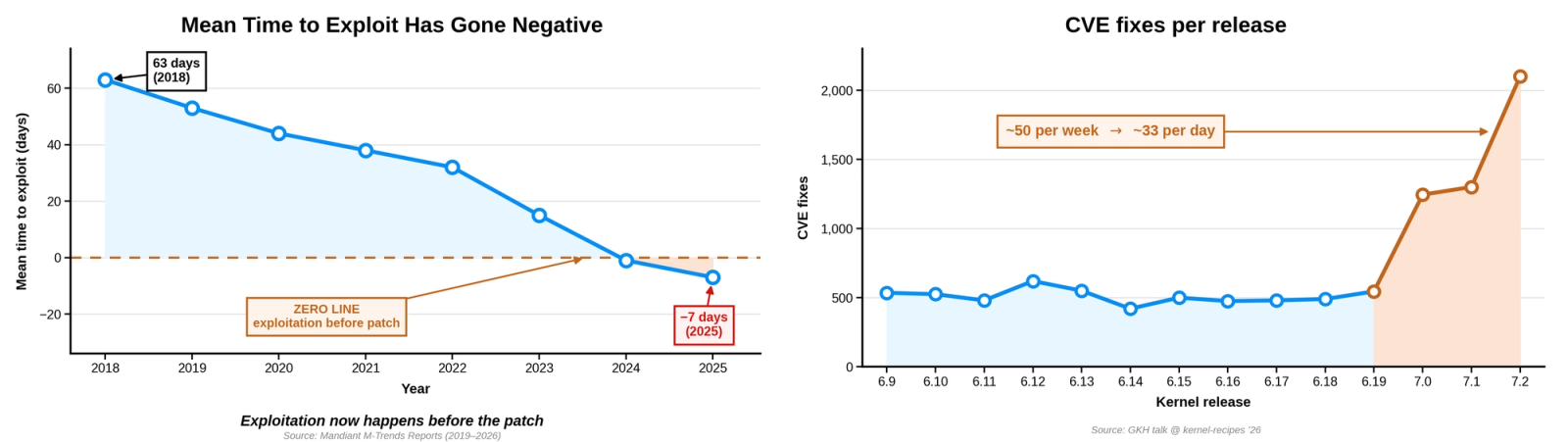
Kernel CVE fixes per release, per the same post, climbed from roughly 500 to over 2,000 by kernel 7.2 - about 33 a day. A critical fix, Isovalent writes, can take "days, weeks, or even months" to reach most systems.
Shirudo is a bet that the stopgap, a virtual patch, can be produced as fast as AI models now find bugs. And shipped with proof of exactly what was loaded.
How a shield gets from an agent to a server
A shield is either an eBPF program in the kernel or a change to application bytecode, for bug classes eBPF cannot reach. Either way it can block the vulnerable path, swap vulnerable code for fixed code, or only add visibility so you can watch for exploitation attempts.
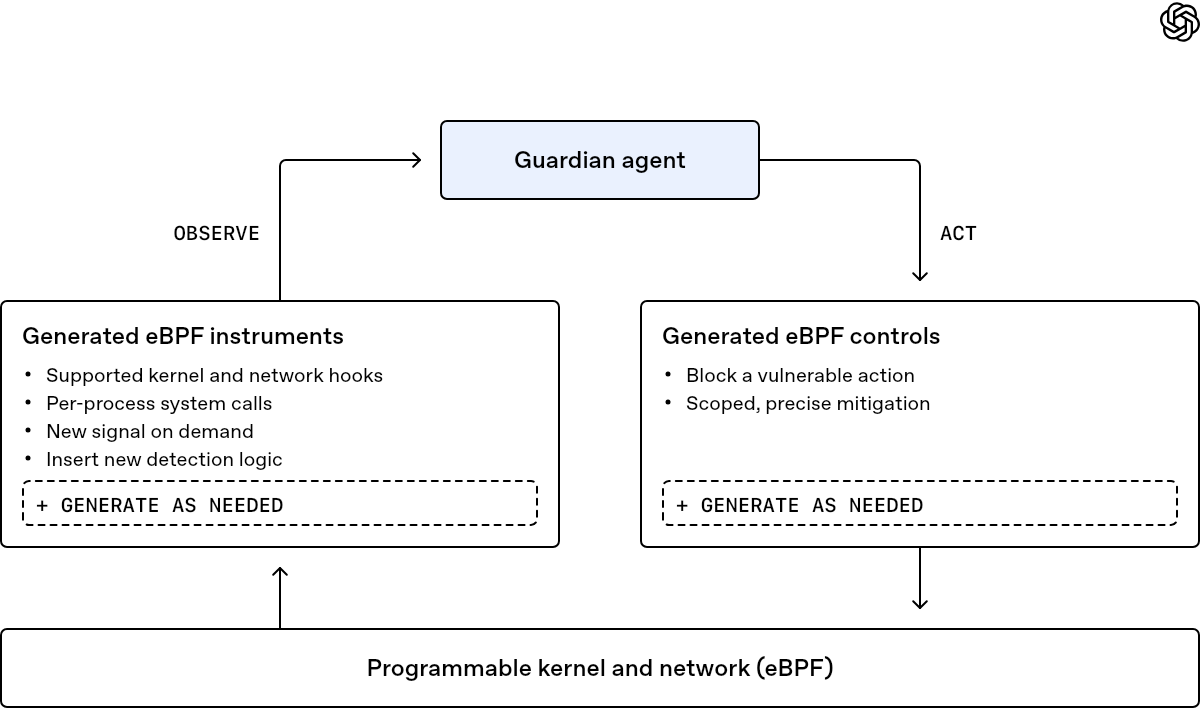
Isovalent describes a four-step agent loop. The agent gathers what is known about a vulnerability from search or a disclosure, writes the mitigation together with an exploit reproducer and tests until the reproducer fails, rolls the signed shield out to affected nodes while watching their health, then counts "hits" as exploitation attempts arrive. How much of that runs without a person is configurable, and OpenAI's post says humans decide what gets deployed.
The delivery chain is where it differs most from existing tools. There is no daemon on the target or on the operator's machine, only a one-shot CLI. The operator builds a shield, signs it with an ML-DSA-87 key that never leaves the operator, and pushes it as a .bee package to an OCI registry the operator runs - there is no official one. Targets pull it, check the signature against a sealed kernel keyring and refuse any BPF that did not come from a verified loader. A TPM measures every load and removal, so there is a hardware-backed record of what ran.
No OpenAI model is required. The project FAQ says shields can be written by hand or with any coding agent, open-weight models included.
The demo: Java4Shell on a live Elasticsearch
That demo used Java4Shell (CVE-2026-114938), an out-of-bounds write in OpenJDK's x86-64 Base64 decoder intrinsic that Calif disclosed and Oracle patched on November 17. It scores 9.2 under CVSS 4.0 and affects OpenJDK 17.0.6 and newer, but only on x86-64 CPUs with AVX-512 VBMI; ARM64 is not affected. Calif does not say it has been exploited in the wild.
Codex was handed the vulnerability details and produced a shield - Java bytecode, not eBPF - that adds validation to java.util.Base64 decoding. Attached to a running Elasticsearch 9.5.5 process, it made the exploit attempt fail while Elasticsearch stayed up. The log line: "Base64 guard rejected candidate: length=65, padding=1, remainder=1, alphabet=standard." Isovalent says only that it "appears to be effective" until OpenJDK is patched.
Keep the scale in mind: this is one company-run test. Security Boulevard's Steven J. Vaughan-Nichols called it "a company-reported controlled test, not proof that an agent can reliably defend arbitrary production workloads." No performance figures were published.
What it changes if you run Linux servers
Today, almost nothing you can deploy. The FAQ is blunt: "shirudo is pre-release and has no stable releases or supported release branches," and SecurityWeek reports it is not ready for production use. A target needs a bpf-next kernel with the signed-loader BPF ABI, plus a few Shirudo kernel patches that are not upstream yet, plus a TPM 2.0. No stock Ubuntu or RHEL kernel qualifies. Cloud VMs work only if they expose a TPM 2.0 and boot a signed UKI under UEFI Secure Boot. x86-64 is tested in CI, arm64 runs in a test VM, and riscv64 has not booted.
The bigger cost lands on teams already running eBPF. Cilium, Falco and bpftrace cannot run on a Shirudo target as-is, because they load their own BPF programs and Shirudo admits only signed loaders. Convert a node and you lose your Cilium networking or Falco detection on it until the project closes that gap, which it says it plans to do. Awkward, given OpenAI already uses Cilium for its own network security.
The trust model has edges the FAQ states openly. A signature proves who built a shield, not that it works: "whether it mitigates the problem is the author's responsibility." Root cannot switch Shirudo off without the signing key, but an attacker with kernel-level access can bypass the checks, and root can still load any previously signed artifact, old vulnerable versions included. The TPM records each such action, which helps an investigation more than it prevents anything. It does not replace upgrades, kernel live patching or a WAF.
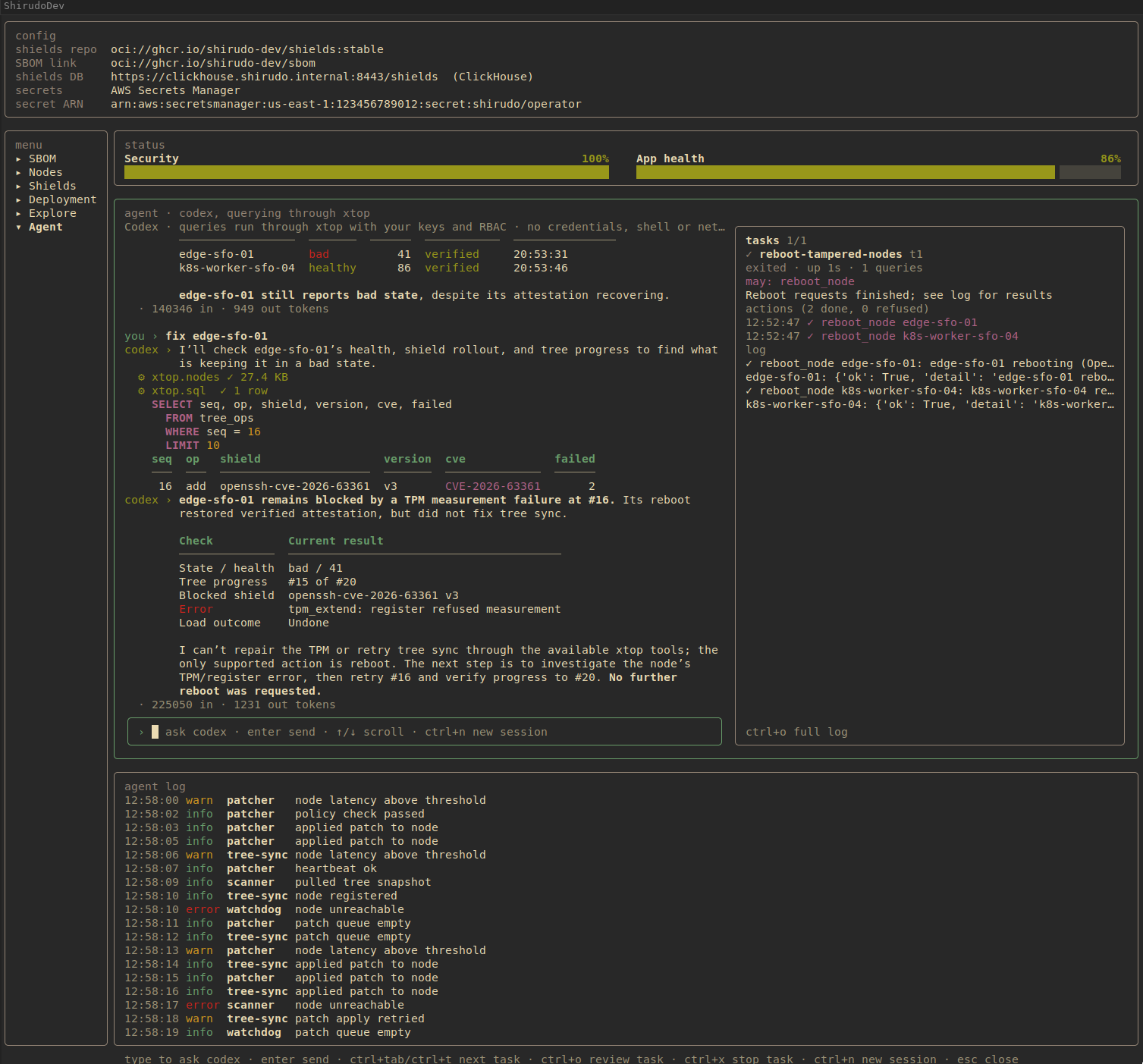
Not everyone likes the premise. "Writing the most sensitive kernel code on the fly and deploying it straight to runtime is a very risky concept," Amiram Shachar, CEO and co-founder of Upwind, told SecurityWeek. "There are countless Linux versions and distributions this has to work across."
What's next
Two modes are planned before a first release: one for older kernels and one without a TPM for trusted-root environments. OpenAI's stated goal is to offer tested shields alongside vulnerability disclosures, so an operator could load a temporary block on the day a CVE is published. That is a goal, not a service. A technical deep-dive webinar is set for December 15.
To try it now, there is a VM quickstart, which uses a software TPM, or Isovalent's browser lab, Shirudo: Getting Started. Checked on 28 November 2026, the repo had about 2.4k stars, 253 forks and 1,890 commits, with no tagged release yet.
Until shields ship with disclosures, the patch gap is still handled the old way - see this month's Patch Tuesday and its Outlook zero-day, or the Cisco ISE authentication bypass.