FCC Approves SpaceX's Starmind: Up to 1 Million AI Data-Center Satellites, With Strings Attached
The FCC conditionally approved SpaceX's Starmind, up to 1 million AI data-center satellites. What the order grants, what it defers, the 2033-2040 deadlines and who objected.
News Report

What the FCC approved
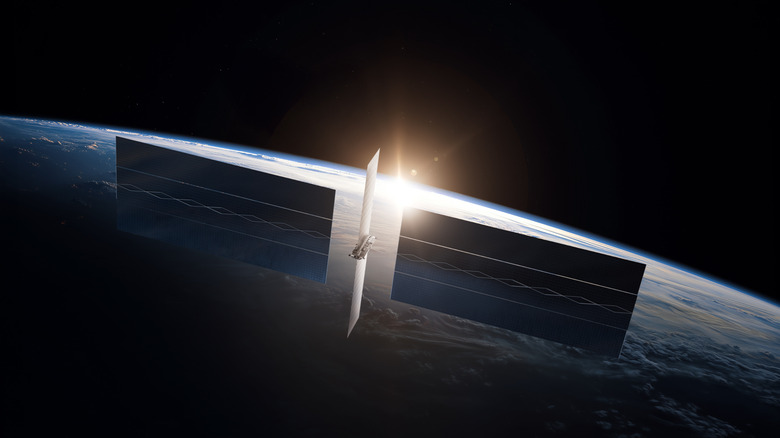
On November 25, 2026, the FCC's Space Bureau licensed SpaceX to put up to 1,000,000 satellites into orbit as data centers for AI workloads. The system's formal name is the "SpaceX Orbital Data Center System". SpaceX calls it Starmind. No U.S. regulator had licensed a space-based compute network before, and at full size this one would be roughly 100 times the Starlink fleet flying today.
FCC Chair Brendan Carr announced it on X as "a historic first", saying the action "opens a bold new frontier for the computing infrastructure needed to power America's leadership and growth." Elon Musk replied: "Much appreciated. This will be a great asset to America and the world."
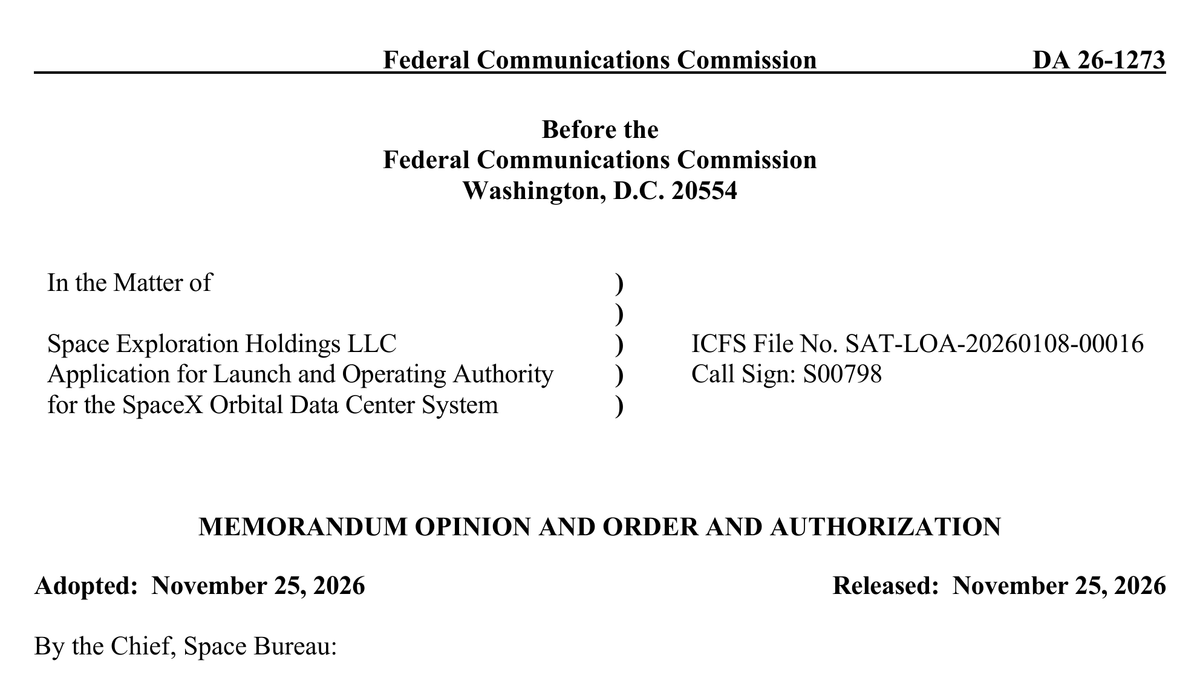
The headline undersells the fine print. The order, DA 26-1273, was signed by Space Bureau Chief Courtney Reinhard rather than voted on by the full Commission, and it is "granted-in-part and deferred-in-part". SpaceX got permission to build. It did not get everything it asked for.
What the license covers, and what it holds back
SpaceX's January 2026 application asked for altitudes from 500 to 2,000 km. The approved range stops at 1,002 km, split into six nominal shells: three at low inclinations around 30 degrees (550-568 km, 686-718 km and 946-978 km) and three in sun-synchronous orbits (565-585 km, 707-744 km and 967-1,002 km).
The spectrum grant is thinner than "1 million satellites" suggests. Starmind satellites are meant to move their data over optical laser links, to each other and to Starlink satellites, which carry results down to Earth. The radio frequencies the FCC granted, 18.8-19.3 GHz down and 28.6-29.1 GHz up, are for backup telemetry, tracking and command only, on an unprotected, non-interference basis. That is a lifeline for reaching a satellite whose lasers have failed. It is not a data pipe.
Then there is debris. FCC rules say a satellite that ends its mission below 2,000 km must re-enter the atmosphere within five years. SpaceX asked for a waiver because it wants to push some retired satellites into other Earth orbits or into orbit around the sun. The Bureau deferred that request, saying SpaceX "has not provided sufficient information". Before launching any satellite above 600 km, or any that will not be disposed of by re-entry, SpaceX must file a modification application with its final debris-mitigation plan. As of November 27, 2026, that leaves only the two shells below 600 km cleared without another round of filings.
Other waivers went through: standalone Ka-band control links outside the U.S. Table of Allocations, the processing-round rules for non-geostationary systems, the surety-bond requirement and the Schedule S software limits. In return SpaceX owes semi-annual reports every January 1 and July 1 on conjunctions, deployments, re-entries and orbital parameters, must not interfere with federal systems in 28.6-29.1 GHz, and has to coordinate with national-security and safety-of-life services before using 18.8-19.3 GHz.
The deadlines: 2033 to 2040
SpaceX first asked to skip deployment milestones altogether, then withdrew the request and took the schedule in the FCC's new Part 100 rules. Missing any one of these dates makes the authorization null and void.
| Milestone | Deadline |
|---|---|
| First satellite in its assigned orbit and operating | November 25, 2033 |
| 10% of the constellation (100,000 satellites) | November 25, 2035 |
| 50% (500,000 satellites) | November 25, 2038 |
| Full constellation (1,000,000 satellites) | November 25, 2040 |
The 15-year license term does not start this week. It starts when SpaceX certifies that its first satellite is in orbit and conforms to the license, which it must do within five business days of that satellite starting operation.
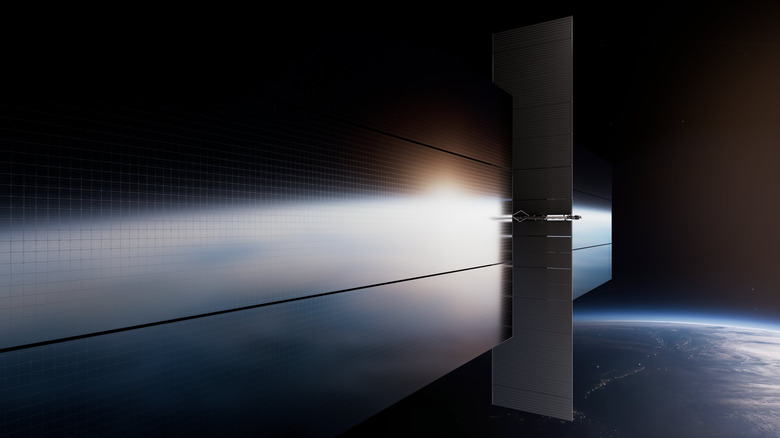
SpaceX's own timeline is far tighter than the FCC's. Its May 2026 IPO filing said deployment of orbital AI compute could start "as early as 2028", and in August Musk said launches would begin in 2027, a date Engadget called optimistic. According to Engadget's reporting, the first satellite, AI1, would carry Nvidia Rubin GPUs and Vera CPUs, about 72 chips or one server rack's worth, with SpaceX expecting around 175 kW of compute per satellite from a solar array of about 210 kW. Other outlets have reported power figures anywhere from 120 to 250 kW, so treat it as a target.
Who objected, and what happened to them
Three parties filed petitions to deny: Viasat, Amazon's Kuiper Systems (Amazon Leo) and the American Astronomical Society. All three lost. In March, Amazon had called the plan a "lofty ambition rather than a real plan" that would take SpaceX "centuries" to build and that "risks real harm". Carr shot back that Amazon "should focus on the fact" that it was falling short of its own deployment milestone.
The order dealt with Amazon's debris concerns through SpaceX's debris analysis and the deferred waiver, and called its milestone complaint moot once SpaceX accepted the Part 100 schedule. Viasat's interference worries were folded into the non-interference condition and the reporting rules. The astronomers' objections were ruled outside the FCC's authority or covered by SpaceX's commitment to coordinate with the National Science Foundation. Amazon declined to comment to CNBC.
Environmental groups are not finished. Earthjustice says the FCC approved the plan without the review the National Environmental Policy Act requires, after groups had asked it to pause licensing until a programmatic review was done. "It is dismaying that the FCC has ignored the law so blatantly," said Jan Hasselman, a senior attorney there, who also faulted the agency for releasing the decision during a holiday week. Ruskin Hartley of DarkSky International warned that "these projects could permanently alter the night sky as we know it," and astrophysicist Adam Becker told CNBC that "any serious attempt at this is going to further pollute the night sky."
The scale explains the alarm. A GAO report cited by Earthjustice counted about 1,400 active satellites in 2015 and about 15,000 in 2026. A finished Starmind would outnumber every active satellite in orbit today by more than 60 to one.
What it changes for AI infrastructure
For anyone planning AI capacity, nothing changes this decade. The license puts a clock on orbital compute, but TechCrunch lists the hurdles it leaves untouched: SpaceX still has to cut satellite manufacturing and launch costs, keep processors cool in a vacuum and finance chips bound for orbit.
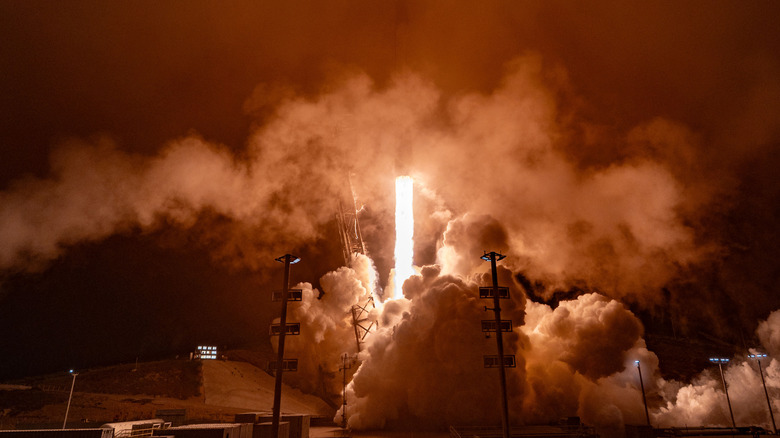
The competitive position is what moved. Google's Project Suncatcher put its first chips into orbit in October aboard a Planet Labs satellite, launched on a SpaceX rocket. Blue Origin asked the FCC in March for up to 51,600 satellites for Project Sunrise. The FCC says it is still reviewing other orbital data-center applications, and Carr's own statement already mentioned "competitor constellations". SpaceX is first with a license, and the conditions in this order are the template the next applicant will be measured against. It also fits a pattern of SpaceX pulling compute in-house, from the Terafab chip plan to the Nvidia hardware it has picked for AI1.
Three things to watch. First, the modification filing with a final debris plan, which decides whether four of the six shells can be used at all. Second, whether Earthjustice and its allies take the NEPA argument to court. Third, AI1 itself: 2027 by Musk's count, 2028 by SpaceX's IPO filing, and November 2033 by the only deadline that carries legal weight.