Ryte Review: The Munich SEO Crawler, Now Owned by Semrush and Adobe
Ryte review: what the Semrush-owned, now Adobe-owned SEO crawler does, its quote-only Enterprise and Partner plans, the 14-day auto-renewal clause, GDPR gaps and better alternatives.
Expert Review

Who owns Ryte now
The company that built Ryte no longer owns it, and the company that bought it has since been bought too. Ryte started in Munich in 2012 as OnPage.org and took its current name in July 2017. In July 2024 Semrush acquired it, saying in Ryte's own announcement that the point was to bring Ryte's crawling technology into the Semrush Enterprise SEO Platform. No price was disclosed. Then on 28 April 2026 Adobe completed its acquisition of Semrush, which now runs as "an Adobe company" next to Adobe Experience Manager and Adobe Commerce.
Neither the Adobe release nor the Semrush one mentions Ryte. The product still lives at en.ryte.com under its own brand, and Semrush also sells it from an enterprise crawler page as "the enterprise-level crawler that makes peak performance easy". We found no shutdown or migration notice anywhere, checked in October 2026.
What there is instead is quiet. The product-update feed's last entry is the Shadow DOM crawler of 3 April 2025, and nothing has been announced in the eighteen months since. The footer still reads "Copyright (c) 2024 Ryte GmbH", the marketing pages carry G2 badges from summer 2022, and most product screenshots on the site date from 2020 and 2021. None of that means the crawler is broken. It does mean the roadmap you would be buying into is now set somewhere inside Semrush Enterprise, inside Adobe, and Ryte's own site is no longer where you hear about it.
What the crawler actually does
Under the branding, Ryte is a cloud crawler whose reports are grouped into what it calls six "optimization pillars": SEO, Quality Assurance, Performance, Sustainability, Accessibility and Compliance, with a Content area added in 2024. You point it at a domain, it crawls on a schedule, and every page lands in issue reports - broken canonicals, internal nofollow links, noindex pages, indexable pages missing from the sitemap, orphaned pages, broken hreflang. Each issue carries a count and a trend line, so a regression after a release shows up as a spike rather than a number someone has to remember.
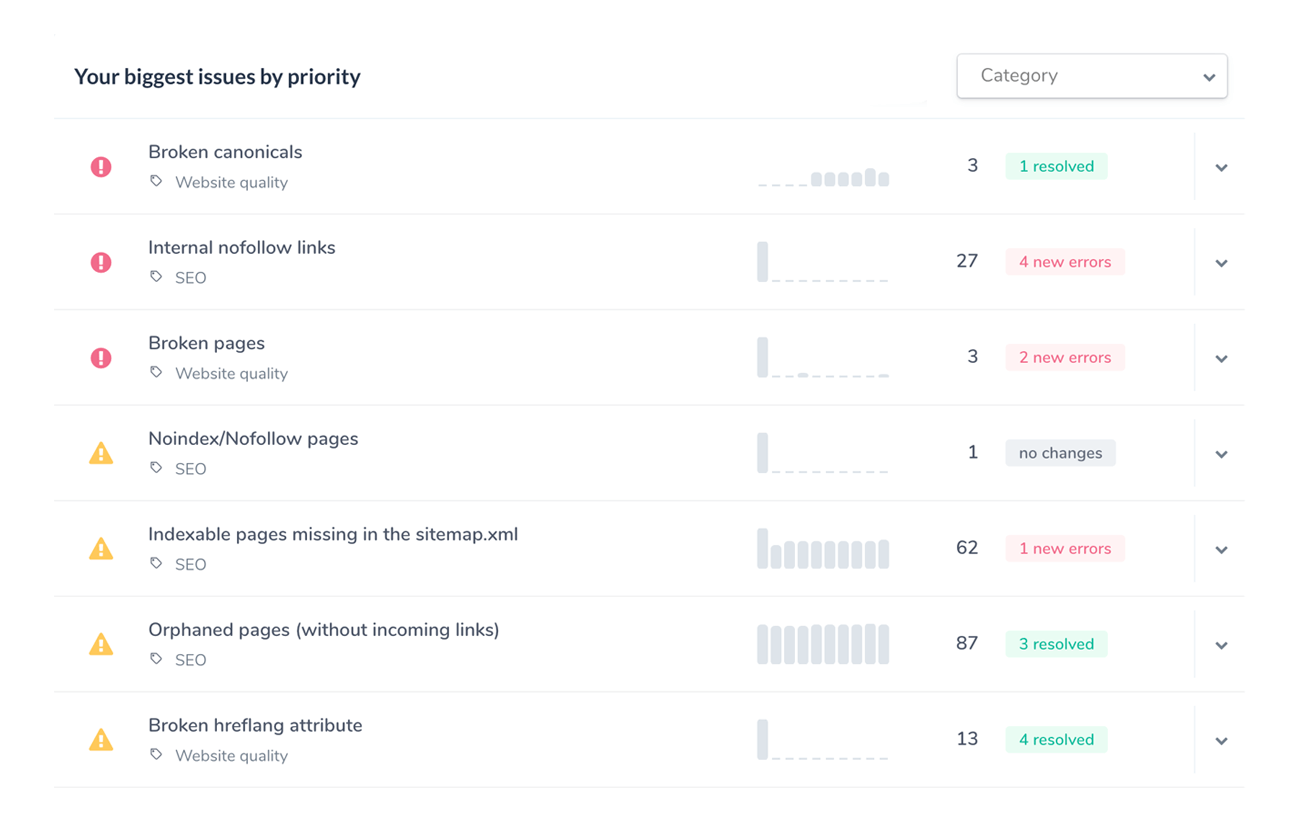
JavaScript rendering is included, and since April 2025 so is Shadow DOM parsing. That matters for sites built on web components, where the content never appears in the ordinary DOM a simpler crawler reads. It is on by default for new projects. Projects created earlier have to switch it on by hand under Project Settings, Crawl Settings, "Enable Shadow DOM analysis" - easy to miss on an account that predates 2025.
Ryte also pulls in Google Search Console and Google Analytics (GA4 since June 2023), so a crawl issue can be ranked by the clicks and sessions on the pages it touches instead of by raw count. On a site with tens of thousands of URLs, that ordering is the real product. It tells a developer which of 300 broken pages are worth a sprint.
The WUX score
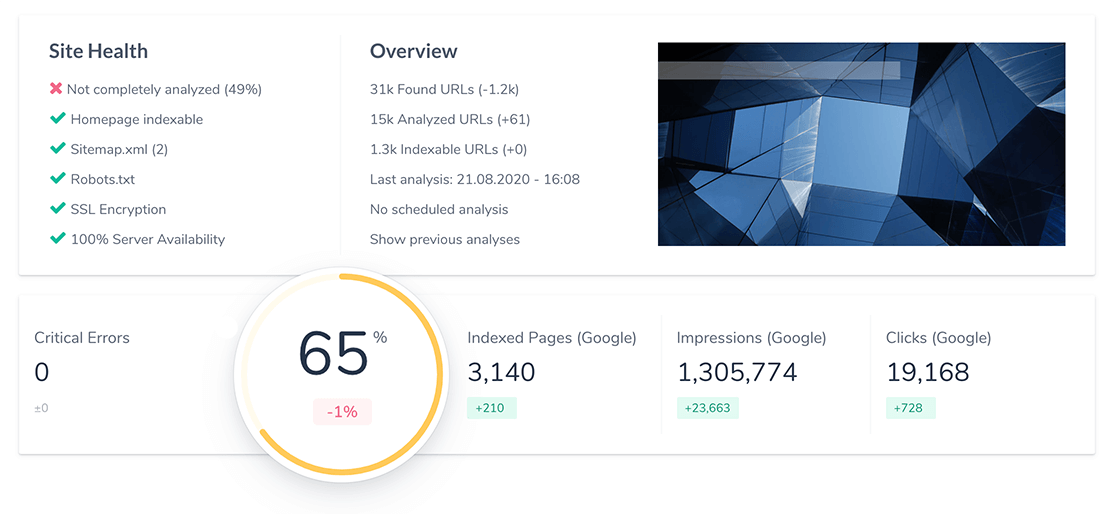
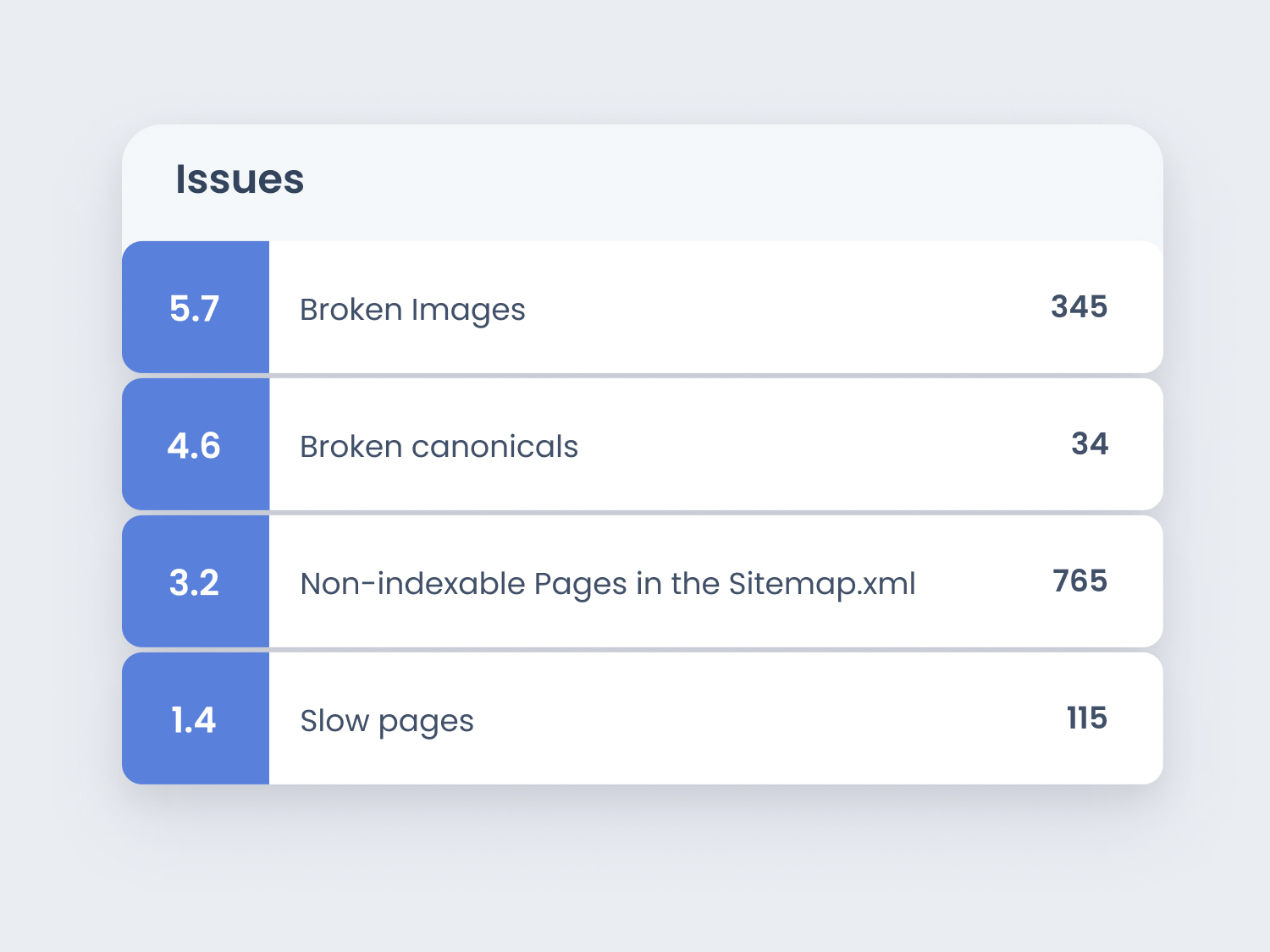
Everything rolls up into one "Website User Experience" score. Ryte says it "transparently shows on a scale from 0-100 how a website is doing", then never explains how it is calculated. Individual issues carry weights - in Ryte's own example, broken images score 5.7 and slow pages 1.4 - but the formula behind the total is not published. Use it as a progress number for the dashboard management sees. Do not compare it with any other vendor's health score.
Accessibility is a check, not an audit
The accessibility pillar flags overlapping tap targets, missing viewport tags and absent alt text. Neither the English nor the German pages mention WCAG, Germany's BFSG or the European Accessibility Act, which has applied since June 2025. If a regulator or a public-sector client wants a conformance report, Ryte is not built to produce one.
Content Hub
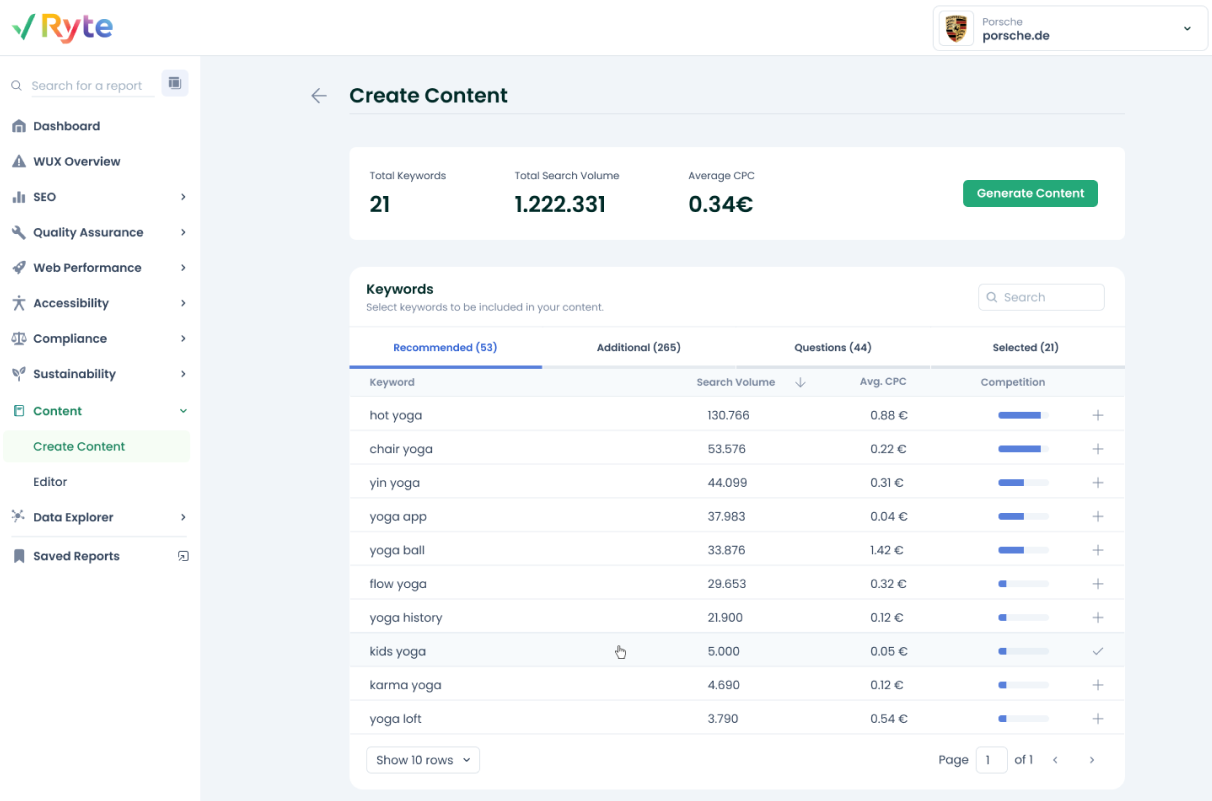
The Content Hub, launched in July 2024, adds keyword research with search volume, CPC and competition, plus a "Generate Content" button for AI-assisted drafts. It is the only AI feature Ryte has announced. Treat it as a bonus inside a crawler contract, not a reason to sign one.
Pricing and the contract
The pricing page shows no prices, checked in October 2026. It lists two plans, and both end in a "Book free demo" button.
| Plan | Aimed at | Monthly crawl budget | Projects and users |
|---|---|---|---|
| Enterprise | In-house teams | "Customised crawling and session budget" | Unlimited |
| Partner (small) | Agencies | 1,000,000 URLs, 100,000 sessions | Unlimited |
| Partner (large) | Agencies | 5,000,000 URLs, 1,000,000 sessions | Unlimited |
Ryte says prices "are based on monthly sessions, feature sets, and additional services", and both plans come with a dedicated customer success manager and quarterly business reviews - the furniture of an enterprise contract, not a card-on-file subscription. The $0, $120 and $500 monthly tiers still quoted on software directories belong to the old self-serve product and are gone. So is the free plan: the old signup addresses return a 404 and only the demo form works. One accessibility page still invites you to "Test the power of the Ryte Platform in your free trial", but no trial length or signup path exists anywhere else on the site. Ask for one on the demo call rather than count on it.
The terms are where to slow down. Clause 7.1 extends the agreement "by a further term of the same duration" unless it is cancelled with 14 days' notice before the term ends. Clause 8.1 invoices each term in advance, payable within 30 days. Miss that window on a one-year contract and you owe another full year, already invoiced. Cancelling means an email to [email protected] or a message through the in-app chat, and Ryte "can only fulfill cancellation requests by the account owner" - if the person who signed has left your company, fix the account ownership long before the deadline. The account's Subscriptions page shows the contract term and the cancellation period; put that date in a shared calendar the day you sign. Disputes go to the Munich courts, and the German text of the terms is the binding one.
Data and GDPR
Ryte keeps crawl data "indefinitely as long as you remain a customer" and says it gives none to third parties. A data processing agreement is available on request. Two things are missing. Ryte does not publish where the data is hosted, which an EU procurement team will ask, all the more now that the parent company is American twice over. And its GDPR help article, updated in August 2026, still says Ryte "self-certified under the E.U.-U.S. Privacy Shield", a framework the EU Court of Justice struck down in 2020. That is more likely a stale page than a stale practice. It is still the page your data protection officer will read, so get the hosting region and the current transfer mechanism in writing.
What users complain about
Independent reviews are thin and old. On OMR Reviews Ryte holds 4.09 out of 5 from 75 reviews, checked in October 2026, and most were written in 2020 and 2021, before either acquisition. The complaints that recur are specific. Bulk jobs of around 300 links or keywords "usually" fail to process. The weekly crawl sometimes failed to detect the sitemap. The older keyword analysis was called "ungenau" - inaccurate. And the one that has aged best: "there are many tools that bring similar benefits but are much cheaper." Ryte's Trustpilot page is mixed up with an unrelated business, so we leave it out.
Alternatives
If you are already on Semrush Enterprise, ask your account manager first whether Ryte's crawler is part of what you pay for - feeding that platform was the stated reason for the acquisition, and it could make a separate Ryte contract redundant.
For a team that wants to see a price before a sales call, Screaming Frog SEO Spider and Sitebulb both publish theirs and run on your own machine. You give up scheduled cloud crawls and the Search Console weighting built into every Ryte report; you gain an audit you can run this afternoon with no auto-renewing contract. For a true enterprise crawler, put Lumar (formerly DeepCrawl), Botify and OnCrawl on the same shortlist and ask each vendor, Ryte included, for its last twelve months of release notes. ContentKing shows how these stories can end: absorbed by a bigger vendor and sold under its name.
Verdict
Ryte is a capable enterprise crawler with a sound idea - one priority list for SEO, QA, performance and accessibility issues, weighted by real Google traffic - attached to a product that has stopped telling anyone what comes next. Book the demo if you run a large German or EU site, already work with Semrush Enterprise, and want a Munich-contracted vendor with a named customer success manager. Its customer list includes Allianz, Hilti and Bauhaus, and it credits Personio with "+93% clicks" in its own case study. On that call, ask three things: the hosting region, the 2026 roadmap, and whether the first term can be shorter than a year.
Skip it if you want a price before talking to sales, need a WCAG conformance report, or run a small site. Screaming Frog or Sitebulb will do the audit for a published price, and Lumar, Botify or OnCrawl compete for the same enterprise budget with a visible product behind them. Whatever you pick, do not sign Ryte's terms without writing down the date 14 days before the term ends.
Ready to try Ryte?
Visit the official website to see the latest plans, pricing, and special offers.
Get Started - Ryte* Affiliate link - we may earn a commission at no extra cost to you.